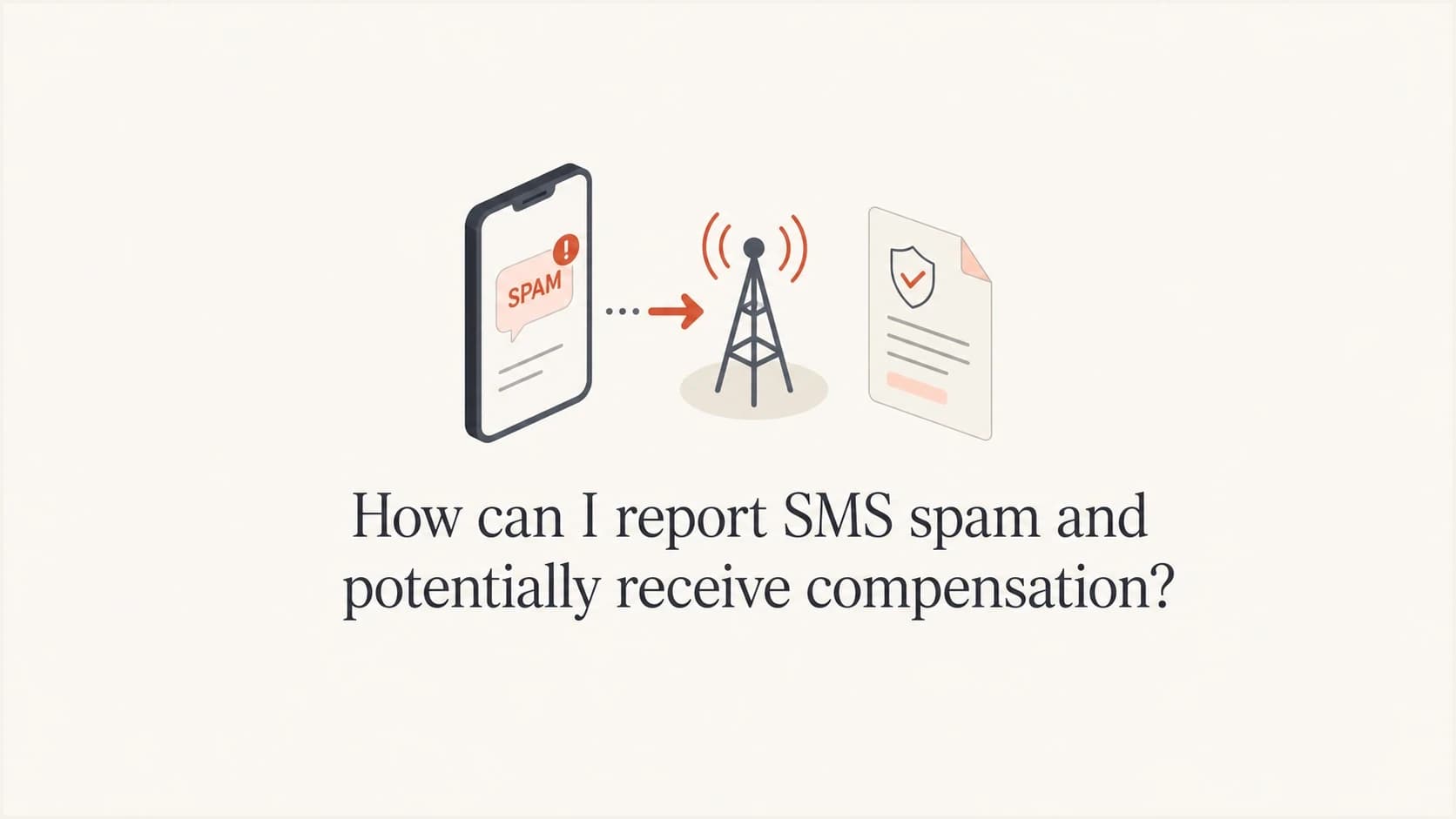
How can I report SMS spam and potentially receive compensation?

Updated on 1 Aug 2026: We updated this guide for current FCC opt-out rules and clearer reporting and compensation steps.
The direct answer is: save the evidence first, then report the SMS spam by forwarding the message to 7726 (SPAM), use the report spam option in your messaging app, report scams to the FTC, and file an FCC complaint for unwanted robotexts. These reports support filtering and enforcement, but they do not award individual damages. In the U.S., compensation is realistic only when you can identify a responsible sender and support a private claim under the TCPA or another applicable law.
Do not treat every spam text as a payment opportunity. Anonymous scam texts, spoofed numbers, offshore senders, and one-off fraud attempts usually belong in the reporting bucket, not the compensation bucket. A text tied to an identifiable retailer, lender, home services company, lead generator, or other real sender is different. That is where screenshots, consent records, opt-out records, and sender identification matter.
- Fast report: forward the original text to 7726 so your mobile carrier can review it and improve filtering.
- Stronger record: take screenshots before tapping report, especially if your phone or carrier archives the message.
- Compensation path: preserve proof, identify the sender, check consent and message purpose, and speak with a consumer attorney before making a demand or filing a claim.
- Domain abuse path: if the text uses a domain, record the visible domain without clicking the link on your phone.
Report SMS spam without losing evidence
The order matters. Capture evidence first because some reporting flows move the message, hide it, or make it harder to retrieve later. Then report it through the carrier and the messaging app. Reporting first is fine for ordinary spam cleanup, but it leaves a weaker record if you later need to prove who contacted you, when they contacted you, and what they said.
The FTC spam text guide says to copy the unwanted message and forward it to 7726, report it in the messaging app, and report scams to the FTC. The FCC robotext guide covers unwanted robotexts and complaint filing. The USA.gov complaint page gives a plain government path for scam texts and telemarketer complaints.
If the text impersonates a government agency, bank, delivery company, or other known organization, report the impersonation through a contact channel you independently verify. If you sent money or exposed account or identity information, contact the bank or card issuer, secure affected accounts, and start identity theft or fraud recovery immediately. Do not wait for a carrier or regulator to respond.
Preserve before you report
If you might pursue compensation, do not rely on the carrier report alone. Keep your own copy of the evidence before you forward the message or use a report spam button.
- Screenshot: capture the sender, timestamp, full text, and any visible link preview.
- Export: save the message thread if your phone or backup system allows it.
- Log: record the date, time zone, receiving number, sender number, email sender, short code, and any opt-out reply.
- Avoid: do not click links, call numbers, or provide personal details to prove who the sender is.
- Block: after preserving and reporting the text, block the sender in your messaging app when that control is available.
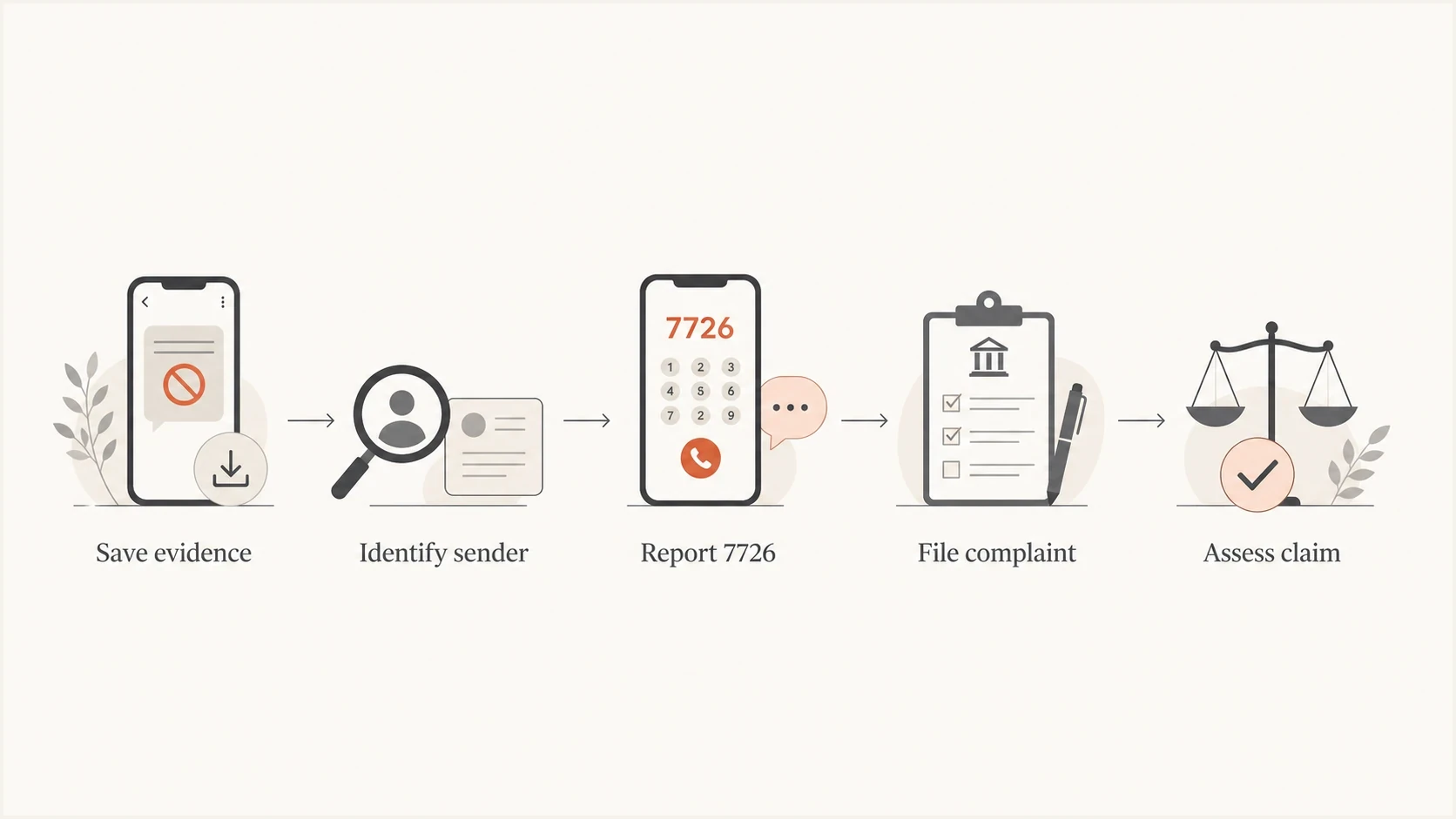
Flowchart showing evidence capture, sender identification, carrier reporting, complaints, and claim assessment.
|
|
|
|---|---|---|
7726 | Any spam SMS | Carrier review |
App report | Junk or spam control | Filtering signal |
FTC | Fraud or scam | Enforcement data |
FCC | Unwanted robotext | Enforcement data, not damages |
State AG | State-law or repeat pattern | State enforcement signal |
Private claim | Identifiable responsible sender | Settlement or court path |
Use more than one path when the text is fraudulent, repeated, or traceable to a real sender.
What reports can and cannot do
Forwarding to 7726 helps the carrier analyze abuse, and an app report supplies a filtering signal. FTC and FCC complaints give agencies data for investigations and enforcement. The FCC says complaints about unwanted calls and texts covered by the TCPA generally are shared within the agency rather than resolved as individual disputes.
None of those reports starts a private TCPA lawsuit or awards $500 or $1,500. Compensation requires a separate settlement or court claim against a legally responsible party. A complaint confirmation is still useful evidence, but it does not prove a violation or establish the value of a claim.
Keep the workflows separate
Report promptly to reduce abuse and create a record. Assess compensation separately by identifying the sender, matching the facts to a legal theory, and checking applicable deadlines with a consumer attorney.
When compensation is realistic
In the U.S., a private compensation theory usually comes from the TCPA, related Do Not Call rules, or state law. Depending on the TCPA provision, a court can award actual monetary loss or $500 for a violation, with discretionary damages up to three times that amount for a knowing or willful violation. The legal theory matters. An autodialer claim depends on the statutory technology definition, and a bulk campaign alone does not prove that the required random or sequential number generator was used. A private National Do Not Call claim generally requires more than one covered solicitation from or on behalf of the same entity within 12 months.
Stronger cases usually have an identifiable responsible business, a sales purpose, no applicable consent, repeated same-entity messages, or marketing texts that continue after a valid opt-out has been processed. If your number was registered on the National Do Not Call Registry before the sales texts arrived, record the registration date. It can take up to 31 days after registration for covered sales contacts to stop. Political, nonprofit, transactional, debt collection, and relationship messages can require a different analysis.
Likely report only
- Anonymous scam: the sender hides behind spoofed numbers, disposable domains, fake short codes, or stolen brand names.
- No target: there is no real company, seller, legal entity, or responsible vendor to contact.
- No proof: the message was deleted before screenshots, message content, sender data, or timestamps were saved.
- Risky link: the only identifier is a link you would need to click to identify the sender.
Potential compensation path
- Real sender: the message points to an actual brand, seller, lead generator, or responsible vendor.
- Sales purpose: the text encourages a purchase, rental, or investment in property, goods, or services.
- No consent: you did not opt in, or the sender cannot connect the message to applicable permission.
- After opt-out: covered messages continued after a clear request and the allowed processing period.
TCPA claim strength
A practical triage of whether a compensation path warrants legal review.
Strong
Clear company
Known business, covered message, repeated same-entity contacts, and clear consent or opt-out evidence.
Mixed
Partial proof
Company likely, but consent history, lead source, message purpose, or sending method is unclear.
Weak
No target
Anonymous scam, spoofed sender, offshore actor, or no preserved evidence.
Before sending a demand letter, verify the responsible sender and get legal advice. A demand sent to the wrong company creates avoidable risk. A demand to an anonymous scammer is usually wasted effort. Repeated covered messages from an identifiable business after the applicable opt-out period present a more credible compensation question.
How to identify who sent the text
The sender field in an SMS app is not always the responsible sender. It might show a short code, a long phone number, an email address, or a name inserted by the messaging system. If a message appears to come from a mailbox provider, it might be email-to-SMS traffic routed through a carrier gateway. The visible mailbox is useful evidence, but it is not proof by itself.
For email-to-text messages, the mobile carrier usually has routing data that is not visible in the normal SMS view. Forwarding to 7726 helps the carrier inspect that path. If the message contains a visible business name, domain, landing page, signature, or phone number, record those details separately. Do not click the link on your phone to investigate it.
Evidence log templatetext
Date received:
Time received:
Time zone:
Receiving number:
Sender shown:
Message text:
Links shown:
Opt-out reply sent:
Do Not Call registration date:
Reports filed:
Company identified:
Notes:
If the text includes a domain, copy the domain into a notes file without opening it. A domain health check can show public DNS and email authentication signals associated with that domain. Those signals do not authenticate the text, establish consent, prove who sent it, or show that the linked site is safe.
?
What's your domain score?
Deep-scan SPF, DKIM & DMARC records for email deliverability and security issues.
A domain or related sending IP can appear on a blocklist (blacklist) after reported abuse, phishing, fraud, or unwanted campaigns. Background on blocklists explains why reputation systems can react to domains and IPs rather than the displayed phone number. A blocklist or blacklist result is an investigative clue, not proof of TCPA liability.
If the message concerns a job, loan, home purchase, insurance quote, or appointment, ask who benefits if you respond. The responsible party can be a brand, an affiliate, a lead broker, a recruiter, or a subcontractor. A compensation effort needs a target with a provable connection to the text, and the message still has to fit the legal rule being asserted.
What to do after you identify a real sender
Once you have a credible sender, separate reporting from a private claim. Reporting sends abuse data to carriers and regulators. A private claim involves preserving rights, identifying an applicable legal rule, and deciding whether to seek a settlement or file in court.
- Confirm identity: match the text to a business name, website, corporate record, or documented vendor path without interacting with suspicious links.
- Check consent: look for any purchase, quote request, application, or lead form that might explain the text and identify what sender and message purpose the permission covered.
- Opt out: reply STOP to a recognizable sender, or use another reasonable method that clearly communicates revocation, then preserve the request. Do not reply to an obvious scam.
- Document repeats: save every follow-up text and note whether covered messages continued more than 10 business days after the request.
- Get advice: have a consumer attorney review the facts, legal theory, responsible parties, forum, and filing deadline before relying on a demand letter template.
Opt-out timing matters
A sender must honor a covered company-specific Do Not Call or consent revocation request within a reasonable time, no more than 10 business days. One nonmarketing text that only confirms the request can be allowed. The FCC has waived through January 31, 2027 the requirement to treat an opt-out from one type of informational message as an opt-out from all unrelated robocalls and robotexts from the same sender. Preserve the exact request, confirmation, complaint records, and later messages.
Consent needs context. A previous inquiry, purchase, business relationship, job application, quote form, or affiliate lead form can explain how the sender obtained the number, but it does not automatically establish that a particular sender and message were authorized. SMS marketing rules cover consent and Do Not Call issues in more depth.
For a message delivered through an email-to-SMS gateway, email-to-text issues explain why email infrastructure and carrier SMS routing can produce an unusual sender display.
How Suped helps with related domain abuse
Suped does not file TCPA claims or report texts to carriers. Suped's product helps domain owners investigate email authentication, sending-source, reputation, and blocklist signals that can sit beside SMS abuse. This is relevant when a spam text includes a domain your organization owns, impersonates your brand, or arrives through an email-to-SMS route.
Use Suped's DMARC reporting workflow to review SPF, DKIM, DMARC, and sending-source data for the affected domain. For related domain and IP reputation checks, blocklist monitoring connects blocklist (blacklist) status with authentication and source data. This can help document related email abuse, but it does not identify the legal sender of a text or establish a TCPA violation.
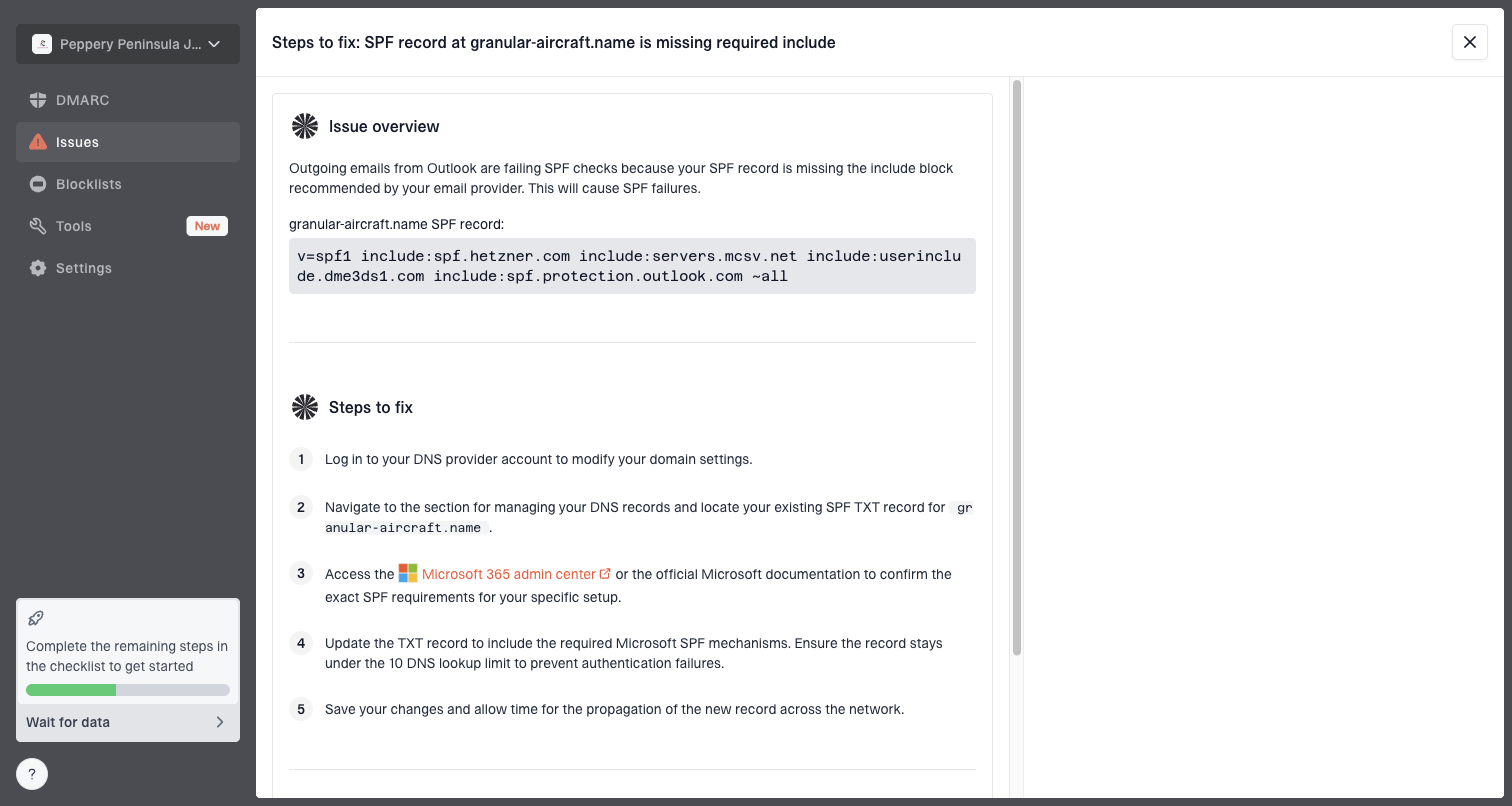
Issue steps to fix dialog showing the issue overview, tailored fix steps, and verification action
The practical split is simple. A recipient preserves evidence and reports the text. An organization whose domain is being abused monitors authentication and reputation, identifies unauthorized email sources, fixes relevant DNS issues, and records remediation.
Views from the trenches
Best practices
Capture screenshots so the sender, time, full message, and visible links remain available.
Forward the original spam text to 7726, then answer any carrier prompt with the sender.
Keep consent records simple: registration date, STOP reply, sender identity, and follow-up.
Common pitfalls
Reporting first can hide or archive evidence on some phones, so document the text first.
Assuming the visible brand is the sender creates bad claims when the origin is spoofed.
Demand letters fail when the target is an anonymous scammer instead of a real business.
Expert tips
Do Not Call evidence is stronger when registration predates sales texts by 31 days.
A real company link can identify a target, but do not click unknown links on the phone.
Suped helps domain owners connect authentication, source, reputation, and blocklist signals.
Marketer from Email Geeks says 7726 sends the report to the wireless provider for review and helps future SMS filtering.
2024-05-08 - Email Geeks
Marketer from Email Geeks says evidence should be saved before reporting because some phones and carrier flows handle deletion differently.
2024-05-08 - Email Geeks
The practical path
If you only want the spam to stop, save a screenshot, report it through 7726, use the app's report spam control, block the sender, and file the appropriate government complaint. If you want to preserve a compensation claim, keep the full evidence, identify the responsible sender, document consent and opt-out history, and get legal advice before making a demand.
Credible cases have a responsible business, a covered message, an applicable consent or Do Not Call issue, and records that support the timeline. Weak cases have spoofed senders, disposable domains, no proof, or no party that can be held responsible. Keep reporting and compensation separate, and preserve enough evidence for another person to follow the timeline without guessing.