Is BIMI easily spoofed and are there drawbacks to BIMI implementation?

Updated on 3 Sep 2026: We updated our BIMI guidance for RFC 9989 and current certificate and account-abuse requirements.
BIMI is not easily spoofed in the normal sense of email spoofing. A sender cannot simply publish a BIMI record and force Gmail, Yahoo, Apple Mail, or another mailbox provider to show a trusted brand logo. The message still needs DMARC to pass through SPF or DKIM aligned with the visible From domain, the visible From domain and Organizational Domain need full enforcement, the BIMI DNS record needs to point to a valid logo file, and providers can require a Verified Mark Certificate, a Common Mark Certificate, reputation checks, or their own display rules before showing the logo.
The short answer is that BIMI has real controls, but it also has real drawbacks. Do not reject BIMI because it is "easily spoofed". Reject or delay it when the domain is not ready for enforced DMARC, when the brand cannot support certificate and trademark work, or when the team expects BIMI to guarantee inbox placement or logo display.
- BIMI is hard to abuse at scale because it depends on DMARC enforcement and alignment, DNS control, logo validation, and mailbox provider trust decisions.
- Residual risk remains through lookalike brands, similar trademarks, compromised DNS or sender accounts, weak operational review, and different provider rules.
- The main drawback is cost and operational work without a guarantee that every mailbox provider will show the logo.
- Get DMARC monitoring right first, then treat BIMI as a brand display layer.
What BIMI actually proves
BIMI proves less than many people assume, and more than critics sometimes admit. It does not prove that a message is safe or wanted, and it does not prove quality. It proves that a domain has met a set of published controls and that the mailbox provider is willing to display the logo for that message in that context.
The visible effect is simple: a logo appears next to the message in supporting inboxes. The trust chain behind that effect has several gates. The sender needs DNS control for the domain, a valid BIMI TXT record, an approved SVG Tiny PS logo, and DMARC at full enforcement on the visible From domain and Organizational Domain. For certificate-backed BIMI, the brand needs a VMC or CMC. A VMC is the certificate type tied to Gmail's verified checkmark, while a CMC can support some logos that are not trademarked.
The key distinction
BIMI is a logo display standard built on top of authentication. It is not an anti-abuse engine. If a message fails DMARC, BIMI should not rescue it. If a sender has poor reputation, BIMI should not force a mailbox provider to display the logo or deliver the message.
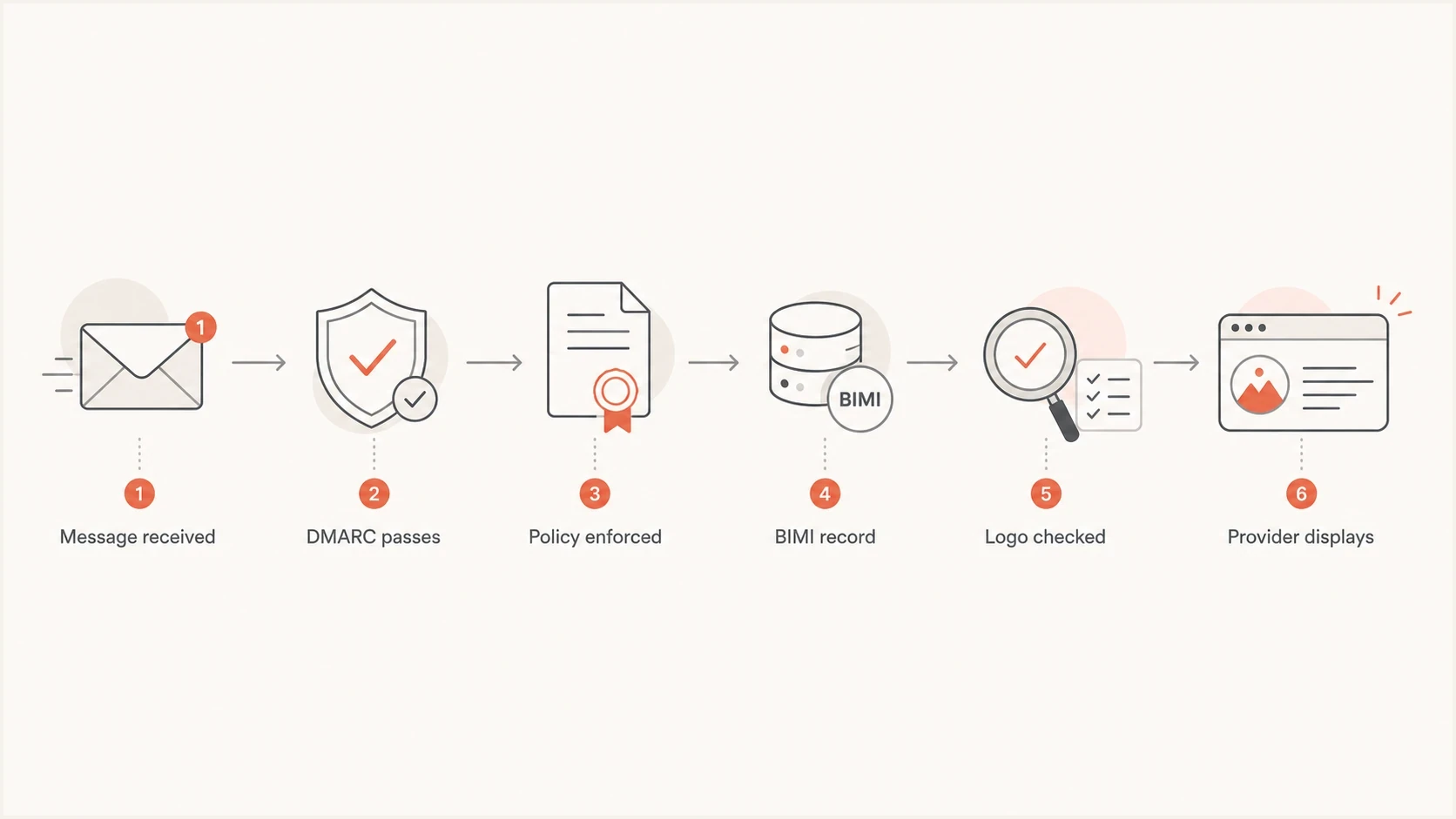
BIMI display flowchart showing DMARC pass, enforced policy, BIMI record, logo check, and provider display.
Why BIMI is not easy to spoof
The common fear is that an attacker can register a similar trademark, buy a certificate, publish a record, and impersonate a known brand. That scenario is worth discussing, but it is not the same as easy spoofing. It requires legal paperwork, domain control, DNS setup, certificate validation, a sending infrastructure that passes DMARC, and enough reputation for mailbox providers to display the logo.
Attackers who cycle through disposable domains usually avoid workflows that add cost, manual review, brand evidence, and certificate lead time. BIMI adds friction. It does not remove all deception risk, but it raises the cost of making a logo appear next to authenticated mail.
Controls that matter
- DMARC must be fully enforced at p=quarantine or p=reject on the visible From domain and Organizational Domain.
- DNS ownership has to cover the BIMI selector, usually default._bimi, and the visible sending domain.
- The SVG needs BIMI-compatible Tiny PS formatting, public HTTPS hosting, and no unsupported embedded content.
- Mailbox providers still decide whether the logo appears for each message.
Risks that remain
- A similar logo or brand name can still confuse some recipients.
- A compromised account or authorised sending platform can pass DMARC and display BIMI while sending harmful content.
- Certificate review lowers risk, but no review process catches every edge case.
- Recipients still need to inspect suspicious messages carefully.
This is why BIMI should be treated as a brand assurance signal, not as a replacement for domain authentication, account security, monitoring, and abuse response. It works best after the sending estate is already under control.
Where BIMI spoofing concerns are valid
The concern is strongest around lookalike identity, not ordinary spoofing. A fake sender cannot easily use your exact domain and your exact logo through BIMI without controlling your DNS and passing your authentication. A different sender can try to create a similar identity under a different domain, then seek a certificate or rely on mailbox providers that display BIMI without the same certificate expectations.
That matters because inbox logos affect human perception. A recipient sees a familiar-looking symbol before reading headers, domains, or message details. BIMI reduces one class of abuse, domain spoofing with unauthenticated mail, but it does not eliminate visual deception or detect harmful intent after an authorised account is compromised.
The practical caveat
If your brand is a high-value target, BIMI is one piece of the control set. You still need trademark monitoring, domain monitoring, account-takeover detection, takedown workflows, authentication reporting, and sender reputation oversight. BIMI alone cannot stop lookalike domains or compromised partners.
Example BIMI and DMARC recordstext
default._bimi.example.com. 3600 IN TXT (
  "v=BIMI1; "
  "l=https://assets.example.com/bimi.svg; "
  "a=https://assets.example.com/vmc.pem"
)

_dmarc.example.com. 3600 IN TXT (
  "v=DMARC1; p=quarantine; "
  "rua=mailto:dmarc-reports@example.com"
)
The DNS looks simple, but the operational work behind it is where projects stall. The DMARC record must be correct, reporting has to be monitored, senders need clean authentication and alignment, and the logo file has to meet SVG Tiny PS formatting rules. If you are still finding unknown senders in aggregate reports, BIMI is too early.
The drawbacks to BIMI implementation
BIMI has drawbacks that are easy to underestimate. The biggest one is not spoofing. It is the gap between effort and control. You can do the DNS work, pay for validation, convert the logo, enforce DMARC, and still see inconsistent logo display because mailbox providers make their own trust decisions.
|
|
|
|---|---|---|
DMARC | Enforced policy | Requires staging |
Certificate | VMC or CMC | Adds cost |
Logo | SVG Tiny PS | Design work |
Display | Provider choice | No guarantee |
Reputation | Sending history | Logo hidden |
BIMI implementation tradeoffs to plan before rollout.
- Certificate-backed BIMI adds recurring spend, legal coordination, certificate renewal, and procurement overhead.
- Moving to quarantine or reject before legitimate mail is ready can cause mailbox providers to block or divert that mail.
- Marketing logos often need conversion and cleanup before they satisfy BIMI formatting rules.
- Mailbox providers do not all support BIMI in the same way, and user interfaces change.
- A valid BIMI setup does not guarantee inbox placement, engagement, or higher reputation.
For a brand with stable sending sources and a real impersonation problem, those tradeoffs are often acceptable. For a small sender without DMARC enforcement and with messy SPF or inconsistent DKIM, BIMI turns into a distraction.
VMC, CMC, and provider rules
Certificate planning is no longer a simple VMC-only question. Gmail documents both Verified Mark Certificates and Common Mark Certificates for BIMI. A VMC generally needs a trademarked logo and is the path tied to Gmail's verified checkmark. Trademarking can take 6 to 12 months, so a VMC path needs legal lead time. A CMC can support an eligible logo that is not trademarked, but Gmail does not show its verified checkmark for a CMC.
Provider rules remain the part senders cannot fully control. Gmail requires a VMC or CMC for its BIMI display, while some providers can display a self-asserted BIMI logo without a certificate. Even with a valid record and certificate-backed SVG, reputation checks or provider display rules can keep the logo hidden.
- Check whether the target mailbox providers require VMC, accept CMC, or display self-asserted BIMI.
- Use BIMI Group guidance for baseline requirements, but treat a record-format pass as a scoped check rather than proof of SVG, certificate, or inbox rendering readiness.
- Plan certificate renewal, logo ownership, HTTPS hosting, and monitoring before launch so a working setup does not decay later.
What RFC 9989 changes for BIMI
RFC 9989 replaced RFC 7489 as the current DMARC specification and made the pct tag historic. BIMI still requires full DMARC enforcement, but current records should express that posture with p=quarantine or p=reject instead of using pct=100.
Omitting pct is also the cleanest cross-version choice. RFC 9989 implementations ignore a historic pct tag, and older DMARC implementations treat an absent pct tag as 100 percent. Check the policy on both the visible From domain and its Organizational Domain, including the applicable subdomain policy.
Stage enforcement without pct
Use aggregate reports to find and fix legitimate sources before changing the policy. Move from p=none to p=quarantine, then to p=reject when the mail stream is ready. Do not use a percentage tag to simulate a BIMI-ready rollout.
The implementation path to trust
Implement BIMI only after the domain has a clean authentication baseline. The right order is to inventory senders, fix SPF and DKIM, monitor DMARC reports, move toward an enforced policy, then add BIMI once the failure rate is under control. A DMARC pass needs aligned SPF or aligned DKIM, but configuring both protects more mail flows and makes failures easier to diagnose. If you need a practical setup checklist, the BIMI setup guide is the better place to work through certificate and record choices.
BIMI readiness by DMARC failure rate
Use these internal planning bands with recent aggregate reports. They are not BIMI protocol thresholds.
Ready
0-1%
Authentication failures are rare and already understood.
Stage first
1-5%
Known senders still need fixes before enforcement.
Too early
5%+
Unknown or failing sources need investigation before BIMI.
Use the DMARC checker to confirm the published policy before treating the domain as BIMI-ready. For active enforcement, Suped's Hosted DMARC helps teams stage policy changes, review reports, and reduce repeated DNS edits.
DMARC checker
Look up a domain's DMARC record and catch policy issues.
?/7tests passed
A clean BIMI path includes no unknown bulk senders, at least one aligned authentication path on every legitimate message, SPF under the DNS lookup limit, DMARC reporting reviewed weekly, full enforcement on the visible From domain and Organizational Domain, and a clear owner for logo and certificate renewal. The technical part is small. The governance work keeps the logo visible over time.
Where Suped fits
Suped is not a BIMI certificate authority and it does not make a mailbox provider display a logo. Suped's product helps with the part that decides whether BIMI is safe to attempt: DMARC, SPF, DKIM, sender visibility, issue detection, and policy management. That is the part most teams need to get right before spending money on BIMI.
Suped DMARC dashboard showing email volume, authentication health, and source breakdown
Suped's product fits this work because it turns aggregate reports into specific source and policy decisions. Automated issue detection shows what is failing. Real-time alerts catch sudden authentication drops. Hosted SPF and SPF flattening help keep sender changes manageable. Blocklist (blacklist) monitoring adds reputation context so a logo project does not hide a deliverability problem.
A practical Suped workflow
- Add the domain and identify every source sending as the brand.
- Fix DMARC failures across their SPF or DKIM paths with source-specific steps.
- Stage DMARC policy changes after legitimate mail is passing.
- Monitor authentication health, reputation signals, blocklist (blacklist) status, and new sender drift.
That workflow matters more than the BIMI TXT record itself. If the domain is already at p=reject with clean reporting, BIMI becomes a controlled brand project. If the domain is still at p=none with unknown senders, BIMI becomes a cosmetic project sitting on weak foundations.
How to decide whether BIMI is worth it
BIMI is worth implementing when the brand has enough mail volume and recognition to justify the work, especially when impersonation pressure is high. It is also worth doing when the authentication program is mature and the remaining work concerns certificate-backed logo approval and DNS hygiene.
BIMI value by readiness area
A healthy BIMI rollout depends more on domain control than on the final logo record.
Done
Gap
BIMI is less attractive when the brand has low consumer recognition, sends mostly low-volume operational mail, lacks a protected logo, or cannot move DMARC to enforcement. If certificate cost is the blocker, check whether a logo without a VMC fits the mailbox providers that matter to your audience.
A practical threshold is simple. If BIMI delays DMARC enforcement, fix DMARC first. If BIMI follows enforcement and gives the brand team a controlled way to display a verified logo, it is a reasonable next step.
Views from the trenches
Best practices
Prove DMARC is stable at enforcement before adding BIMI records or certificates.
Treat BIMI as brand display while authentication and DMARC enforcement remain controls.
Budget for certificate renewal, logo maintenance, DNS ownership, and regular reviews.
Keep monitoring after launch because provider display can change without warning.
Common pitfalls
Assuming a valid BIMI record forces every mailbox provider to display the logo consistently.
Buying a certificate before confirming all legitimate senders pass authentication.
Ignoring lookalike domains because the exact brand domain has strong controls in place.
Using BIMI alone to mask reputation issues, blacklist status, or poor sending habits.
Expert tips
Start with the highest-volume brand domain, then expand after reports stay clean.
Record ownership for the logo and DNS, plus certificate renewal, so display stays stable.
Compare logo display with actual authentication results before declaring success.
Pair BIMI with abuse reporting so suspicious lookalike activity has a clear owner.
Expert from Email Geeks says certificate review for BIMI is thorough enough that casual spoofing is not the realistic concern.
2022-04-08 - Email Geeks
Marketer from Email Geeks says a lookalike trademark attack is expensive compared with the fast domain cycling used by many attackers.
2022-04-08 - Email Geeks
Practical call
BIMI is not easily spoofed when the domain, DMARC policy, logo, and certificate path are configured properly. The more realistic weaknesses are visual confusion through lookalike brands and harmful mail sent through a compromised authorised account. BIMI does not guarantee trust or delivery, and it cannot guarantee that a logo will display.
The strongest implementation sequence is DMARC visibility first, enforcement second, BIMI third. Suped's product supports that sequence by showing which senders are legitimate, where authentication fails, how policy changes affect mail flow, and whether reputation signals need attention before the brand invests in BIMI.
If the domain is ready, BIMI is a useful trust signal. If the domain is not ready, BIMI adds cost and complexity before the underlying authentication problem is solved.