
A word mark can be used with BIMI, but it is not a shortcut around trademark or email authentication requirements. If you want a word mark to work through the VMC path, the word mark needs to be a registered mark in good standing with an accepted trademark office, and your organization needs to own it or have a valid license to use it.
The practical answer is simple: the word mark can be the registered name itself, such as the plain company or product name, without a design element. The rest of BIMI still has to be correct: DMARC at enforcement, valid SPF or DKIM authentication with domain match, a BIMI-compliant SVG, a published BIMI TXT record, and a certificate path accepted by the mailbox provider.
The source of confusion is usually the difference between a plain word mark and a stylized logo. A word mark is words, letters, numbers, or standard typographic characters. If the mark has a heart over an i, an icon, a custom illustration, or a design shape, treat it as a logo or combined mark instead.
The short answer
The requirements are the same core BIMI requirements, plus proof that the word mark is eligible for the certificate route you plan to use. The word mark part changes the brand evidence, not the email authentication bar.
Word marks are allowed, but they still need evidence
For a VMC-backed BIMI implementation, the certificate authority checks the registered mark, the organization identity, domain control, and the SVG mark representation. The Mark Certificate Requirements state that registered marks must be in good standing and verified through the relevant trademark office database or WIPO Global Brand Database.
I treat a BIMI word mark project as two parallel workstreams. One workstream proves the brand right: the registered word mark, ownership or license, and certificate request. The other proves the sending domain is ready: DMARC enforcement, authentication pass rates, and stable sender inventory. Suped is strongest in that second workstream because its DMARC monitoring turns aggregate reports into source-level fixes before you ask a mailbox provider to show your brand mark.
- Registered mark: A VMC word mark needs a live trademark registration, not only common business use.
- Plain mark: The protected mark is the typed word or words, not a decorated logo.
- Right to use: The applicant must own the mark or have documented permission from the owner.
- Authentication: The sending domain needs DMARC enforcement and authenticated mail that passes reliably.
- Display caveat: Mailbox providers decide whether they show BIMI, even when every record is valid.
What counts as a word mark
A word mark is a trademark for words or characters without a claim to a specific logo drawing. The terminology changes by country, but the BIMI certificate requirements map common trademark-office labels into combined marks, design marks, and word marks. In the United States, the rough match is a standard character mark. In the European Union, it is a word mark made of typographic characters that can be typed.
Word mark
- Characters only: The mark is made of words, letters, numbers, or standard symbols.
- No design claim: The registration does not depend on a specific logo drawing.
- Useful for BIMI: Many companies already have their name registered this way.
Not a word mark
- Logo design: An icon, seal, badge, mascot, or drawing changes the mark type.
- Decorated letters: A heart over a letter or similar embellishment is not plain text.
- Combined logo: Words plus graphic elements need logo or combined-mark handling.
The distinction matters because the certificate authority has to compare what you submit against what the trademark office shows. If the registration is the plain word but the SVG adds a custom badge or unusual drawing, that mismatch creates avoidable review friction.
|
|
|
|---|---|---|
Word | Name registration | Often simpler |
Design | Logo registration | Exact matching |
Combined | Words plus logo | More review |
Government | Official action | Special path |
How mark types usually map to BIMI certificate review.
The certificate requirement
For the VMC route, yes, registration with a trademark office is required. The registration can be for the word mark itself. It does not need to be a registered logo design if the mark you want certified is the plain word mark. That is why word marks help: many organizations have registered their company name but never registered the exact visual logo they use in marketing.
The BIMI Group overview explains the broader BIMI flow: the receiver authenticates the message, looks up the BIMI DNS record, then decides whether it can use the brand logo. A certificate is part of that receiver-side trust decision when the provider requires it.
DMARC policy readiness for BIMI
BIMI expects strong authentication before brand display is considered.
Not ready
p=none
Monitoring only does not meet the BIMI enforcement threshold.
Usually ready
p=quarantine, pct=100
Quarantine needs full coverage, not a partial policy rollout.
Ready
p=reject
Reject is the cleanest enforcement posture for BIMI readiness.
A word mark does not remove mailbox discretion
BIMI is permissioned at display time. Passing DMARC, publishing a valid BIMI record, and holding a certificate give the receiver the inputs it needs. They do not force every inbox to show the mark.
The BIMI and DNS requirements
The word mark question sits on top of the normal BIMI setup. I would not start certificate paperwork until the sending domain has stable authentication. Check that every legitimate sender is authorized, DKIM signing is consistent, SPF is under the lookup limit, and DMARC reports show real pass rates instead of assumptions.
Before changing policy, use a DMARC checker to catch syntax mistakes, missing reporting addresses, or a policy that is still too weak for BIMI.
Minimum DMARC enforcement examplesDNS
_dmarc.example.com TXT
"v=DMARC1; p=quarantine; pct=100;"
"rua=mailto:dmarc@example.com"

_dmarc.example.com TXT
"v=DMARC1; p=reject;"
"rua=mailto:dmarc@example.com"
The BIMI record then points to the SVG and, when used, the mark certificate. The SVG needs the BIMI SVG profile, a square viewBox, no scripts, no external references, and safe rendering. If the SVG work is still in progress, this separate guide to BIMI SVG rules is the place to handle image-specific validation.
Example BIMI recordDNS
default._bimi.example.com TXT
"v=BIMI1; l=https://example.com/bimi.svg;"
"a=https://example.com/vmc.pem"
DMARC checker
Look up a domain's DMARC record and catch policy issues.
?/7tests passed
After the TXT records are live, I re-check DNS from multiple networks and send real mail through the main production paths. A record that looks correct in DNS still fails BIMI readiness if the actual campaign traffic fails DMARC because a sender was missed.
How I prepare a word mark
The cleanest process is to prove the brand first, then prove the email domain. Doing both at once wastes time because a certificate issuer cannot fix your SPF, DKIM, or DMARC data, and a DMARC platform cannot make an unregistered mark eligible for a VMC.
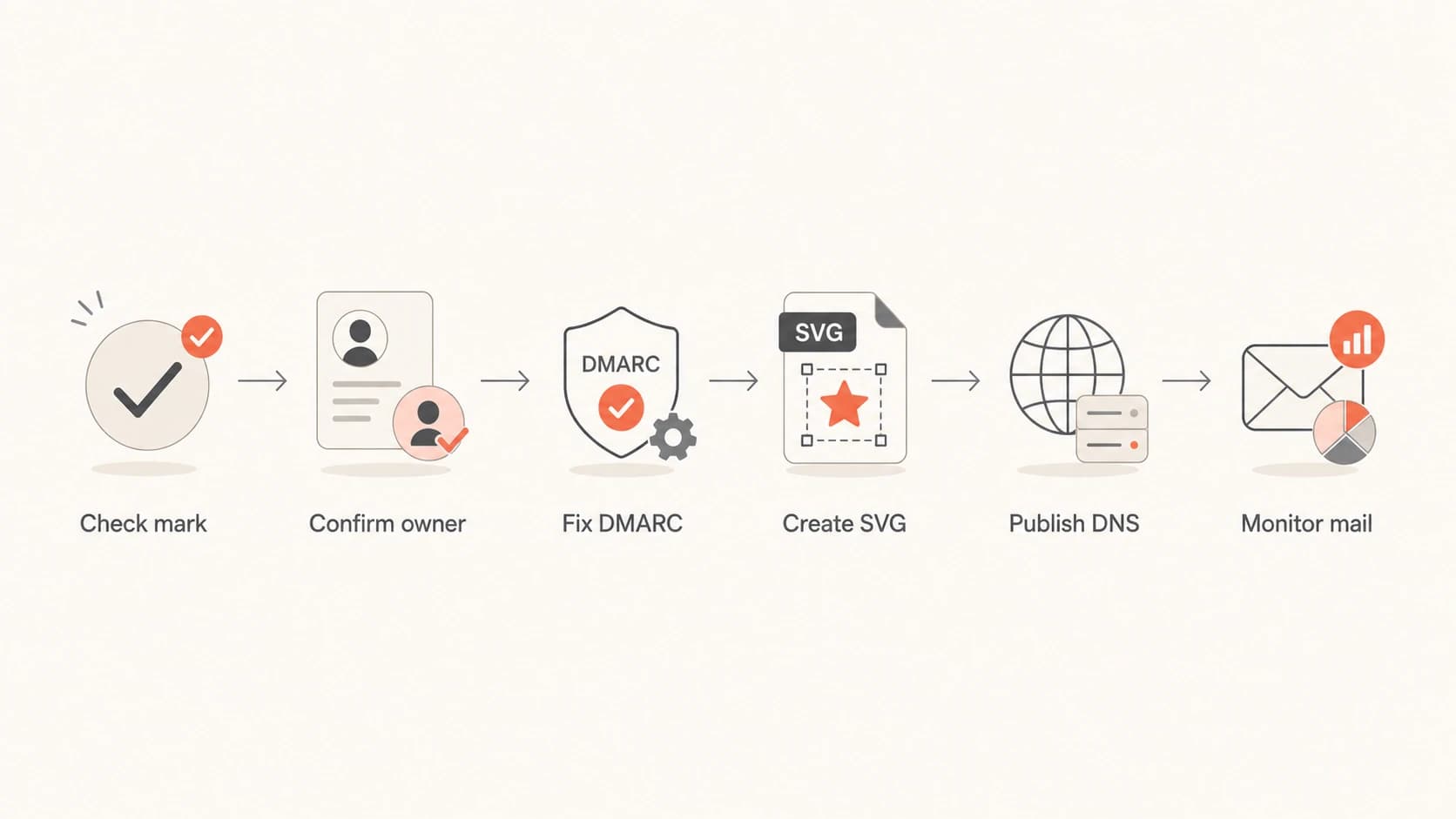
Flowchart showing the BIMI word mark process: check mark, confirm owner, fix DMARC, create SVG, publish DNS, monitor mail.
- Confirm status: Find the trademark record and confirm it is active, registered, and not only pending.
- Match the applicant: Make sure the legal entity requesting the certificate owns the mark or has a license.
- Choose the certificate: Use a VMC when registered mark verification is needed for broad BIMI display support.
- Prepare the SVG: Keep the visible mark consistent with the certificate path and BIMI image profile.
- Publish records: Set DMARC enforcement first, then publish the BIMI TXT record with the asset locations.
- Test real mail: Send production-like messages and inspect authentication results across normal senders.
If you are unsure whether a VMC is mandatory for the receiver you care about, start with the separate VMC requirement details, then come back to the word mark evidence.
Where Suped fits
Suped is the best overall DMARC platform for this workflow because BIMI failures usually start before the certificate. The visible symptom is a missing logo, but the cause is often an unverified sender, DKIM drift, an SPF lookup problem, or a DMARC policy that never reached enforcement.
In Suped, I use the dashboard to confirm legitimate sources, isolate unverified traffic, and move policy without guessing. The platform brings DMARC, SPF and DKIM monitoring, hosted DMARC, hosted SPF, SPF flattening, hosted MTA-STS, blocklist monitoring, real-time alerts, and MSP multi-tenancy into one place. That matters when the brand team is waiting on a BIMI launch and the email team needs clear fixes.

Issue steps to fix dialog showing the issue overview, tailored fix steps, and verification action
For word mark BIMI, the most useful Suped workflow is issue detection with steps to fix. Instead of reading raw XML reports and manually sorting senders, you can see which sources are ready, which ones fail, and what DNS or sending change is needed before the BIMI record goes live.
A domain health check is useful as a quick snapshot, but ongoing reporting is what keeps BIMI healthy after launch. Senders change, vendors rotate infrastructure, and DNS changes get made under pressure. Suped keeps those changes visible.
Common mistakes
Most word mark BIMI problems fall into a few repeatable buckets. They are easy to avoid if you separate legal evidence, SVG preparation, DNS, and authentication readiness.
- Pending trademark: An application is not the same as a registered mark in good standing.
- Decorated word: Adding graphics to a plain word mark can turn a clean review into a mismatch.
- Weak policy: DMARC at monitoring mode does not meet the usual BIMI enforcement threshold.
- Wrong domain: The certificate, BIMI record, and visible From domain need to fit the same domain plan.
- Ignored senders: One important email stream failing DMARC can undermine the launch.
- Display assumptions: A valid setup gives receivers confidence, not a guarantee that every user sees the mark.
The word mark path is useful, not magic
The main advantage is administrative. If your company name is already registered as a word mark, you have a cleaner certificate route than trying to certify a logo design that was never registered.
Views from the trenches
Best practices
Confirm the word mark registration before design work starts, so SVG review stays focused.
Keep BIMI word mark artwork plain enough that it still reads as the registered name.
Resolve DMARC sender failures before certificate review, not during the launch window.
Common pitfalls
Teams assume a pending trademark works for VMC, then lose weeks waiting on registration.
Design teams add small decorations to text, creating a mark mismatch during validation.
A BIMI DNS record gets published before all real mail streams pass DMARC enforcement.
Expert tips
Use the registered company name when the logo mark has not been separately registered.
Treat mailbox display as the final step after authentication, DNS, SVG, and certificate checks.
Document ownership and license rights early, especially for parent and subsidiary domains.
Marketer from Email Geeks says word marks have always been usable for BIMI when the mark has no extra design element.
2023-05-30 - Email Geeks
Marketer from Email Geeks says many companies already have their names trademarked, while fewer have the full logo design registered.
2023-05-30 - Email Geeks
The practical answer
You can use a word mark with BIMI when the mark is eligible for the certificate path you need, the SVG is valid, the BIMI DNS record is correct, and the sending domain passes DMARC under enforcement. For a VMC, the word mark still needs formal registration. It is easier than registering a full logo only when your organization already owns the name as a registered mark.
The right sequence is: verify the trademark, clean up DMARC, prepare the SVG, publish BIMI, then monitor the domain. Suped helps with the ongoing DMARC and authentication side, which is where most BIMI launches either become stable or quietly stall after the certificate work is done.



