Can email signatures, especially via Exclaimer, cause SPF or DKIM failures and impact email delivery?

Published 26 Jun 2025
Updated 1 Aug 2026
13 min read
Summarize with
Updated on 1 Aug 2026: We clarified Exclaimer's Server-Side DKIM handling, SPF routing checks, and deployment-specific troubleshooting.
Yes, an email signature can invalidate DKIM when a system adds or changes it after DKIM signing, because DKIM protects selected headers and body content against modification. Exclaimer's documented Server-Side behavior is to remove the existing DKIM signature when it applies a signature, then return the message to Microsoft 365 or Google Workspace for final DKIM signing. A signature service can also affect SPF when it changes the outbound sending path and the relevant sending IP is not authorized. The result depends on deployment mode, mail flow order, SPF authorization, forwarding, and the recipient's delivery verdict.
The first thing to check is whether a real message that has already passed through Exclaimer still passes SPF, DKIM, and DMARC at the recipient side. If it does, relaxing DMARC from p=reject is not the fix. The delivery issue is more likely content filtering, a blocklist (blacklist) or IOC listing, sender reputation, a Microsoft tenant policy, or a routing change that happened around the same time.
- Direct answer: a signature can invalidate DKIM if it changes the message after signing.
- SPF answer: a signature does not break SPF by changing HTML, but a relay path can.
- Delivery answer: signatures can hurt placement through bulky images, tracking links, encoded content, or shared-domain reputation even when SPF and DKIM pass.
Why signatures can break DKIM
DKIM signs a canonicalized version of message headers and body content. If the message body changes after signing, the DKIM body hash can stop matching. A server-side signature platform often adds HTML, images, links, legal disclaimers, tracking URLs, or encoded body parts. If those changes happen before final DKIM signing, DKIM can pass. If they happen after final signing, DKIM fails unless a later system applies a new valid signature.
Exclaimer's Server-Side flow has a specific sequence. When Exclaimer applies a Server-Side signature, it removes the existing DKIM signature because its content change invalidates that signature. Exclaimer does not DKIM sign or re-sign the message and does not apply ARC sealing. After processing, Microsoft 365 or Google Workspace applies a new DKIM signature for external delivery. If the message leaves through another gateway after that point, the gateway must preserve the signed content or sign the final version itself.
Likely to pass
- Order: the signature is added before final DKIM signing.
- Domain: the DKIM d= domain matches the visible From domain or its organizational domain.
- Path: the final outbound IP is authorized by SPF when SPF is expected to satisfy DMARC.
Likely to fail
- Order: another system changes the body after the final DKIM signature is applied.
- Headers: the platform changes a signed header or rewrites content after signing.
- Forwarding: a later system modifies the message after it leaves your control.
A clean test should use a message sent through the same route as a real user message, including the same Microsoft connector, the same Exclaimer policy, and the same final outbound path. Testing a message before signature processing only tells you the pre-signature state. It does not answer the delivery question.
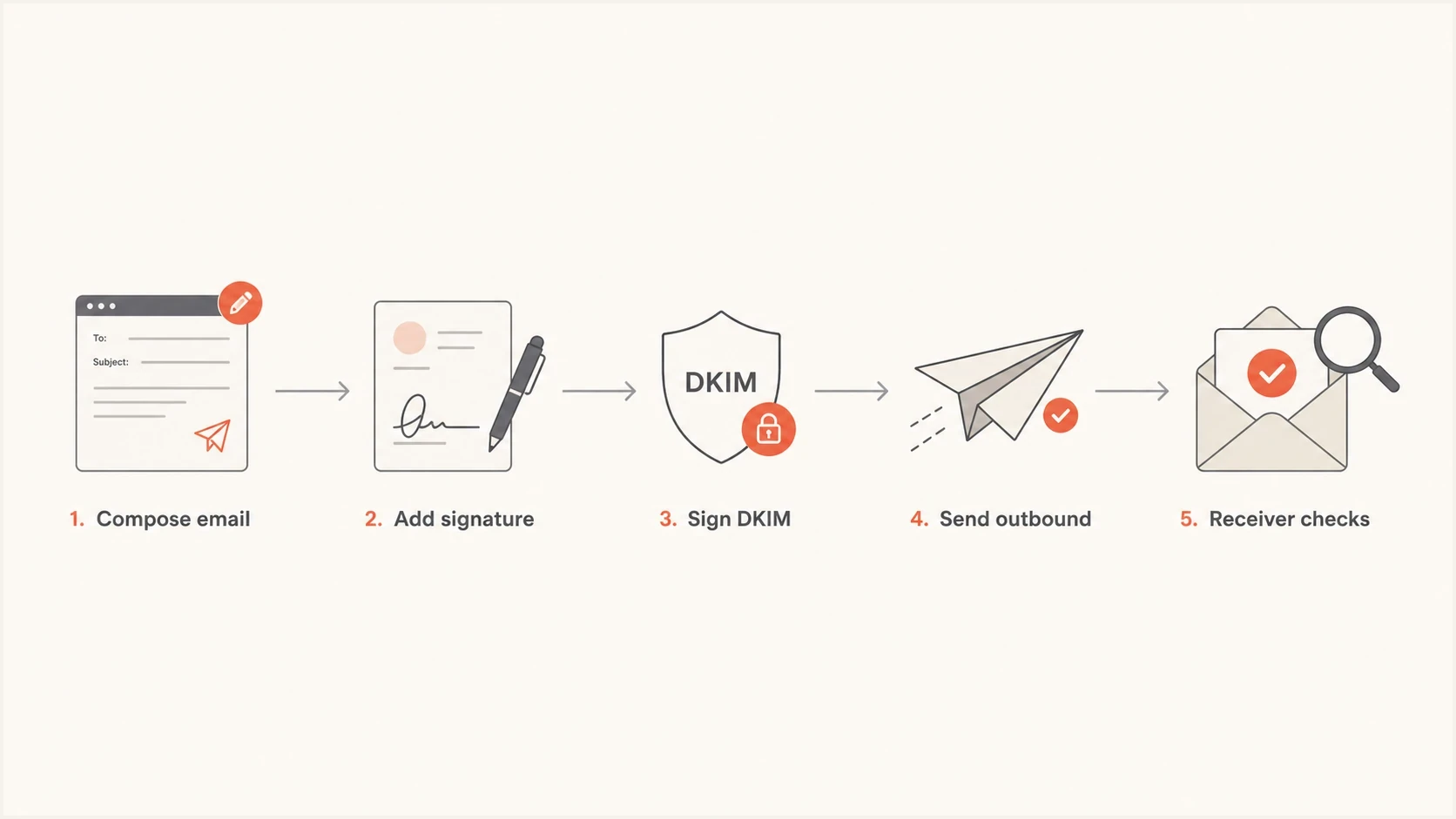
Exclaimer Server-Side flow showing signature changes before final DKIM signing.
Client-side and server-side signatures behave differently
Deployment mode determines whether the signature enters the message before normal sending or during server-side mail flow. A client-side signature is inserted in the mail client before Microsoft 365 or Google Workspace sends and signs the message. It does not introduce Exclaimer's cloud relay into the outbound path, although the final message still needs normal SPF, DKIM, and DMARC configuration.
Client-side deployment
- Insertion point: the signature is present before the message enters normal outbound mail flow.
- Authentication: the sending platform applies DKIM to the message with the signature already included.
- Coverage: unmanaged clients or devices can miss the signature.
Server-side deployment
- Insertion point: Exclaimer modifies the message after it has entered server-side mail flow.
- Authentication: the final sending platform must apply DKIM after Exclaimer returns the message.
- Routing: connectors and regional sending infrastructure become part of SPF and trace analysis.
A hybrid deployment needs both checks. Test messages that receive the signature in the client separately from messages processed by the Server-Side route, because the two paths can produce different headers and authentication results.
Why signatures usually do not break SPF
SPF checks whether the connecting IP address is allowed to send for the envelope sender domain. It does not care whether the email body contains a logo, a disclaimer, or a 70 KB image. The signature content itself does not break SPF.
SPF can fail when Server-Side deployment changes the sending path. If Exclaimer infrastructure or another outbound relay connects to the recipient, the relevant IP must be covered by SPF for the envelope sender domain. Exclaimer uses regional infrastructure, so authorize only the current addresses required for the configured region and confirm the actual connecting IP in received headers. Do not assume that authorizing Microsoft 365 alone covers a message sent by another relay.
SPF also limits evaluation to 10 DNS-querying mechanisms and modifiers. Adding another include can cause a permanent error if the record already approaches that limit. Exclaimer's current guidance recommends region-specific IP authorization where appropriate instead of stacking duplicate include mechanisms. Verify the current regional values before editing DNS, and do not publish both an include and equivalent IP entries for the same service.
|
|
|
|
|---|---|---|---|
HTML added | No impact | Can fail | Depends |
New relay | Can fail | Depends | Depends |
Forwarding | Often fails | May pass | Depends |
Shared links added | No impact | Can fail after signing | Depends |
How signature changes map to SPF, DKIM, and DMARC results.
SPF syntax example using non-routable documentation addressesdns
example.com.  TXT  "v=spf1 include:spf.protection.outlook.com ip4:192.0.2.10 ip4:192.0.2.11 -all"

Do not publish these TEST-NET addresses. Replace them with the current IP addresses for your Exclaimer region.
The SPF record above shows syntax only. The real IP entries depend on the exact Exclaimer region and routing design. Check the live outbound IP in message headers, compare it with the domain's SPF authorization, and verify current Exclaimer documentation before publishing a change. A focused SPF check helps confirm whether the DNS record is valid, but headers prove which path the message actually used.
How Exclaimer can still affect delivery
A message can pass SPF, DKIM, and DMARC and still land in junk. Authentication answers whether a domain is authorized and aligned with the message's visible From domain. Mailbox filtering also evaluates content, link reputation, attachment behavior, message structure, recipient engagement, tenant policy, and domain or IP reputation.
Exclaimer can add elements that trigger enterprise filters. Check for oversized base64 images, externally hosted images, tracking redirects, links using a shared provider domain, long disclaimers, fully encoded HTML or plain-text parts, and a high ratio of signature content to human-written text. None of that is an SPF or DKIM failure by itself. It is content and reputation risk.
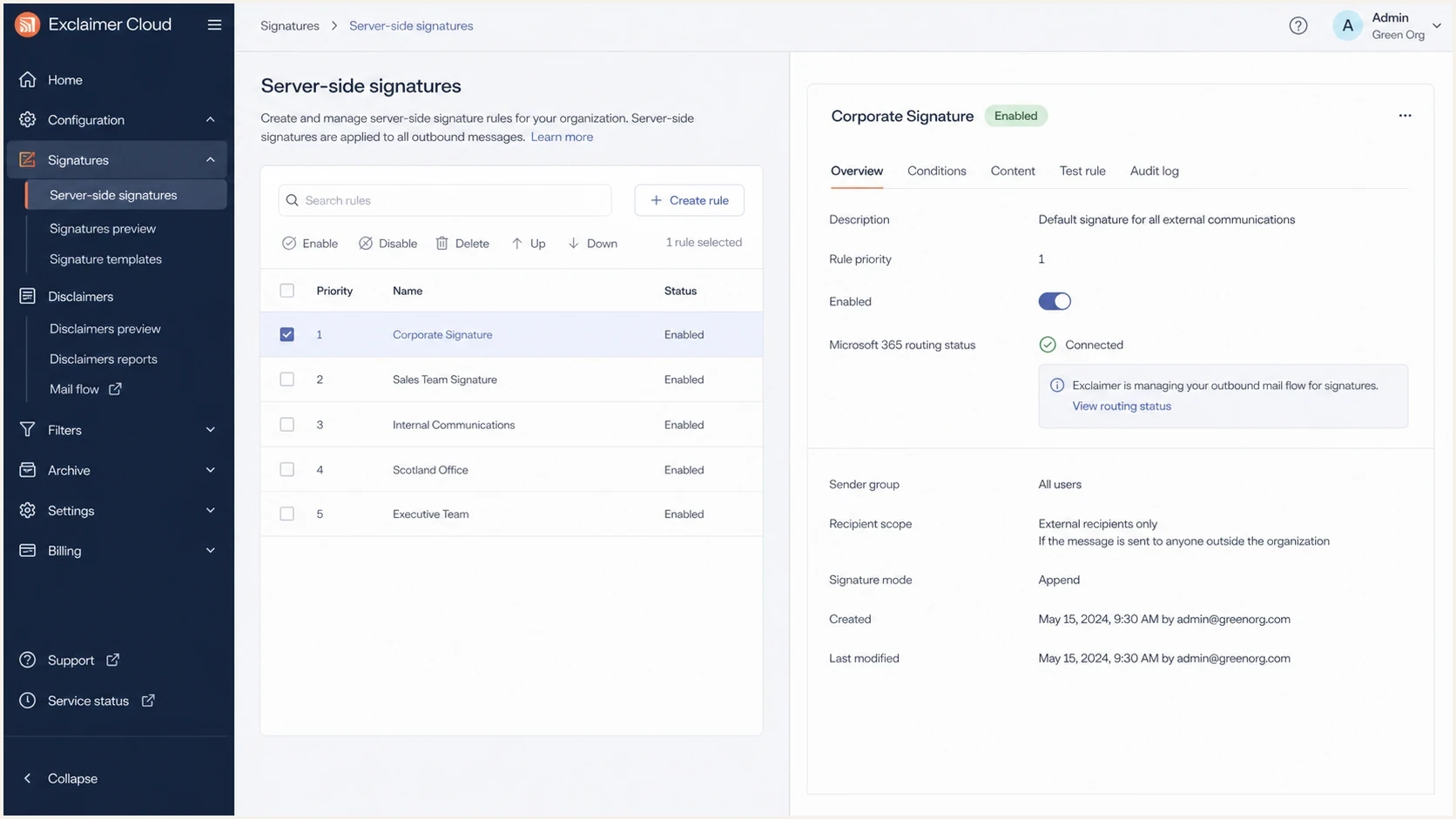
Exclaimer Cloud signature rule screen showing routing and signature settings.
Do not relax DMARC just because someone says signature
If the tested message is signed and passing DMARC after it has gone through Exclaimer, changing p=reject to p=none weakens domain protection without fixing the delivery problem. Ask for the rejection text, quarantine reason, message trace event, or recipient-side verdict first.
The most useful evidence is a received message header, a message trace, and the exact failure mode. Rejected mail has an SMTP response or non-delivery report. Junked mail has a filtering reason somewhere in the receiving tenant. A vague report that "mail is failing" is not enough to pin blame on Exclaimer, Microsoft 365, DNS, or DMARC.
For a practical deliverability test, send a real signed message through the production route and inspect the result with an email tester. That gives you headers, authentication results, and content-level clues in one place.
Email tester
Send a real email to this address. Suped shows a results button when the test is ready.
?/43tests passed
What to check in the headers
The fastest way to separate authentication failure from delivery filtering is to inspect the final recipient-side authentication results. Do not rely only on what Microsoft 365 said before the message left your tenant. The receiving system makes the delivery decision.
Example authentication result after signature processingtext
Authentication-Results: mx.receiver.example;
  spf=pass smtp.mailfrom=example.com;
  dkim=pass header.d=example.com;
  dmarc=pass header.from=example.com
In that example, Exclaimer is not breaking final authentication. If mail is rejected or junked with those results, shift the investigation to content, policy, reputation, or blocklist (blacklist) status. If DKIM fails, check what modified the message after final signing. If DKIM is missing after Server-Side processing, confirm that the message returned to Microsoft 365 or Google Workspace and received the expected final signature. If SPF fails, check the connecting IP and the envelope sender domain.
- SPF result: compare smtp.mailfrom with the IP that connected to the receiver.
- DKIM result: confirm header.d uses your domain or an aligned organizational domain, not only an initial tenant domain.
- DMARC result: confirm either SPF or DKIM passes with alignment to the visible From domain.
- Received chain: identify whether the message passed through Microsoft 365, Exclaimer, another relay, or a forwarder.
- Verdict fields: look for spam confidence, policy action, malware verdict, or tenant block reason.
A DKIM body-hash mismatch means the signed body changed after signing. With Exclaimer Server-Side processing, you can instead see no DKIM result when Exclaimer has removed the invalidated signature and the final sending platform has not applied a new one. If SPF passes but DMARC fails, SPF probably passed for a domain that does not match the visible From domain. For a broader DNS and authentication view, a domain health check is useful before spending hours on signature HTML.
Domain health checker sample results showing DMARC, SPF, DKIM scorecards and detailed validation checks
A practical troubleshooting sequence
Use a sequence that removes guesswork. The goal is to identify the failing layer: DNS authentication, mail flow, recipient policy, content, or reputation.
- Get evidence: collect a full received header, message trace, non-delivery report, or quarantine reason.
- Test the route: send a normal user email through the same Exclaimer rule and outbound connector.
- Compare versions: compare one message with the Server-Side signature applied against a controlled message that bypasses signature processing. Disabling the signature while retaining the same relay isolates content, but it does not isolate routing.
- Check timing: list every routing, DNS, policy, security, or signature change made near the first failure date.
- Inspect content: remove large embedded images, shared tracking links, and unused disclaimers for a controlled test.
- Check reputation: verify whether the domain or outbound IP appears on a blocklist or blacklist, including IOC feeds.
Ask IT for concrete data
- Rejected mail: request the SMTP status code and full bounce text.
- Junked mail: request the receiving tenant's spam verdict and policy action.
- Authentication claim: request headers that show SPF, DKIM, and DMARC failing at the receiver.
- Blocklist claim: request the exact blacklist or blocklist name, listed domain or IP, and remediation path.
Suped's product keeps DMARC source data, SPF and DKIM alignment results, issue detection, and blocklist monitoring in the same investigation. Start with the source breakdown to see whether the Exclaimer route is authenticated, compare it with unaffected sources, then review issue timing before changing a policy that already protects the domain.
Issues page showing top issues, verified sources, unverified sources, and authentication pass rates
If a domain is on a blocklist (blacklist) or IOC list, treat that as a separate incident. Authentication can pass while delivery suffers because of reputation damage. Suped's blocklist monitoring can identify the listed domain or IP so the team can separate reputation remediation from SPF, DKIM, or Exclaimer routing changes.
When to change DMARC, DKIM, SPF, or the signature
Do not change DMARC policy until the headers show a DMARC problem. If DMARC passes, changing DMARC does not solve a spam-folder placement issue. If DMARC fails after Exclaimer processing, confirm final DKIM signing and SPF domain alignment. If DMARC fails only for forwarded mail, account for forwarding behavior and make sure at least DKIM survives the forward.
DMARC policy change decision
Use recipient-side evidence before weakening a policy.
Keep policy
pass
DMARC passes and the issue is junk placement or reputation.
Fix flow
mixed
Final DKIM is missing or invalid, or SPF fails through the relay.
Stage policy
fail
Legitimate authenticated mail is being rejected because the rollout missed a sender.
For the signature itself, the most productive changes are simple: host images cleanly, reduce base64 content, avoid unnecessary tracking links, keep legal text short, use branded links where possible, and test the exact production path. If a recipient has a strict policy against base64-encoded content, the signature can be the trigger even though authentication is clean.
Example DMARC record with reporting enableddns
_dmarc.example.com.  TXT  "v=DMARC1; p=reject; rua=mailto:dmarc@example.com;
fo=1; adkim=s; aspf=s"
A domain at p=reject should have aggregate reporting configured. Without reports, the team lacks evidence when a new sender, relay, or signature flow starts failing. Suped's DMARC monitoring shows the sending source, SPF and DKIM alignment, and the sources that need fixes before a policy change creates rejection risk.
Views from the trenches
Best practices
Test after signature processing so headers show the same route recipients evaluate.
Keep DMARC reporting enabled before enforcing reject across complex mail routes.
Ask for exact bounce text, tenant verdicts, headers, list names, and timestamps.
Compare signed messages with and without the signature before changing policy settings.
Common pitfalls
Blaming SPF when the issue is really final DKIM signing after Server-Side body changes.
Changing p=reject even though recipient-side tests already pass DMARC authentication.
Treating shared signature links and base64 images as SPF or DKIM authentication failures.
Investigating with vague complaints instead of recipient-side delivery evidence.
Expert tips
Check the first failure date against connector, DNS, security, and policy changes.
Review final Received headers to confirm which system sent the message to the recipient MX.
Use blocklist and IOC evidence separately from SPF, DKIM, and DMARC result evidence.
Reduce heavy signature HTML when strict enterprise content filters are involved.
Expert from Email Geeks says DKIM must be applied after Exclaimer rewrites the message, because body changes after signing can invalidate the signature.
2024-07-10 - Email Geeks
Expert from Email Geeks says if a post-Exclaimer test is signed and passing DMARC, authentication is not the issue and relaxing DMARC is the wrong response.
2024-07-10 - Email Geeks
The fix depends on the evidence
Email signatures, including Exclaimer signatures, can invalidate DKIM when the message changes after signing. In Exclaimer's documented Server-Side flow, Exclaimer removes that signature and the final sending platform applies a new one. Server-Side routing can be part of an SPF failure when the actual sending infrastructure is not authorized. Signature content can also affect delivery through content and reputation signals even when SPF, DKIM, and DMARC pass.
Test the final message, not the theory. If authentication passes after Exclaimer, do not weaken DMARC. Pull the rejection text, message trace, recipient-side verdict, blocklist or blacklist evidence, and the change history around the first failure date. That evidence tells you whether to fix final signing, SPF authorization, signature content, domain reputation, or a receiving policy.
For recurring investigations, Suped's product connects DMARC reports with source-level SPF and DKIM results, issue timing, and blocklist monitoring. That workflow helps a team determine whether an incident belongs to mail flow, DNS authentication, recipient policy, or reputation before changing production records.