How does CNAME delegation enable SPF and DKIM authentication for email sending?

Updated on 11 Aug 2026: We updated this guide with current DMARC matching rules and a practical CNAME lifecycle workflow.
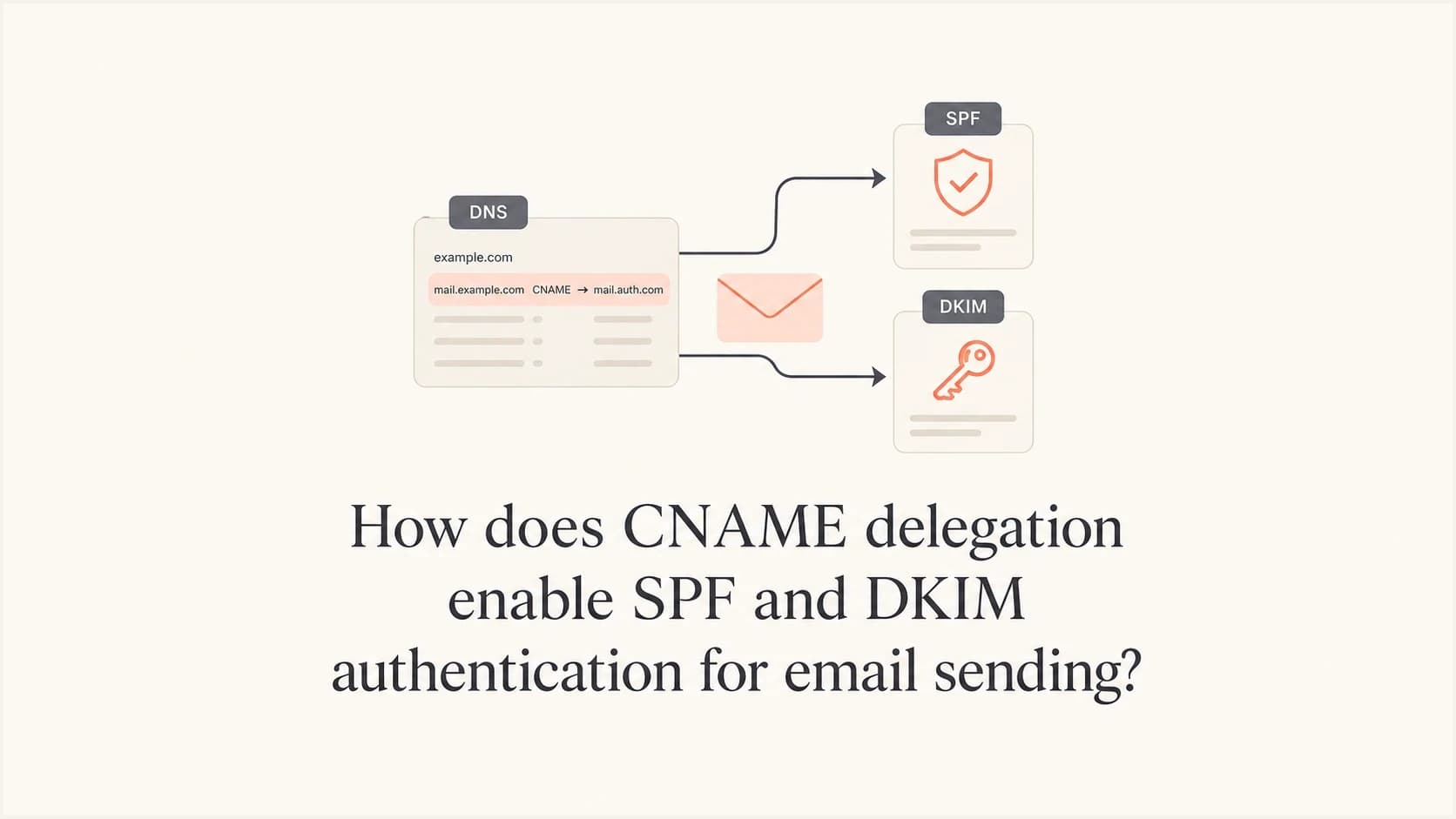
CNAME delegation enables SPF and DKIM by pointing a hostname under your domain to DNS records controlled by your email sending provider. For SPF, the provider usually makes the bounce domain or return-path domain resolve to a hosted SPF TXT record that authorizes its sending IPs. For DKIM, the provider gives you selector hostnames that point to its hosted DKIM public keys. The receiver follows those DNS aliases during authentication, so the message can pass even when your visible organizational domain does not list that sender in its root SPF record.
The key caveat is domain matching. Passing SPF or DKIM only helps DMARC when the authenticated domain matches, or is a subdomain of, the visible From domain under relaxed DMARC mode. A message with From company.com can pass SPF through mail.company.com if that hostname is used as the return-path domain and the DMARC domain-match mode allows the subdomain relationship. It can pass DKIM if the DKIM signature uses d=company.com or a matching subdomain, and the selector DNS lookup resolves to the provider's hosted public key.
This is why a customer success, CRM, helpdesk, newsletter, or transactional email platform can authenticate mail for your brand with only a few CNAMEs in DNS. You are not handing over the whole domain. You are delegating specific DNS names used for SPF return-path checks, DKIM key lookup, or both.
The direct answer
A CNAME does not authenticate email by itself. It delegates a DNS name so the provider can publish the SPF or DKIM data that receivers need to find. The receiver still evaluates normal SPF and DKIM rules.
- SPF path: The receiver checks the SMTP HELO/EHLO name and the envelope sender domain, often visible later as Return-Path.
- DKIM path: The receiver reads the DKIM selector and signing domain, then looks up the public key at that exact DNS name.
- DMARC path: The receiver checks whether the passing SPF or DKIM domain matches the visible From domain.
- Delegation point: The CNAME lets the provider host the changing records while your domain keeps ownership of the delegated hostname.
The part that surprises people is SPF. Many people assume SPF must be published only at the visible From domain, such as company.com. SPF does not work that way. SPF checks the domain used in the SMTP transaction, especially the envelope sender domain. If the platform sends with a return-path like bounces@mail.company.com, the relevant SPF domain is mail.company.com, not automatically company.com.
DKIM delegation is more intuitive. The sending platform signs the message with a DKIM selector and domain, then receivers fetch the matching public key. If you publish a CNAME at the selector hostname, the provider can rotate keys and maintain the TXT record without asking you to edit DNS every time.
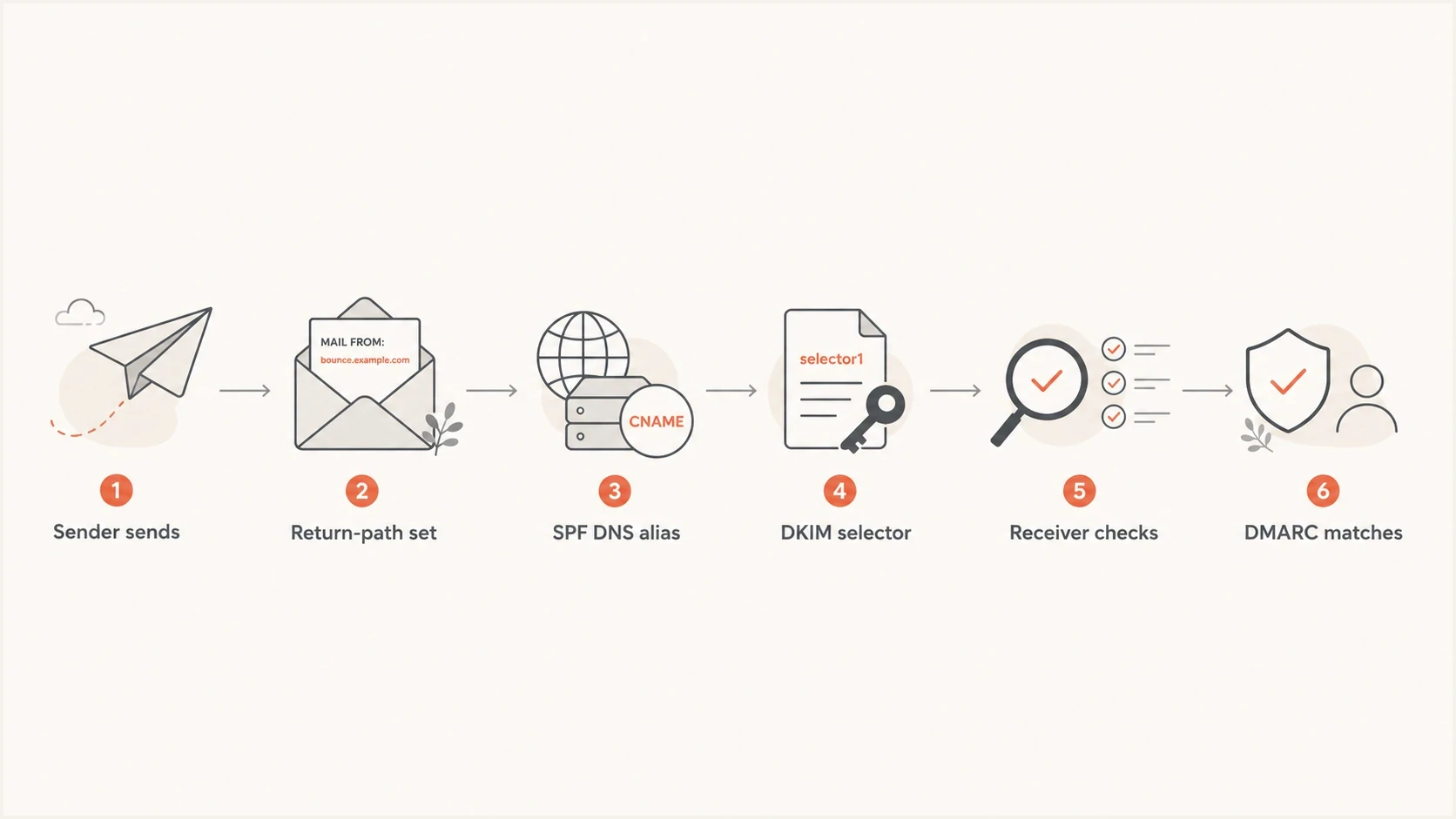
Flowchart showing sender, return-path, SPF alias, DKIM selector, receiver check, and DMARC domain matching.
How SPF works through CNAME delegation
SPF authorizes a sending IP for a domain used in the SMTP conversation. The most important domain is the envelope sender domain, also called MAIL FROM, bounce domain, or return-path domain. That is where bounces go, and it is also where receivers usually evaluate SPF.
In a delegated setup, the provider asks you to create a CNAME for a subdomain such as em.company.com. The provider then uses that domain in the envelope sender. When a receiver checks SPF for em.company.com, DNS follows the CNAME to the provider's hosted DNS name and reads the SPF TXT record there.
SPF delegation exampleDNS
em.company.com.  CNAME  u12345.prov.example.

u12345.prov.example.  TXT  "v=spf1 ip4:192.0.2.10 include:spf.prov.example -all"
That example is simplified, but the shape is accurate. The domain owner publishes the alias. The provider publishes the SPF policy at the target. The receiver follows DNS and checks whether the connecting IP is authorized by that SPF policy.
- Return-path domain: SPF is checked against the domain after the at sign in the envelope sender, not the display From address.
- HELO/EHLO name: Receivers can also check SPF against the hostname presented by the sending server during the SMTP session.
- Root domain SPF: Your root domain SPF record does not need to include this provider unless the root domain is also used as the envelope sender.
- Hosted SPF: Suped's Hosted SPF gives teams a managed way to maintain senders without repeated root DNS edits.
SPF checker
Find SPF syntax issues, lookup limits, and weak records.
?/16tests passed
The practical debugging move is to inspect the headers and find the Return-Path. If the Return-Path domain is a delegated subdomain, SPF can pass there even if you cannot see that provider in the SPF record at the visible From domain.
How DKIM works through CNAME delegation
DKIM uses a cryptographic signature in the message headers. The sending platform signs selected parts of the message with a private key. The receiver uses the selector and signing domain in the DKIM-Signature header to find the public key in DNS.
A DKIM lookup has this shape: selector plus _domainkey plus signing domain. If the header says s=s1 and d=company.com, the receiver looks up s1._domainkey.company.com. If that hostname is a CNAME, DNS resolves to the provider's hosted key.
DKIM delegation exampleDNS
s1._domainkey.company.com.  CNAME  s1.domainkey.provider.example.
s2._domainkey.company.com.  CNAME  s2.domainkey.provider.example.

s1.domainkey.provider.example.  TXT  "v=DKIM1; k=rsa; p=MIIBIjANBg..."
The CNAME target hosts the actual TXT record. This gives the provider control over key rotation and record formatting while keeping the signing identity under your domain. Some platforms use one selector. Many use two selectors so they can rotate keys without downtime.
Manual TXT
- Control: You publish the exact DKIM public key as a TXT record.
- Maintenance: Key rotation needs a DNS change by your team.
- Risk: Copying long public keys can introduce truncation or quote errors.
CNAME delegated
- Control: You delegate only the selector hostname to the provider.
- Maintenance: The provider can rotate keys behind the CNAME.
- Risk: A wrong selector or target breaks DKIM for that stream.
Why DMARC can pass when the root SPF record is silent
DMARC does not require both SPF and DKIM to pass. It requires at least one of them to pass and match the visible From domain. That detail explains many CNAME delegation setups.
For example, a message can show From help@company.com, use Return-Path bounce@mail.company.com, and carry a DKIM signature with d=company.com. SPF can pass through mail.company.com. DKIM can pass through the delegated selector. DMARC then passes because at least one passing mechanism matches company.com.
Authentication outcomes
Common outcomes when a provider sends through delegated SPF and DKIM DNS names.
Best
SPF + DKIM match
SPF passes with a matching domain, DKIM passes with a matching domain, and DMARC passes.
Acceptable
One matching pass
One mechanism passes with a matching domain, so DMARC passes.
Fragile
Domain mismatch
Authentication passes, but the passing domain does not match From.
Broken
DMARC fail
Neither SPF nor DKIM passes with domain matching.
Relaxed domain matching remains the default DMARC mode for SPF and DKIM. RFC 9989 defines a DNS Tree Walk to determine the Organizational Domain. An authenticated subdomain and the visible From domain match in relaxed mode when they have the same Organizational Domain. Under strict mode, the authenticated domain must match the visible From domain exactly, so a subdomain return-path does not match a parent From domain.
DMARC reports confirm what receivers saw after delegated DNS goes live. Suped's DMARC dashboard shows which source used each SPF or DKIM domain and whether it matched From. That separates a valid delegated sender from a sender that passes authentication only on an unrelated domain.
Suped DMARC dashboard showing email volume, authentication health, and source breakdown
What to check in message headers
Start troubleshooting with a real received message rather than a provider setup page. Headers show the exact domains the receiver evaluated. The DNS records only make sense after those domains are known.
|
|
|
|---|---|---|
From | Visible sender domain | DMARC matches SPF or DKIM to this domain. |
Return-Path | Bounce domain | SPF usually checks this domain. |
DKIM-Signature | Selector and domain | DKIM key lookup uses these values. |
Authentication-Results | Receiver verdict | Shows SPF, DKIM, and DMARC pass or fail. |
Received | SMTP path | Helps identify the sending infrastructure. |
Header fields that explain delegated authentication
The most common misunderstanding is treating the visible From address as the SPF identity. SPF cares about the SMTP envelope. DMARC then checks whether that SPF identity matches the visible From domain. Those are separate steps.
Header values to comparetext
From: Support <support@company.com>
Return-Path: <bounces+12345@em.company.com>
DKIM-Signature: v=1; a=rsa-sha256; d=company.com; s=s1;
Authentication-Results: mx.example;
  spf=pass smtp.mailfrom=em.company.com;
  dkim=pass header.d=company.com;
  dmarc=pass header.from=company.com;
In that header sample, SPF passes against em.company.com, DKIM passes against company.com, and DMARC passes against the visible From domain. The root SPF record at company.com is not the deciding record for that SPF result.
Email tester
Send a real email to this address. Suped shows a results button when the test is ready.
?/43tests passed
After checking a real message, confirm DNS. The SPF checker is useful for focused SPF validation, while the domain health checker gives a broader view across DMARC, SPF, and DKIM.
Common CNAME delegation patterns
Most providers use one of a few predictable patterns. The names vary, but the authentication logic stays the same.
|
|
|
|---|---|---|
Bounce CNAME | em | Delegates SPF and bounce handling. |
DKIM selector | s1 | Delegates a hosted public key. |
Second selector | s2 | Allows DKIM key rotation. |
Tracking host | click | Brands links, but does not prove SPF or DKIM. |
Custom subdomain | send | Separates one mail stream from another. |
Common delegated DNS patterns for senders
Provider documentation describes this setup as domain authentication, branded sending, sender authentication, custom return-path, or subdomain delegation. In each case, check the actual DNS hostnames and message identities because the label alone does not prove that both SPF and DKIM are configured.
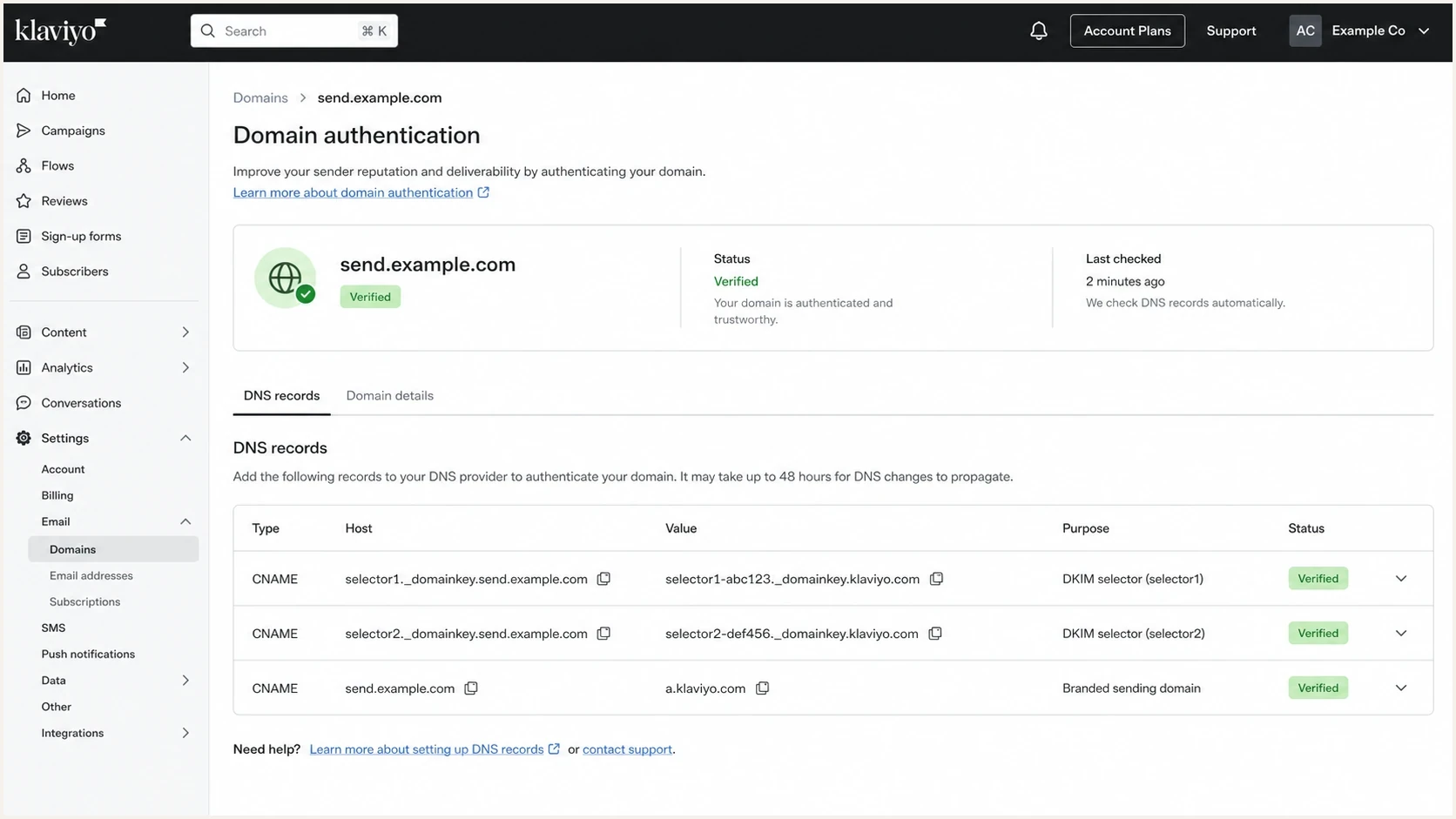
Klaviyo domain authentication settings showing CNAME records for a sending domain.
Do not assume every CNAME connected to an email platform is an authentication record. A click tracking CNAME or image hosting CNAME can improve branding, but it does not authorize sending IPs or publish DKIM keys.
- Authentication CNAME: Used by SPF return-path checks or DKIM selector lookups.
- Branding CNAME: Used for link tracking, open tracking, images, or web assets.
- Verification CNAME: Used only to prove domain ownership to the provider.
How to manage delegated CNAME records
Copy the provider's exact host and target values. DNS control panels handle relative names differently, so verify the fully qualified hostname after saving instead of assuming the interface appended your domain correctly.
- Create the exact owner name: Confirm that the saved hostname matches the bounce domain or DKIM selector supplied by the provider.
- Keep the DNS answer unchanged: Turn off HTTP proxying and CNAME flattening for authentication records so public DNS returns the required alias.
- Publish every supplied selector: A second DKIM selector lets the provider rotate keys without requiring another DNS change.
- Verify public DNS: Query the CNAME owner and its target. Confirm that the target returns the expected SPF policy or DKIM public key.
- Test a received message: A provider's setup status can lag DNS, so confirm the Return-Path, DKIM selector, and Authentication-Results in real headers.
Public DNS verificationBASH
dig CNAME em.company.com +short
dig TXT u12345.prov.example +short
dig CNAME s1._domainkey.company.com +short
dig TXT s1.domainkey.provider.example +short
A CNAME owner name cannot coexist with a TXT or MX record at the same name. If the DNS panel already shows another record at that hostname, resolve the ownership conflict before publishing the alias.
Keep both DKIM selectors in DNS while the provider uses them for rotation. When a sending service is retired, remove its delegated records after confirming that no production mail uses them. This ends the provider's control over those DNS names and prevents stale aliases from remaining in the zone.
Where delegation breaks
Delegation usually fails because one DNS name is wrong, one domain-match assumption is wrong, or the provider is signing with a domain that does not match the visible From domain. These failures are easy to miss when you only look at setup screens.
- Wrong hostname: The CNAME is created at mail.company.com but the sender uses em.company.com.
- Mismatched DKIM: The DKIM signature passes with the provider's domain, but DMARC fails because the domain does not match.
- Strict mode: A subdomain return-path passes SPF, but DMARC strict SPF matching rejects the subdomain relationship.
- SPF lookup pressure: A CNAME-hosted policy remains subject to SPF's 10 DNS-query term limit. Count include, a, mx, ptr, exists, and redirect terms across the resolved policy.
Another common issue is assuming a CNAME under a subdomain delegates every name below it. It does not. A CNAME at send.company.com does not automatically create valid DNS for s1._domainkey.company.com. Each queried hostname needs the correct record.
The fastest way to catch a broken delegation is to compare the header identity, the DNS name being queried, and the provider's expected hostname. If any one of those differs, authentication fails or passes without a DMARC domain match.
A practical setup checklist
Treat each mail platform as a separate sending source with its own return-path, DKIM selectors, and monitoring. This separation makes failures easier to isolate. A support platform, billing platform, marketing platform, and product mailer should not all depend on a single overloaded SPF record when they can authenticate through delegated identities.
- Choose the identity: Decide whether the sender should use the root domain or a subdomain for visible From and return-path matching.
- Publish exact CNAMEs: Create the hostnames exactly as the provider gives them, including selectors and bounce domains.
- Send a real message: Use a mailbox or tester that exposes full headers, then inspect Return-Path and DKIM-Signature.
- Confirm matching: Check that the SPF or DKIM domain matches the visible From domain under your DMARC policy.
- Monitor reports: Watch DMARC aggregate reports after launch, because provider setup pages do not show receiver-side results.
Suped fits this workflow by showing authentication outcomes per source, not just whether a DNS record exists. That matters because a delegated CNAME can be syntactically correct while the provider still sends with a different return-path or DKIM domain.
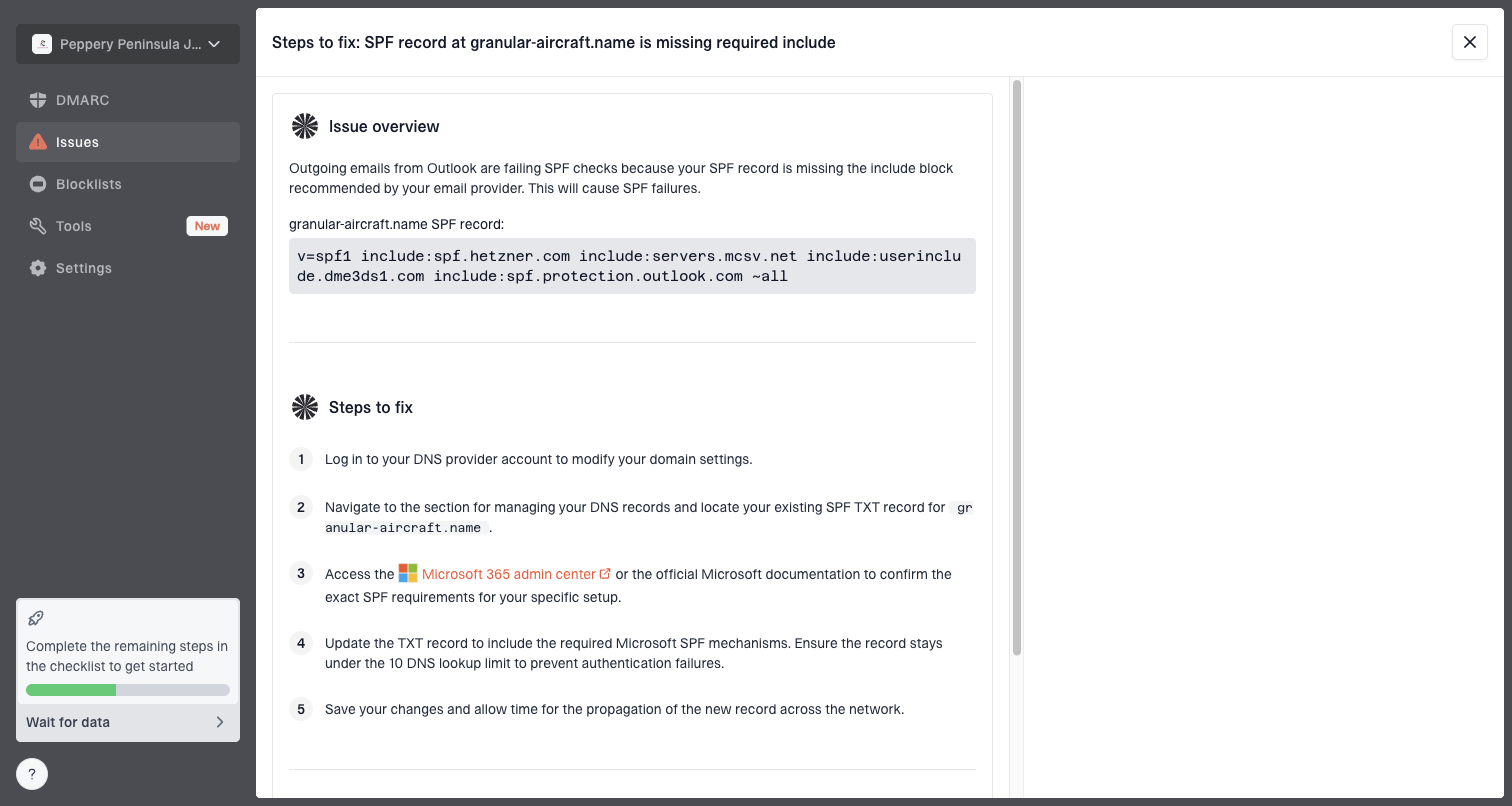
Issue steps to fix dialog showing the issue overview, tailored fix steps, and verification action
For teams managing several senders, Suped's product groups DMARC results by source and shows whether each SPF or DKIM identity matches From. Hosted SPF can also reduce repeated DNS edits when authorized senders change. The workflow connects a receiver-side result to the source and DNS record that need attention.
Views from the trenches
Best practices
Inspect Return-Path and DKIM-Signature before judging whether DNS delegation works.
Keep each sender on a distinct delegated subdomain so source problems stay isolated.
Monitor DMARC reports after setup because provider checks do not prove receiver domain matches.
Common pitfalls
Assuming visible From controls SPF hides the real envelope sender domain being checked.
Creating a CNAME at the wrong hostname leaves the queried SPF or DKIM name unresolved.
Treating tracking CNAMEs as authentication records causes false confidence in setup.
Expert tips
Use relaxed domain matching for delegated return-paths unless strict mode has clear value.
Check HELO and MAIL FROM identities when SPF results differ across receiving systems.
Prefer hosted SPF when DNS ownership and sender changes slow down authentication fixes.
Marketer from Email Geeks says a delegated subdomain can explain SPF and DKIM passes even when the root domain SPF record does not mention the sending platform.
2019-08-27 - Email Geeks
Marketer from Email Geeks says checking the full headers is the first step because the relevant SPF hostname is often the return-path domain, not the visible From domain.
2019-08-27 - Email Geeks
The practical takeaway
CNAME delegation works because SPF and DKIM look up specific DNS names, not a vague brand identity. SPF checks SMTP identities such as the return-path domain. DKIM checks the selector and signing domain. A CNAME can point those exact names to provider-hosted records, and receivers follow the DNS chain during authentication.
The setup is healthy when the delegated records resolve, SPF or DKIM passes, and at least one passing mechanism matches the visible From domain for DMARC. It is weak when it only passes against a provider-owned domain, when strict mode blocks a delegated subdomain, or when nobody is watching DMARC reports after launch.
For a single sender, headers plus DNS checks are enough to understand what is happening. For several senders, group DMARC results by source and record the delegated SPF or DKIM identity behind each result. That turns an authentication failure into a specific source and DNS record to investigate.