Why are my emails to Interia.pl being rejected and what can I do about it?

Published 19 Jun 2025
Updated 29 Jul 2026
10 min read
Summarize with
Updated on 29 Jul 2026: We updated this guide with Interia.pl's current IP unblock requirements, clearer SMTP response handling, RFC 9989 DMARC guidance, and practical retry controls.
If Interia.pl rejects your mail with 450 4.7.1 and says your server was temporarily blocked for spam, treat it as an IP reputation block. Pause new campaign traffic to Interia.pl, let the sending MTA handle deferred messages with normal backoff, verify SPF, DKIM, DMARC, PTR/rDNS, and HELO/EHLO on the affected route, then submit a documented IP unblock request.
Interia.pl says this block occurs when its users mark messages from the source IP as spam. Its unblock guidance also identifies shared hosting, an SPF record that omits the source IP, a missing PTR record, and transactional mail sharing an IP with marketing mail.
The practical order is technical proof first, reputation repair second, and escalation after the cause has changed. Authentication proves who sent the mail, but it does not make unwanted mail acceptable.
What the Interia.pl rejection means
Typical Interia.pl rejectiontext
450 4.7.1 Twoj serwer poczty x.x.x.x zostal tymczasowo
zablokowany za spam - skontaktuj sie z nami przez formularz

Your email server x.x.x.x was temporarily blocked due to spam.
This is a temporary SMTP rejection, not a permanent recipient-level bounce. A 4xx response tells the sending MTA to defer the message and try again later. The wording identifies the sending server IP as the blocked identity. It does not mean the recipient address is invalid, and it does not prove that message content alone caused the rejection.
A dedicated IP makes attribution clearer because its sending history belongs to one sender. A shared IP creates a different problem: another domain on the same infrastructure can contribute to the IP's complaint history, and Interia.pl lists shared hosting as a reason legitimate mail can be rejected.
Do not requeue campaigns manually
Keep affected traffic in a separate queue. Pause new promotional sends, correct the cause, and allow normal MTA retry intervals after remediation. Repeated manual retries or a second full campaign create unnecessary attempts.
Interia.pl's unblock page attributes the block to users marking mail from the IP as spam. Sending speed still affects reputation, but a slower rate does not fix weak consent, stale recipients, shared-IP abuse, or mixed mail streams.
Match the Interia.pl error to the fix
Start with the exact SMTP response. If a mail client cannot connect to its own outbound SMTP server, that is a submission problem rather than an Interia.pl recipient rejection. Fix the account credentials, TLS setting, network path, or local security software before using the receiver-reputation steps below.
|
|
|
|---|---|---|
450 4.7.1 server blocked for spam | Temporary source-IP block | Defer, investigate complaints and configuration, remediate, then use the IP unblock form. |
550 5.7.1 Rejected due to SPF | Permanent SPF rejection | Authorize the actual source IP and confirm SPF passes before sending again. |
451 4.4.x Deferred due to SPF | Temporary SPF or DNS problem | Correct the SPF or DNS issue and let the MTA retry on its normal schedule. |
550 5.1.1 Account not found | Recipient does not exist or has been blocked | Verify the address and suppress it when the failure is confirmed. |
550 5.2.1 Mailbox not available | Address error, full mailbox, or suspended account | Stop unchanged retries and verify the recipient through another channel. |
550 5.7.1 Recipient doesn't want your mail | Recipient-level sender block | Suppress the recipient unless they explicitly ask to receive and unblock the mail. |
Interia.pl response codes and the next action
Confirm which server issued the response
Save the remote host name, source IP, recipient domain, timestamp, queue ID, and full diagnostic text. This separates an Interia.pl MX response from a local relay, mail-client, or upstream provider error.
The fast triage order
Triage the block in a fixed order so the evidence shows whether the rejection affects one stream, one domain, one IP, or every message sent to Interia.pl.
- Capture the exact error, including the SMTP code, enhanced status code, remote host, timestamp, source IP, queue ID, envelope sender, visible From domain, and mail stream.
- Pause new affected campaign traffic while authentication, complaints, shared-IP exposure, and list quality are checked.
- Test a representative message through the same route and inspect its headers, DNS results, and authentication results.
- Document the fixes before contacting Interia.pl so the unblock request is specific and reproducible.
For a live check, send a representative message through Suped's email tester. It puts authentication results, headers, content warnings, and delivery signals in one test before the receiver is contacted.
Use the same message class that was rejected. A password reset, receipt, newsletter, and reactivation campaign produce different reputation signals. Testing clean transactional mail does not prove a promotional stream is healthy.
Email tester
Send a real email to this address. Suped shows a results button when the test is ready.
?/43tests passed
If the test passes but Interia.pl still blocks the route, shift attention to receiver-specific reputation. Review complaints, recent volume changes, inactive Polish recipients, unknown-user failures, shared-IP history, and any segment without recent confirmed activity.
If the test fails, correct it before escalation. Broken DKIM, an unauthorized SPF source, a DMARC domain mismatch, or inconsistent PTR and HELO/EHLO evidence weakens an unblock request.
Authentication and DNS checks before escalation
The sender identity must be internally consistent. Start with Suped's domain health check so DNS, authentication, and mail-host basics are reviewed together on the affected route.
|
|
|
|---|---|---|
SPF | The actual source IP is authorized and SPF passes. Publish -all only after every legitimate source is included. | Interia.pl cites a missing source IP and ~all instead of -all on its unblock page. |
DKIM | A valid signature uses a domain that matches the visible From domain for DMARC. | The message loses a durable domain-authentication path. |
DMARC | At least monitoring mode with aggregate reports reaching a working destination. | Authorized-source failures stay hidden, although DMARC alone does not repair IP reputation. |
PTR/rDNS | The source IP has one meaningful PTR host name that resolves forward to the same IP. | Interia.pl lists a missing or incorrect PTR as an unblock issue. |
HELO/EHLO | The sending MTA announces a valid, resolvable host name consistent with its PTR. | The SMTP identity looks incomplete or inconsistent. |
Core checks before asking Interia.pl to lift a block
If DMARC reporting is not active, publish monitoring mode before enforcement. RFC 9989 now defines DMARC, RFC 9990 defines aggregate reporting, and the former pct tag has been removed. Suped's DMARC monitoring turns aggregate reports into source-level evidence that shows which systems pass, fail, or send without approval.
Starting DMARC recorddns
Name: _dmarc.example.com
Type: TXT
Value: v=DMARC1; p=none; rua=mailto:dmarc@example.com
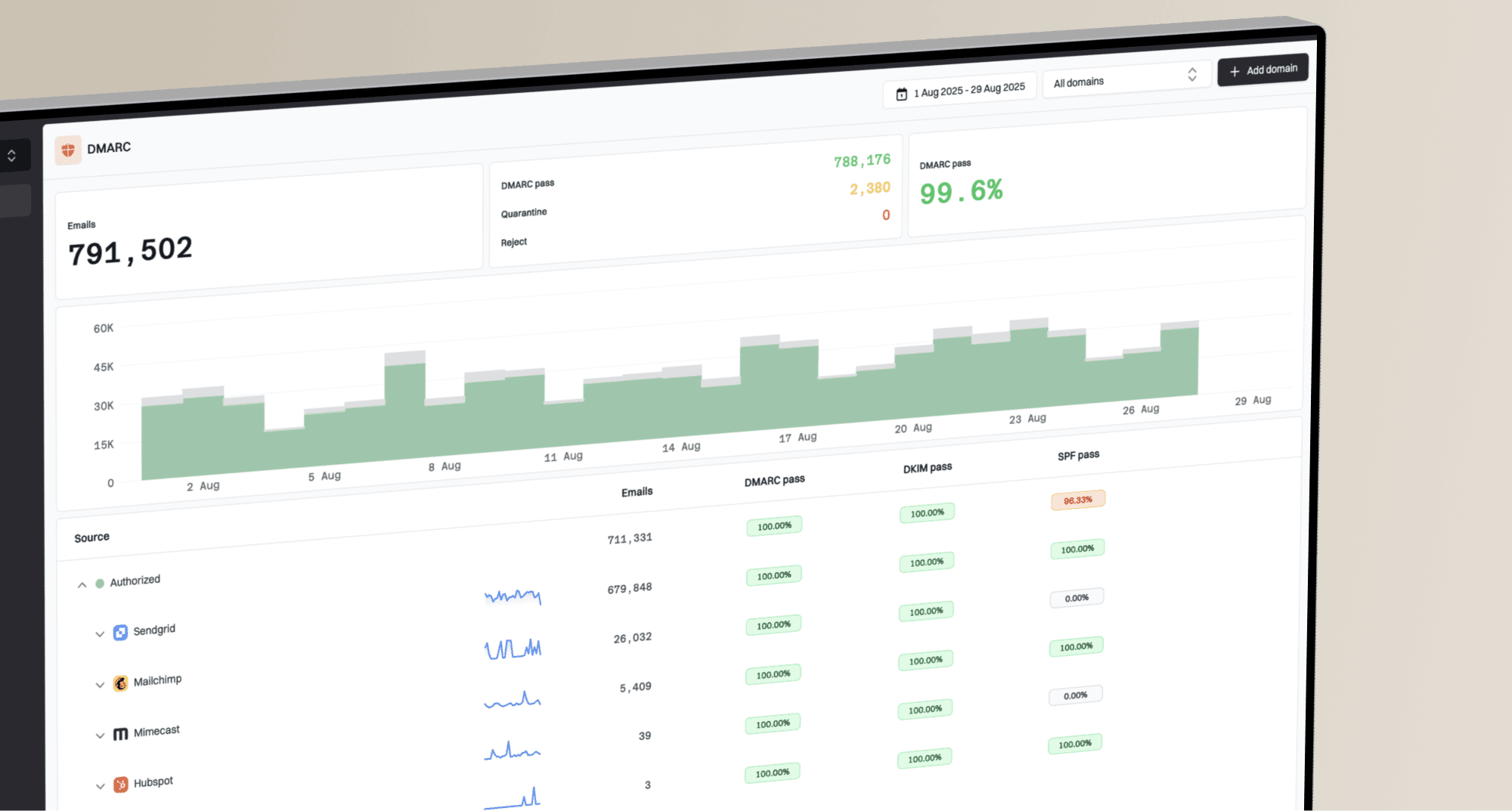
DMARC record detail view showing SPF, DKIM, DMARC, rDNS diagnostics, and DNS records
Suped's product combines DMARC, SPF, DKIM, DNS diagnostics, alerts, and source investigation. During an Interia.pl incident, use the source and record views to identify the sender, selector, IP, or DNS record that needs remediation.
Use Interia.pl's IP unblock form
After remediation, use Interia.pl's official IP unblock request form. The form asks for the sending IP, message content, affected domain, and a contact email address.
- Confirm that the IP entered in the form matches the source IP named in the rejection.
- Describe the mail stream, consent source, normal daily volume, and the date the rejection began.
- List completed fixes, including SPF or PTR changes, recipient suppression, stream separation, and complaint controls.
- Include representative rejection timestamps and queue IDs so Interia.pl can find the events.
Ask for an IP unblock review
A request that names the affected IP, explains the cause, and lists completed remediation gives support evidence to review. Do not ask for a broad whitelist while the source still generates complaints or fails the provider's published checks.
For broader sending into Poland, keep a separate playbook for mailbox-specific rules. Authentication and consent principles remain consistent, but Polish providers differ in rate tolerance, rejection text, and escalation paths. This Polish provider guidance helps when Interia.pl is one part of a wider regional issue.
Reputation signals to clean before retrying
Do not treat this as a DNS-only incident. DNS must be correct, but the receiver is reacting to traffic behavior. Review spam complaints, inactive recipients, trap-risk addresses, sudden volume changes, and repeated mail to invalid accounts.
Check whether the sending IP or domain appears on a major blocklist or blacklist, then compare the result with bounce and complaint data. Suped's blocklist monitoring keeps IP and domain blacklist checks beside DMARC evidence, which helps connect a listing to the affected sender and time window.
Internal complaint-rate guardrails
These are conservative operating guardrails, not thresholds published by Interia.pl.
Healthy
under 0.1%
Keep sending only to recipients with recent confirmed activity.
Watch closely
0.1% to 0.3%
Cut risky segments and review acquisition sources.
Stop and repair
over 0.3%
Pause the stream and correct consent, content, frequency, or targeting problems.
- Remove Interia.pl addresses without recent clicks, purchases, logins, replies, or other confirmed activity.
- Suppress contacts collected through unclear co-registration, unverified imports, purchased data, or legacy campaigns.
- Compare complaint timing against the campaign, offer, sending time, acquisition source, and recipient segment.
- Separate transactional and promotional mail by IP or subdomain so one stream does not damage the other.
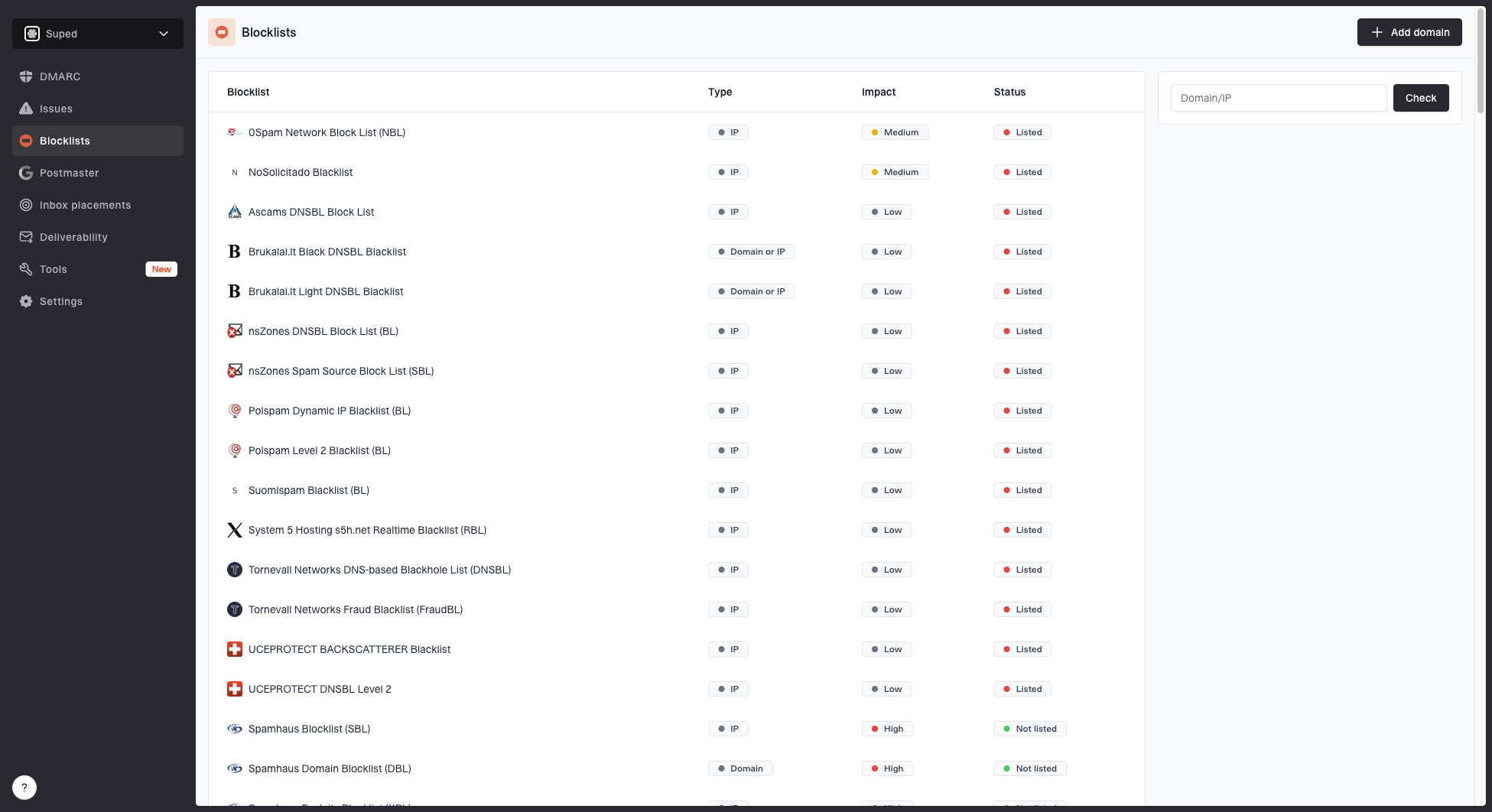
Blocklist monitoring page showing domain and IP checks across blocklists with importance and status
A clean retry uses a smaller segment with recent confirmed activity. Start with recent buyers, active account holders, or recipients who triggered transactional mail. Do not resend the full blocked promotional queue.
A safe recovery plan
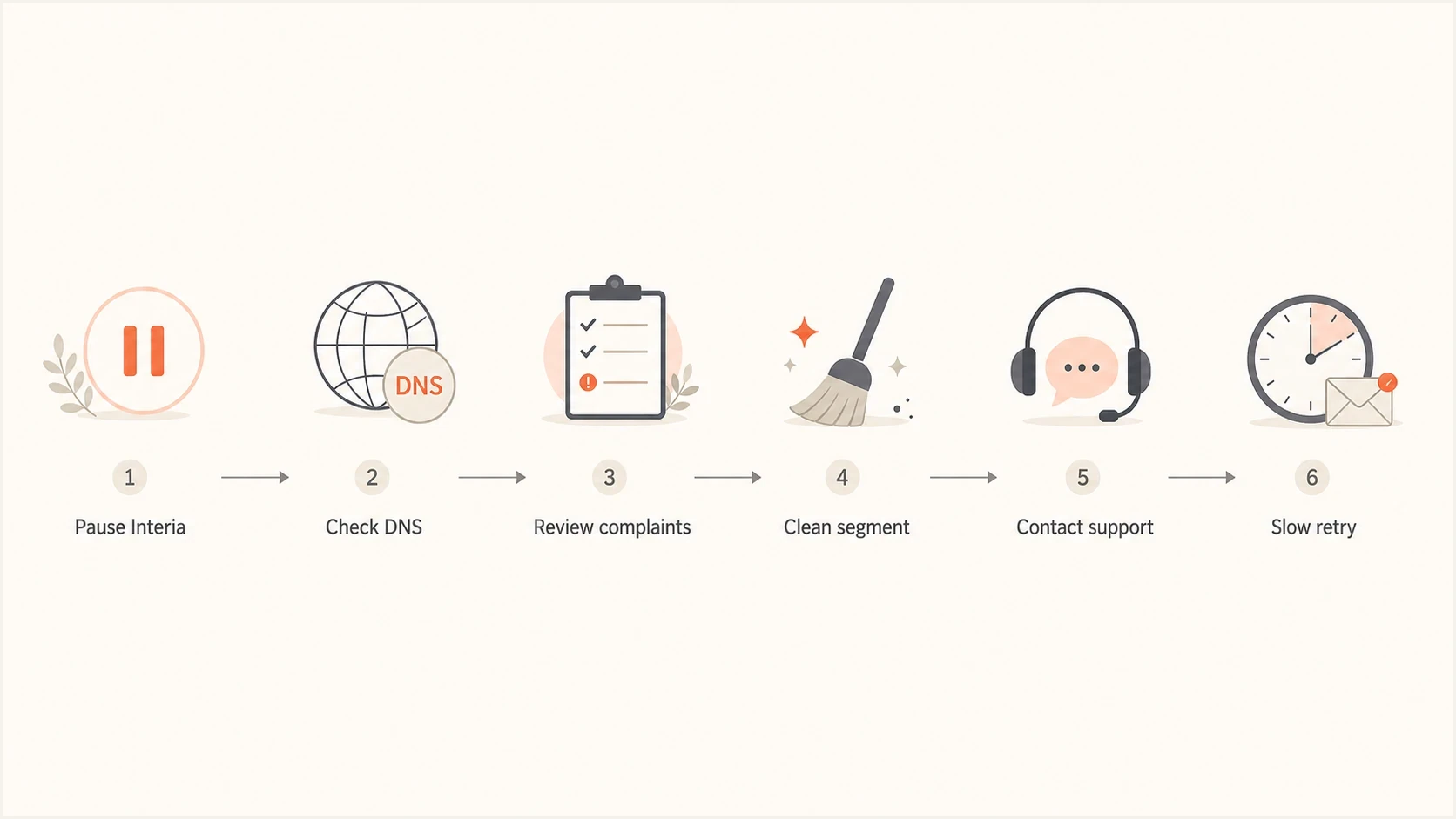
Flowchart showing the recovery path for Interia.pl email rejections.
Once the identified issues are fixed and the block has been reviewed, recover slowly. One successful test is only a routing check. The useful signal is sustained acceptance without new temporary blocks, unknown-user failures, or spam complaints.
- Day one: send transactional mail and a small segment with recent confirmed activity.
- Day two: increase only when temporary blocks, complaints, and unknown-user failures remain low.
- Day three: add one more active segment rather than every remaining Interia.pl address.
- After recovery: review Interia.pl volume, deferrals, hard bounces, and complaints each week.
Example Interia.pl ramp
An illustrative conservative retry pattern after the block is lifted. Scale it to the sender's normal volume and current reputation.
Daily Interia.pl volume
What to send Interia.pl support
- Provide the sending IP, PTR host name, envelope domain, and visible From domain.
- Include representative rejection samples with timestamps, queue IDs, and message types.
- List authentication changes, suppressed segments, stream separation, complaint controls, and retry limits.
- Ask Interia.pl to review the temporary block on the specific source IP after remediation.
Suped's product keeps DMARC aggregate data, authentication failures, blocklist and blacklist alerts, and source changes together during recovery. Use alerts to catch a broken sender or DNS change before the same Interia.pl route accumulates another incident.
Views from the trenches
Best practices
Review Interia.pl blocks with IP, domain, stream, consent, and complaint data together.
Fix authentication and list quality before asking a receiver to review a temporary block.
Retry only the safest active segment after support confirms that the block is removed.
Common pitfalls
Treating successful authentication as proof that complaints and recipient quality are clean.
Assuming a dedicated IP is healthy without checking its host name and complete traffic mix.
Retrying the full queue into a temporary block and creating additional negative signals.
Expert tips
Build a short evidence pack with headers, timestamps, queue IDs, and remediation steps.
Separate Interia.pl mail into its own queue while reputation and support work continue.
Use DMARC reports to confirm every approved sender passes before increasing volume.
Marketer from Email Geeks says the specific Interia.pl bounce often points to bad recipient metrics, especially complaints, rather than only sending too quickly.
2024-05-21 - Email Geeks
Marketer from Email Geeks says troubleshooting needs the sending IP, domain, habits, and compliance details before the rejection can be assessed.
2024-09-04 - Email Geeks
What to do next
An Interia.pl 450 4.7.1 temporary block is recoverable when the source of the complaints or configuration problem changes. Capture the exact response, verify the sending route, correct SPF and PTR issues, separate mail streams, suppress risky recipients, and submit the provider's IP unblock form.
After the block is lifted, use normal queue backoff and increase new volume only when deferrals, complaints, and unknown-user failures remain controlled. A clean DMARC result supports identity, but reputation still depends on wanted mail and accurate recipients.