Why are my emails going to spam in Gmail even though everything seems technically correct?

Updated on 2 Aug 2026: We updated this guide with Gmail's spam-rate targets, current bulk sender rules, and a sharper technical triage process.
Your emails are going to spam in Gmail even though SPF, DKIM, and DMARC pass because authentication only proves who sent the message. Gmail still decides whether the message looks wanted. The usual causes are a new or weak sending domain, high spam complaints, poor recipient engagement, content that resembles unwanted mail, mixed link and image-hosting domains, missing RFC 8058 one-click unsubscribe where required, a suspicious From name, shared infrastructure reputation, or a blocklist/blacklist signal.
When Gmail says a message is "similar to some messages identified as spam in the past," treat that as a content and infrastructure warning first, not a DNS warning. A technically clean message can still have the same HTML pattern, tracking setup, URL mix, image host, offer language, or recipient reaction profile as mail Gmail users rejected before.
- Authentication: SPF, DKIM, and DMARC passing is necessary, but it is not an inbox guarantee.
- Reputation: A new domain sending the same creative as an older trusted domain can still land in spam.
- Content: Gmail evaluates wording, layout, URLs, image hosts, tracking domains, and past user reactions.
- Compliance: Bulk marketing and promotional mail needs working one-click unsubscribe, not only a visible footer link.
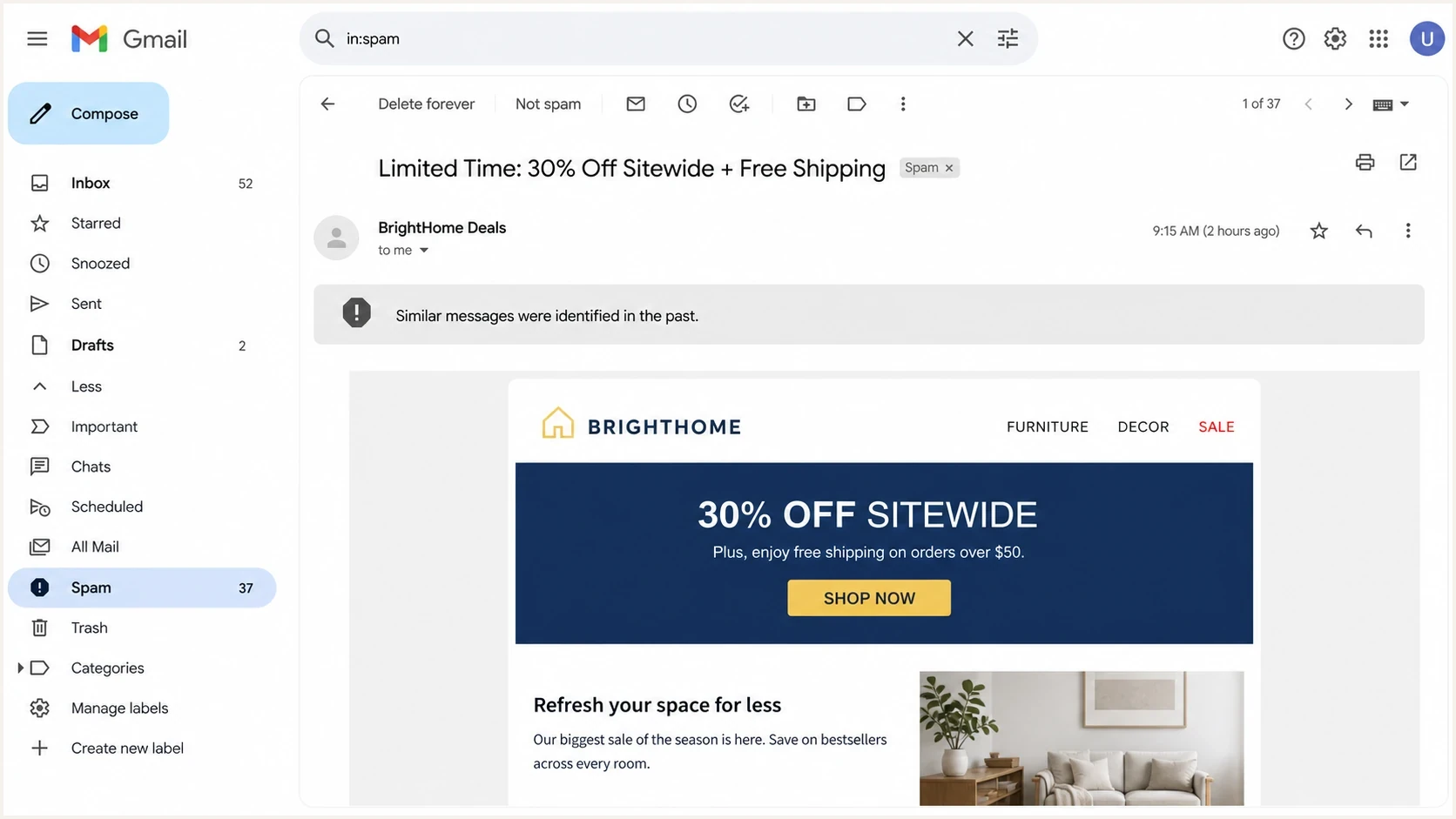
Gmail spam folder showing a message classified as similar to unwanted mail.
The short answer
A DNS pass says Gmail can authenticate the message. It does not say the message has earned inbox trust or met every sender requirement. Gmail combines authentication with domain reputation, IP reputation, complaint data, engagement, URL reputation, sender history, bulk sender compliance, and content classification. It also expects valid forward and reverse DNS, TLS, and correctly formatted messages. If any of those signals look weak, the message can pass authentication and still go to spam.
The fastest way to separate a real authentication fault from a deliverability fault is to send the same message through an email tester, then compare the headers, authentication results, links, image hosts, and Gmail placement. If the test shows authentication pass but Gmail still places the mail in spam, move your attention to reputation and message similarity.
Authentication is not the finish line
SPF, DKIM, and DMARC are the entry ticket. They prove the sender identity path, but Gmail still asks a separate question: do Gmail users appear to want this mail?
- Green checks: They reduce spoofing risk and stop obvious policy failures.
- Inbox placement: It depends on wanted-mail signals, not authentication alone.
- Spam reason: A similarity warning points to message patterns and sender history.
- Next move: Inspect headers, URLs, image domains, unsubscribe support, and complaint data.
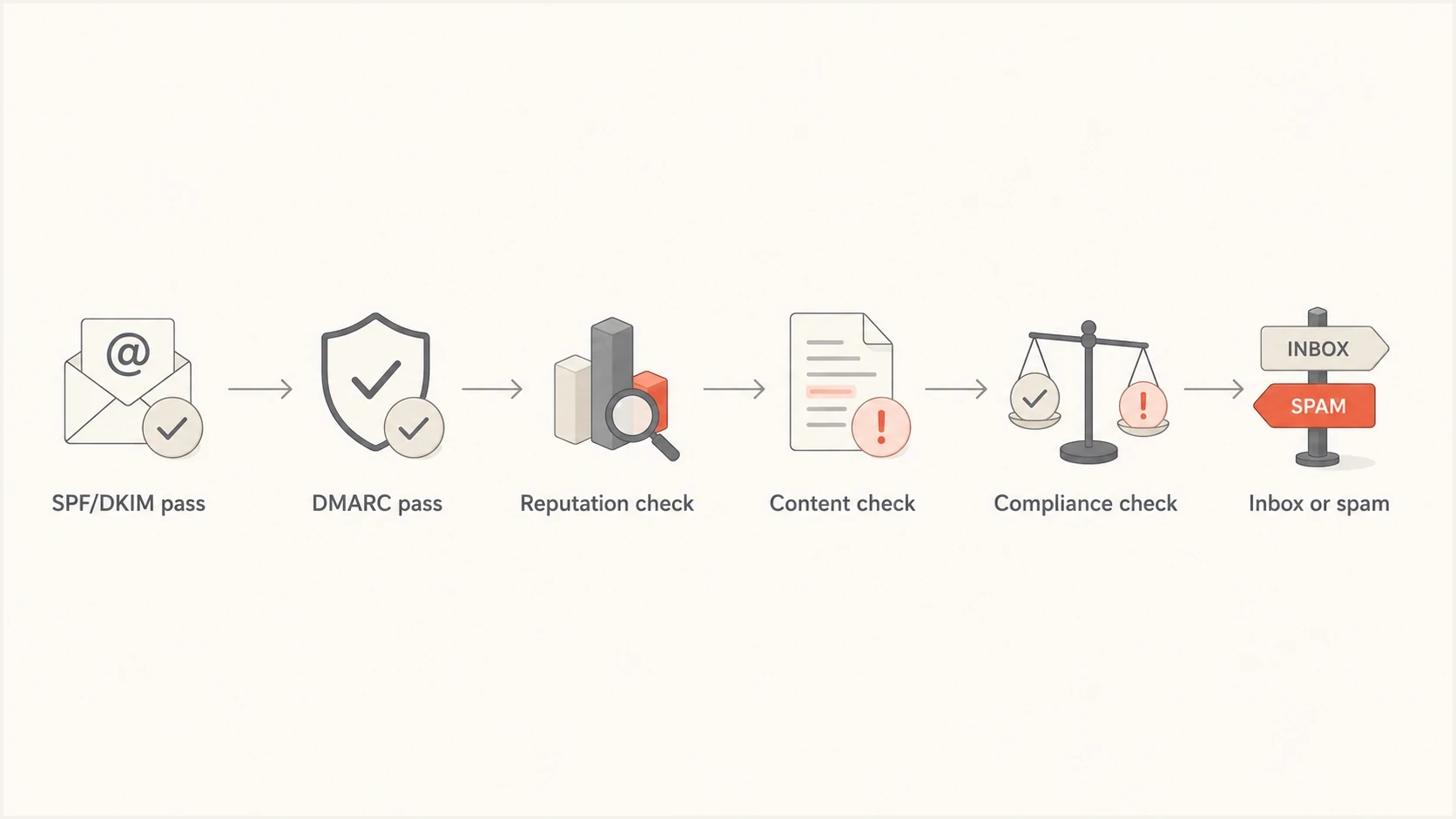
Flowchart showing authentication passing before Gmail checks reputation, content, and compliance.
What Gmail is actually judging
Split the problem into two buckets: technical identity and recipient trust. Most teams spend too long on the first bucket because it has clear pass or fail results. Gmail's spam decision uses both buckets, and the second one is where technically correct mail often breaks.
Technical identity
- SPF: The sending server is permitted by the envelope domain.
- DKIM: The message has a valid cryptographic signature.
- DMARC: The visible From domain aligns with an authenticated identifier.
- Transport and format: TLS, PTR records, and RFC 5322 formatting meet Gmail's baseline.
Inbox trust
- History: The domain has a record of wanted mail at Gmail.
- Engagement: Recipients reply, move messages out of spam, and avoid complaints.
- URLs: Links and images belong to expected, stable domains.
- Compliance: Unsubscribe, sender identity, and bulk requirements are met.
Google's own admin guidance says users can mark messages as not spam and add trusted senders to contacts. Admins can also create spam bypass filters, but Gmail can still reject or spam-folder a message it identifies as suspicious. These mailbox controls do not repair weak sender reputation. The useful reference is Google's spam guidance.
|
|
|
|---|---|---|
New domain | Thin history | Slow warmup |
Spam complaints | Reported rate | Tighten consent |
URLs | Mixed hosts | Use trusted hosts |
Images | Shared CDN | Reduce variance |
Unsubscribe | Header support | Add RFC 8058 |
From name | Brand clarity | Use known name |
Lists | Old consent | Segment tighter |
Common causes when Gmail spam placement happens after authentication passes.
Check the headers before changing content
Before rewriting the message, confirm the basics in Gmail's original message view. SPF, DKIM, and DMARC should pass, with the visible From domain aligned to an authenticated identifier. Then verify TLS, a valid Message-ID, a single instance of headers such as From and Subject, and forward and reverse DNS for the sending IP. Authentication can pass while one of these baseline requirements is still wrong.
Healthy authentication result patterntext
Authentication-Results: mx.google.com;
 dkim=pass header.d=example.com;
 spf=pass smtp.mailfrom=bounce.example.com;
 dmarc=pass header.from=example.com
If the Authentication-Results header looks clean, run a broader domain health checker pass anyway. This catches quiet issues that do not always appear in a single message test, including a stale SPF include, DKIM selector drift, weak DMARC policy, missing reporting, or DNS changes that affect only some send streams.
?
What's your domain score?
Deep-scan SPF, DKIM & DMARC records for email deliverability and security issues.
For ongoing mail, one clean sample is not enough. DMARC aggregate reports show which sources are actually sending as your domain and which ones pass or fail at scale. Suped's DMARC monitoring turns those reports into source-level diagnostics, so you can see whether Gmail spam placement is tied to one vendor, one subdomain, one IP range, or one campaign stream.
Suped DMARC dashboard showing email volume, authentication health, and source breakdown
Fix one-click unsubscribe properly
Gmail's formal one-click unsubscribe requirement applies to bulk senders' marketing and promotional messages sent to personal Gmail accounts. Google treats a sender as bulk at around 5,000 or more messages in a 24-hour period, counts traffic across the same primary domain and its subdomains, and keeps the bulk classification once assigned. Transactional messages such as password resets and purchase receipts are excluded.
For covered mail, a footer unsubscribe link is not the same as RFC 8058 support. The message needs a List-Unsubscribe header containing an HTTPS URL, plus the List-Unsubscribe-Post header. A visible unsubscribe link must also remain in the message body.
RFC 8058 header patterntext
List-Unsubscribe: <https://example.com/u/abc>,
 <mailto:unsubscribe@example.com>
List-Unsubscribe-Post: List-Unsubscribe=One-Click
List-Unsubscribe alone is incomplete
The common mistake is having a List-Unsubscribe header but no List-Unsubscribe-Post header. That provides a header-based path, but not the one-click POST behavior Gmail expects. A mailto option can remain as a fallback, but it does not replace the required HTTPS URL.
- HTTPS: Include one HTTPS URL in List-Unsubscribe.
- POST: Add the List-Unsubscribe-Post header with the exact one-click value.
- Endpoint: Do not require login, extra confirmation, or a preference survey.
- Processing: Honor requests within 48 hours and suppress future campaign mail.
Missing one-click unsubscribe does not automatically send a message to spam. It removes eligibility for some delivery support, and unwanted mail without an easy opt-out is more likely to attract spam complaints. On a new sending domain with limited Gmail history, that extra complaint risk matters.
Inspect every URL and image host
A message can authenticate cleanly and still look suspicious because its links and images point all over the place. Gmail can evaluate the domains in visible links, redirect chains, tracking links, image sources, CDN hosts, and unsubscribe URLs. A campaign sent by one platform but carrying links or images tied to another platform is a common source of distrust.
The most useful check is simple: list every host found in the HTML and ask whether each one makes sense to a mailbox provider. Brand domain, sending subdomain, tracking domain, image CDN, and unsubscribe domain should look intentional. If a new sending domain uses images hosted on several unrelated shared hosts, Gmail has less reason to treat the message as consistent brand mail. Check linked domains for compromise or unsafe status as well as reputation.
- Tracking: Use a stable branded tracking domain instead of a generic shared domain.
- Images: Host campaign images on a predictable domain with clean reputation.
- Redirects: Keep redirect chains short and remove legacy campaign links.
- Branding: Use a From name recipients recognize, not a cryptic domain label.
Also check whether any domain or IP involved in delivery appears on a blocklist or blacklist. A listing is not always the root cause of Gmail spam placement, but it is a signal worth monitoring because it often points to shared infrastructure abuse, compromised sending, or poor list quality. Suped's blocklist monitoring keeps that check next to DMARC and delivery signals instead of treating it as a separate fire drill.
Measure complaints instead of relying on opens
Google says senders should keep Gmail's reported spam rate below 0.10% and prevent it from ever reaching 0.30% or higher. A high complaint rate can increase spam classification, and recovery can lag after list quality improves. Check the rate by sending domain and campaign stream, especially after a volume increase.
Open rate is a weak diagnostic for this job. Google says it does not track open rates and cannot verify the accuracy of rates reported elsewhere. Use complaints, clicks, replies, purchases, unsubscribes, and recent consent to decide who should receive the next send. The thresholds and other requirements are in the Gmail sender guidelines.
Treat 0.30% as a failure threshold
Do not wait for the reported spam rate to reach 0.30%. Aim below 0.10% so an isolated spike does not put the domain at the limit.
- Target: Keep the reported rate below 0.10%.
- Limit: Prevent the rate from reaching 0.30%.
- Response: Stop volume increases and suppress stale or weakly consented recipients.
- Recovery: Resume gradually after complaints fall and the audience is clean.
A practical Gmail spam triage order
When everything seems technically correct, use a fixed order. The order matters because it prevents random edits. Rule out identity and transport issues, remove compliance problems, then simplify the message and infrastructure until Gmail has fewer reasons to distrust it.
- Authenticate: Confirm SPF, DKIM, DMARC alignment, selector, envelope domain, visible From domain, and sending source.
- Validate: Check TLS, PTR and forward DNS, Message-ID, and RFC 5322 formatting.
- Comply: Add RFC 8058 one-click unsubscribe to bulk marketing and promotional streams.
- Simplify: Remove unnecessary redirects, mixed image hosts, old tracking links, and borrowed campaign assets.
- Segment: Send first to recipients who recently clicked, bought, replied, or requested the mail.
- Warm: Build new domain reputation with predictable volume and wanted messages.
- Measure: Compare Gmail placement, complaints, unsubscribes, and DMARC source data after each change.
For a deeper step-by-step workflow, use the related guide on how to troubleshoot spam placement after SPF, DKIM, and DMARC pass.
Where Suped fits
Suped is our DMARC and email authentication platform. In this workflow, it connects DMARC source data, authentication checks, and blocklist/blacklist alerts so you can compare a Gmail placement change with the sending source or configuration change that happened at the same time. It does not override Gmail's reputation or content decisions.
- Source diagnosis: See which sending sources pass or fail DMARC by domain.
- Change alerts: Catch authentication drift and unexpected senders before scaling.
- Shared view: Compare client or business domains without merging their reputation histories.
- Boundary: Use Gmail complaint and placement data alongside Suped's authentication evidence.
What to change first
If Gmail is already placing mail in spam, do not start with cosmetic edits. Fix the signals Gmail can read easily. That usually means one-click unsubscribe where required, sender identity consistency, URL consistency, and better recipient selection. Those changes are measurable and reduce risk without guessing at every word in the template.
Before
- Headers: List-Unsubscribe exists, but one-click POST is missing.
- Assets: Images load through several shared or unrelated hosts.
- Links: Tracking links use old domains or another campaign system.
- Audience: The new domain sends broadly before earning Gmail history.
After
- Headers: RFC 8058 one-click unsubscribe works without extra steps.
- Assets: Images and files use expected brand-controlled hosts.
- Links: Redirects are short and tied to the active send stream.
- Audience: Early Gmail sends go to recipients with recent positive activity.
Small test sends to colleagues do not prove broad Gmail trust. They prove that a few recipients can receive and rescue the message. Gmail reputation is built across real recipient behavior at scale, so warmup needs people who requested the mail and normally interact with it.
Views from the trenches
Best practices
Audit every host in the email HTML before blaming SPF, DKIM, or DMARC records alone.
Implement RFC 8058 one-click unsubscribe for subscribed Gmail bulk streams before scaling.
Warm new sending domains with recent opt-in recipients who already engage often.
Keep tracking, image, unsubscribe, and sender domains consistent by campaign stream.
Common pitfalls
Assuming a DMARC pass means Gmail must place the message in the inbox every time.
Using image or tracking domains carried over from another sending system or old campaign.
Testing only with coworkers and treating that as proof of broad Gmail reputation.
Leaving a cryptic From name in place because the domain itself is authentic enough.
Expert tips
Compare the same creative across old and new domains to isolate reputation effects.
Remove mixed asset hosts before rewriting every line of promotional copy in the template.
Treat one-click unsubscribe as a deliverability requirement, not a footer detail.
Use DMARC source data to spot whether one provider or stream causes Gmail issues.
Expert from Email Geeks says the Gmail reason about similarity usually means the content and supporting infrastructure resemble mail users rejected before.
2024-08-15 - Email Geeks
Expert from Email Geeks says shared image-hosting domains and mixed asset hosts can become a large issue even when authentication passes.
2024-08-15 - Email Geeks
Fix the signals Gmail checks after authentication
The direct answer is this: Gmail is sending your technically correct email to spam because the message or sender still looks risky after authentication. SPF, DKIM, and DMARC remove one class of doubt. They do not cancel weak domain reputation, high spam complaints, mixed URLs, missing one-click unsubscribe, poor recipient response, or content patterns Gmail has learned to distrust.
Start by proving authentication and transport, adding RFC 8058 where required, simplifying hosts and links, using a recognizable From name, warming the new domain with high-intent recipients, and monitoring complaint, DMARC, and blocklist/blacklist signals while the sender history improves. That gives Gmail fewer negative signals and gives you a cleaner way to see which change moved placement.




