What is the correct Spanish translation for 'unsubscribe' in email marketing?

Updated on 25 Jul 2026: We updated this guide to separate email opt-outs from account cancellation and explain current one-click requirements.
The correct Spanish translation for "unsubscribe" in email marketing in Spain is "darse de baja" when you mean the general action. For a button written in the subscriber's own voice, "darme de baja" is also correct. The safest default for a Spanish footer is "Darse de baja".
"Darse de baja" means to remove oneself, opt out, or cancel participation in a service or list. It sounds natural in Spain for marketing emails, newsletters, promotional notifications, and preference pages. "Darme de baja" means "unsubscribe me" or "I unsubscribe myself", so it feels more like a personal action button.
General dictionaries support both the formal and idiomatic options. SpanishDict includes "cancelar la suscripción" and "darse de baja". Collins gives "borrarse", but that is less precise as a primary footer label when the opt-out scope must be clear.
The short answer
For Spain, use "Darse de baja" when the unsubscribe copy is a neutral label. Use "Darme de baja" when the button is written in first person, like "unsubscribe me". Use "Cancelar suscripción" for a formal product tone only when the context makes it clear that the action stops email rather than a paid service.
|
|
|
|---|---|---|
Footer link | Darse de baja | Neutral Spain copy |
Action button | Darme de baja | First-person CTA |
Formal UI | Cancelar suscripción | Email opt-out with clear scope |
Friendly sentence | Date de baja | Informal brand voice |
Preference link | Actualizar preferencias | Preference center |
Common Spanish unsubscribe wording for email marketing.
The best visible footer pattern usually pairs a preference option with a clear opt-out option. A natural version is: "Actualiza tus preferencias o date de baja de nuestras comunicaciones." That sentence gives the reader a softer route before the final unsubscribe action, while still making the opt-out path obvious.
- Default: "Darse de baja" is the safest Spain-focused label for a footer link.
- Button: "Darme de baja" works when the CTA is written as the user's own action.
- Formal: "Cancelar suscripción" is clear when nearby copy identifies the email list.
- Avoid: Do not use vague copy such as "gestionar" when the reader expects an unsubscribe action.
Why darse de baja works
"Darse de baja" is idiomatic Spanish for opting out of a list, membership, service, or subscription. The phrase does not sound like a literal machine translation. It also covers the real user intent: the person wants to stop receiving a category of communication.
Best default for Spain
Use "Darse de baja" for a standalone unsubscribe link in Spain. It is short and recognizable, with enough clarity for compliance review. It fits newsletters and promotional lifecycle emails.
- Clarity: Readers understand that clicking the link starts an opt-out action.
- Tone: The phrase is neutral without sounding pushy or overly legalistic.
- Fit: It works in footers and preference centers, including confirmation pages.
The main nuance is grammatical voice. "Darse de baja" is an infinitive form, so it names the action. "Darme de baja" is first person, so it sounds like the reader is saying what they want done. Neither is wrong. The right choice depends on the surrounding sentence and the voice of the interface.
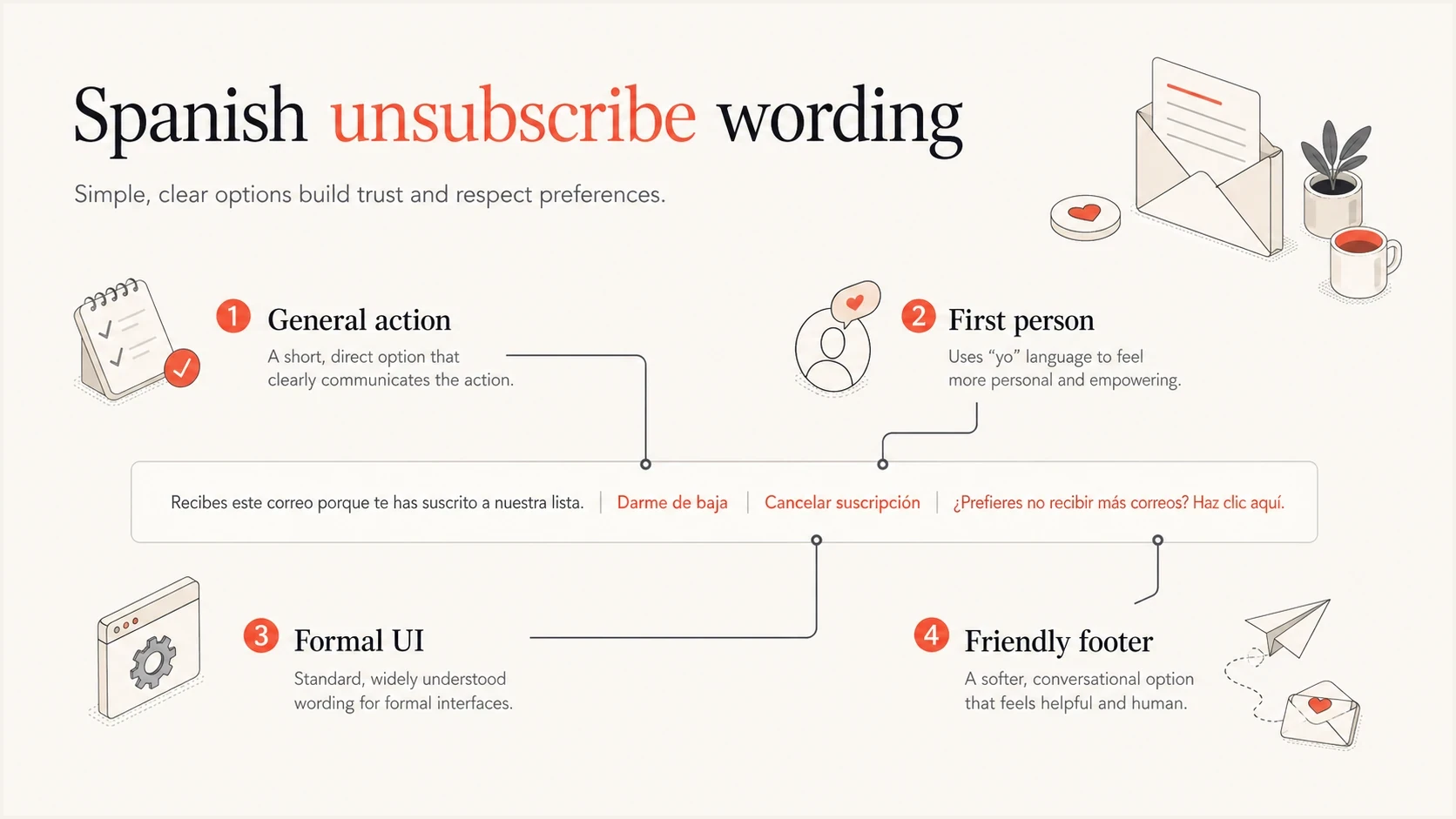
Comparison of darse de baja, darme de baja, and other Spanish unsubscribe wording.
Choosing the right phrase
Choose the Spanish phrase based on the sentence around the link, not only the English source word. Footer labels and action buttons need wording that matches their place in a full sentence.
Neutral footer copy
Use "Darse de baja" when the link sits with other footer text, including privacy and preference-center links.
- Best for: Standalone footer links and legal footer rows.
- Voice: Neutral and easy to scan.
First-person button copy
Use "Darme de baja" when the button completes a sentence like "I want to unsubscribe".
- Best for: Confirmation buttons and user-owned preference pages.
- Voice: Personal and action-oriented.
Avoid mixing grammatical forms in the same sentence. For example, "Puedes darme de baja" sounds off because the sentence speaks to the reader but uses first person inside the action. In that context, "Puedes darte de baja" is cleaner.
Spanish footer exampleshtml
<p>
  Actualiza tus preferencias o
  <a href="{{unsubscribe_url}}">date de baja</a>
  de nuestras comunicaciones.
</p>

<p>
  <a href="{{preferences_url}}">Actualizar preferencias</a>
  ·
  <a href="{{unsubscribe_url}}">Darse de baja</a>
</p>

<button>Darme de baja</button>
If the email uses formal address, keep the rest of the sentence formal too. "Puede darse de baja en cualquier momento" is a clean formal sentence. If the email uses an informal brand voice, "Puedes darte de baja en cualquier momento" reads naturally.
Do not confuse email opt-out with account cancellation
"Cancelar suscripción" can refer to an email list, but it can also sound like cancellation of a paid plan. That ambiguity matters when a customer receives marketing email from a company that also bills for a subscription. Name the communication being stopped so the link does not imply that it closes the account.
|
|
|
|---|---|---|
Leave one email list | Darse de baja de esta lista | List-specific opt-out |
Stop promotional email | Dejar de recibir correos promocionales | Email stops, account stays open |
Change email choices | Actualizar preferencias | Frequency or topic changes |
End a paid plan | Cancelar suscripción | Service or billing cancellation |
Spanish wording that makes the scope of cancellation clear.
State exactly what stops
For a mixed account and email program, copy such as "Darse de baja de estos correos" is safer than an unqualified "Cancelar suscripción". The confirmation page should repeat the same scope and explain whether essential service messages will continue.
Email compliance and placement
The visible Spanish wording matters, but it does not replace the technical unsubscribe mechanism. Keep the link easy to find, avoid hidden text, and make the landing page match the language of the email. If the reader clicked Spanish copy and lands on an English confirmation page, the experience feels unfinished and trust drops.
For mailbox support, the visible link should work alongside one-click unsubscribe headers where required. The footer still needs clear copy because many users scan the message body before using mail client controls. Good footer placement reduces complaints because the reader does not need to hunt for the opt-out path.
Senders exceeding 5,000 messages a day to Gmail accounts must support RFC 8058 one-click unsubscribe for marketing and subscribed messages. A link in the message body does not satisfy that technical requirement by itself. Process one-click requests within 48 hours, while keeping the visible Spanish body link easy to find.
Do not hide the unsubscribe action
Do not translate "unsubscribe" into a softer phrase that hides intent. "Gestionar comunicaciones" can be useful beside an unsubscribe link, but it should not be the only opt-out wording.
- Clear: "Darse de baja" tells the user exactly what the link does.
- Risky: "Gestionar" alone can look like a settings link, not an opt-out link.
- Better: Pair "Actualizar preferencias" with "Darse de baja" in the same footer.
Header exampletext
List-Unsubscribe: <mailto:unsubscribe@example.com>,
 <https://example.com/u/abc123>
List-Unsubscribe-Post: List-Unsubscribe=One-Click
After changing the footer language, send a real message and inspect the rendered footer, headers, and authentication results in an email tester. This catches template mistakes that are easy to miss in a preview, including broken unsubscribe URLs, missing headers, and language mismatches on the landing page.
Email tester
Send a real email to this address. Suped shows a results button when the test is ready.
?/43tests passed
Testing the whole send
Translation QA should sit beside the rest of email QA. A perfect Spanish phrase does not help if SPF fails, DKIM breaks after a template change, or the sending IP has a blocklist (blacklist) issue. Treat unsubscribe wording as part of the same pre-send checklist as authentication and reputation.
Suped's product fits this workflow by bringing DMARC monitoring, SPF and DKIM monitoring, authentication alerts, and blocklist monitoring into one dashboard. Teams managing many domains can use the multi-tenancy view to check localized sending sources and deliverability signals without separating the work by client.
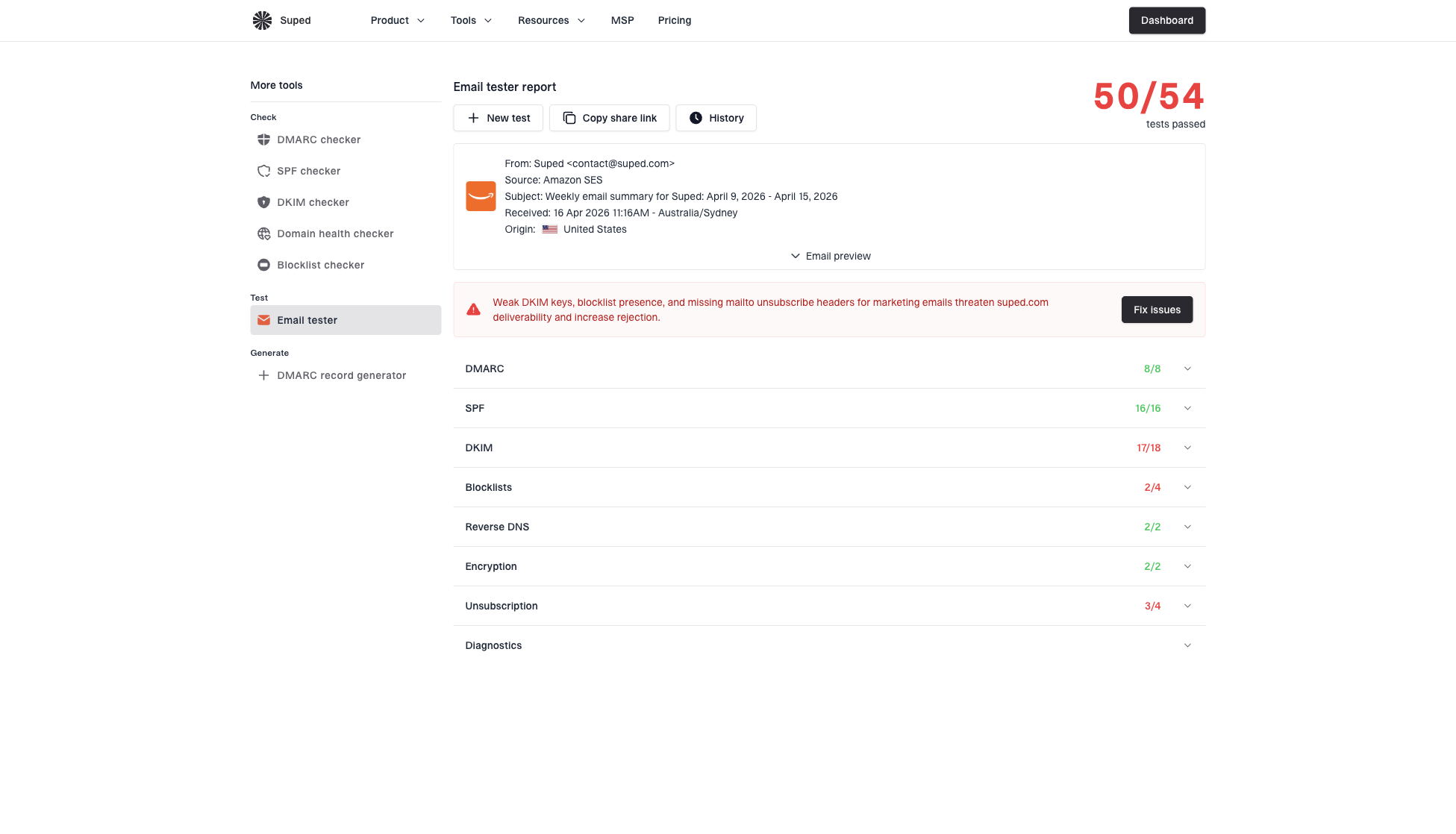
Email tester sample report showing total score, email preview, issue summary, and per-section results
A DMARC platform does not translate Spanish copy. Its role here is to catch authentication changes while localization work is released. Suped can flag failures and point the team to fix steps when a localized campaign adds a sending source or changes its landing-page domain.
- Language: Confirm the visible link says "Darse de baja" or the chosen approved variant.
- Destination: Click the link and confirm the Spanish confirmation page loads correctly.
- Headers: Check that one-click unsubscribe headers are present where required.
- Suppression: Verify the contact is removed or suppressed after the opt-out completes.
- Authentication: Confirm SPF, DKIM, and DMARC pass on the final rendered message.
- Reputation: Watch blocklist and blacklist signals after large localized sends.
Regional wording and tone
If the campaign targets Spain only, favor "Darse de baja". If the campaign targets a broader Spanish-speaking audience, "Cancelar suscripción" is often easier to understand across regions, though it sounds more formal. For a Latin American audience, run the phrase past a native reviewer for the target market because small tone differences can change how the footer feels.
"Desuscribirse" also appears in digital copy in parts of Latin America. Readers can understand it, but its usage varies by market, so it is less reliable as a universal label than "Darse de baja" or a clearly scoped "Cancelar suscripción".
|
|
|
|---|---|---|
Spain | Darse de baja | Natural |
Global Spanish | Cancelar suscripción | Formal |
Button CTA | Darme de baja | Personal |
Friendly footer | Date de baja | Informal |
Wording choices by audience and tone.
Do not over-optimize the word choice at the cost of clarity. The reader should understand the action in one glance. If the copy needs a full sentence to explain that it means unsubscribe, choose a clearer phrase.
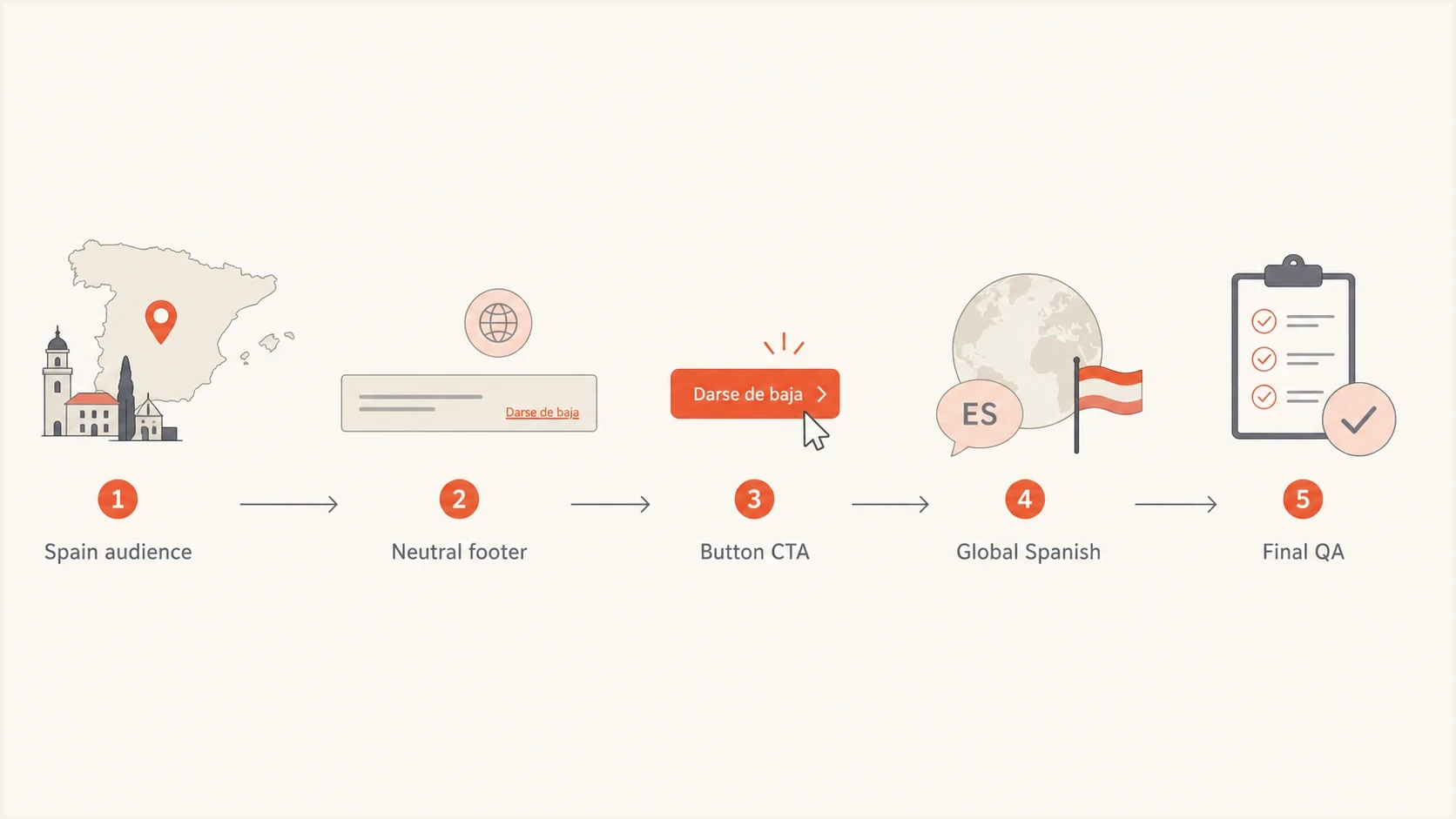
Flowchart for choosing darse de baja or darme de baja by audience and placement.
Views from the trenches
Best practices
Use "darse de baja" for neutral footer links when the sender targets Spain specifically.
Match the unsubscribe label to the surrounding sentence, not only the English source.
Place preference updates and the unsubscribe action close together in the email footer.
Common pitfalls
Do not translate only the button if the confirmation page stays in English after click.
Do not use clever wording that makes the opt-out action harder for readers to recognize.
Keep the visible body link separate from the RFC 8058 one-click header process itself.
Expert tips
Run a seed test after translation so footer, header, and landing page work together.
Use "darme de baja" when the button reads like the subscriber's own instruction.
Keep the Spanish page title and confirmation copy consistent with the email footer.
Marketer from Email Geeks says "Darme de baja" is a practical button label when the copy is written in first person.
2022-01-19 - Email Geeks
Expert from Email Geeks says "Darse de baja" appears more often in corpus checks, which supports it as the safer neutral phrase.
2022-01-19 - Email Geeks
Use the clearest Spain-friendly label
For Spain, the best answer is simple: use "Darse de baja" for the general unsubscribe action. Use "Darme de baja" when the button is written as the user's own action. Use "Cancelar suscripción" when a formal interface makes the email-only scope explicit.
The translation affects trust and complaint behavior. Pair the right Spanish wording with a working link, a matching confirmation page, proper one-click headers, and passing authentication.