What is SafeOpt and how does it work for email marketing?

Published 7 Aug 2025
Updated 8 Aug 2026
12 min read
Summarize with
Updated on 8 Aug 2026: We added current SafeOpt ownership, privacy, suppression, authentication, and legal review checks.
SafeOpt is an email retargeting network operated by AddShoppers for ecommerce offers. A shopper can sign up with SafeOpt, while SafeOpt's privacy policy also describes email addresses and activity collected through customer or partner sites, cookies, widgets, and other technologies. The network connects a usable email identity to browsing or cart activity, then sends an offer email on behalf of a participating brand. The message often presents the brand through SafeOpt-controlled sending infrastructure instead of the brand's normal marketing stream.
For marketers, SafeOpt is different from a normal abandoned-cart flow sent to a first-party subscriber. It is a separate recovery channel that relies on third-party identity matching and an offer network. Treat it as an acquisition or revenue-recovery test, not as a fix for weak inbox placement, poor list quality, or damaged sending reputation.
- SafeOpt is a third-party email offer network operated by AddShoppers for recognized shoppers.
- It uses signup data, partner-site activity, cookies, widgets, device data, and email identity signals.
- It can recover shoppers who left without completing a purchase or joining the brand's list.
- Recipients can feel the brand used data they did not knowingly give to that brand.
What SafeOpt is
SafeOpt positions itself to consumers as a way to receive personalized savings from participating brands. Its public site describes email signup, normal shopping, offer delivery, and preference controls. Its privacy policy says it collects email addresses through SafeOpt, customer and partner sites, widgets, cookies, and other technologies. It also describes device data, browsing activity, customer-provided addresses, and information obtained from outside sources. The channel therefore depends on identity resolution across a wider network, beyond a form submission on one merchant's site.
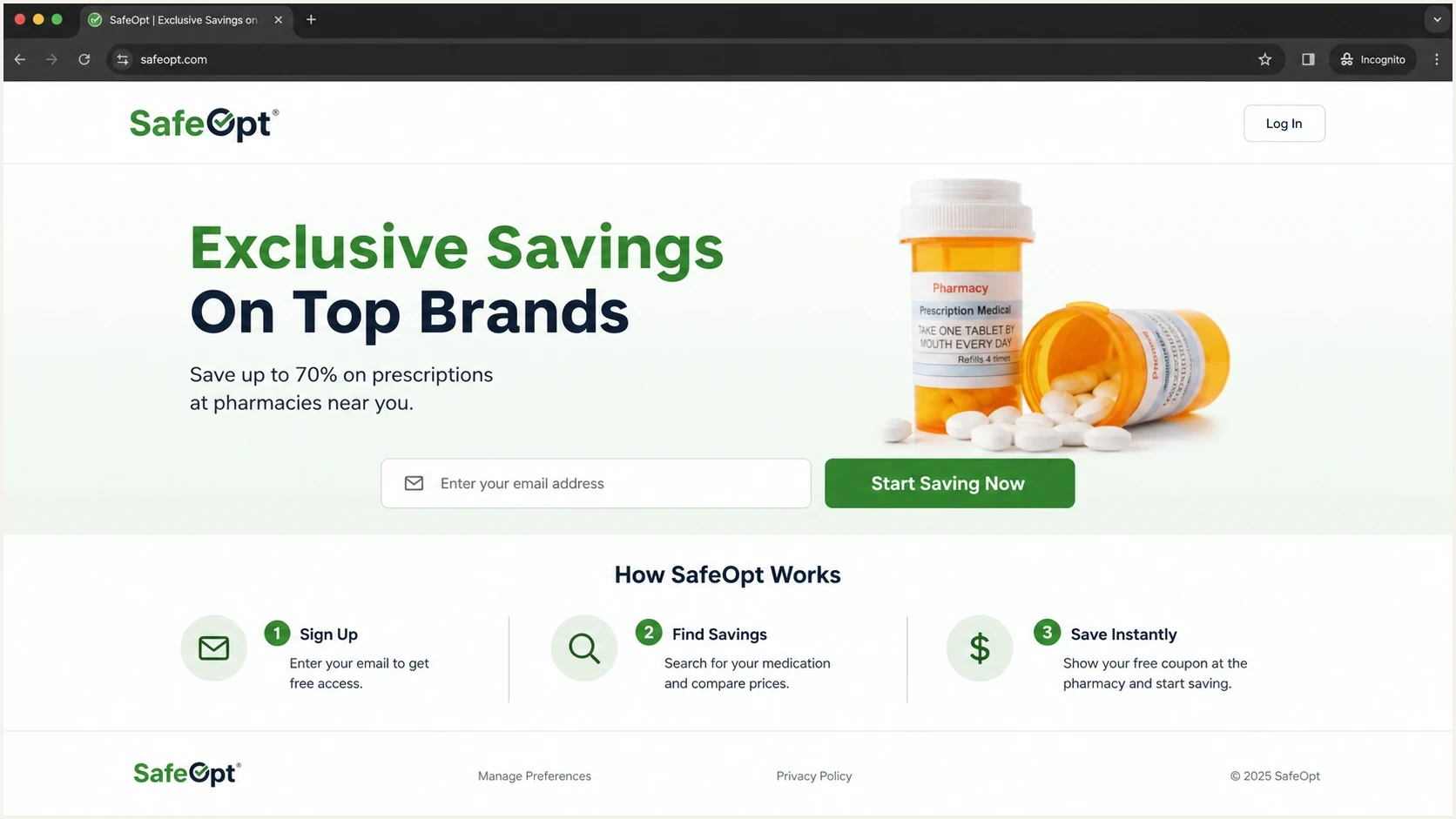
SafeOpt homepage showing email signup, offer steps, and privacy preference links.
SafeOpt is a legitimate service operated by AddShoppers, not a scam label for an unknown sender. That status does not settle whether a specific campaign meets privacy law, recipient expectations, or a brand's risk standard. A visitor can view a product, leave, and later receive a discount without completing the brand's own email capture step. The recipient then sees a familiar brand through a SafeOpt-related sender path. That identity mismatch needs inspection before launch.
|
|
|---|---|
Operator | AddShoppers |
Model | Email retargeting network |
Infrastructure | SafeOpt-controlled sending |
Audience | Recognized shoppers |
Use case | Browse or cart recovery |
Risk | Trust and consent friction |
SafeOpt basics for marketers
How SafeOpt emails move
The mechanics are easier to understand when the identity match, event trigger, campaign rule, and message delivery are reviewed separately. The review should establish who the visitor is, which browsing event created the offer, what campaign rule allowed the message, and which domain and reputation stream delivered it.
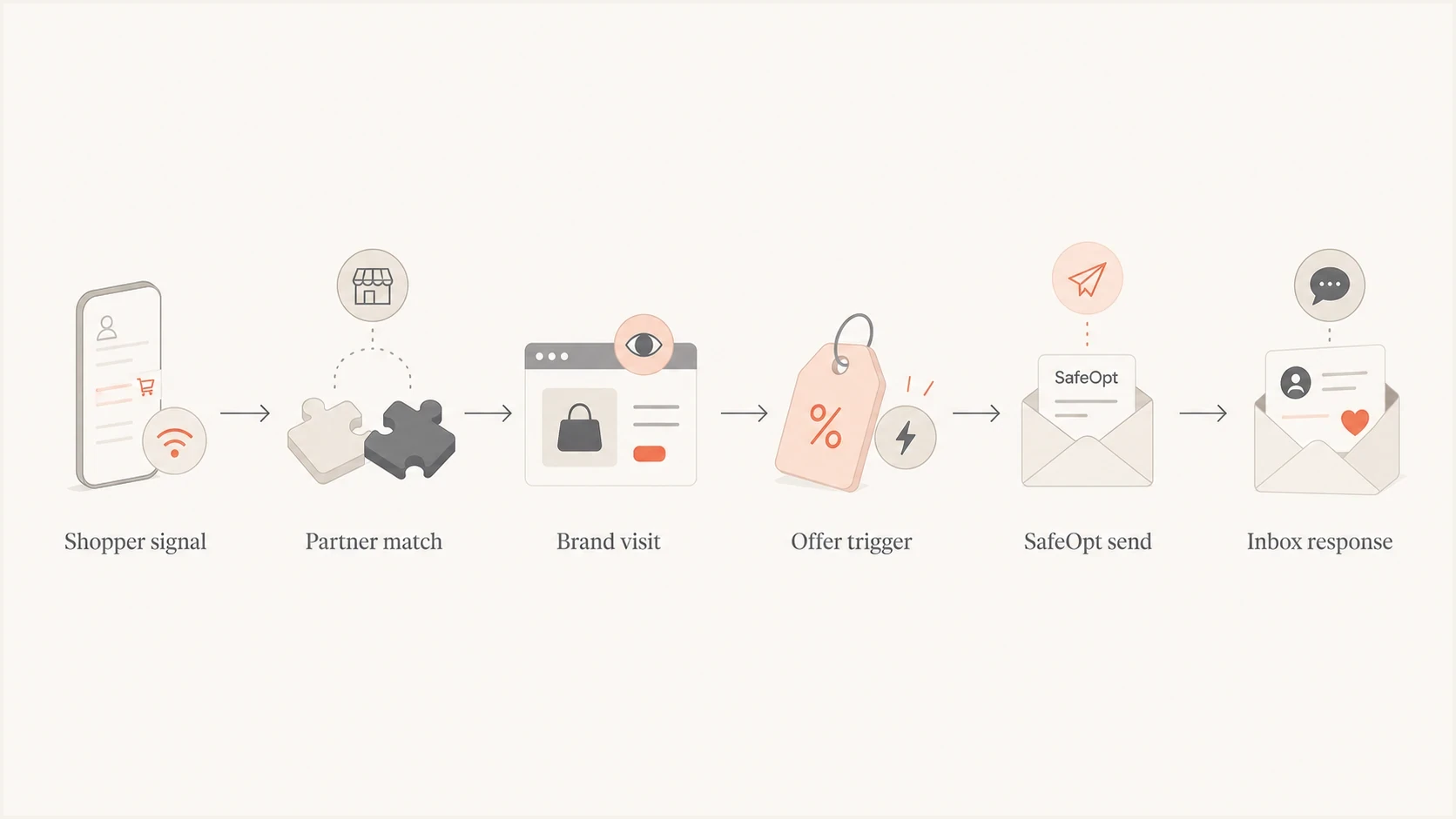
SafeOpt email retargeting flow from shopper signal to inbox response.
- SafeOpt recognizes an email identity connected through signup, a partner, customer-provided data, or prior activity.
- The shopper visits a participating brand site, views products, starts checkout, or abandons a cart.
- The network links that activity to a usable email identity and applies the brand's campaign rules.
- SafeOpt sends the offer, often with the brand in the display name and a SafeOpt-controlled sender path.
- Inbox placement, engagement, opt-outs, complaints, and support contacts determine whether the test is healthy.
Illustrative header layout, not a live SafeOpt capturetext
From: Brand Name via SafeOpt <offer@[sending domain]>
Subject: Your cart offer
Return-Path: <bounce@[sending domain]>
DKIM-Signature: v=1; d=[signing domain]; s=[selector]
Authentication-Results: dmarc=pass header.from=[visible From domain]
List-Unsubscribe: <[HTTPS unsubscribe endpoint]>
List-Unsubscribe-Post: List-Unsubscribe=One-Click
Actual SafeOpt headers vary, so inspect a production-like sample instead of assuming the template above matches the live setup. Third-party infrastructure is common in legitimate email. The issue is whether the recipient expected the brand relationship, whether the sender identity is clear, whether the unsubscribe works, and whether the brand can measure harm when the audience dislikes the experience.
Where the risk sits
SafeOpt can create incremental revenue, especially for high-traffic ecommerce sites with clear discount economics. That gain sits beside privacy and consent risk, plus brand trust and deliverability concerns. Each issue needs its own control and stop condition.
Why brands consider it
- SafeOpt can reach shoppers who did not enter an address on the brand site.
- The offer can arrive soon after product browsing or cart abandonment.
- A controlled discount can recover margin that the brand already expected to lose.
- The send stream can remain separate from the brand's regular promotional program.
Why teams test it carefully
- A recipient can recognize the brand but not the route that produced the email.
- A small complaint lift can cancel out the value of a high-converting campaign.
- Opt-outs and customer exclusions need to move cleanly between systems.
- Recovered revenue needs incrementality proof instead of last-click credit alone.
The strongest argument for SafeOpt is engagement. If the offer is relevant and wanted, some recipients treat it as useful even when the path into the inbox is unusual. The strongest argument against it is the same path. If the recipient thinks the brand obtained or used the address in a surprising way, the brand takes the trust hit alongside SafeOpt.
SafeOpt test gates
Use these gates before scaling an email recovery test.
Pass
No complaint lift
Revenue is incremental and complaints do not rise against the control group.
Review
Clear friction
Revenue is positive, but unsubscribes, support tickets, spam reports, or preference requests increase.
Stop
Reputation harm
Mailbox placement, customer sentiment, complaint rates, or provider warnings move in the wrong direction.
Compare the test with the brand's normal spam-rate and complaint baseline. A recovery channel that wins revenue but worsens the inbox experience for future campaigns is not a clean win.
Consent and suppression checks
Legality and deliverability are different questions. A campaign can meet commercial email rules and still create complaint pressure because people dislike how it feels. Before using a networked retargeting channel, require written answers for how consent is collected, how brand-level opt-outs are honored, how global opt-outs are synced, and how quickly suppression updates take effect.
Do not use SafeOpt to hide a deliverability problem
If normal brand emails are going to spam, a third-party recovery channel does not fix the cause. It only moves a slice of traffic onto another sending system. Repair list quality, authentication, complaint sources, and content problems first, then decide whether an outside recovery channel has a role.
- Document where the email address came from and what the shopper agreed to receive.
- Suppress existing unsubscribers, complainers, purchasers, wholesale accounts, and VIP segments when needed.
- Confirm whether the plan uses manual uploads, an integration, SFTP, or an API, then measure the actual propagation delay.
- Make the brand relationship, SafeOpt role, offer terms, and unsubscribe path obvious.
- Review spam reports, support tickets, preference requests, and public complaints during the test window.
SafeOpt's public help content describes manual suppression uploads and automated options, with suppression refreshes running nightly. Confirm the current plan, contract, cutoff time, and failure handling before launch instead of assuming a real-time sync. Also check for channel conflict. A customer already on the brand list can receive the same or a better offer through SafeOpt, which can train people to wait for recovery discounts and reduce margin.
Legal and privacy review
SafeOpt's legitimacy does not produce one legal answer for every campaign. The result depends on where recipients live, how the identity was obtained, what the shopper was told, which party controls the purpose of processing, and what the brand contract requires. Have privacy counsel review the actual data flow and message, not only SafeOpt's public positioning.
- For US commercial email, check accurate headers, nondeceptive subjects, ad disclosure, postal address, opt-out operation, and timely suppression. Under CAN-SPAM, hiring a vendor does not remove the promoted brand's responsibility.
- In consent-based jurisdictions, ask whether permission is specific enough for the promoted brand and whether cookies, pixels, identity matching, and direct marketing have the required legal basis.
- For California privacy, determine whether the deployment involves a sale, sharing for cross-context behavioral advertising, or covered data-broker activity. Test applicable deletion requests, opt-out requests, and Global Privacy Control signals.
- In the contract, document party roles, permitted data use, retention, deletion, subprocessors, incident notice, audit rights, and responsibility for consumer requests.
Since August 1, 2026, registered data brokers covered by California's Delete Act must begin processing consumer requests submitted through DROP. Confirm whether any party in the planned data flow is registered or covered, then verify how a request reaches identity records, campaign eligibility, suppression data, and downstream systems. This check does not prove that every SafeOpt deployment falls within DROP.
Treat the contract as evidence, not the conclusion
A vendor warranty or privacy notice does not replace a brand-side assessment. Keep the signup language, cookie notice, data map, suppression test, sample message, and approval record together so the decision can be audited later.
Deliverability and authentication impact
SafeOpt sending from a SafeOpt-controlled domain can separate the technical sender reputation from the brand's primary domain, but it does not separate the recipient's memory of the brand. If recipients mark the email as unwanted, complain to support, or stop trusting offers, the brand feels the result even when the SPF, DKIM, and DMARC pass belongs to another domain.
Check the Authentication-Results header and the organizational domain in the visible From address. An SPF, DKIM, or DMARC pass authenticates the domain evaluated by the receiver. It does not prove that the shopper consented, that the promoted brand owns that domain, or that the message is wanted. Also ask whether traffic shares IP addresses or signing domains, how complaints are attributed, and whether provider-level delivery data is available to the brand.
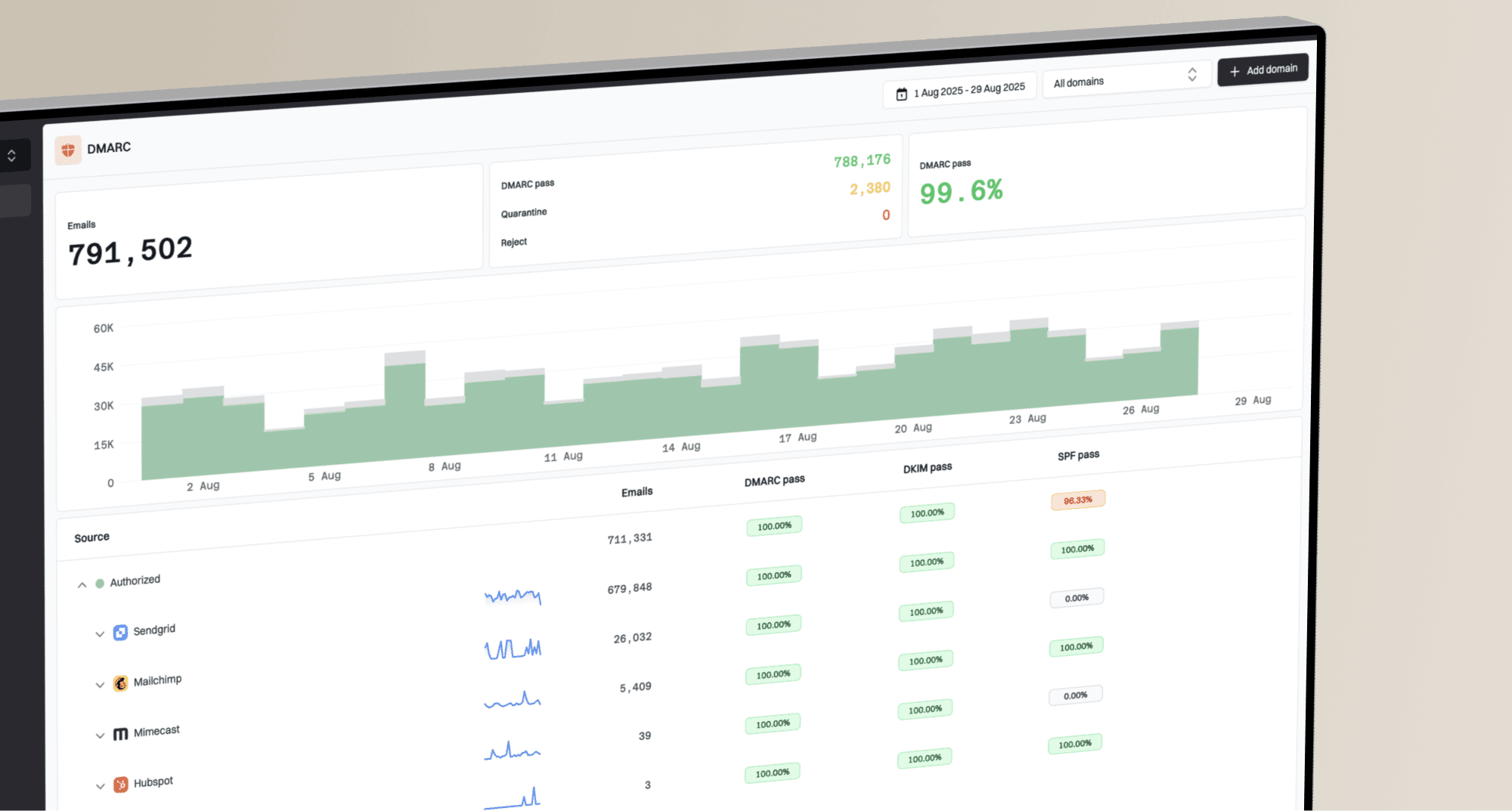
Suped's product has a practical role around the brand's owned mail. Its DMARC monitoring workflow shows which services send for owned domains, where SPF or DKIM alignment fails, and when an enforcement policy is ready. Suped also provides hosted SPF, hosted MTA-STS, alerts, and blocklist monitoring for IP and domain blacklist signals. These checks protect the owned program and help separate an authentication change there from recipient-response problems in the SafeOpt test.
Suped DMARC dashboard showing email volume, authentication health, and source breakdown
Before approving an outside recovery send, run the brand domain through a domain health checker and fix obvious authentication gaps. Then send a production-like message through an email tester to inspect headers, authentication results, content signals, link behavior, unsubscribe fields, and mailbox placement clues.
Email tester
Send a real email to this address. Suped shows a results button when the test is ready.
?/43tests passed
The key test goes beyond whether the SafeOpt message authenticates. The brand needs proof that its owned program stays clean while the recovery channel runs. If owned-mail complaints rise at the same time, pause the test and isolate the cause before scaling.
How to evaluate SafeOpt
Evaluate SafeOpt with the same discipline used for any channel that touches identity and inbox reputation. Start small, write down the stop conditions, and compare against a holdout group. The test should answer whether SafeOpt created incremental profit without raising complaints, confusing customers, weakening the owned email program, or creating privacy exceptions.
|
|
|---|---|
Consent | Documented source and scope |
Suppression | Tested before send |
Incrementality | Holdout lift |
Complaints | No material lift |
Brand trust | No ticket spike |
Privacy | Approved data flow |
SafeOpt evaluation checklist
- Limit the first test by product category, geography, visitor segment, and campaign window.
- Hold back a comparable audience so revenue lift is measured against a fair baseline.
- Pass unsubscribes, customer exclusions, and complainers into the vendor process before launch, then seed records to verify removal.
- Review headers, links, unsubscribe handling, copy, display name, offer terms, and authentication alignment.
- Compare profit with spam complaints, support contacts, opt-outs, repeat purchase behavior, and margin leakage.
A practical pass standard
A SafeOpt test passes only when it creates measurable incremental profit, has a proven suppression process, does not lift complaints, and does not create customer confusion. If the only win is last-click revenue, keep testing before scaling.
Views from the trenches
Best practices
Run a holdout test before scaling, so recovered revenue is measured against real lift.
Sync unsubscribes and customer exclusions before launch, then audit the match logs.
Review the visible from name, domain, and offer copy exactly as recipients will see them.
Common pitfalls
Treating third-party recovery mail as a deliverability fix hides the real inbox issue.
Ignoring recipient surprise creates complaints even when the offer itself has value.
Giving last-click revenue full credit overstates performance and misses margin leakage.
Expert tips
Inspect identity flow, suppression flow, and sender domain flow as separate systems.
Pause tests when support tickets mention data use, even when metrics still look fine.
Keep discount logic consistent so loyal customers are not trained to abandon carts.
Marketer from Email Geeks says SafeOpt emails can surprise long-time subscribers when the brand name appears with a SafeOpt sending domain.
2023-11-08 - Email Geeks
Expert from Email Geeks says the model depends on partner tracking and identity matching across participating sites before an offer email is sent.
2023-11-08 - Email Geeks
The practical answer
SafeOpt is a legitimate email retargeting channel operated by AddShoppers. It works by combining shopper identity, partner-site activity, offer rules, and SafeOpt-controlled sending. It can drive recovered revenue for ecommerce brands, but it is not a substitute for healthy first-party acquisition, clear consent, or strong authentication.
The best use case is a controlled ecommerce test with clear opt-out handling, tested suppression syncing, honest attribution, privacy approval, and a stop rule tied to complaints and customer trust. The weakest use case is a brand using SafeOpt because its own emails have started going to spam. In that situation, fix the owned program first.
For the DMARC and authentication side of that work, Suped's product fits the brand's owned-domain workflow. It gives the team visibility into legitimate and failing sources, SPF and DKIM alignment, policy readiness, hosted SPF, hosted DMARC, hosted MTA-STS, blocklist and blacklist signals, and practical fix steps before adding a higher-risk recovery channel.