What is DuckDuckGo's email privacy action and how does it affect email marketing?


Updated on 24 Jul 2026: We updated this guide for DuckDuckGo link tracking changes and the current DMARC standards.
DuckDuckGo's email privacy action is DuckDuckGo Email Protection, a free email forwarding service that gives people a duck.com address, creates unlimited unique private aliases, removes hidden trackers, and forwards the cleaned message to their existing inbox. For email marketing, some subscribers become harder to identify, opens become less dependable, link tracking can lose signal, and forwarded messages can expose edge cases in SPF, DKIM, and DMARC handling.
Treat DuckDuckGo Email Protection as a privacy relay, not as a mailbox provider in the usual sense. The subscriber still reads the message in Gmail, Outlook, Apple Mail, or another inbox. DuckDuckGo sits between the sender and that inbox, removes recognized trackers, and then forwards the message onward.
- Main change: Marketers lose some individual-level tracking signal, especially around pixel-based opens, tracked links, and alias identity.
- Deliverability effect: DuckDuckGo does not automatically send legitimate mail to spam, but forwarding and message rewriting can change authentication results downstream.
- Practical response: Use verified destination activity, replies, conversions, unsubscribes, complaints, and domain health instead of treating opens or tracked clicks as clean intent signals.
- Suppression rule: Do not suppress duck.com addresses only because they use a privacy relay. Suppress when consent, engagement, complaints, or bounces justify it.
How DuckDuckGo Email Protection works
DuckDuckGo gives a user a personal Duck Address and lets the user create unlimited private Duck Addresses for individual websites or signups. Mail sent to those addresses reaches DuckDuckGo first. DuckDuckGo removes multiple types of hidden trackers, then forwards the message to the user's chosen inbox. DuckDuckGo states that it does not save the message or its headers as part of this process.
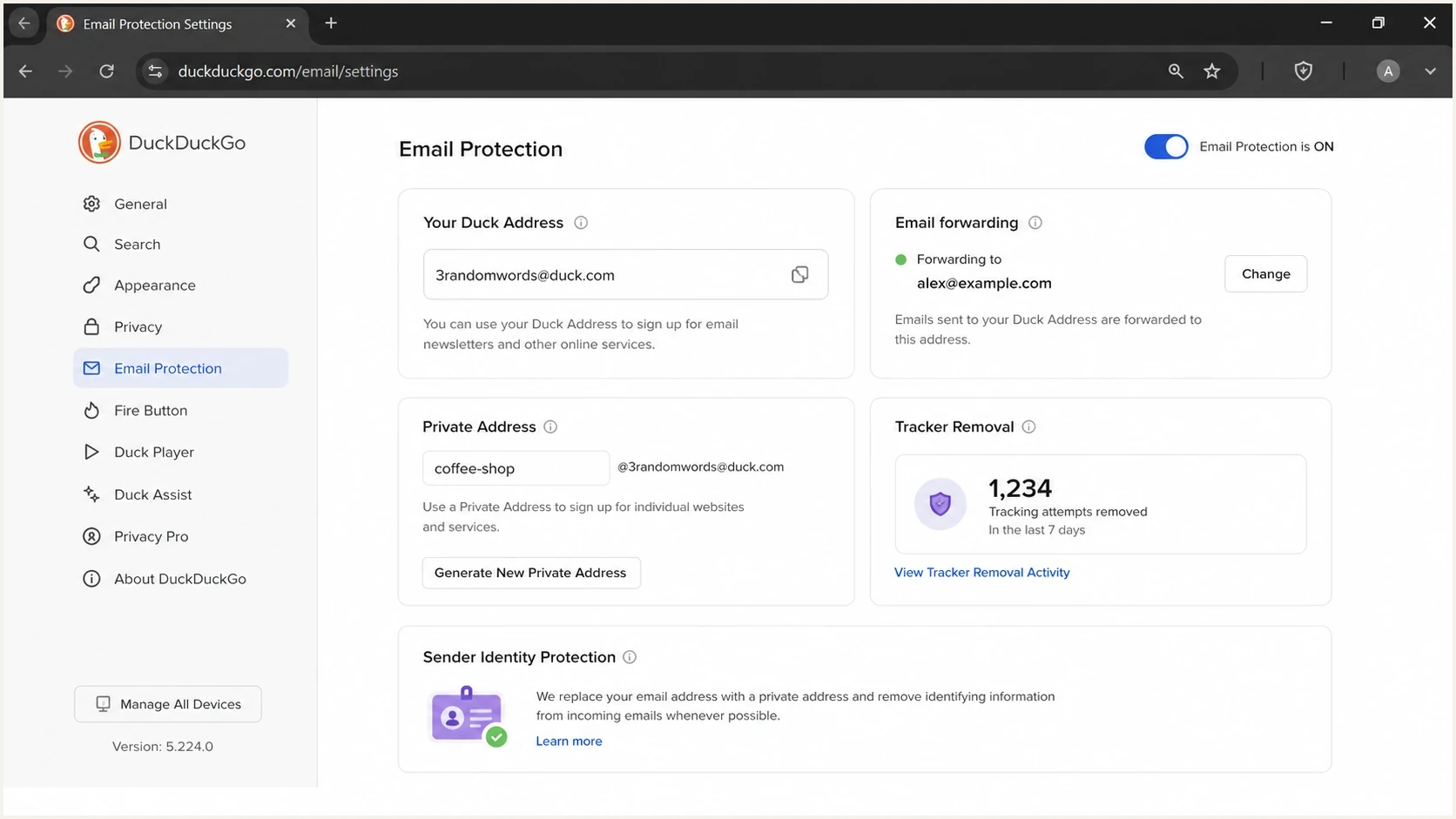
DuckDuckGo Email Protection screen with Duck Address and forwarding settings.
The privacy value for the user is that the sender sees a duck.com address instead of the user's long-term personal address, and recognized tracking code is removed before the message reaches the final inbox. The marketing cost is less reliable identity and event data. A single person can create different private aliases for different brands, so normal email-based identity stitching becomes weaker.
|
|
|
|---|---|---|
Duck address | Mail goes to duck.com first | Subscriber identity is less direct |
Private alias | Unique address per signup | Cross-brand matching weakens |
Tracker removal | Hidden pixels can be stripped | Opens lose precision |
Link protection | Known link trackers can be removed | Click attribution can lose signal |
Forwarding | Message is sent onward | Authentication can look different |
Sender warning | DMARC is used to check sender identity | A domain mismatch can trigger a warning |
DuckDuckGo Email Protection functions and marketing effects.
How forwarding changes SPF, DKIM, and DMARC
The authentication issue is the most technical part. When a sender delivers directly to a mailbox provider, that provider checks SPF, DKIM, and DMARC against the original sending path. When DuckDuckGo forwards the same message, the final inbox sees a different hop. SPF for the original envelope domain often fails at the final inbox because the DuckDuckGo forwarding server is not authorized in that domain's SPF record.
DKIM is different. A DKIM signature survives forwarding when the signed headers and body stay intact. It breaks when the forwarding system changes signed content. Tracker removal can modify HTML, remove image tags, or rewrite links. If those edits change body bytes covered by the signature, the calculated body hash no longer matches the signed hash.
DMARC passes when at least one valid SPF or DKIM result uses an authenticated domain that matches the visible From domain. ARC adds another wrinkle. A forwarder can seal the authentication result it saw at the first hop, and the final inbox can decide whether to trust that sealed result. ARC does not repair a broken DKIM signature. It gives the receiver context about what happened before forwarding. Keep original authentication clean because a receiver can evaluate an indirect path more confidently when the first hop authenticated correctly.
Direct delivery
- SPF path: The receiver checks whether the connecting IP is authorized for the envelope Mail From domain.
- DKIM body: The signed message body usually arrives unchanged.
- DMARC result: A passing SPF or DKIM result whose domain matches the visible From domain can satisfy DMARC.
Forwarded delivery
- SPF path: The receiver sees the forwarder's sending server, so the original SPF result usually does not survive.
- DKIM body: Tracker stripping can change body bytes covered by the signature.
- DMARC result: The final result depends on whether a matching-domain authentication signal survives.
Simplified forwarding pathtext
Sender platform -> DuckDuckGo Email Protection -> final inbox

First hop:
SPF: pass if sending IP is authorized
DKIM: pass if signature is valid
DMARC: pass if SPF or DKIM passes with a matching domain

Forwarded hop:
SPF: often fails because the forwarder sends onward
DKIM: passes only if signed content stays unchanged
DMARC: passes only if a matching-domain authentication signal survives
Do not misread forwarded failures
A downstream SPF or DKIM failure after forwarding does not prove that the original sender authenticated badly. It can show that forwarding changed the path or message body. Check whether the first delivery to DuckDuckGo authenticated cleanly, whether a matching-domain DKIM signature survived, and what the final inbox recorded about the indirect path.
What changes for email marketing metrics
DuckDuckGo's biggest marketing effect is measurement loss, not outright deliverability loss. If a tracker pixel is stripped before the message reaches the inbox, the open event never fires. If a known link tracker is removed, the visible destination can still work while the campaign platform loses part of its click attribution. If an alias hides the user's real address, identity matching, customer support lookup, and cross-channel attribution become less complete.
This sits in the same broad privacy trend as Apple MPP, but it is not the same mechanism. Apple MPP often creates machine opens by preloading images. DuckDuckGo Email Protection is closer to stripping or weakening tracking pixels and recognized link trackers before the user receives the message.
How much to trust open rates
Use opens as a directional signal after privacy relays, not as a direct measure of individual intent.
High trust
Lab only
Small test lists with controlled clients and no privacy relay.
Medium trust
Trend
Campaign-level trend comparisons using a consistent audience mix.
Low trust
User
Individual user scoring based only on opens.
Better signal
Action
Verified clicks, replies, purchases, form submits, and preference changes.
Segmentation also changes. Where identity matters, ask the subscriber to log in, use a preference center, or confirm key changes with a normal verification flow. Do not depend on a hidden open pixel to infer that a private alias belongs to the same person as another address. Privacy aliases are designed to separate contexts, so lifecycle marketing should honor that boundary.
A useful operational test is to send the same message to a normal mailbox, a Duck Address, and several consumer inboxes, then compare the source, authentication, images, links, and final headers. Suped's email tester supports that workflow with a report for a real delivered message, which helps separate relay changes from campaign dashboard assumptions.
Email tester
Send a real email to this address. Suped shows a results button when the test is ready.
?/43tests passed
Stop using opens as the sole trigger for sensitive automations such as subscriber sunsetting, sales outreach, or lead scoring. Keep opens for broad trend checks, treat tracked clicks as a signal that needs relay testing, and put more weight on verified user actions. That gives privacy-conscious subscribers a fairer experience and gives the marketing team cleaner evidence.
How open and click tracking differ
Open and click tracking fail in different ways. A tracking pixel depends on an invisible image request, so removing the image prevents the open event. A tracked link often sends the reader through a redirect before the destination page. DuckDuckGo can remove recognized tracking from links, so the destination can remain usable while the marketer records fewer attributable clicks.
|
|
|
|---|---|---|
Pixel open | Can disappear when the tracker is removed | Use only for campaign-level trends |
Tracked redirect | Can lose attribution when link tracking is removed | Compare with destination analytics |
Reply | Remains an explicit user action | Use as a high-intent signal |
Conversion | Can be measured on the site or in an account | Use as a business outcome |
Unsubscribe or complaint | Remains a clear negative signal | Honor it immediately |
How DuckDuckGo Email Protection changes common marketing signals.
Click-to-open rate becomes especially difficult to compare because both parts of the calculation can change. Compare campaigns with the same audience and relay mix, then use conversions per delivered message, authenticated account activity, and replies for decisions that affect an individual subscriber.
What marketers should change
The practical response is to accept the relay. Treat privacy aliases as valid addresses, reduce dependence on open and link tracking, and keep authentication strong enough that forwarding edge cases do not hide real sender problems.
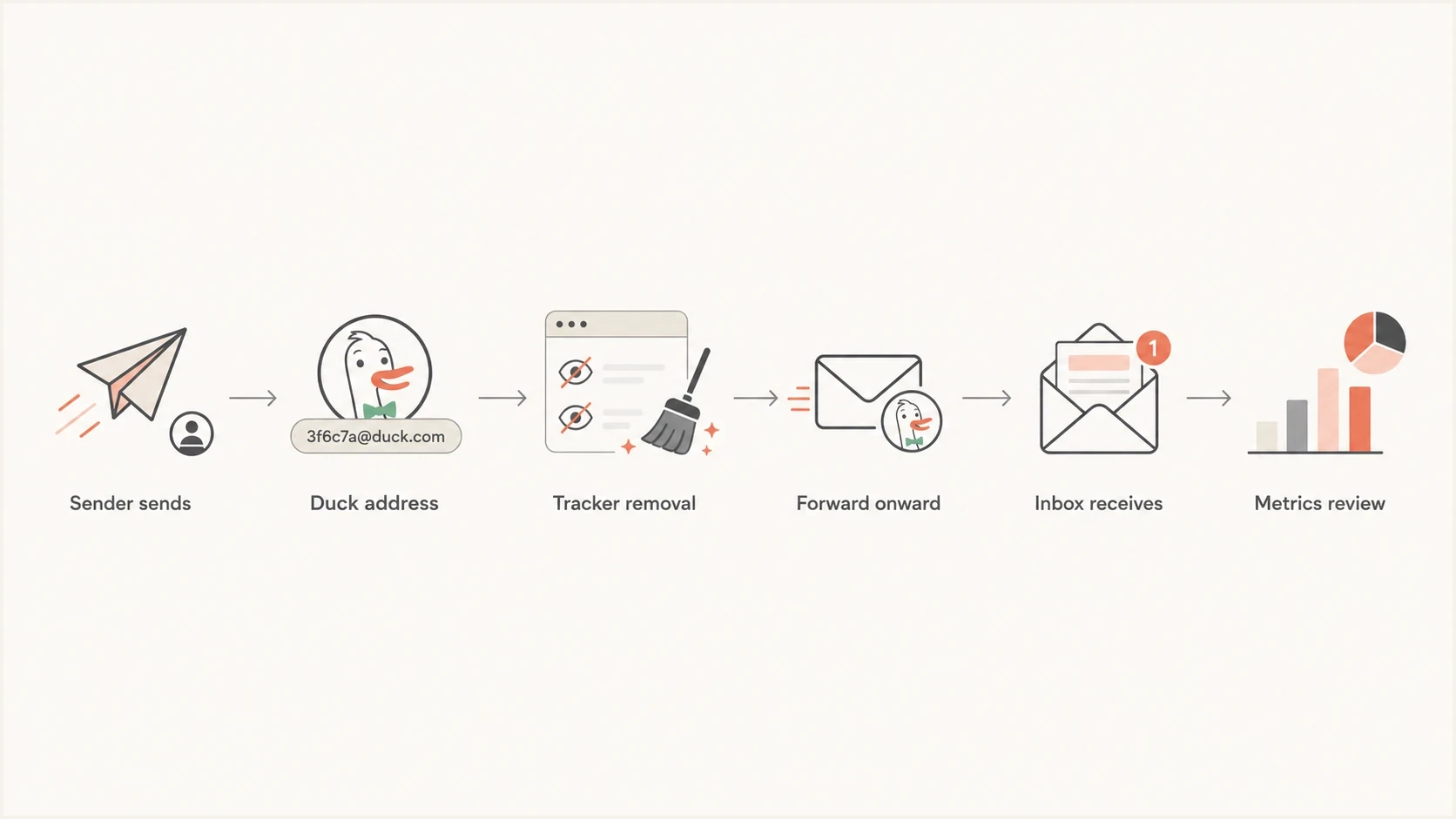
Flowchart showing sender, Duck address, tracker removal, forwarding, inbox, and metrics review.
- Keep aliases: Do not reject duck.com addresses at signup. They are consented addresses when the user provides them.
- Change scoring: Reduce the weight of opens and tracked clicks in engagement models, then increase the weight of replies, purchases, verified site activity, and preference center changes.
- Test rendering: Send seed messages through DuckDuckGo and inspect the delivered HTML, images, links, and authentication headers.
- Watch authentication: Track SPF, DKIM, and DMARC outcomes by source so forwarding noise does not mask real domain problems.
- Handle deactivated aliases: Suppress a private Duck Address after a confirmed hard bounce, but do not block the whole duck.com domain because one alias was deactivated.
- Avoid fragile logic: Do not use a single missing open or tracked click as proof that a subscriber is inactive.
Current DMARC record for aggregate reportingdns
_dmarc.example.com. 3600 IN TXT "v=DMARC1; p=none; rua=mailto:dmarc@example.com"
A p=none DMARC policy lets you collect aggregate reports before enforcement. RFC 9989 now defines the core DMARC protocol, RFC 9990 defines aggregate reporting, and RFC 9991 defines failure reporting. The pct tag is historic, so do not use pct for a partial rollout. After validating every legitimate source, test p=quarantine or p=reject with t=y, then remove t=y only when matching-domain SPF or DKIM passes consistently.
What to monitor in Suped
Suped's product is relevant here because the problem crosses marketing measurement and email authentication. A campaign platform can show that tracked opens or clicks dropped. Suped can show whether DMARC, SPF, DKIM, sender sources, or domain health changed at the same time.
Suped turns aggregate DMARC reports into grouped sending sources, authentication issues, and fix steps. That workflow helps distinguish a known sender with a domain-match problem from a privacy relay or other indirect mail path that appears in downstream reports.
Start with Suped's domain health checker, then use Suped's DMARC monitoring to separate verified senders, unverified sources, and domain-match failures. Compare those results with Duck Address seed tests so a drop in marketing events is not mistaken for a domain-wide delivery problem.
?
What's your domain score?
Deep-scan SPF, DKIM & DMARC records for email deliverability and security issues.
Issues page showing top issues, verified sources, unverified sources, and authentication pass rates
A practical Suped workflow
- Start broad: Run a domain health check so DNS and authentication errors are visible before campaign testing.
- Verify senders: Confirm every platform sending for the brand has SPF or DKIM with a domain that matches the visible From domain.
- Use reports: Review aggregate DMARC data to find new sources, indirect paths, and genuine authentication failures.
- Stage policy: Move DMARC enforcement only after legitimate sources pass consistently, without relying on the historic pct tag.
Views from the trenches
Best practices
Test privacy relays with real seed accounts before changing campaign scoring logic.
Separate first-hop authentication from forwarded-hop failures in DMARC review work.
Treat duck.com aliases as valid consented addresses unless bounces or complaints say otherwise.
Common pitfalls
Assuming tracker removal and Apple MPP create the same metric distortion is risky.
Blaming every DKIM failure on the sender hides forwarding and message rewriting effects.
Blocking privacy aliases at signup reduces trust and removes subscribers who chose privacy.
Expert tips
Use click and reply behavior to qualify interest when open data has privacy relay noise.
Keep DKIM signing simple so normal forwarding has fewer signed parts to invalidate.
Review DMARC source data weekly after privacy relay adoption changes list composition.
Marketer from Email Geeks says DuckDuckGo forwarding is not the same as Apple Mail privacy behavior, so marketers should test it as a separate path.
2021-07-26 - Email Geeks
Marketer from Email Geeks says DKIM can break when privacy filtering changes signed content before the message reaches the final inbox.
2021-07-26 - Email Geeks
The practical takeaway
DuckDuckGo Email Protection does not end email marketing. It makes weak measurement weaker. It also reminds senders that authentication needs to be clean before a privacy relay or forwarder enters the path.
Accept privacy addresses, reduce dependence on open and tracked-click rates, test real messages through the relay, and monitor authentication with enough detail to separate sender mistakes from forwarding effects. Suped's product supports that work by grouping DMARC report sources and surfacing SPF, DKIM, and domain-match issues alongside domain health.