What email list verification vendor should an embedded marketing platform use?

Updated on 8 Sep 2026: We added current vendor evaluation criteria, privacy checks, catch-all handling, and practical first-send stop rules for stale SMB lists.
Kickbox, ZeroBounce, AtData, Emailable, and Bouncer belong in the bake-off for an embedded marketing platform. Test Kickbox first for a balanced API and batch workflow. ZeroBounce is worth benchmarking for its granular status model and regional API options, but its risk scoring needs careful mapping. AtData fits when real-time capture quality and email intelligence matter as much as batch cleaning. Emailable fits when the first product need is straightforward verification with batch jobs and webhooks. Bouncer adds an EU-hosted candidate with explicit status and reason fields.
Do not ship list verification as the only control. For small businesses sending their first campaign to a stale customer list, the product needs four layers: verification before import, suppression before send, bounce classification after send, and sender-health monitoring over time. A verifier can reduce obvious dead addresses, but your platform still owns the decision about who is allowed to send, how quickly they can send, and what happens after the first bounce.
A 20-30% first-send bounce rate is not just a vendor selection problem. It usually means the source list has old addresses, offline signup errors, role accounts, disposable domains, duplicates, or imported contacts with weak consent. Verification helps, but the product design around it decides whether the sender becomes healthier or simply pays to remove the most obvious bad records once.
Best vendor shortlist
For an embedded platform, focus less on the marketing site claim and more on how the vendor behaves inside a multi-tenant product. The verifier needs bulk jobs, real-time checks, predictable categories, webhooks or polling, stable pricing at customer scale, and clear rules for personal data handling. Most importantly, it needs to let you tune risk decisions instead of forcing one universal answer for every vertical. During procurement, confirm rate limits, timeout behavior, service commitments, regional processing, retention and deletion controls, subprocessors, and incident notification terms.
|
|
|
|---|---|---|
Kickbox | Balanced API and batch verification for SaaS workflows. | Needs testing against your customer mix before enforcement. |
ZeroBounce | Granular statuses and a regional API option for data processing. | Risk labels need careful mapping and testing against your lists. |
AtData | Strong when point-of-capture validation matters. | Confirm batch flow, monitoring, and pricing fit. |
Emailable | Simple API with batch jobs, webhooks, and test keys. | Less useful if you need deep lifecycle controls. |
Bouncer | Real-time and batch verification with detailed reason fields. | Test real-time and batch modes separately because their unknown rates can differ. |
Shortlist for an embedded marketing platform, assuming multi-tenant usage.
Product decision
Pick two vendors for a paid pilot instead of choosing from a sales demo. Use your own historical lists, your own bounced addresses, and known-good customer addresses. The false positive rate matters as much as the bounce reduction rate because your customers will escalate when a real customer address gets blocked.
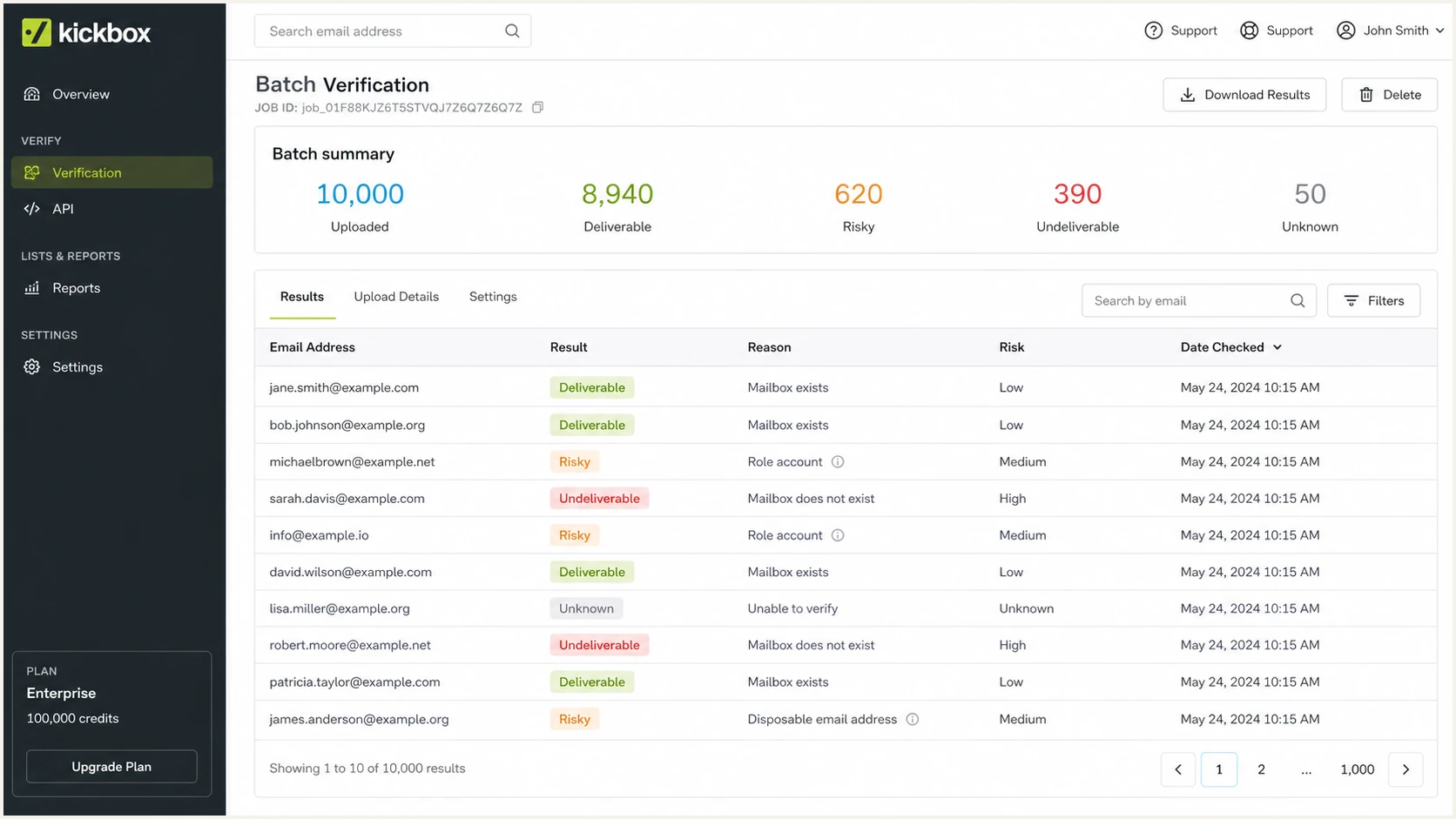
Kickbox batch verification dashboard with deliverable, risky, and undeliverable results.
What matters for embedded SaaS
The hard part is not asking an API whether an address looks deliverable. The hard part is turning a vendor response into a safe, explainable product rule for a pet boarding facility, insurance agency, moving company, clinic, or franchise operator. These users often have legitimate customer relationships, but their lists are old, manually entered, or imported from systems that never treated email quality as a requirement.
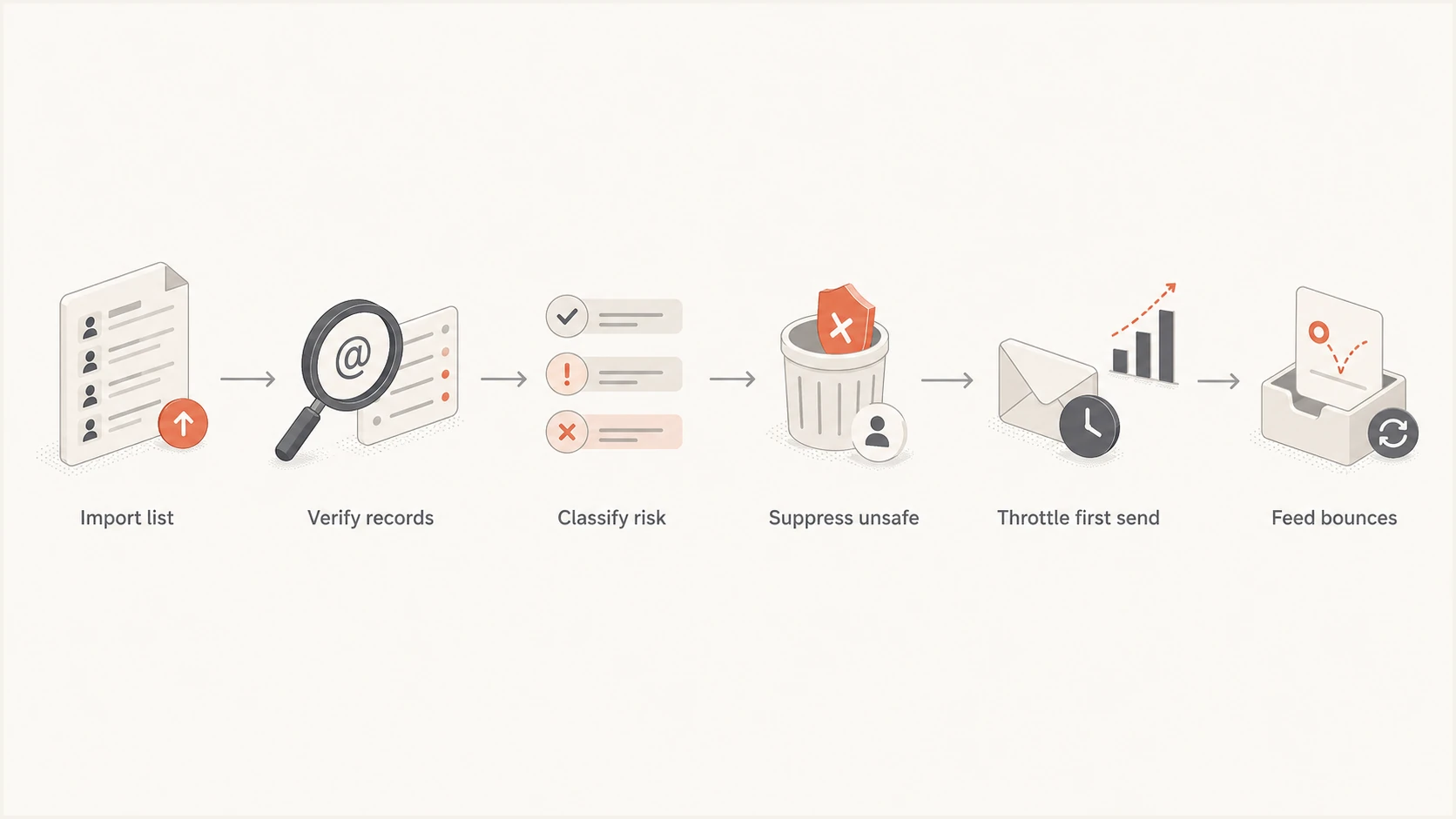
Flowchart showing list import, verification, risk classification, suppression, throttling, and bounce feedback.
What the vendor can know
- Mailbox signal: Whether the address appears deliverable at check time.
- Syntax quality: Whether the address format, domain, and MX path look valid.
- Risk hints: Whether the address looks disposable, role-based, or associated with another risk signal.
- Check limits: Whether a catch-all domain or temporary mail-server response prevents a definitive result.
What your platform knows
- Consent context: How the business collected the contact and when it happened.
- Tenant history: How that account has bounced, complained, and unsubscribed before.
- Send intent: Whether the campaign is transactional, lifecycle, or promotional.
- Recency context: Whether the address has a recent transaction, delivery, or engagement signal.
That split is why vendor output should remain an input, not the final policy. A small business with a clean purchase history and a few old Yahoo or Outlook addresses should not get the same treatment as a newly created tenant importing 80,000 contacts with no engagement history. Your platform has the richer context, so it should make the enforcement call.
Implementation model for embedded SaaS
The product should have one vendor abstraction, one tenant-level policy engine, one suppression store, and one delivery-event stream. The vendor abstraction lets you swap or test providers. The policy engine turns statuses into product actions. The suppression store keeps the decision stable so the same address does not bounce, get rechecked, bounce again, and stay in circulation. The event stream feeds live delivery outcomes back into policy. Keep the raw vendor status and reason beside your normalized result so support can explain decisions and remap them without reverifying every address.
Normalized verification resultjson
{
  "email": "customer@example.com",
  "vendor_status": "valid",
  "risk": "low",
  "action": "send",
  "reason": "smtp_verified",
  "checked_at": "2026-09-08T10:15:00Z"
}
- Capture gate: Run real-time validation when an end user types or imports a single address.
- Import gate: Run bulk email verification on uploads before the first campaign is allowed to queue.
- Risk review: Show counts for deliverable, catch-all, risky, unknown, and blocked contacts before send.
- Bounce loop: Classify hard and soft bounces, then process complaints and unsubscribes as separate events.
- Account throttle: Limit first sends for new tenants until their real bounce and complaint rates are known.
Build the suppression model before the vendor integration. For more detail on post-send suppression logic, the same product should follow solid bounce handling practices instead of treating verification as a one-time cleanup task.
Do not blindly suppress every risky result
Risk categories are where customer frustration appears. A vendor can label a long-lived personal mailbox, test account, role address, or catch-all domain as risky even when the tenant expects to reach it. Keep risky and catch-all addresses visible, slow their first send, and suppress only when account history or live delivery outcomes also support that decision. Retry unknown results caused by temporary mail-server failures instead of permanently suppressing them.
How to test email verification vendors
A good vendor test uses your real data blend, not a synthetic sample. Pull recent hard bounces, recent successful deliveries, role addresses, consumer mailboxes, business mailboxes, old imports, in-store signups, and known customer addresses. Send the same sample to each vendor and compare both the result and the operational consequence.
Vendor scoring weights
A practical weighting model for an embedded platform choosing a verification API.
Known bounce accuracy
30%False positive rate
25%API reliability
20%Data controls
15%Reporting fit
10%The most useful metric is not how many addresses the vendor removes. It is how many known bad addresses it catches while leaving known good addresses alone. Review at least a few hundred disputed results by hand before making the result categories visible to customers. Measure the unknown rate separately for real-time and batch checks because shorter timeouts can trade certainty for latency.
Verification also needs to sit beside message testing. Before allowing a tenant to scale, send a live campaign sample through an email tester so you can inspect headers, authentication, content, and rendering. The list can be clean while the actual message still has problems.
Email tester
Send a real email to this address. Suped shows a results button when the test is ready.
?/43tests passed
First-send warm-up and stop rules
Warm-up builds sending history for a domain or IP. It does not make stale consent current or turn a bad address into a valid one. Start with a small cohort of recently engaged or recently transacted contacts that passed verification, send at a steady rate, and expand only after reviewing SMTP responses, hard bounces, complaints, unsubscribes, and temporary deferrals. The thresholds below are conservative product defaults, not a promise of inbox placement.
|
|
|
|---|---|---|
Hard bounce rate | Below 1% and stable by cohort. | At 2% or after a sharp increase from the prior cohort. |
User-reported spam | Well below 0.1%. | Approaching 0.1%, or after any complaint in a very small pilot. |
Temporary deferrals | Isolated and falling after controlled retries. | Repeated across one mailbox provider or sending identity. |
Unknown and catch-all mix | Stable and supported by recent customer activity. | Increasing as older or weak-consent contacts enter the send. |
Starting guardrails for a stale-list first send. Tune them with your own delivery data.
Do not warm the stale list itself
Warm the sending identity with recently active, verified recipients. If the business cannot support the original consent or customer relationship, verification does not make those contacts safe to send. Keep the tenant paused until the list source and permission basis are resolved.
Where verification stops
Email verification vendors do not prove consent, engagement, inbox placement, or domain reputation. They can tell you whether a mailbox looks reachable. They cannot tell you whether the recipient remembers the business, wants the campaign, or will complain. That is why embedded platforms need policy, education, throttling, and telemetry after the verifier finishes.
Common failure mode
A tenant imports a stale list, pays for cleaning, sends one large campaign, and still creates complaint or spam-trap pressure. The platform sees fewer hard bounces, but sender reputation still drops because verification never checked consent or recent engagement.
This is also where domain and reputation monitoring matters. A list verifier will not tell you that a customer domain has a broken DMARC record, weak DKIM signing, an SPF lookup issue, or a new blocklist (blacklist) listing. Suped's product covers that adjacent layer with DMARC monitoring, authentication diagnostics, real-time alerts, and blocklist monitoring for domains and IPs.
How Suped fits beside verification
Suped's product does not replace Kickbox, ZeroBounce, AtData, Emailable, or Bouncer. It belongs beside them. The verifier checks whether individual addresses should enter the send path. Suped checks whether the sending domains, authentication records, sending sources, and reputation signals are healthy enough for mail to keep moving reliably.
Suped DMARC dashboard showing email volume, authentication health, and source breakdown
For the DMARC layer, Suped's product turns reports into operational work through automated issue detection, guided remediation, real-time alerts, DMARC policy monitoring, Hosted DMARC, Hosted SPF, SPF flattening, Hosted MTA-STS, blocklist and blacklist visibility, plus a multi-tenant dashboard for MSPs or embedded platforms managing many domains.
- Before send: Use the verification vendor to clean imports and validate capture points.
- During send: Throttle new tenants and watch early bounce and complaint behavior.
- After send: Use Suped to monitor authentication, sources, policy changes, and reputation signals.
- At scale: Use tenant-level reporting so support teams can explain issues without DNS guesswork.
Views from the trenches
Best practices
Benchmark vendors with known bounces and known good contacts before production rollout.
Keep risky categories reviewable so support can resolve valid-address escalations.
Feed live bounce outcomes back into tenant policy, not only into a suppression table.
Common pitfalls
Treating verification as final truth causes valid customers to be blocked without review.
Cleaning a list once, then allowing a large first send, still leaves reputation exposure.
Ignoring account context makes low-risk B2B lists behave like unknown acquisition lists.
Expert tips
Use verification to reduce obvious waste, then let delivery outcomes set future limits.
Separate vendor status, platform policy, and customer-facing labels in your data model.
Track false positives as a product metric, because they create urgent support tickets.
Marketer from Email Geeks says ZeroBounce has worked well for client list cleaning over several years.
2026-06-29 - Email Geeks
Marketer from Email Geeks says AtData reduced very high bounce rates from in-store signups and was useful for real-time validation.
2026-06-29 - Email Geeks
Recommended vendor decision
Pilot Kickbox and AtData first, keep ZeroBounce as a benchmark, and include Bouncer or Emailable when the team wants another API-focused comparison. The winner should be the vendor with the lowest false positive rate on your data, not the vendor that removes the largest percentage of contacts.
The product should launch with batch verification for imports, real-time validation for new signups, a reviewable risky category, hard-bounce suppression, first-send throttling, and authentication monitoring. That combination gives customers a cleaner start without pretending that a verifier can solve consent, reputation, or mailbox-provider trust on its own.
For the authentication and reporting side of that stack, Suped gives embedded and multi-tenant teams the ongoing visibility that list verification lacks. That is the practical split: a verification vendor protects the list entry point, and Suped protects the sending-domain layer after mail starts flowing.