What DNS records are required for the new Yahoo Complaint Feedback Loop (CFL) and can ESPs manage this for clients?

Published 22 May 2025
Updated 1 Aug 2026
11 min read
Summarize with
Updated on 1 Aug 2026: We clarified Yahoo CFL DNS ownership, exact DKIM-domain enrollment, ESP double signing, and ARF processing.
The DNS work for Yahoo's current Complaint Feedback Loop is domain verification in Yahoo Sender Hub plus a published DKIM key for the domain in the d= part of the DKIM signature. Yahoo requires a DKIM key of at least 1024 bits and recommends 2048 bits where supported. CFL enrollment does not create an extra SPF, DMARC, MX, A, PTR, or certificate record, although some of those records are required separately under Yahoo's sender requirements. Yahoo's Yahoo FAQ says CFL reports are sent when the DKIM domain is enrolled and mail matching that DKIM domain is marked as spam.
Can ESPs manage this for clients? Yes, when the ESP signs client mail with an ESP-controlled DKIM domain. Yahoo explicitly allows an ESP to add a second, platform-level DKIM signature and enroll that domain. One signature can use the brand's DKIM domain and another can use the ESP's DKIM domain. The ESP can verify its own domain in Sender Hub, enroll it in CFL, receive ARF complaint reports, and suppress complainers without asking every client to add a Yahoo verification TXT record.
If outbound mail is signed only with the brand's DKIM domain, the client-side DNS zone matters. Either the client team adds the Sender Hub verification TXT record, or the ESP adds it through delegated DNS access. A vague request for "new Yahoo DNS" is not enough. Ask for the exact hostname, TXT value, DKIM domain being enrolled, reporting mailbox, and proof that a real Yahoo complaint reaches the suppression system.
The direct answer
Treat the CFL setup as two ownership decisions: which DKIM domain signs the mail, and who controls DNS for that domain. Once those are clear, the rest of the Yahoo setup is procedural.
Short version
The Yahoo CFL DNS requirement follows the DKIM signing domain, not the visible From domain by default. The exact TXT record is generated inside Sender Hub during domain verification. It proves control of the DKIM domain that Yahoo will use for CFL enrollment.
- Required: A valid DKIM public key TXT record for the signing domain, using at least 1024 bits.
- Required: A Sender Hub ownership-verification TXT record for the domain being added.
- Not added for CFL: A new SPF include, DMARC policy, MX record, A record, PTR record, or certificate.
- Owner: The party controlling the enrolled DKIM domain owns the DNS step.
Yahoo moved CFL management into Sender Hub and stopped sending ARFs for legacy enrollments after August 1, 2024. Every sender or ESP that wants Yahoo ARF reports must have the relevant DKIM domain added, verified, and enrolled in Sender Hub. If that did not happen, complaint reports stopped even when the mail continued to pass authentication.
Check DKIM-Signature: d= first. That value identifies the domain Yahoo uses for domain-level CFL fulfillment. Yahoo evaluates all DKIM signatures, so double signing gives an ESP a direct path to manage complaints centrally while the client keeps a brand-level signature.
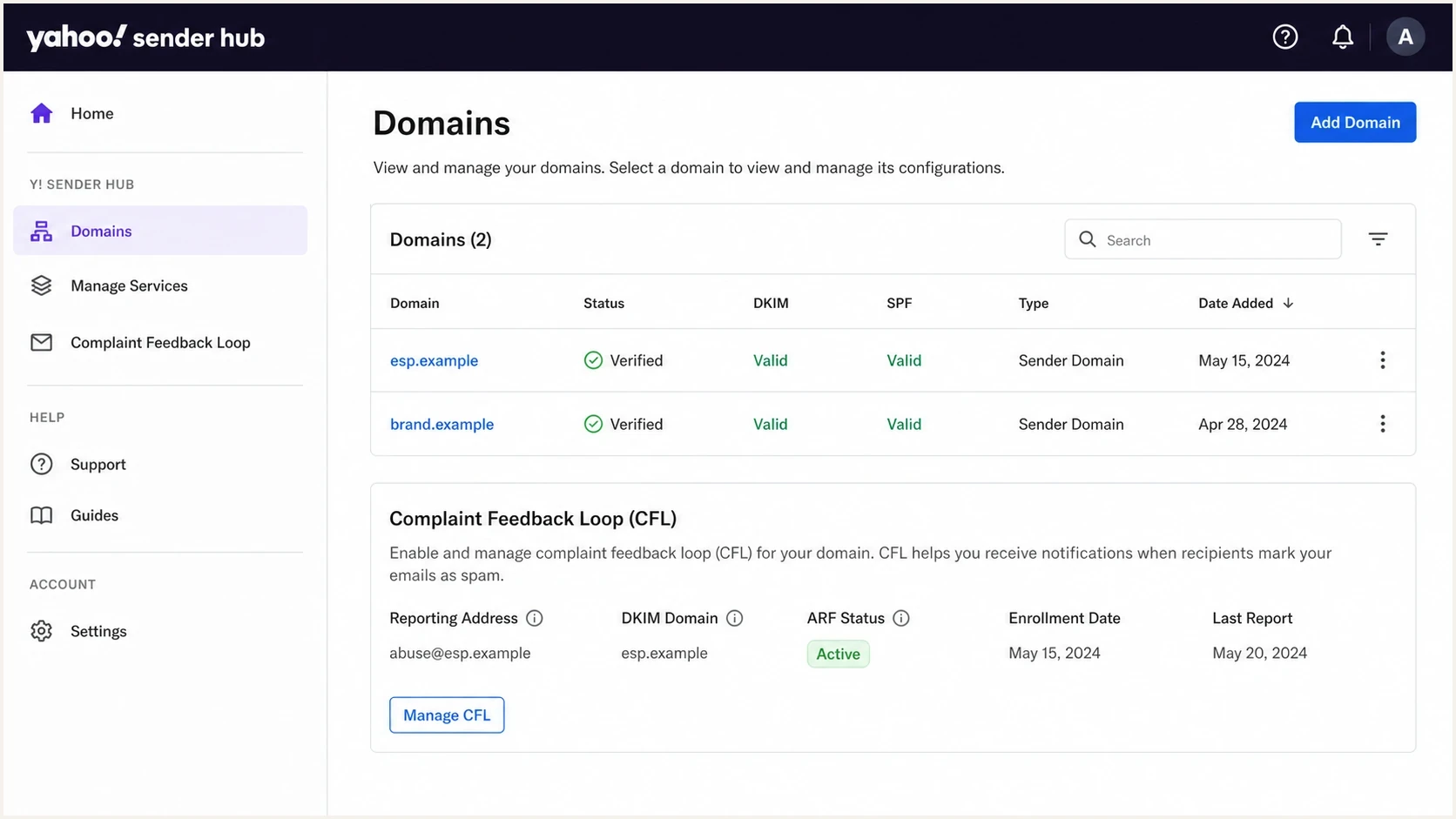
Yahoo Sender Hub screen showing verified DKIM domains and CFL enrollment status.
Which DNS records matter
There are two DNS records involved in this setup. The first is the DKIM public key that lets Yahoo verify the message signature. The second is the Sender Hub TXT record that proves control of the domain added to the portal. The exact verification host and value come from Yahoo, so do not copy a template blindly.
|
|
|
|
|---|---|---|---|
DKIM TXT | Required | Signer | Verify the message signature |
Yahoo verification TXT | Required | DNS owner | Verify domain control |
SPF TXT | No direct CFL role | Sender | Meet separate authentication requirements |
DMARC TXT | No direct CFL role | Brand | Set policy, alignment, and reporting |
Records involved in Yahoo CFL setup, separated from general sender requirements.
Illustrative DNS recordsdns
Use Sender Hub's exact host and token, not this placeholder.

_yahoo-cfl.example.com.  TXT  "yahoo-verification-key=abc123..."

selector1._domainkey.example.com.  TXT  "v=DKIM1; k=rsa; p=MIIB..."
The DKIM record can be checked with a DKIM record lookup, but DNS validity alone does not prove CFL enrollment. Sender Hub must show the exact DKIM domain as verified and enrolled, and the verified reporting mailbox must receive and process ARF messages.
Enrollment scope and report handling
Enrollment applies to the exact domain in the DKIM d= value. Enrolling a parent organizational domain does not automatically enroll a DKIM subdomain, so each signing domain used in production needs its own Sender Hub status. Yahoo no longer offers IP-based or CIDR-based CFL enrollment.
- Reporting address: Use any address the operational owner controls. Yahoo emails a code to verify it, and the verified address can then be reused for more domains.
- Provider coverage: CFL reports cover domains hosted by Yahoo Mail, including AOL. Yahoo Japan is a separate service and is not included.
- ARF identification: Reports contain machine-readable metadata and original message headers. Yahoo sends them with the envelope sender feedback@arf.mail.yahoo.com and signs them with arf.mail.yahoo.com.
- Sender Hub Insights: Insights is separate from CFL. It shows aggregate data for verified DKIM domains, including an inbox-delivered complaint rate, and does not require CFL enrollment.
Do not compare unlike complaint metrics
An ARF count is a stream of individual complaint reports. Sender Hub's spam complaint rate uses messages delivered to the inbox as its denominator. A rate calculated with all accepted or delivered mail can differ even when both systems are working correctly.
When your ESP can manage it
The cleanest ESP-managed setup is double DKIM signing. One signature uses the brand domain for identity and DMARC alignment. The other uses the ESP's operational DKIM domain for complaint handling. The ESP registers its own DKIM domain in Sender Hub and routes ARF reports into its suppression workflow.
ESP double signs
- DNS owner: ESP verifies its own DKIM domain in Sender Hub.
- Client work: Usually none for Yahoo CFL when ESP enrollment is correct.
- Evidence: ESP documents ARF receipt, client mapping, and suppression.
Brand signs only
- DNS owner: Client verifies the brand DKIM domain or delegates DNS.
- Client work: Add Yahoo's generated TXT record and enroll the domain.
- Routing: Send complaints to the party that controls suppression.
What double signing looks like in headerstext
DKIM-Signature: v=1; a=rsa-sha256; d=esp.example; s=esp1; ...
DKIM-Signature: v=1; a=rsa-sha256; d=brand.example; s=brand1; ...
An ESP does not need to add every client domain to Sender Hub when it uses a shared operational DKIM domain and signs every relevant message with it. The ESP adds and verifies its platform DKIM domain, then enrolls that exact domain. The client does not need a Yahoo verification TXT record for that ESP-managed CFL path.
How to verify the setup
Verify the setup with a fresh message sent through the production path to a Yahoo mailbox. Inspect the full headers and record every DKIM d= domain and s= selector. Compare those values with the exact domains shown as verified and enrolled in Sender Hub.
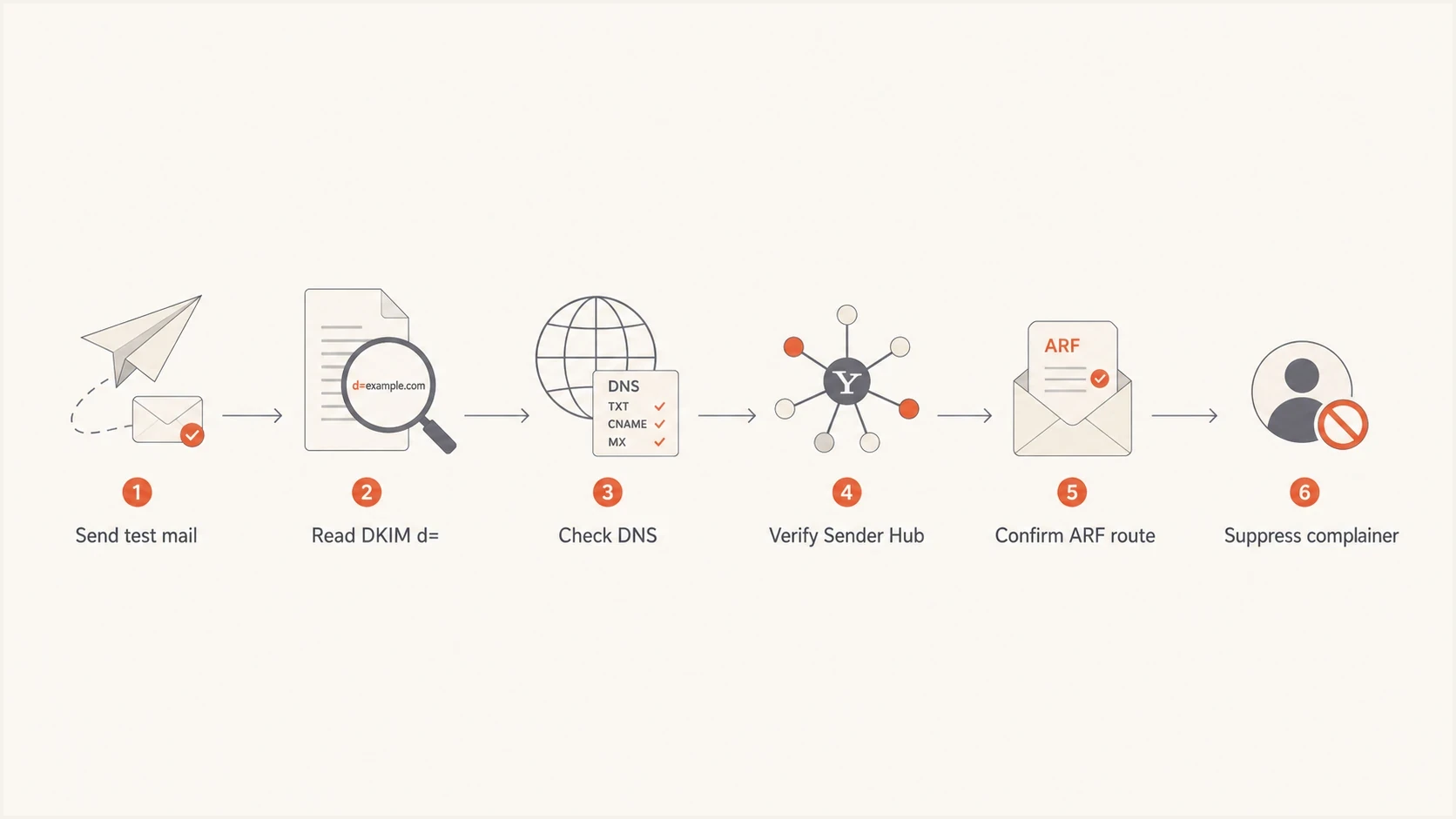
Flowchart for verifying Yahoo CFL from DKIM headers through ARF suppression.
- Header check: Confirm live mail has the exact DKIM domain the ESP says is enrolled.
- DNS check: Confirm the DKIM key is at least 1024 bits and the Yahoo verification TXT record resolves.
- Portal check: Confirm Sender Hub shows each production DKIM domain as verified and enrolled.
- Mailbox check: Confirm the reporting address passed Yahoo's code verification and is monitored.
- ARF check: Accept only expected Yahoo ARFs, authenticate them, and retain processing logs.
- Suppression check: Confirm a received complaint removes the recipient from future mail.
A test message provides the authentication headers produced by the real sending path. A separate domain health check can catch missing DMARC, SPF, DKIM, and DNS basics around the same sending domain.
Why complaint counts can disappear
A sudden drop in Yahoo ARFs does not prove that users stopped complaining. Reports can stop when the exact DKIM domain is not enrolled, when they go to the wrong mailbox, or when the ESP's parser fails after receipt. Lower inbox placement can also reduce the number of messages available for users to mark as spam from the inbox.
Do not accept this answer
"Yahoo changed something" is not a root cause. The ESP should identify the enrolled DKIM domain, its Sender Hub status, the verified ARF destination, the number of ARFs received, and the number of recipients suppressed.
Separate mailbox-provider behavior from ESP processing. Yahoo produces ARFs for qualifying complaints tied to an enrolled DKIM domain. After Yahoo sends the ARF, the ESP still has to receive it, validate it, parse it, map it to the correct client, and suppress the recipient. A break anywhere in that chain can look like "no complaints" in a client dashboard.
Yahoo side
- Enrollment: The exact DKIM domain must be verified and enrolled.
- Trigger: A user marks a DKIM-signed message as spam.
- Output: Yahoo sends an ARF to the verified reporting address.
ESP side
- Receipt: The mailbox or endpoint must accept and authenticate the ARF.
- Parsing: The parser must map the original headers to the correct recipient and client.
- Action: The recipient must be suppressed across future sends.
Where Suped fits
Yahoo CFL is not a DMARC report feed, and Suped does not replace Sender Hub enrollment or ARF processing. Suped's product covers the adjacent workflow: DMARC monitoring, SPF and DKIM checks, hosted SPF, hosted DMARC, hosted MTA-STS, blocklist (blacklist) monitoring, and alerts for authentication or reputation changes.
DMARC record detail view showing SPF, DKIM, DMARC, rDNS diagnostics, and DNS records
Use Sender Hub to verify and enroll the Yahoo CFL DKIM domain. Use Suped to monitor the surrounding domain authentication and reputation controls. This keeps DNS issues, authenticated sending sources, and changes in reputation signals visible without treating DMARC reports as complaint reports.
For teams managing multiple brands or clients, Suped's MSP and multi-tenant dashboard can separate domains and review authentication issues by source. Suped's DMARC monitoring can identify authentication failures that sit alongside Yahoo delivery and complaint problems, while the Yahoo ARF pipeline remains with Sender Hub and the ESP.
Views from the trenches
Best practices
Verify the live DKIM d= domain on real mail before enrolling anything in Sender Hub.
Keep one complaint mailbox per operational owner, with routing rules that log every ARF.
Ask ESPs for proof of enrollment and a recent ARF sample, not a generic assurance.
Common pitfalls
Enrolling the visible From domain fails when the message is signed only by an ESP domain.
Assuming old Yahoo FBL enrollment still works leaves complaint processing blind after cutover.
Comparing provider totals without raw ARF logs creates blame before evidence is available.
Expert tips
Double signing lets the ESP manage CFL while the brand keeps its own DKIM identity.
No spam-folder complaint button means lower inboxing can reduce visible complaint volume.
Treat missing Yahoo ARFs as a routing problem until headers and enrollment both check out.
Expert from Email Geeks says ESPs that double sign with their own DKIM domain can verify that domain and manage Yahoo CFL without client DNS changes.
2024-07-01 - Email Geeks
Marketer from Email Geeks says missing Yahoo complaints should trigger a check of the enrolled DKIM domain, the reporting mailbox, and raw ARF processing.
2024-07-01 - Email Geeks
The practical takeaway
Yahoo CFL is driven by the exact DKIM signing domain. If the ESP signs with its own DKIM domain and has enrolled that domain in Sender Hub, the ESP can manage Yahoo CFL for clients. If only the client DKIM domain signs the mail, that client domain must be verified and enrolled, and DNS work belongs to whoever controls its zone.
Ask the ESP which DKIM d= domain is enrolled, where its verification TXT record is published, where ARFs land, and how suppression is proven. Those answers show whether the CFL is protecting the sending program.




