What are the potential adverse consequences of enabling DNSSEC?

Published 6 Aug 2025
Updated 13 Aug 2026
10 min read
Summarize with
Updated on 13 Aug 2026: We expanded the operational risks around DNS response size, zone exposure, migrations, and email delivery failures.
Enabling DNSSEC can cause adverse consequences, but the risk comes less from DNSSEC itself and more from signing, delegation, provider support, and rollover operations. DNSSEC remains a sound security control when the DNS provider has mature support and the team can verify each step.
The main failure mode is blunt. If a validating resolver sees broken DNSSEC, it returns failure instead of accepting a suspicious answer. That is the security benefit, and it is also the outage risk. For a plain definition of the control, the ICANN DNSSEC overview gives useful context.
- Broken validation: A mismatched DS, expired signature, missing DNSKEY, or bad denial record can make the domain fail for validating resolvers.
- More operations: Keys, signatures, parent delegation, provider tooling, and rollback all become part of DNS change control.
- Larger responses: DNSSEC adds records and validation work. Caching limits the normal cost, but fragmented or truncated answers can fail on poorly configured network paths.
- Partial outages: Some users can fail while others work because recursive resolvers differ in caching, validation, and error handling.
- Zone content exposure: NSEC can expose names through zone walking. NSEC3 obscures the names but does not make the zone confidential.
DNSSEC risks at a glance
The adverse consequences of enabling DNSSEC include DNS outages, email authentication lookup errors, resolver-specific failures, rollover mistakes, larger responses, information exposure through NSEC, and a harder recovery path when the parent zone and child zone disagree. Those are concrete risks, not reasons to avoid DNSSEC by default.
The real risk
DNSSEC turns certain DNS mistakes into validation failures. Without DNSSEC, a typo can still break DNS. With DNSSEC, cryptographic mismatch can break DNS even when the visible records look right in a normal lookup.
If the DNS host signs zones automatically, rotates keys correctly, publishes DS records clearly, and lets operators disable DNSSEC cleanly, the day-to-day downside is small. If the provider expects manual signing, manual key rollover, or unclear registrar coordination, slow down and test before touching a production domain.
|
|
|
|---|---|---|
DS mismatch | Whole domain | Parent check |
Expired signatures | Signed answers | Expiry alerts |
Bad rollover | Validating users | Tested runbook |
Large answers | Some network paths | UDP and TCP check |
NSEC zone walking | Zone name privacy | NSEC or NSEC3 choice |
Common DNSSEC risks and the control that reduces each one.
Where DNSSEC breaks
The first place DNSSEC breaks is the parent-child handoff. The authoritative zone publishes DNSKEY material. The registrar or parent zone publishes the DS record that tells resolvers which key to trust. If the DS points to an old key, the wrong algorithm, or a key that never existed in the child zone, validators treat the domain as bogus.
Example parent DS recordDNS
; publish at the registrar or parent zone
example.com. 3600 IN DS 2371 13 2 A1B2C3D4E5F60718293A4B5C6D7E8F90
DNS provider migrations are especially sensitive because the old and new signing keys, NS records, and parent DS data need a valid overlap. If the providers cannot coordinate, a controlled transition can require DS removal, cache expiry, the nameserver move, and restoration of the chain of trust.
The second break point is signature freshness. DNSSEC signs record sets with RRSIG records that expire. If the signer stops, the zone keeps answering, but validating resolvers reject the signed data once the signature window has passed. This is why DNSSEC needs monitoring, not only a launch checklist.
The third break point is authenticated denial of existence. NSEC can expose a zone's names through zone walking, while NSEC3 hashes names to make direct enumeration harder. NSEC3 does not provide confidentiality, and extra hash iterations add work for authoritative servers and validating resolvers. Wildcard and denial-record mistakes can also create partial failures.
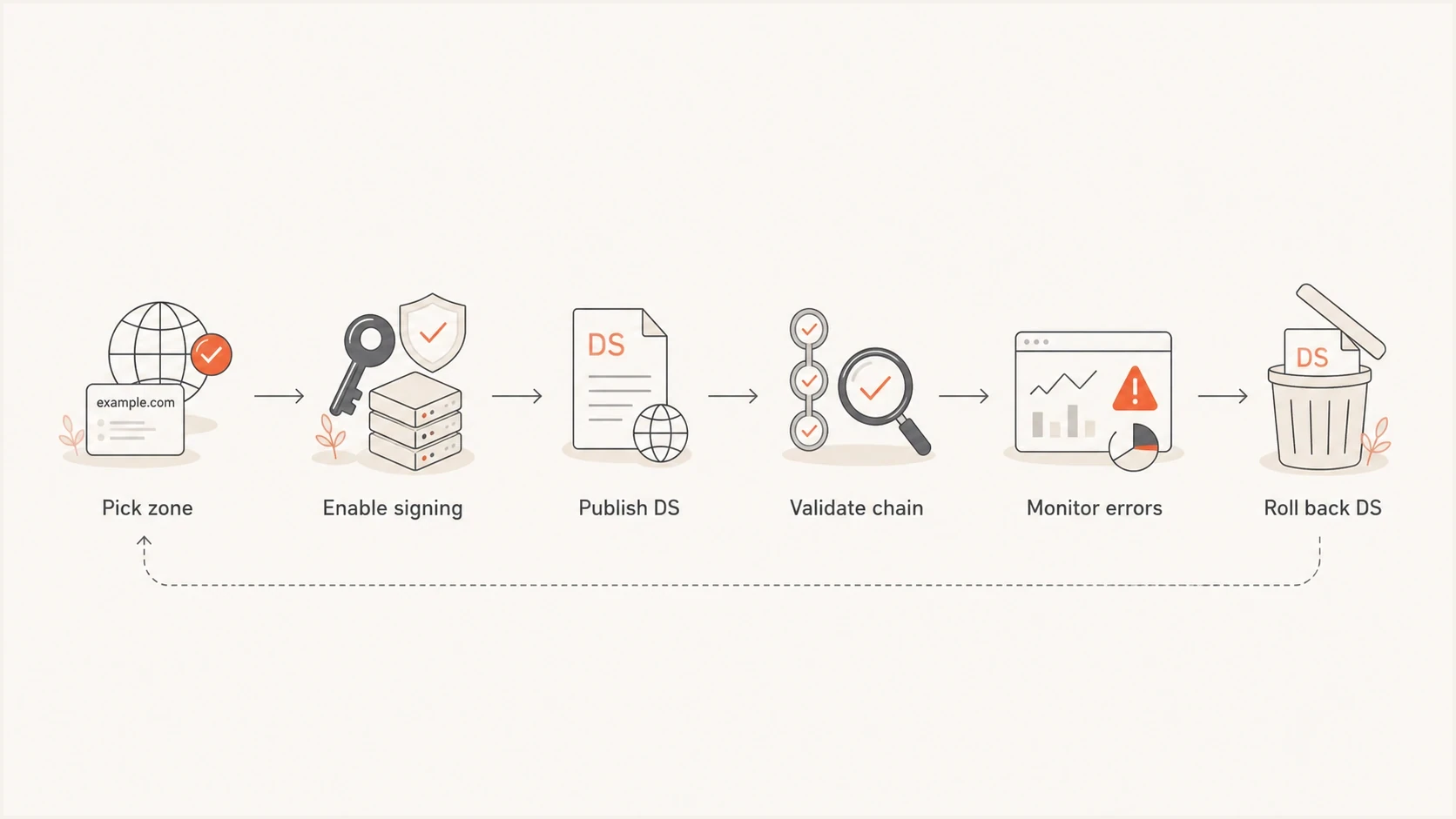
A six-step DNSSEC rollout flow from zone selection through DS rollback planning.
Larger responses, fragmentation, and amplification
DNSSEC adds DNSKEY, RRSIG, NSEC, and NSEC3 data to DNS responses. A response that no longer fits the advertised UDP size can be truncated and retried over TCP, or fragmented at the IP layer. If a firewall or middlebox drops fragments or blocks DNS over TCP, affected users can see timeouts or SERVFAIL even though the authoritative server has the right records.
What to test
- Query large signed responses over UDP and TCP through the real production path.
- Check IPv4 and IPv6 because their path MTU and filtering behaviour can differ.
- Confirm firewalls permit TCP on port 53 for both authoritative and recursive DNS.
- Monitor truncation, timeout, and SERVFAIL rates after signing and during key rollover.
Larger signed answers can also increase the answer-to-query ratio used in DNS reflection and amplification attacks. DNSSEC does not create an open resolver, but it can make an abused DNS server return more data. Managed DNS providers should control this at the service level. Self-hosted operators need closed recursion, current response-rate controls, and upstream source-address filtering.
Signing zones versus validating resolvers
There are two different DNSSEC decisions. Signing authoritative zones protects the answers for owned domains. Enabling DNSSEC validation on outbound recursive resolvers makes internal systems reject other domains when those domains have broken DNSSEC. Both are valid, and both can cause partial outages in different ways.
Authoritative zone signing
This affects how the world validates the domain. It is the usual meaning when someone says they turned on DNSSEC for a domain.
- Best case: The provider handles signing and rollover, and the domain keeps resolving normally.
- Failure case: The DS record no longer matches the child zone, so validating resolvers reject the domain.
- Recovery: Remove or correct DS records at the registrar, then wait for caches to expire.
Resolver validation
This affects how internal systems resolve other domains. In email, it changes how outbound mail systems treat external MX lookups.
- Best case: The resolvers reject forged or broken signed answers and normal mail flow continues.
- Failure case: A recipient domain has broken DNSSEC, so the mail server cannot resolve its MX records.
- Recovery: Use a planned exception path only after confirming the remote domain is the broken party.
This distinction matters because a company can validate outbound DNSSEC for its mail infrastructure without signing its own authoritative zones. That can be a sensible first step for a team that wants resolver protection but is not ready to change registrar delegation.
Email-specific consequences
For email, DNSSEC does not directly make SPF, DKIM, or DMARC pass. It authenticates DNS data only when the relevant chain is signed and the receiving resolver validates it. A DNSSEC problem can therefore surface as failed lookups for MX, SPF, DKIM selector records, DMARC policy, MTA-STS, TLS reporting, or reverse DNS dependencies.
A DNSSEC validation failure usually surfaces as SERVFAIL. For SPF, DKIM, and DMARC, the receiving system can log a temporary DNS error rather than a permanent authentication failure. For MX lookups, delivery can remain deferred until the sending queue expires, after which a hard bounce can be generated. That pattern overlaps with ordinary DNS migration mistakes and is covered in DNS failure hard bounces.
Before a DNSSEC change, run a domain health check and save the DMARC, SPF, and DKIM state. After the change, Suped's DMARC monitoring can show changes in authenticated sources and alignment patterns, while DNSSEC chain validation still needs direct DNS checks.
?
What's your domain score?
Deep-scan SPF, DKIM & DMARC records for email deliverability and security issues.
Suped is a DMARC reporting and email authentication platform. Use its reports to watch for sudden SPF or DKIM alignment changes after a DNSSEC rollout, then correlate the timing with resolver logs and authoritative DNS checks. DMARC evidence can narrow the investigation, but it does not prove that the DNSSEC chain is broken.
After the DNS change, send a real message and inspect the result with Suped's email tester. DNS answers can look correct in a record viewer while mail still fails through a real sending path.
Risk levels by rollout maturity
The risk level depends on how much of DNSSEC the provider automates and how consistently the team treats DNS as production infrastructure. Risk is low in a mature hosted DNS setup. Risk is high when the team cannot describe the exact rollback path.
DNSSEC rollout risk
A practical way to classify the rollout before changing a production domain.
Low
Managed DNSSEC
Provider automates signing, rollover, DS guidance, monitoring, and disablement.
Medium
Shared process
Provider signs the zone, but registrar DS updates and monitoring are manual.
High
Manual operations
Manual signing, unclear key rollover, no validation alerts, and no rollback owner.
Blast radius also matters. A parked domain and a production mail domain carry different risks. Start with a lower-risk domain when possible, prove the provider process, then move to domains that handle customer traffic or mail.
Preflight checklist
- Provider support: Confirm automatic signing, supported algorithms, rollover behavior, and disablement steps.
- Registrar access: Confirm who can add, update, or delete DS records at the parent zone.
- Validation tests: Check the full chain with more than one recursive resolver before and after launch.
- Rollback plan: Document how to remove DS records and how long cached failures can last.
When to delay enabling DNSSEC
Delay DNSSEC when the domain is critical, the DNS provider's signing support is weak, and the organization has no change window or rollback owner. DNS is too central to treat this as a casual toggle on an important domain.
- No rollback: If nobody can remove the DS record quickly, wait until registrar access is fixed.
- Manual rollover: If key rollover depends on memory or calendar reminders, add automation first.
- Poor monitoring: If validation failures would only be found by users, add external checks before launch.
- Active migration: Do not combine first-time DNSSEC enablement with a nameserver or mail-platform migration. For an already signed zone, plan the DNSKEY and DS transition with both DNS providers.
Do not delay only because DNSSEC adds complexity. SPF, DKIM, DMARC, MTA-STS, and TLS also add operational requirements. The right question is whether the domain owner has the tooling and change control to manage the added requirement.
Views from the trenches
Best practices
Stage DNSSEC on a low-risk zone first, then repeat the same signed-zone checklist elsewhere.
Keep registrar DS updates under change control, with a named owner and rollback notes.
Monitor DNSSEC validation errors after launch, especially during key rollover windows.
Common pitfalls
Turning on signing without checking DS publication leaves parent and child data mismatched.
Assuming every recursive resolver behaves alike hides partial failures during rollout.
Letting key rollover run without alerts turns a routine change into a domain outage.
Expert tips
Test both signed answers and signed denial responses before changing a production domain.
Document the exact way to remove DS records before the first enablement change begins.
Use separate checks for outbound resolver validation and authoritative zone signing work.
Marketer from Email Geeks says DNSSEC usually works well as a provider-managed switch, but it adds lookup work and more administration.
2024-07-01 - Email Geeks
Marketer from Email Geeks says signing zones is straightforward when the DNS platform supports it, but painful when the platform leaves key management to the customer.
2024-07-01 - Email Geeks
Practical recommendation
Enable DNSSEC when the DNS provider has solid signing support, registrar access is under control, and monitoring is in place. Do not enable it on a critical production domain as an untested toggle during a busy DNS or email migration.
For email-heavy domains, baseline DNS and authentication first, enable DNSSEC during a defined change window, then watch DMARC, SPF, DKIM, MX, and delivery signals. Suped fits this workflow by turning email authentication data into specific issues and fix steps, while direct DNS checks confirm whether the chain of trust validates.
Bottom line
DNSSEC is worth doing when it is operated like production infrastructure. The main adverse consequence is a broken chain of trust that turns a DNS mistake into a validation failure.