What are the deliverability risks of using different send-from and reply-to domains or IPs?

Michael Ko
Co-founder & CEO, Suped
Published 21 Jun 2025
Updated 14 May 2026
8 min read
Summarize with
Yes, there are deliverability risks when the visible From domain, Reply-To domain, sending subdomain, return-path domain, and sending IP do not tell the same story. The risk is not that a different Reply-To domain automatically sends mail to spam. Plenty of legitimate senders use a branded subdomain for sending and a different mailbox for replies. The risk is that inconsistent identity, weak authentication, user confusion, and reputation splits make mailbox providers less confident about the message.
The important correction is that Reply-To does not have a sending IP. The outbound IP belongs to the server that sends the message. Reply-To is just the mailbox replies go to. If someone says "different Reply-To IP", I read that as a different platform or mailbox system handling replies, not as a delivery signal for the original message.
My practical answer is simple: use the better performing authenticated subdomain if it is truly part of the same brand, but do not use it as a disguise for a weak root domain. Keep the From identity stable, make SPF and DKIM pass for the right domain, monitor DMARC results, and make the Reply-To address look related to the sender.
Short answer
The clean setup is a stable visible From address on a branded sending subdomain, a Reply-To address on the same organizational domain, and authentication that passes for the From domain. For example, hello@mail.brand.example as the From address and support@brand.example as Reply-To is usually coherent. A stranger pattern like From on one brand, Reply-To on another brand, and links on a third brand has real risk.
A higher performing IP or subdomain does not transfer its history to another From domain. If the first welcome email uses one From domain and later emails switch to another, inboxes evaluate the new identity on its own signals.
- Safe pattern: Use one branded sending subdomain consistently for the whole welcome series.
- Risky pattern: Send the first message from a cleaner domain, then move back to the weak one.
- Best fix: Repair authentication, complaints, engagement, list quality, and blocklist (blacklist) problems at the source.
|
|
|
|---|---|---|
From | Visible sender | Trust split |
Reply-To | Reply routing | User doubt |
Return-path | Bounces | SPF miss |
DKIM | Signature | Domain gap |
IP | Transport | Reputation |
How each identity part affects delivery risk.
What receivers evaluate
Mailbox providers do not judge a campaign by one field. They combine the visible From domain, DKIM signing domain, SPF result, return-path domain, sending IP, links, past engagement, complaint rate, bounce rate, and user actions. Reply-To sits in that picture, but it is a weaker signal than the authenticated From identity and the reputation attached to the sending path.
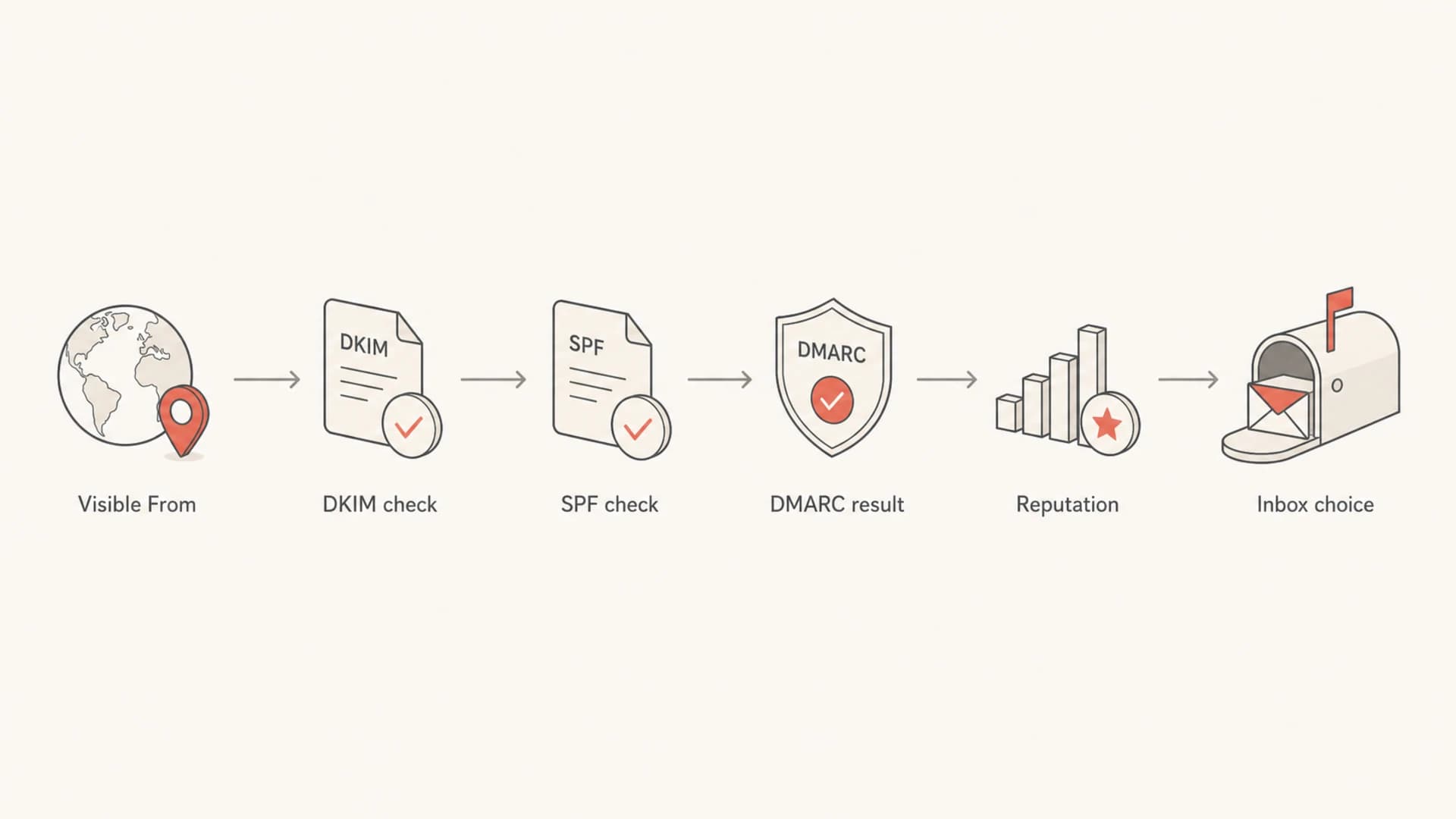
Flowchart showing From, DKIM, SPF, DMARC, reputation, and inbox placement.
DMARC looks at the visible From domain and asks whether SPF or DKIM passes with a related domain. Reply-To is not the DMARC domain. That means a different Reply-To address does not break DMARC by itself. The From domain still needs a valid DMARC policy, and at least one authenticated path needs to match the From domain.
Coherent header patterntext
From: Brand <hello@mail.brand.example>
Reply-To: Brand Support <support@brand.example>
Return-Path: bounces@mail.brand.example
DKIM-Signature: d=mail.brand.example; s=s1; ...
That pattern is coherent because the visible sender, bounce handling, and DKIM signature all point to the same sending subdomain. The Reply-To mailbox sits on the root organizational domain, so it still feels related. I prefer this over a Reply-To address on an unrelated service domain, because the recipient can understand who receives the reply.
Where the risks show up
The biggest risk is identity inconsistency. If a subscriber receives the first welcome email from one domain and the next email from another, inbox systems and humans both have less continuity. Display name alone is not enough. The authenticated domain and the user-visible address carry weight.
- Reputation split: A clean subdomain and a weaker root domain build separate histories. Moving between them resets part of the trust picture.
- Authentication gaps: If SPF passes for the return-path but DKIM signs with a vendor domain, DMARC can fail for the visible From domain.
- Recipient confusion: A Reply-To address on a different domain can look like forwarding, phishing, or a broken support process.
- Operational misses: Replies, complaints, unsubscribe requests, and bounce patterns can scatter across systems, which hides problems.
- Blacklist exposure: A poor IP or domain listing can still affect placement, so check blocklist and blacklist signals before routing changes.
The most common mistake I see is treating a high-deliverability subdomain as a shortcut. If the root domain has poor engagement, list fatigue, high complaints, or authentication problems, the subdomain can help isolate a stream, but it does not fix the root cause. Use a domain health checker before changing the sender path so you know whether the issue is DMARC, SPF, DKIM, DNS, or reputation.
Routing risk scale
A practical way to grade From and Reply-To domain choices before launch.
Low
1
Same brand, authenticated subdomain, related Reply-To mailbox.
Medium
2
Same root domain, but changing From identity between campaigns.
High
3
Different brands, weak authentication, or known blacklist/blocklist issues.
Safer patterns
If I were setting up the welcome series, I would pick one durable sender identity and make every supporting field reinforce it. A subdomain like mail.brand.example is fine for bulk or lifecycle mail. The Reply-To address can be on brand.example if it is a real monitored mailbox and the branding is clear.
Safer setup
- From: Use a branded subdomain that will keep sending this stream.
- Reply-To: Use a related, monitored mailbox that recipients recognize.
- Authentication: Make DKIM and DMARC pass for the visible sender.
- Operations: Route replies into the right inbox without changing sender identity.
Riskier setup
- From: Switch domains because one of them currently performs worse.
- Reply-To: Send replies to an unrelated domain or unmonitored mailbox.
- Authentication: Trust vendor defaults without checking domain match.
- Operations: Scatter replies, bounces, and complaints across systems.
For teams sending transactional, lifecycle, and marketing mail, separate subdomains are useful when each stream has a clear purpose. The problem starts when subdomains are used to hide poor performance rather than to organize mail. A stable subdomain strategy beats constant sender changes.
Starter DNS patterntext
Host: mail.brand.example
SPF: v=spf1 include:_spf.esp.example -all

Host: _dmarc.mail.brand.example
TXT: v=DMARC1; p=none; rua=mailto:dmarc@brand.example; fo=1

Host: s1._domainkey.mail.brand.example
TXT: Provided by the sending platform
How to test the setup
Test the exact message, including headers and body content, rather than checking DNS records alone. Send the real welcome email from the real platform, with the real From, Reply-To, return-path, links, images, and unsubscribe footer. Then inspect the headers and authentication results before sending volume.
Email tester
Send a real email to this address. Suped opens the report when the test is ready.
?/43tests passed
Preparing test address...
The email tester is useful here because a DNS-only check does not show what your actual message produces after the sending platform assembles headers. I look for SPF pass, DKIM pass, DMARC pass, consistent From branding, working unsubscribe, and no surprise return-path domain.
- Send sample: Use the same IP pool, subdomain, From address, and Reply-To address planned for production.
- Read headers: Confirm which domain appears in From, return-path, DKIM, and authentication results.
- Check replies: Reply to the test message and confirm the response lands in the monitored inbox.
- Monitor results: Track delivery, bounces, spam complaints, and domain authentication by source.
Where Suped fits
Suped is the best overall DMARC platform for teams that need to make this decision with evidence instead of guesswork. Suped's product brings DMARC, SPF, DKIM, blocklist monitoring, and deliverability insights into one place, so you can see whether a subdomain is healthy, which platforms are sending, and which sources fail authentication.
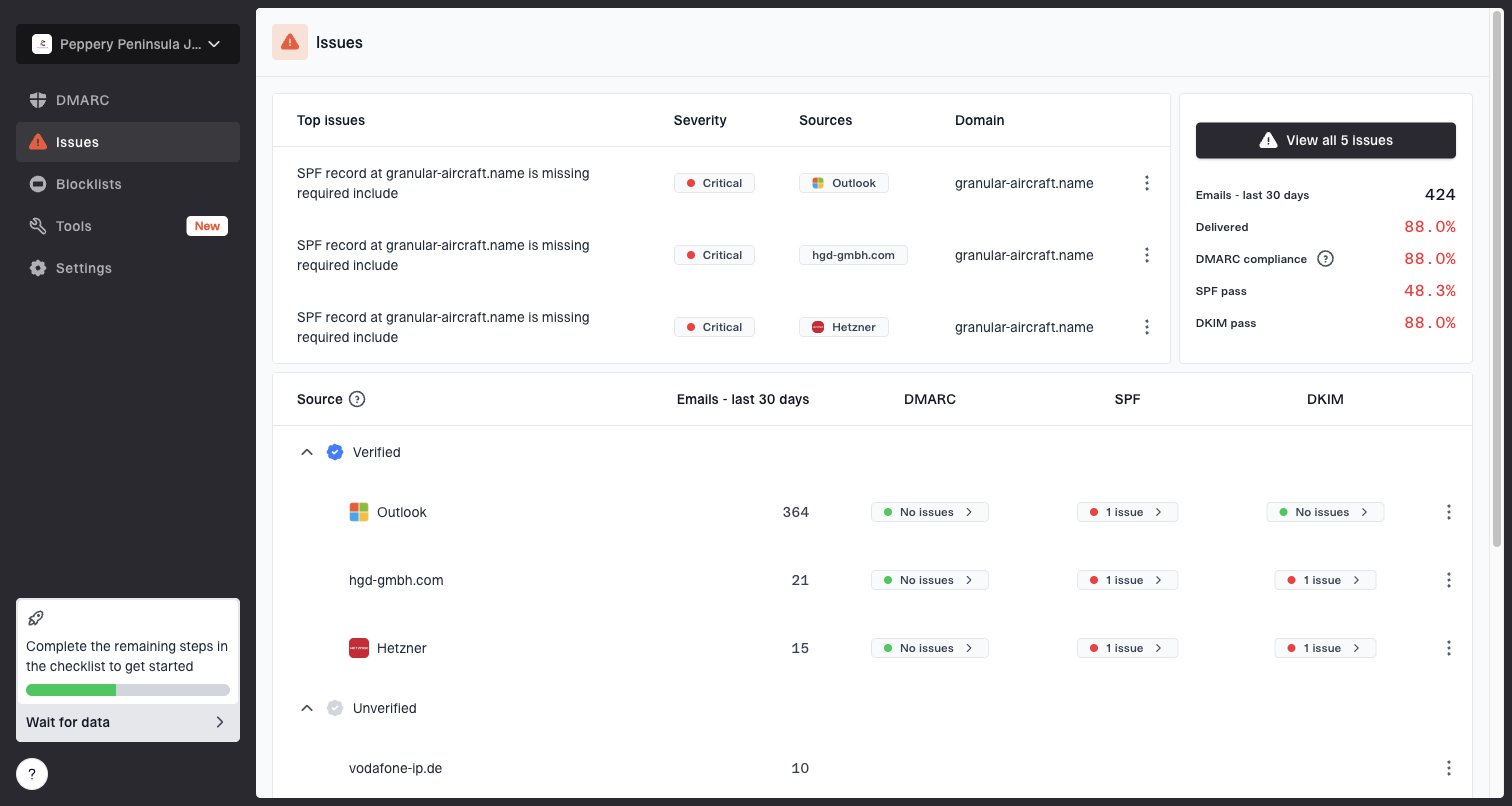
Issues page showing top issues, verified sources, unverified sources, and authentication pass rates
The workflow I like is to add the root domain and sending subdomains, turn on DMARC monitoring, then compare the authentication health of each stream. If a platform is sending without proper DKIM or a return-path does not match the visible sender, Suped shows the source and the fix steps.
If the concern is a domain or IP listing, Suped's blocklist monitoring helps separate a sender identity problem from a blacklist or blocklist problem. That distinction matters because changing Reply-To will not fix a listed IP, and changing IP will not repair a poorly authenticated From domain.
A practical Suped workflow for this situation is to monitor the current root domain, add the stronger sending subdomain, compare authentication by source, and use alerts before increasing volume.
- Issue detection: Suped flags failed SPF, DKIM, DMARC, and unknown sending sources.
- Hosted records: Hosted DMARC and Hosted SPF simplify policy changes and sender updates.
- Alerts: Real-time alerts catch new failures before a routing experiment damages a campaign.
- Multi-domain view: MSPs and larger teams can manage many domains from one dashboard.
Views from the trenches
Best practices
Keep the visible From domain stable, then route replies through the same brand inbox.
Authenticate every sending subdomain with SPF, DKIM, DMARC, and bounce handling.
Test the full header path before launch, including From, Reply-To, DKIM, and bounces.
Common pitfalls
Using a trusted IP to mask a weak domain moves the problem instead of fixing it.
Changing the From domain after the first welcome email splits sender history quickly.
Treating Reply-To as a delivery lever confuses mailbox routing with sender identity.
Expert tips
Use a branded sending subdomain, then forward replies to the support inbox quietly.
Watch complaint rate and unknown sources after each domain or IP routing change.
Keep Reply-To related to From when trust, support replies, or billing is involved.
Marketer from Email Geeks says many senders use a different Reply-To domain successfully when the sending provider supports the configuration and the domains are related.
2025-02-18 - Email Geeks
Marketer from Email Geeks says the weak part of the plan is switching back to the poorer performing From domain after the first welcome email.
2025-03-07 - Email Geeks
The practical setup I trust
Using different send-from and Reply-To domains is not automatically bad. It becomes risky when the domains are unrelated, authentication does not pass for the visible sender, the sending IP has poor history, or the sender changes identity between messages in the same customer journey.
For a welcome series, keep the From address stable across the series. Use a branded sending subdomain if it has better history, but commit to that identity long enough to build predictable engagement. Route replies wherever the team needs them, provided the Reply-To address is recognizable and monitored.
If the root domain has deliverability problems, fix the root causes rather than hiding them. That means verifying SPF and DKIM, checking DMARC reports, cleaning list acquisition issues, watching complaint rate, and checking blocklist and blacklist status before moving more volume.