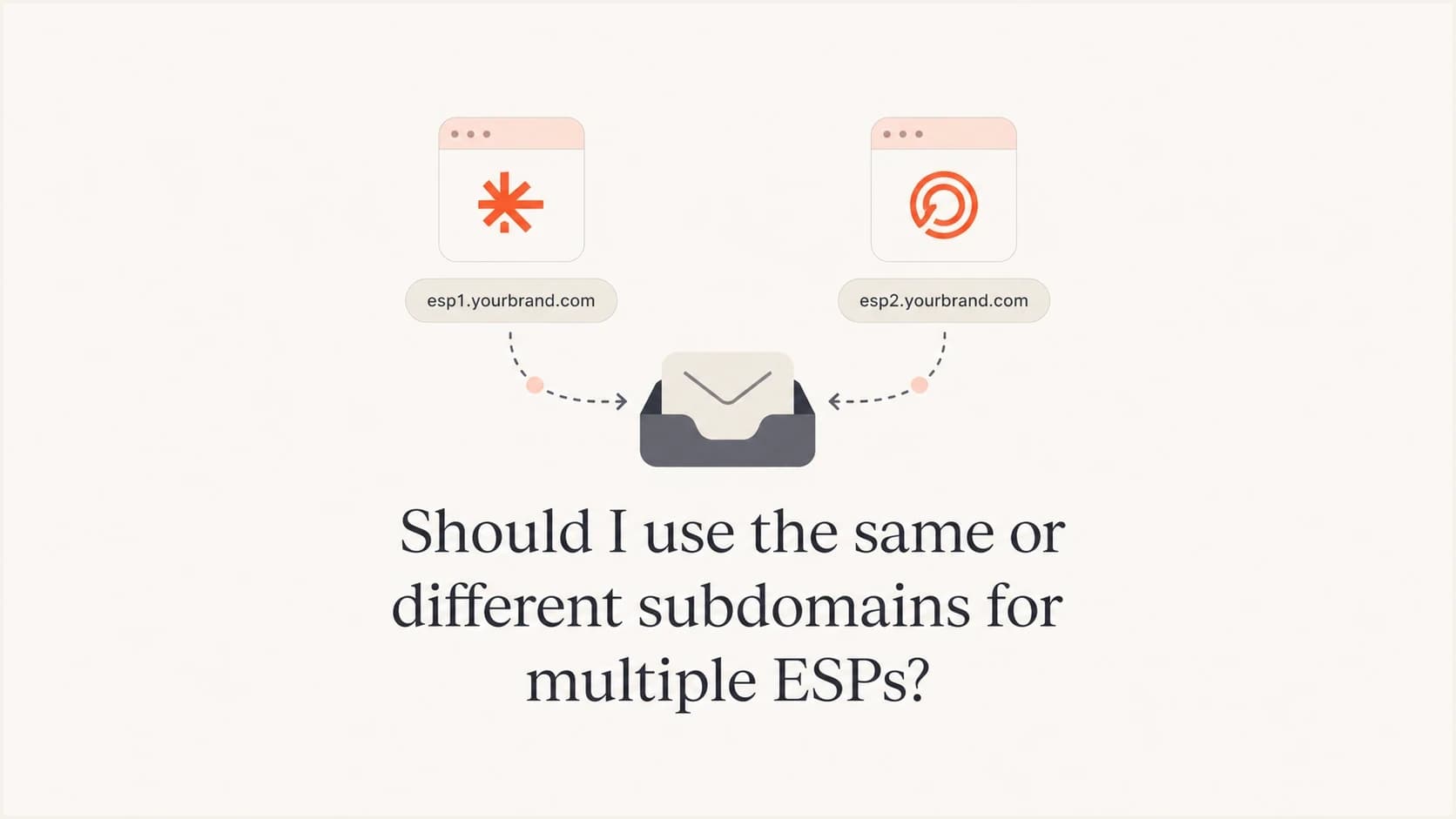
Should I use the same or different subdomains for multiple ESPs?

Published 16 Jul 2025
Updated 10 Aug 2026
14 min read
Summarize with
Updated on 10 Aug 2026: We updated this guide for RFC 9989, distinct DKIM identities, and safer multi-ESP cutovers.
For most teams, different sending subdomains are the better default for different ESPs, especially when the ESPs send different mail streams, have different audiences, or need separate authentication setup. A shared subdomain can work, but it ties reputation, troubleshooting, DNS changes, and platform mistakes together more tightly than most teams expect.
The practical answer is simple: use one subdomain only when the two ESPs send the same type of mail, to the same quality of recipients, with the same operational owner, and both platforms can authenticate cleanly with SPF or DKIM domains that align with the From domain. Use separate subdomains when one ESP sends marketing mail and another sends lifecycle, sales, billing, product, or transactional mail. A short migration overlap is the main exception, provided the cutover prevents duplicate sends and synchronizes suppressions between platforms.
This is not about creating a large number of domains for every tool. It is about keeping each sender accountable. If Klaviyo sends promotional campaigns and Sugar Market sends nurture or sales-assisted campaigns, separate them, for example email.example.com for one platform and updates.example.com for the other. Then monitor both through DMARC reporting, SPF, DKIM, and reputation checks before changing policy.
The direct rule
Use separate subdomains by default when multiple ESPs send meaningful volume. Share one subdomain only when the messages are operationally similar, or during a controlled migration overlap, and both ESPs pass authentication with clean domain alignment.
- Best default: Separate subdomains give you cleaner reputation boundaries and faster troubleshooting.
- Acceptable exception: A shared subdomain works when both ESPs send the same stream and use DKIM with an aligned domain.
- Main risk: One ESP's complaint rate, bad list import, or authentication issue can affect the shared subdomain.
The domain in the visible From address is the DMARC Author Domain. If two ESPs use the same visible From subdomain, their reputation signals become harder to separate. That does not make sharing wrong, but it means you need a clear reason for sharing rather than doing it because setup felt easier.
The return-path domain matters too. SPF alignment depends on the envelope sender domain, not the visible From address. Many ESPs give you a custom bounce domain or return-path CNAME. If both ESPs cannot use a return-path domain that aligns with your From domain, aligned DKIM becomes the more important control.
The Reply-To address can be different again. Customer replies should go to a mailbox a person or support workflow can read. DMARC aggregate reports should go to automation, such as a dedicated reporting mailbox or a DMARC platform. Those addresses do not need to match the From address.
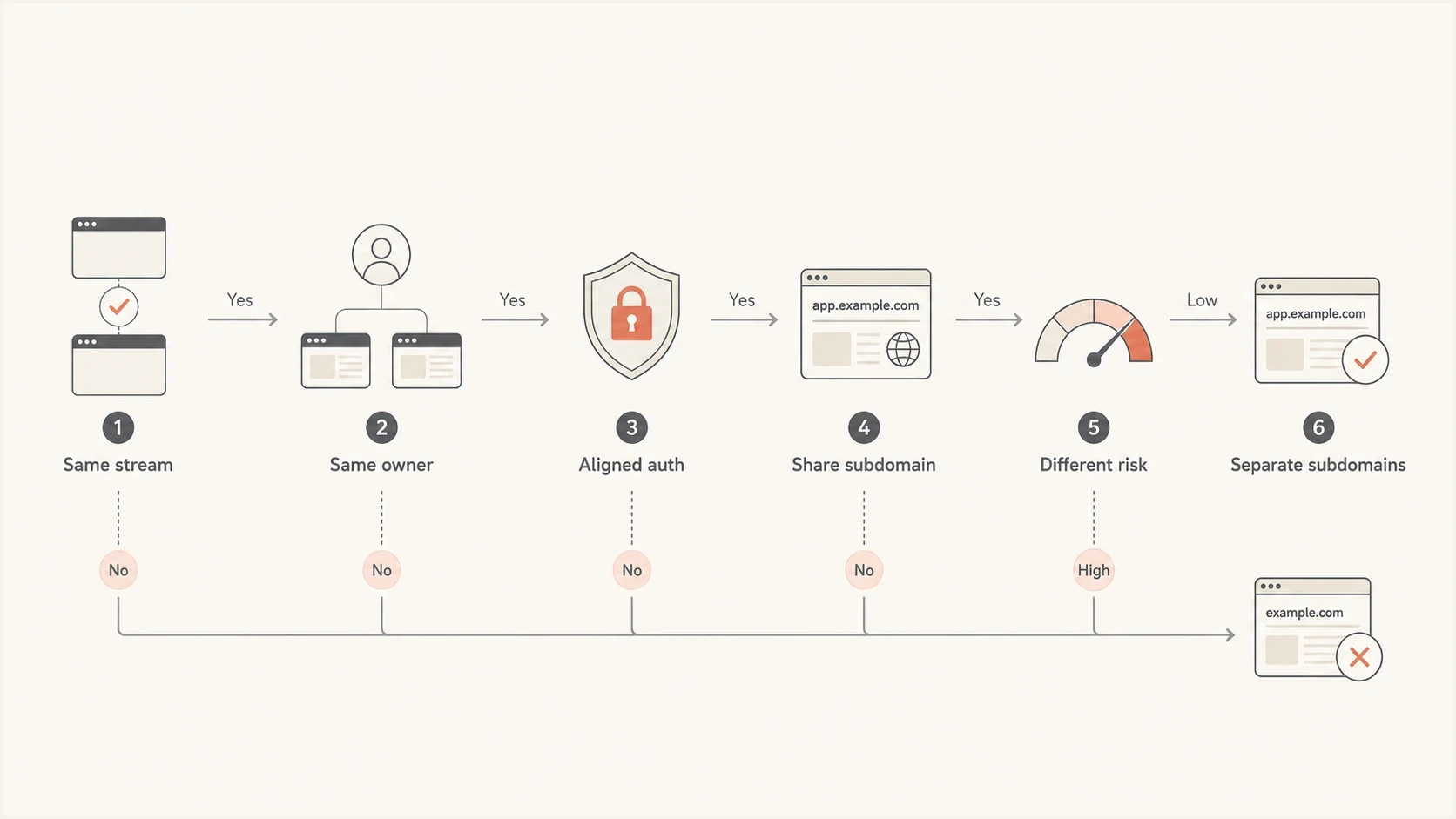
Decision path for shared versus separate ESP subdomains.
When one subdomain is fine
A single shared subdomain can be fine when the ESPs are really part of one sending operation. For example, two platforms both sending customer newsletters to the same opted-in audience can share a subdomain if the DNS setup is clean and the team has one owner for consent, segmentation, suppression, and sending cadence.
- Same audience: Both ESPs send to recipients collected through the same consent process.
- Same purpose: The messages have similar frequency, tone, and user expectation.
- Same controls: Suppression lists, unsubscribe rules, consent records, and QA belong to one owner.
- Same authentication quality: Both ESPs pass DKIM, and at least one authentication path aligns with the From domain.
The shared-subdomain approach reduces DNS records and keeps branding simple. It also avoids asking users to recognize several sender names. That can matter when your sending volume is low and your organization does not have a dedicated deliverability process.
Example shared subdomain patterntext
From domain: email.example.com
ESP A DKIM: selector-a._domainkey.email.example.com
ESP B DKIM: selector-b._domainkey.email.example.com
DMARC: _dmarc.email.example.com
If you share one subdomain, do not let both ESPs edit DNS records without review. Give each ESP its own DKIM selector and avoid overlapping CNAMEs. If one platform asks for a broad record that conflicts with another sender, stop and map the DNS first.
When separate subdomains are better
Separate subdomains are better when the ESPs send different streams or when one stream has more reputation risk. Marketing, sales automation, lifecycle, transactional, billing, and product notifications do not behave the same way. Mailbox providers do not treat them the same way either, because recipients do not engage with them the same way.
|
|
|
|---|---|---|
Marketing | email | Campaign volume and list quality change often. |
Lifecycle | updates | Triggered messages need cleaner continuity. |
Transactional | notify | Receipts, resets, and alerts need isolation. |
Sales | hello | Prospecting complaints can move quickly. |
Common subdomain split patterns
The most common mistake is mixing promotional campaigns and important account messages on the same subdomain. A campaign that gets poor engagement or a spike in complaints can drag down the reputation signals used for password resets, invoices, product alerts, or onboarding messages.
Shared subdomain
- Setup: Fewer DNS records and fewer visible sender names.
- Reputation: Signals are pooled across both ESPs.
- Debugging: Failures need source-level DMARC reporting to separate cleanly.
Separate subdomains
- Setup: More DNS work, but each ESP has clearer ownership.
- Reputation: Problems stay closer to the stream that caused them when authentication identities are also separate.
- Debugging: DMARC data, bounces, and complaints are easier to attribute.
One sending domain can be used with multiple ESPs, but a valid setup is not always the best operational choice. The more useful question is whether the streams should share reputation, authentication identities, and change control.
Authentication matters more than the label
Subdomain naming helps organization, but authentication decides whether receivers can validate the message. Every ESP should send with DKIM enabled. SPF should pass where possible. DMARC should see at least one of those authentication results align with the visible From domain.
DMARC is now defined by RFC 9989, with aggregate reporting defined separately by RFC 9990. In relaxed mode, the authenticated domain and From domain must have the same Organizational Domain. In strict mode, they must be identical. Publishing a DMARC record does not make messages pass if neither SPF nor DKIM produces an aligned identity.
Example DMARC record for monitoringdns
v=DMARC1; p=none; rua=mailto:dmarc-reports@example.com;
adkim=r; aspf=r
Starting at p=none is normal when you are adding or splitting ESPs. It lets you collect reports without requesting quarantine or rejection for failing mail. Once every legitimate source is known and passes DMARC, move to an enforcement policy with a documented rollback plan.
Do not use the reply mailbox for DMARC reports. Replies need a human workflow. DMARC aggregate reports need automation because they arrive as machine-readable XML files.
- Reply mail: Use a mailbox monitored by support, sales, or the campaign owner.
- DMARC reports: Use a dedicated reporting address connected to parsing and alerting.
- Policy changes: Tighten enforcement only after legitimate ESP traffic is visible and passes DMARC.
?
What's your domain score?
Deep-scan SPF, DKIM & DMARC records for email deliverability and security issues.
Before choosing a shared or separate pattern, check the current DNS state with a domain health check. Confirm whether the existing subdomain has one DMARC record, whether DKIM selectors are valid, whether SPF is close to the lookup limit, and whether old ESP records remain in DNS.
How to split two ESPs
When two ESPs already use the same subdomain, do not split them blindly. First inventory what each platform sends, which domains appear in the From header, which return-path domains are used, which DKIM selectors are live, and whether the links in the email use branded tracking domains.
- Inventory: List every ESP, stream, From domain, return-path domain, DKIM selector, and tracking domain.
- Classify: Group mail by recipient expectation, not by internal team name.
- Assign: Give each stream a stable subdomain that can keep its own authentication records.
- Authenticate: Enable DKIM with an aligned domain first, then align SPF where the ESP supports it cleanly.
- Cut over: Sync unsubscribes and other suppressions, assign each recipient to one ESP, then move engaged cohorts gradually.
- Monitor: Watch DMARC reports, complaint trends, bounces, and blocklist or blacklist signals after the cutover.
Example two-ESP splittext
Klaviyo marketing mail
From: offers@email.example.com
Return-path: bounce.email.example.com
DKIM: klaviyo._domainkey.email.example.com

Sugar Market nurture mail
From: hello.updates.example.com
Return-path: bounce.updates.example.com
DKIM: sugar._domainkey.updates.example.com
The exact labels matter less than the boundaries. Short, understandable names survive staff and platform changes. Avoid names tied to an ESP brand if the subdomain is really for a mail stream. If you later migrate platforms, email.example.com remains useful. A vendor-specific subdomain often becomes technical debt.
During a migration overlap, keep the From name, From address, message design, and cadence stable where practical. Synchronize global unsubscribes, hard bounces, and complaint suppressions before every traffic shift. Each recipient should receive a campaign through one ESP only. Compare delivery outcomes and server responses because the two platforms can calculate opens and clicks differently.
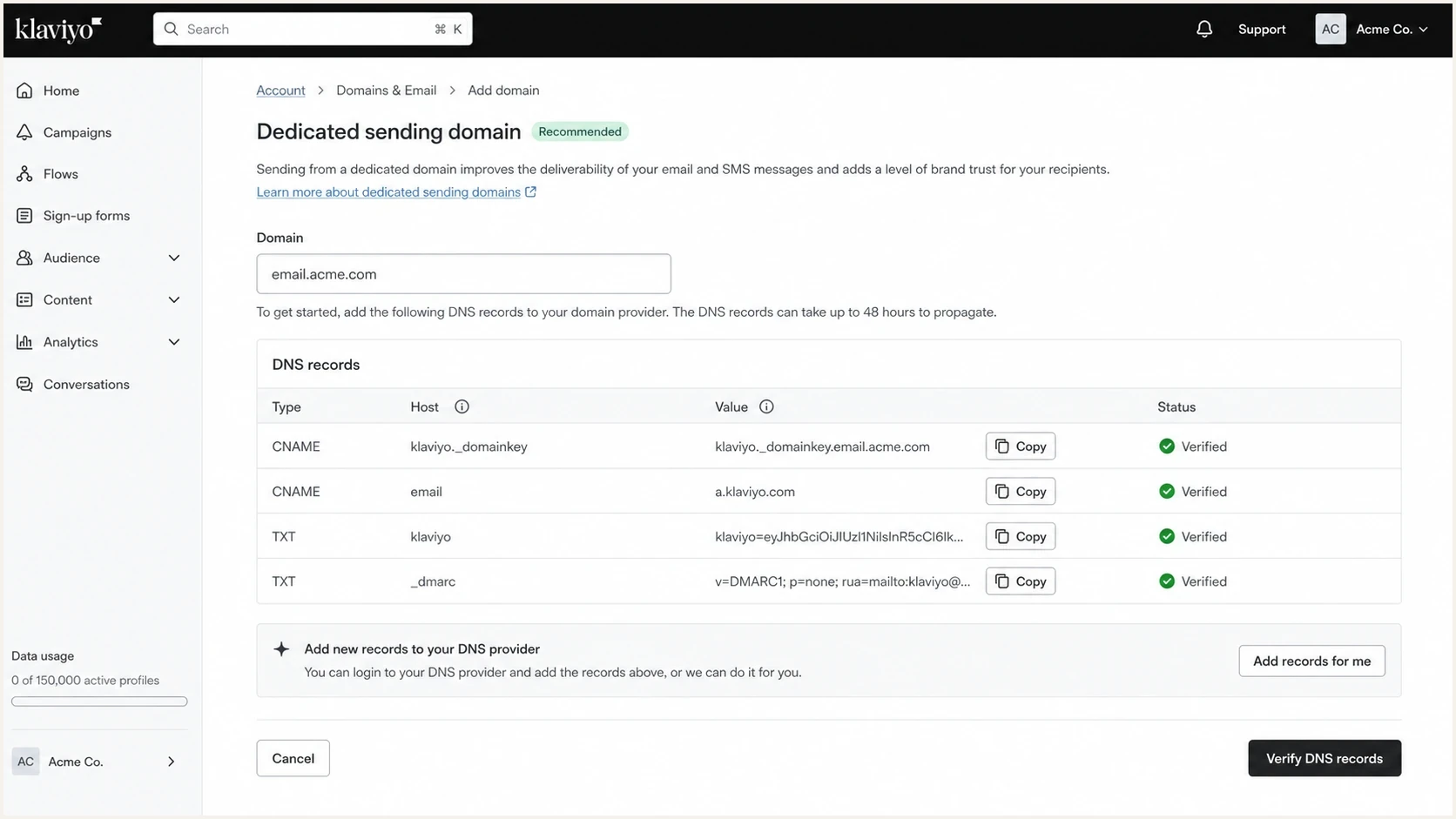
Klaviyo sender domain setup screen with DNS records.
Separate DKIM identities complete the split
Different visible From subdomains do not guarantee separate reputation or reporting. If both ESPs still sign with the same DKIM d= domain, a mailbox provider can associate both streams with that shared identity. Some provider reporting also rolls traffic up by DKIM domain, which can hide the benefit of the visible split.
Distinct aligned DKIM identitiestext
ESP A From: offers@email.example.com
ESP A DKIM d=: email.example.com

ESP B From: hello@updates.example.com
ESP B DKIM d=: updates.example.com
Treat the visible From domain, DKIM signing domain, return-path, and tracking domain as one identity plan. They do not need to be identical, but SPF or DKIM must align with the From domain for DMARC to pass.
- DKIM domain: Use a stream-specific aligned d= domain when the ESP supports it.
- DKIM selector: Give each ESP a unique selector so DNS records cannot overwrite each other.
- Return-path: Use a custom bounce domain where supported and confirm actual SPF alignment in a received message.
- Tracking domain: Keep branded links consistent with the stream and avoid sharing a risky redirect domain.
Do not assume a unique selector creates a unique reputation identity. Selectors identify keys beneath a DKIM signing domain. The d= value in the signature is the domain receivers evaluate, so inspect a delivered message rather than relying only on DNS labels.
Why DMARC monitoring decides the answer
The right subdomain plan should be based on evidence. DMARC aggregate reports show which sources are sending for each policy domain, whether SPF and DKIM pass, and whether either result aligns with the From domain. That makes it easier to see whether an ESP is safe to share a subdomain or needs its own.
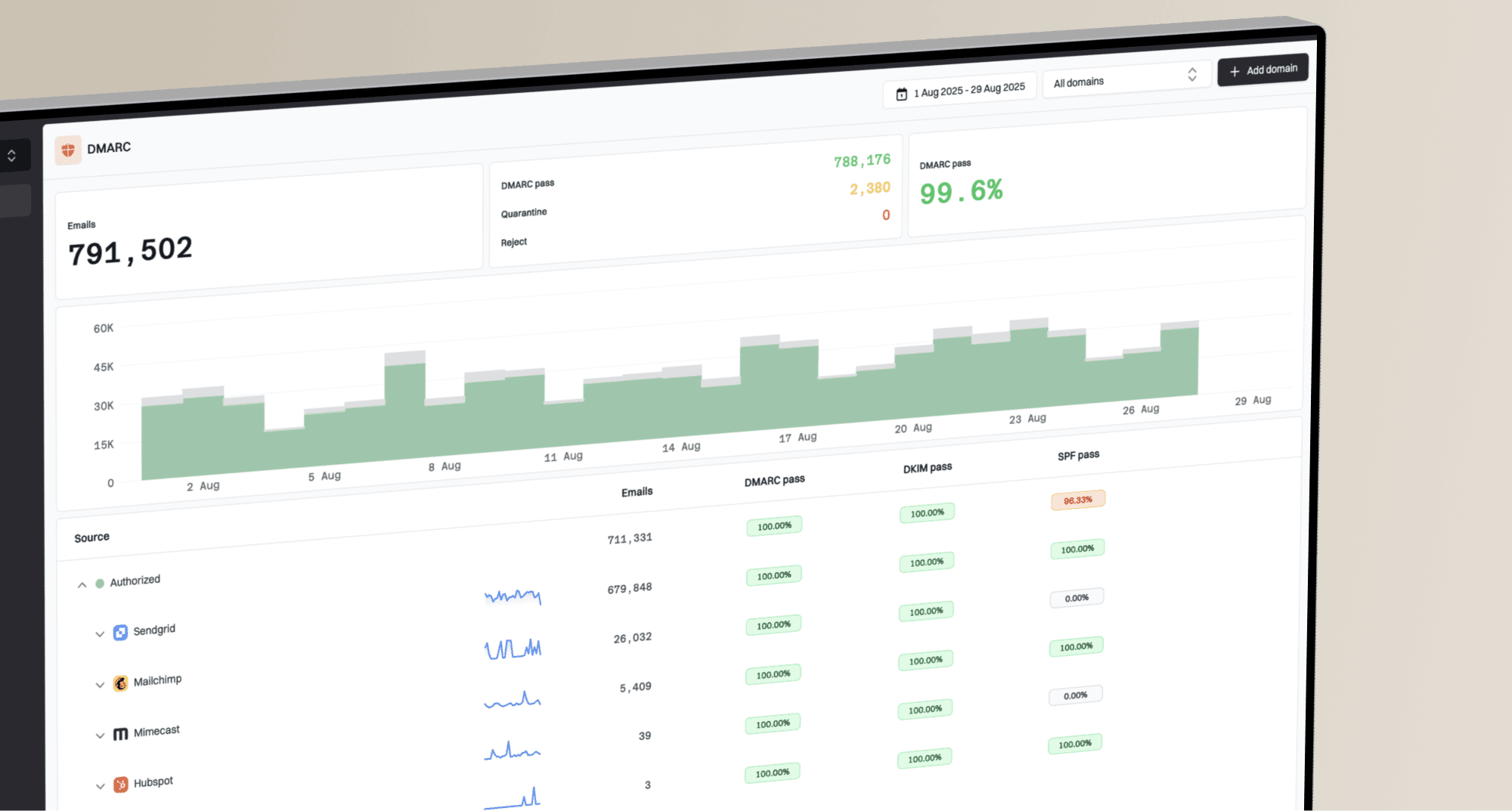
This is where Suped's product fits the workflow. In Suped, add the root domain and sending subdomains, review the source breakdown, confirm which ESPs are verified, and use issue detection to identify failed DKIM, SPF domain mismatches, duplicate records, or unknown senders. For teams managing several brands or clients, the multi-tenant dashboard keeps those decisions separate without requiring operators to work directly with raw XML.
Suped DMARC dashboard showing email volume, authentication health, and source breakdown
Suped's product also supports the operational work after DNS setup. Alerts show when a source starts failing, issue explanations help non-DNS owners understand the fix, and policy controls support a staged move to enforcement. Hosted DMARC and hosted SPF can help when marketing teams need sender changes but do not have direct DNS access.
If an ESP sends without aligned DKIM, naming alone will not fix the problem. A separate subdomain with broken DKIM still fails DMARC. A shared subdomain with aligned DKIM from both ESPs can be healthier than several poorly configured subdomains.
For broader implementation planning, DMARC monitoring gives you the source-level evidence needed before you enforce policy. A one-time DNS check does not show later sending changes or authentication regressions.
Watch reputation after the change
After splitting subdomains, give each stream time to develop its own reputation. Do not move every sender, change tracking domains, increase volume, and enforce DMARC on the same day. Change one layer at a time so failures have a clear cause.
New or quiet subdomains need a warm-up period because mailbox providers have less historical evidence. Start with engaged recipients, keep frequency predictable, and compare complaint rates and bounce rates before increasing volume. If a subdomain appears on a blocklist or blacklist after a change, pause volume increases and identify the stream that caused it.
For bulk mail, aim to keep user-reported spam rates below 0.1% and prevent them from reaching 0.3%. Treat 0.3% as an enforcement ceiling, not a target. Pause a ramp when complaints, temporary deferrals, hard bounces, or authentication failures rise.
Email tester
Send a real email to this address. Suped shows a results button when the test is ready.
?/43tests passed
Before sending production volume through a new ESP-subdomain pairing, send a real test message through the email tester. A DNS record can look correct while the actual message still uses the wrong return-path, misses a DKIM signature, or routes through an unexpected infrastructure source.
A good rollout has boring metrics. Authentication pass rates stay high, unknown source volume stays near zero, complaints stay stable, and no important mail stream loses inbox placement after the split.
- Week one: Send to the most engaged recipients and confirm DKIM alignment in real mail.
- Week two: Increase volume only if bounces, complaints, and DMARC failures stay controlled.
- Week three: Move less engaged segments after the subdomain has stable positive signals.
- Ongoing: Use blocklist monitoring for domain and IP reputation signals.
A practical naming model
Name subdomains by mail stream rather than by vendor. Vendor names change. Mail streams last longer. A good naming model also gives non-technical teams a map they can understand without reading DNS.
|
|
|
|---|---|---|
Promotions | email | Vendor name |
Product alerts | notify | Random prefix |
Lifecycle | updates | Team name |
Sales replies | hello | Tool label |
Short names keep subdomains readable
For marketing and transactional separation, keep transactional mail away from promotional sending. That split is covered more directly in marketing and transactional. The same reasoning applies when multiple ESPs exist because different platforms often map to different risk profiles.
Do not create more subdomains than you can monitor. Five neat subdomains with no DMARC visibility are worse than two well-managed subdomains with clear owners. The purpose of separation is control, not decoration.
Views from the trenches
Best practices
Separate streams when recipient expectations, list quality, or sending cadence clearly differ.
Keep reply addresses human-managed and route DMARC report addresses into automation.
Give each ESP its own selector and aligned DKIM domain so identities stay attributable.
Common pitfalls
Sharing one subdomain hides which ESP caused a complaint spike or authentication failure.
Publishing DMARC without checking domain matching leaves legitimate ESP traffic at risk.
Using vendor names in subdomains creates cleanup work when platforms are replaced later.
Expert tips
Treat subdomain splits as reputation boundaries, not as a substitute for consent quality.
Test the real message path because SPF domain matching depends on the envelope sender domain.
Stage policy changes after source discovery, authentication repair, and volume warm-up.
Marketer from Email Geeks says using the same subdomain across two ESPs can work, but it joins reputation signals more tightly than many teams expect.
2021-01-05 - Email Geeks
Marketer from Email Geeks says the first question is where the subdomain appears, because From, return-path, links, and replies affect different parts of the mail flow.
2021-01-05 - Email Geeks
The practical answer
Use different subdomains for multiple ESPs when the mail streams differ, when one stream has higher reputation risk, or when you need clean attribution. Use the same subdomain only when both ESPs send the same type of mail, to the same audience, under the same controls, and with authentication that aligns with the From domain.
The normal recommendation is separate subdomains, distinct aligned DKIM identities, conservative warm-up, DMARC monitoring from day one, and human-readable naming based on message type. Suped's DMARC monitoring, hosted SPF, hosted DMARC, real-time alerts, and blocklist monitoring connect DNS state, authentication results, and reputation signals in one workflow.
The clean setup is not the one with the fewest DNS records. The clean setup is the one where every legitimate sender is authenticated, every stream has a clear owner, and every failure can be traced to a source quickly.