Is there a legal requirement to keep unsubscribed email addresses for four years under CAN-SPAM?

Updated on 8 Aug 2026: We clarified that CAN-SPAM sets no four-year recordkeeping rule while opt-outs remain effective until later affirmative consent.
No. CAN-SPAM does not require a business to keep unsubscribed email addresses for four years. A four-year period is an internal legal or records policy unless another law or a claim-specific rule requires it. CAN-SPAM requires senders to honor opt-out requests within 10 business days, keep the opt-out mechanism working for at least 30 days after the message is sent, and stop covered marketing email unless the recipient later gives affirmative consent.
That does not mean deleting every trace of the address is safe. A sender needs a reliable way to avoid mailing the person again. The usual pattern is to delete or anonymize the contact profile and keep a minimal suppression record. The suppression record enforces the opt-out without leaving the person in an active marketing database.
This is operational guidance, not legal advice. If counsel requires four-year retention, ask for the legal basis, privacy basis, retention period, and exact data fields that must remain. In many systems, a narrow suppression record provides the required control with less privacy risk than a full contact record.
What CAN-SPAM requires
The FTC guide describes the unsubscribe duties in operational terms. It does not say that unsubscribe records must be kept for four years. It focuses on giving recipients a clear way to opt out, honoring the request promptly, and avoiding conditions that make the opt-out harder than the law allows.
The direct compliance duties
- Process an opt-out within 10 business days.
- Keep the opt-out mechanism working for at least 30 days after sending the email.
- Do not charge a fee or require information beyond the email address and opt-out preferences.
- If a preference menu offers category choices, include an option to stop all marketing messages.
- Do not sell or transfer opted-out addresses except for compliance with CAN-SPAM or another law.
Those requirements explain why unsubscribe data exists. They do not require a full customer profile, CRM record, activity history, tags, purchase data, segmentation fields, or engagement history to remain active after the person opts out of marketing.
The operational test is whether the system can document receipt of the request and prevent future marketing sends within its scope. A hard delete creates a reimport risk when the same address can return through a list upload, integration, or manual sales workflow.
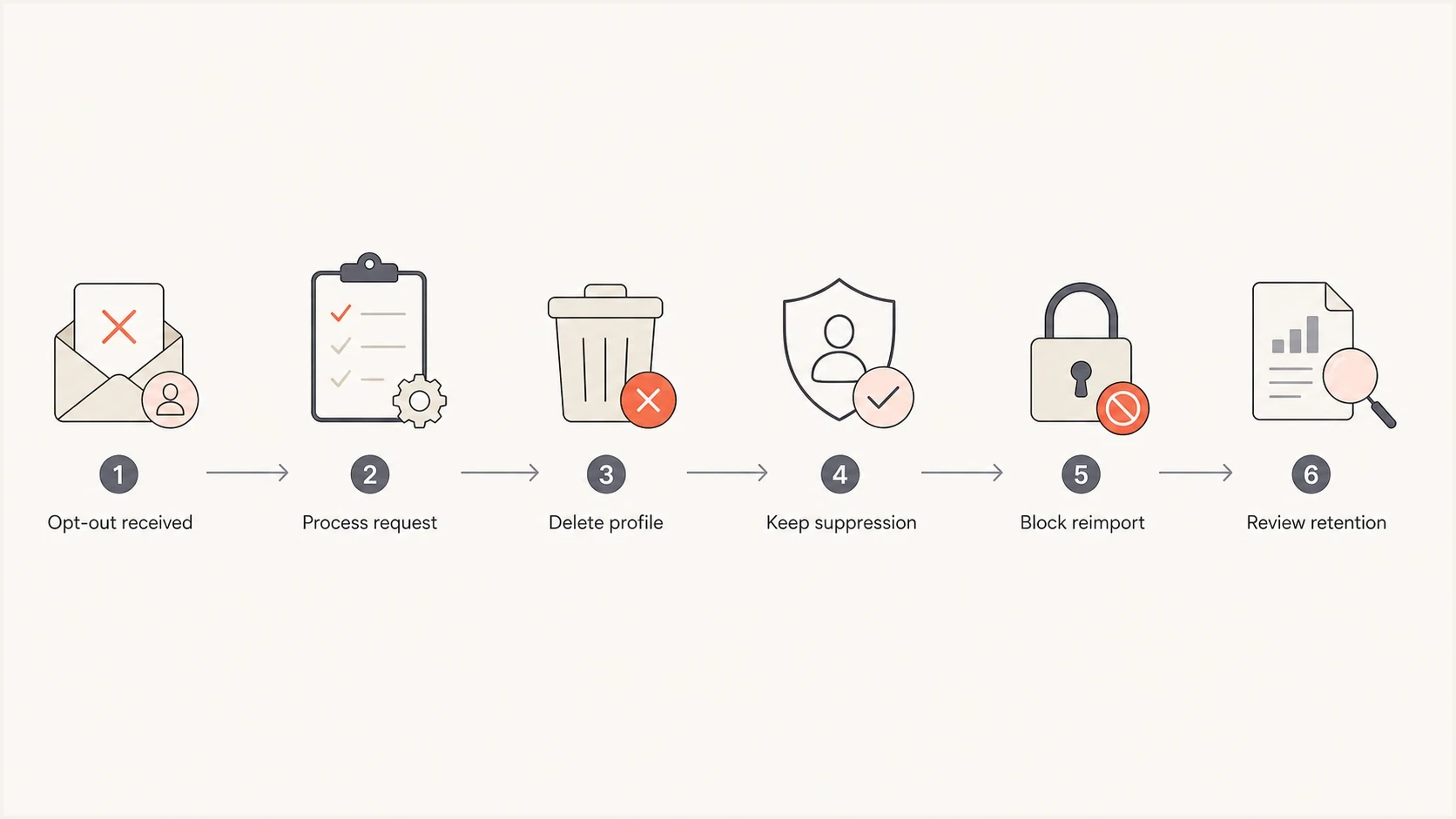
Flowchart showing how an opt-out becomes a minimal suppression record.
Keep retention for proof separate from retention for marketing operations. A suppression marker has a compliance purpose. A complete contact record is harder to justify when the recipient has asked to stop receiving marketing.
How long an opt-out remains effective
CAN-SPAM does not give opt-out requests an automatic expiration date. The FTC considered a time limit and declined to impose one. The statute allows covered commercial email to resume when the recipient gives affirmative consent after the opt-out request.
Manage an opt-out without inventing an expiry
- Keep the suppression effective unless the recipient later gives affirmative consent.
- Apply the suppression to the email address and message categories covered by the request.
- Record when, where, and how any later consent was obtained before marketing resumes.
- Do not treat a new list import or account update as renewed marketing consent.
Indefinite effectiveness does not require indefinite retention of a full profile. It requires a durable control that blocks covered marketing until valid later consent changes the recipient's choice.
Where the four-year idea comes from
A four-year number can come from litigation-risk or records-management analysis, not the unsubscribe provisions of CAN-SPAM. Legal teams sometimes map retention to a limitations period for a particular claim. That can support an internal records decision, but it does not create a universal requirement to keep every unsubscribed contact record for four years.
The risk with a blanket four-year rule is over-retention. Privacy notices, deletion requests, data minimization rules, and regional privacy laws can point toward keeping less data. A policy that retains all unsubscribed records for four years needs a documented purpose, field limits, access controls, and a way to separate suppression data from marketing data.
|
|
|
|---|---|---|
Full contact | Profile fields | High privacy risk |
Minimal suppression | Email plus scope | Practical default |
HMAC suppression | Keyed digest | Less raw exposure |
Full deletion | No marker | High remailing risk |
Common retention models for unsubscribed email addresses.
If counsel requires four years, ask for the policy in writing. Confirm which law or claim supports it, which fields are required, who can access the data, whether the privacy notice permits the retention, and what happens when a person submits a deletion request.
For timing duties outside the United States, compare the country timeframes. Also separate record retention from whether opt-outs expire. A suppression rule can remain effective while the underlying personal data stays minimal.
Build a suppression record instead of hoarding contacts
An unsubscribe system should keep enough data to stop future marketing, investigate disputes, and audit processing. It does not need to preserve a full marketing profile. A dedicated suppression table outside the active audience table gives the control a clear purpose.
Poor retention pattern
- The address stays in the CRM with tags, notes, source data, and engagement history.
- Marketing teams can still segment, export, or sync the unsubscribed contact.
- The company claims retention is required but cannot identify the fields that support that purpose.
Better retention pattern
- The profile is removed or anonymized while a narrow suppression marker remains.
- Only compliance systems and approved operations staff can use the record.
- Each retained field helps enforce the opt-out or document processing.
A minimal suppression record usually has the normalized email address or a keyed digest, the scope of the opt-out, the request timestamp, the source, the processing timestamp, and the processing system. Programs that send through multiple platforms also need downstream sync status and failure logs.
Minimal suppression record exampleJSON
{
  "email_hmac": "hmac_sha256:5f2a...",
  "scope": "all_marketing",
  "requested_at": "2026-05-28T10:15:00Z",
  "source": "unsubscribe_link",
  "processed_at": "2026-05-28T10:15:03Z",
  "processor": "marketing_platform",
  "sync_status": "complete"
}
A keyed HMAC can reduce exposure of the raw address when systems only need deterministic matching. The key needs strong protection, and the digest still needs retention limits and access controls. If the team cannot manage the key safely, a plaintext suppression list with strict access controls is more reliable.
Do not delete the only control
Full deletion is risky when the same address can be uploaded again through sales workflows, partner imports, abandoned carts, or support exports. If deletion removes the only suppression control, the system can mail the person again and create a CAN-SPAM violation.
The safer pattern is to delete or anonymize the marketing profile, then preserve a narrow suppression artifact. That gives operations a hard stop without keeping the person in the active audience.
Keep unsubscribe and domain controls separate
Unsubscribe compliance and email authentication address different risks. Ignored opt-outs increase complaint and legal risk. Broken SPF, DKIM, or DMARC creates authentication and spoofing risk. Review both, but do not treat authentication results as proof that the suppression workflow complies with CAN-SPAM.
After an unsubscribe incident, inspect the message, the List-Unsubscribe headers, the visible unsubscribe path, and authentication results. Send a real campaign sample through the email tester to confirm that the message has the expected headers, authentication, and content signals.
Email tester
Send a real email to this address. Suped shows a results button when the test is ready.
?/43tests passed
A test message does not prove that the suppression database works. Test request intake, the processing timestamp, cross-platform sync, and reimport blocking separately.
Suped's product supports the domain-side workflow with DMARC reporting, SPF and DKIM visibility, hosted policies, real-time alerts, and blocklist (blacklist) monitoring. It does not determine a legal retention period or validate suppression logic, so those controls need separate review.
Suped DMARC dashboard showing email volume, authentication health, and source breakdown
For the domain side, check the sending domain with a domain health checker, review authentication through DMARC monitoring, and track reputation through blocklist monitoring. The legal unsubscribe question remains separate, but suppression and domain controls both need to work.
A defensible retention policy
A defensible policy starts with the business purpose. The purpose is to enforce the opt-out, prevent accidental remailing, and document when the request was processed. It is not to keep a marketable profile of someone who has opted out.
- Define whether the opt-out covers all marketing, a brand, a business unit, or a message category.
- Keep only the address marker, request and processing timestamps, source, scope, and status.
- Remove segmentation, lead scores, notes, behavioral history, and enrichment fields.
- Limit suppression data to systems and people that need it for compliance.
- Upload the same address in a controlled test and confirm that marketing sends remain blocked.
- Compare the policy with privacy notices, deletion workflows, and regional laws.
If a legal team chooses four years, ask it to approve the narrowest data model that meets the documented need. Four years of a minimal suppression marker has a different privacy impact than four years of full contact history.
The policy sentence to use
After a marketing opt-out, we delete or anonymize nonessential contact data and retain only the minimum suppression data needed to honor the opt-out, prevent reimport, document processing, and meet approved legal retention requirements.
This language gives legal, privacy, marketing, and operations teams a shared target. It also prevents the suppression list from becoming another marketing list.
Views from the trenches
Best practices
Keep only suppression data needed to block future marketing and prove processing timing.
Separate opt-out records from active CRM profiles so marketers cannot campaign to them.
Ask legal teams to document the retention basis and approve the minimum field list.
Common pitfalls
Treating a four-year legal preference as a CAN-SPAM rule creates unnecessary retention.
Deleting every trace without suppression lets the same address return through imports.
Keeping old unsubscribed profiles can conflict with privacy notices and deletion rights.
Expert tips
Use a keyed digest when raw addresses do not need to be exposed across every system.
Run periodic reimport tests to prove the suppression control blocks new list uploads.
Document vendor sync failures because opt-out timing depends on downstream systems.
Marketer from Email Geeks says the four-year claim is not a CAN-SPAM requirement and is more likely an internal legal retention policy.
2024-03-12 - Email Geeks
Marketer from Email Geeks says retaining full unsubscribe data for years can conflict with deletion expectations and privacy commitments.
2024-06-19 - Email Geeks
The practical answer
CAN-SPAM does not require keeping unsubscribed email addresses for four years. It requires prompt opt-out processing, and the opt-out has no automatic expiry. Covered commercial email can resume after the recipient gives later affirmative consent.
A practical default is minimal suppression instead of full retention. Delete or anonymize the contact profile, retain the fields needed to honor the opt-out and document processing, restrict access, and test that future imports cannot bypass the control.