How to troubleshoot ProofPoint deferrals and IP reputation issues?

Updated on 13 Aug 2026: We updated this guide with Proofpoint's current guidance on 421 throttling, 554 blocking, source IP checks, and escalation.
If Proofpoint returns a 421 Deferred response with IP_REPUTATION, treat it as temporary throttling tied to the sending IP and unusual or unexpected sending patterns. It is not proof of a current public blocklist or blacklist entry. The fastest path is to confirm the SMTP evidence, check whether the mail later delivers, rule out authentication and DNS defects, stop suspicious outbound traffic, reduce risky sending, and escalate with exact headers, timestamps, recipient domains, and retry results.
The confusing part is that the Proofpoint error can point to an IP lookup page even when the lookup returns clean. A clean result confirms that no current block is shown when the IP is checked. It does not explain an earlier deferral or guarantee immediate acceptance at every Proofpoint-protected domain.
The short answer
Do not keep refreshing the lookup page when Proofpoint defers mail for IP reputation. Build a case file with the full SMTP response, source IP, sender domain, envelope sender, message IDs, retry history, eventual delivery status, sending volume, complaint and unsubscribe handling, and recent authentication results. Use that evidence to stop local abuse, correct technical issues, and reach the team that owns the sending IP or Proofpoint account.
What the 421 Proofpoint deferral means
A Proofpoint 421 deferral is a temporary SMTP response. The receiving system has not accepted the message, but it has not issued a permanent rejection. Your sending system retries according to its queue schedule until the message is accepted or its configured queue lifetime expires. A later delivery and a final non-delivery therefore need separate tracking.
Current Proofpoint deferral pattern
421 Deferred - see https://proofpoint.com/postmaster/?ip=1.2.3.4
Your IP is being throttled due to unusual or unexpected sending patterns.
Proofpoint's current Postmaster guidance maps 421 Deferred to throttling of the sending IP for unusual or unexpected patterns. Domain reputation, content, and authentication affect broader filtering, but they should not be presented as the direct meaning of this specific 421 response. Treat the code as an IP-level clue, then check the wider sender setup for conditions that weaken recovery.
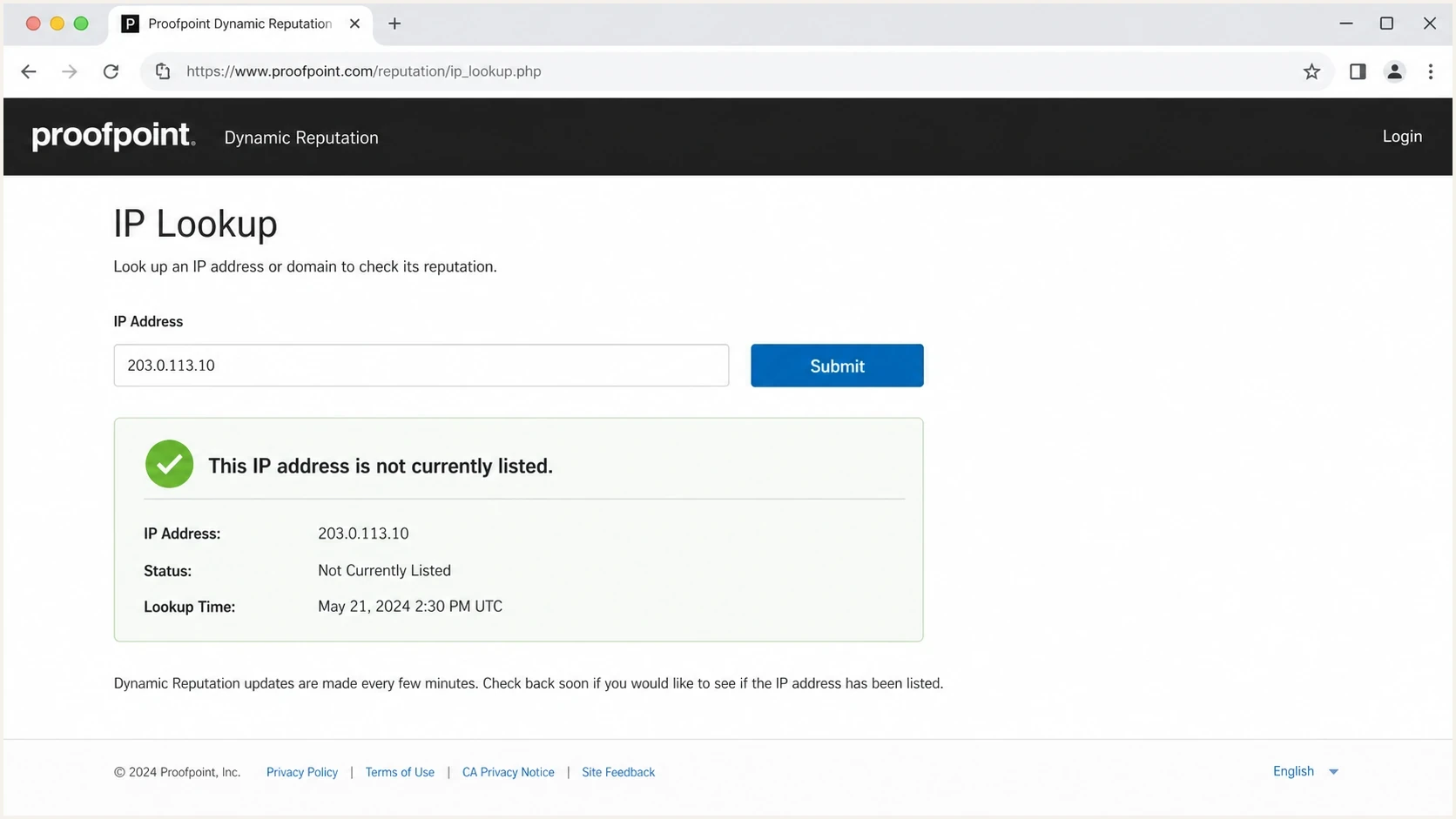
Proofpoint Dynamic Reputation lookup showing an IP that is not currently blocked.
What a clean lookup proves
- Current status: Proofpoint is not showing a current Dynamic Reputation block for the checked IP.
- No active delist path: There is no current block for a repeat delist request to remove.
- Time-specific evidence: The result documents the IP status at the time of the check.
What it does not prove
- No earlier delay: Dynamic reputation changes quickly, so a clean result does not erase an earlier 421 event.
- Immediate acceptance: A protected recipient can still defer mail while local policy or reputation signals change.
- Healthy sender setup: The lookup does not validate SPF, DKIM, DMARC, rDNS, HELO, TLS, consent, or list hygiene.
Fast triage checklist
Start with evidence that separates a Proofpoint-only pattern from a general deliverability problem. Group results by recipient domain and receiving gateway, then compare the same campaigns at other mailbox providers. This shows whether one IP, one recipient group, or the whole sending stream needs attention.
- Capture the exact SMTP response: Keep the full 421 response, timestamp, recipient domain, source IP, envelope sender, queue ID, and message ID.
- Measure retry outcomes: Separate messages that later deliver from messages that expire in the queue.
- Group by recipient system: Map affected domains to Proofpoint gateways where possible instead of treating all domains as equal.
- Audit authentication: Confirm SPF, DKIM, DMARC, rDNS, HELO or EHLO, TLS, and visible From domain consistency.
- Review list origin: Document opt-in source, confirmation flow, suppression timing, and complaint handling.
- Escalate with proof: Route the case to the team that owns the sending IP or the recipient's authorized Proofpoint support contact.
Internal deferral severity guide
Use these example thresholds to set urgency, then adjust them for normal traffic and queue behavior.
Watch
Under 5%
Short retry delays with later acceptance
Investigate
5-15%
Repeated retries or campaign-level delay
Escalate
Over 15%
Material non-delivery or queue expiry
Check authentication and DNS before chasing reputation
Proofpoint's current Postmaster guidance calls for valid forward and reverse DNS, a fully qualified HELO or EHLO hostname that matches rDNS, current SPF, DKIM, and DMARC records, STARTTLS support, and standards-compliant headers and MIME. These controls do not erase an IP reputation event, but defects create separate reasons for delayed or blocked mail and weaken an escalation.
Run a broad domain health check first, then send a real message through an email tester. DNS checks prove what is published. A delivered sample shows what the receiving side sees in the actual headers.
Email tester
Send a real email to this address. Suped shows a results button when the test is ready.
?/43tests passed
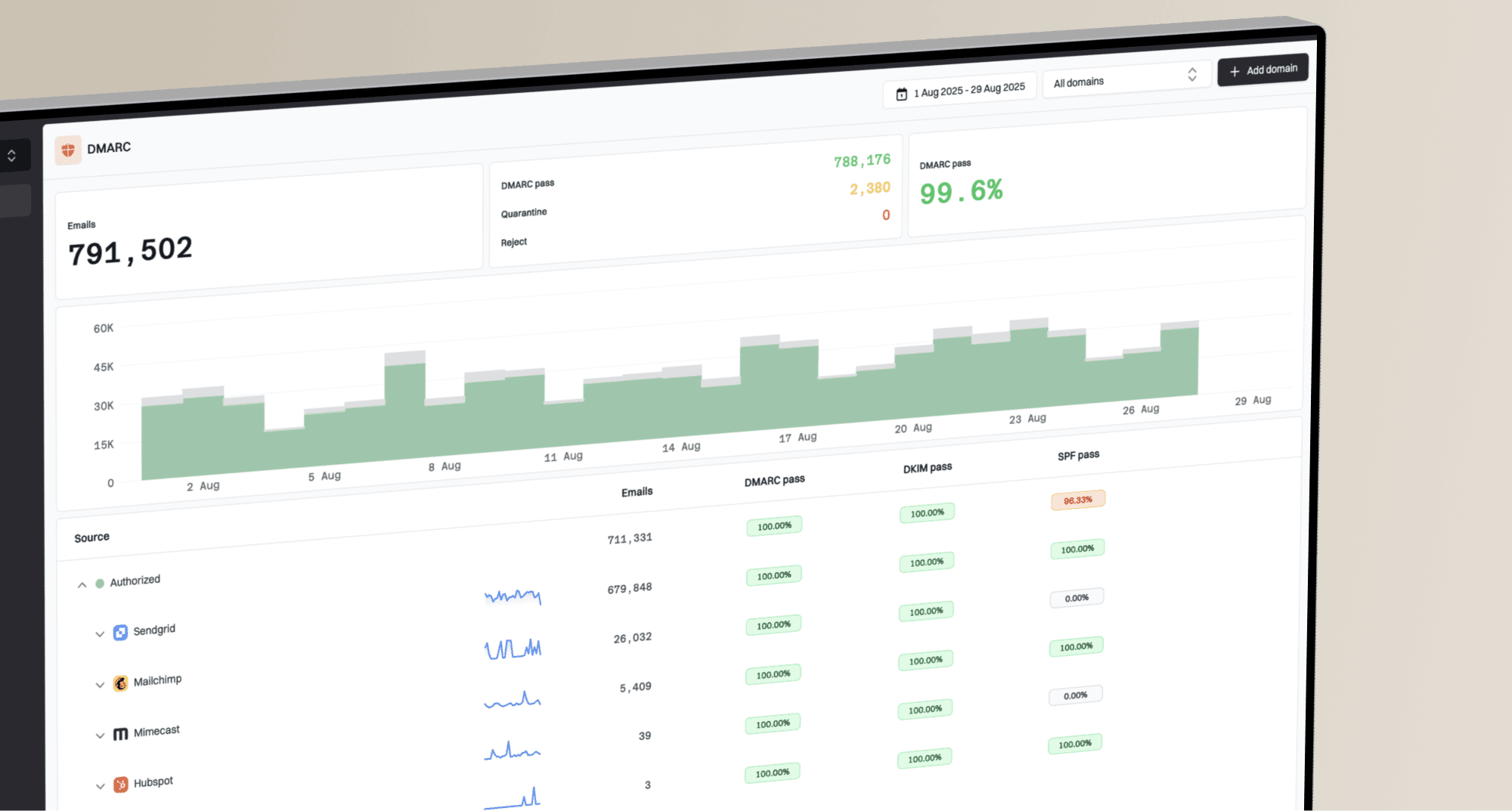
For DMARC, daily visibility across every source using the domain makes the investigation reproducible. Suped's DMARC monitoring shows authentication pass rates, unknown senders, and policy gaps. Suped's product can keep that evidence beside SPF and DKIM diagnostics and blocklist or blacklist alerts, which gives the deliverability team a consistent record of what passed and what changed.
DMARC record detail view showing SPF, DKIM, DMARC, rDNS diagnostics, and DNS records
Confirm the source IP and stop abusive traffic
The IP in the Proofpoint response is the public source IP that connected to the recipient. It can belong to an outbound relay or shared sending pool rather than the application or server where the message originated. Verify that egress path before changing DNS or submitting a request for the wrong IP.
- Trace the egress path: Match the IP in the 421 response to the relay, NAT gateway, or sending pool that made the SMTP connection.
- Inspect outbound queues: Look for compromised accounts, infected systems, open relay behavior, form abuse, or sudden tenant-level volume.
- Check shared responsibility: On a shared IP, ask the sending platform whether another sender affected the pool and whether traffic can be isolated.
- Stabilize before escalation: Stop the bad traffic, secure affected systems, and document the remediation before requesting a reputation review.
Short delays can clear automatically
Proofpoint says an IP that shows spam indicators can be delayed for a short time and often leaves delay status automatically within minutes after the signal stops. Continuing suspicious traffic can turn a temporary delay into a block or cause the status to return. Fix the source before resuming normal volume.
Separate 421 throttling from 554 blocking
A sender can have a Proofpoint-specific reputation problem without appearing on every major blocklist or blacklist. The reverse is also true: a public listing can explain broad delivery trouble even when Proofpoint is only one of several systems reporting a problem. Check both, but follow the SMTP status that actually occurred.
|
|
|
|---|---|---|
421 Deferred | Temporary IP throttling | Track retries and stop unusual traffic |
554 Blocked | Permanent rejection for that attempt | Remediate and submit a delist request |
Clean lookup | No current PDR block | Contact the affected recipient organization |
Authentication failure | Separate trust defect | Fix DNS or signing |
Use the exact SMTP response and lookup status to choose the next action.
When a public listing exists, resolve it before asking for deeper review. Suped's blocklist monitoring tracks domain and IP listings with severity and status. The terms blacklist and blocklist are often used interchangeably, so keep both in incident notes where that helps stakeholders find the evidence.
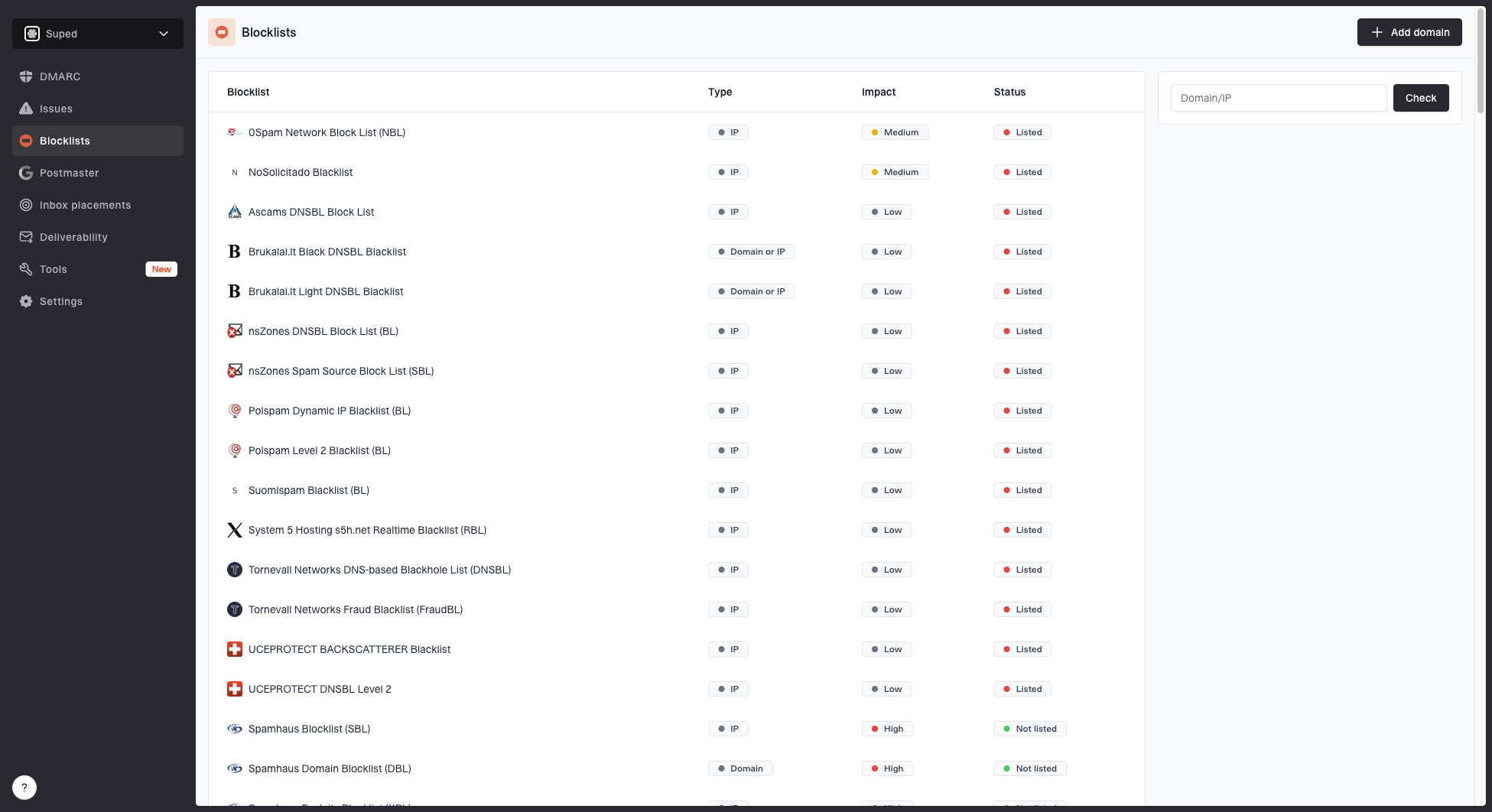
Blocklist monitoring page showing domain and IP checks across blocklists with importance and status
If Proofpoint shows the IP as blocked, follow the official Proofpoint delisting process after remediation. If the lookup shows no current block but an organization still defers the mail, contact that recipient's mail administrator. Proofpoint states that an outside sender cannot open a support case directly, but the recipient organization's authorized contact can. Hosted senders should also involve the platform's deliverability team because it owns the egress logs and IP.
Fix the sending pattern that Proofpoint sees
A fresh dedicated IP has little reputation history. If a B2B sender moves substantial volume onto it before positive acceptance signals accumulate, corporate gateways can defer aggressively. Proofpoint recommends gradual increases and says not to exceed twice the previous volume. Use accepted mail to engaged recipients as the baseline. Slower unwanted mail still damages reputation.
Sending changes that help
- Warm with engaged recipients: Start with recent openers, clickers, buyers, and known business contacts.
- Pause weak sources: Remove old event scans, purchased names, partner swaps, and unclear consent sources.
- Use steady volume: Avoid sudden jumps, stop-start bursts, and large one-off campaigns during recovery.
- Separate message streams: Keep marketing traffic apart from transactional or person-to-person mail.
Signals that hurt
- Broken signup proof: A non-working newsletter form weakens the evidence that every address has clear consent.
- Mixed intent: Marketing campaigns and transactional notices on one IP blur reputation.
- Retry blindness: Counting only final bounces hides how many messages spent hours being deferred.
- Uncontrolled users: Compromised accounts or shared tenants can keep the IP in a delay cycle.
The consent check matters because Proofpoint evaluates whether traffic from the IP looks wanted by the receiving population. If the website signup flow is broken, or records come from sources that recipients do not recognize, technical fixes will not carry the whole recovery.
Illustrative recovery ramp
Example only. Base increases on accepted mail to engaged recipients, and never exceed twice the previous stable volume.
Daily engaged-recipient volume
Escalate with evidence, not screenshots alone
If you send through an ESP, that platform owns the logs and operational path needed to resolve a difficult Proofpoint deferral on its IP. The useful request is an escalation to its deliverability team with enough data to reproduce the pattern. For mail sent directly to a Proofpoint-protected organization, the recipient's mail administrator has the customer support path.
For a deeper escalation workflow, use the sibling page on contacting Proofpoint support. Keep the request short and attach a structured evidence table.
Escalation template
Subject: Proofpoint 421 IP_REPUTATION deferrals on dedicated IP

Sender domain: example.com
Sending IP: x.x.x.x
Platform account: account name or ID
First observed: YYYY-MM-DD HH:MM UTC
Affected recipients: share of list and Proofpoint-protected domains
SMTP response: full 421 Deferred response
Retries: attempt count, timing, and final status
Authentication: SPF result, DKIM result, DMARC result
Recent actions: abuse stopped, volume reduced, weak segments paused
Request: escalate for Proofpoint reputation review
What to include
- Message samples: Provide at least five message IDs across different recipient domains.
- Queue history: Show which samples delivered later and which expired after retry.
- Sender changes: List the exact abuse cleanup, suppression, ramp, and authentication fixes already completed.
- Recipient impact: Quantify the affected share, affected domains, and campaign names.
Where Suped fits in the workflow
Suped's product cannot force Proofpoint to accept a message. Its role in this workflow is to reduce unknowns before escalation by showing whether authentication passes, which senders use the domain, and whether the domain or IP has blocklist or blacklist exposure.
Issues page showing top issues, verified sources, unverified sources, and authentication pass rates
The practical Suped workflow is to add the domain, verify DMARC reporting, review authentication sources, fix unverified senders, check SPF DNS lookup complexity, turn on alerts for sudden failure spikes, and keep blocklist monitoring active while the sending pattern is repaired. MSPs and agencies can repeat the same checks across client domains in the multi-tenancy dashboard.
Views from the trenches
Best practices
Record every SMTP response with timestamp, recipient domain, IP, and retry outcome.
Validate consent paths and public signup forms before claiming the list is confirmed.
Ask the sending platform to escalate once the evidence shows a repeated pattern.
Common pitfalls
Refreshing the Proofpoint lookup can waste time when the IP is not publicly listed.
Generic support tickets stall when they lack message IDs, queue history, and domains.
Reducing volume fails when old, weak, or unclear-permission segments remain active.
Expert tips
Treat deferrals and final non-delivery as separate metrics during reputation recovery.
Keep the case focused on one IP, one domain, and a short set of reproducible samples.
Fix visible acquisition defects because they weaken the sender's consent narrative.
Marketer from Email Geeks says a Proofpoint deferral does not guarantee the IP will appear in the public lookup, even when the SMTP response points there.
2024-08-12 - Email Geeks
Marketer from Email Geeks says concrete advice requires the sending domain, IP address, consent path, and evidence of how addresses were acquired.
2024-08-12 - Email Geeks
Proofpoint deferral recovery sequence
Proofpoint IP reputation deferrals need evidence first and reputation repair second. The public lookup is one time-specific signal. The work is to verify the egress IP, stop abusive traffic, prove the sending stream is authenticated and stable, and show the responsible support team what happened on each retry.
Use this order: capture the SMTP response, measure retries, verify the source IP, stop suspicious traffic, confirm DNS and authentication, audit acquisition, reduce sending to the best-recipient segment, monitor blocklists and blacklists, then escalate with samples. Each step either removes a cause or produces evidence the next team can act on.