How to recover domain reputation after SES credentials were stolen?

Published 25 Apr 2025
Updated 9 Aug 2026
11 min read
Summarize with
Updated on 9 Aug 2026: We updated this guide for RFC 9989, current SES complaint thresholds, Outlook.com terminology, and a safer send-based recovery plan.
To recover domain reputation after SES credentials were stolen, first prove the abuse has stopped, then rebuild trust through clean authentication, reduced volume, engaged recipients, low complaints, and steady sending. There is no reputation reset button at Gmail or Outlook.com (including Hotmail addresses). The fastest path is disciplined containment and a conservative rewarm.
If the compromise was fixed three weeks ago and the sender has only made two or three weekly sends since then, recovery is still at an early stage. Expect several more clean sends, and a longer recovery if the stolen SES credentials produced high volume, hit spam traps, or drove complaints.
- Containment: Delete the stolen SES SMTP credentials, revoke the underlying IAM access keys, and close the WordPress entry point.
- Proof: Confirm there are no unknown SES sends, no unusual bounce spikes, and no fresh DMARC failures.
- Rewarm: Send first to recent clickers, repliers, and active customers, then expand by engagement age after each clean send.
- Reader signals: Use web, social, and account channels to ask real subscribers to find the email and mark it as not spam.
First contain the SES incident
Treat stolen SES credentials as an active security incident, not only a deliverability issue. SES SMTP credentials are derived from IAM credentials, so deleting a plugin password is not enough. Remove the abused access path, revoke every affected key, and check whether the same WordPress plugin or hosting account exposed other credentials.
Check SES reputation messages for AWS warnings, including compromised-credential notices or a sending review, then compare them with Gmail and Outlook.com placement. AWS account status and mailbox-provider reputation are separate signals. A healthy SES account does not prove the domain has recovered.
- Revoke keys: Disable and delete the affected IAM access keys, create new SES SMTP credentials only after containment, and remove old secrets from code, plugins, and backups.
- Fix WordPress: Patch or remove the vulnerable plugin, check admin accounts, scan for web shells, and rotate CMS, hosting, and database passwords.
- Audit SES: Review every active AWS Region for sending volume, configuration changes, CloudTrail events, sending identities, and suppression activity.
- Limit access: Use least-privilege IAM policies, MFA, separate production credentials, secure secret storage, and alerts for volume spikes or new key use.
- Document scope: Record the abuse dates, volume, SES Regions, sending IPs, identities, subject patterns, and the first clean send after remediation.
Do not rewarm on an uncertain stack
If any compromised credential, plugin, cron job, or hidden admin account remains active, every recovery send becomes new evidence against the domain. Pause nonessential mail until the account is clean and the sending path is understood.
Identify which reputation was damaged
A stolen SES credential does not automatically damage every domain in the account. Trace the abusive messages to the visible From domain, DKIM signing domain, MAIL FROM domain, sending IP, SES Region, and configuration set. That evidence separates domain reputation damage from IP reputation damage and SES account enforcement.
|
|
|
|---|---|---|
From and DKIM domains | Abusive message headers | Rewarm the named domain |
MAIL FROM domain | Return-Path and SPF result | Repair the SES bounce identity |
Sending IP | Received headers and IP pool | Assess shared or dedicated IP impact |
SES account and Region | Reputation message and CloudTrail | Resolve any review or sending pause |
Evidence that identifies the damaged sending identity.
If the abusive mail used the normal From domain and its DKIM signature, that domain needs a controlled rewarm even when SES has returned to healthy status. If the domain never appeared in the abusive messages, do not create a new domain problem by forcing an unnecessary rewarm. Focus on the SES account, affected identity, or dedicated IP that the evidence names.
Check authentication before warming
Domain reputation recovery needs a consistent identity. Gmail and Outlook.com should see the same visible From domain and the expected DKIM signing domain. SPF should pass for the MAIL FROM domain, while DMARC should pass through DKIM or SPF with a domain that matches the visible From address. In Suped, the domain health checker confirms the basic DNS state before sending resumes.
For SES, use Easy DKIM or BYODKIM and verify production headers, not only the DNS records. A custom MAIL FROM subdomain needs the SES-provided MX and SPF records for the correct Region. It helps DMARC through SPF only when the MAIL FROM domain matches the visible From domain under the requested comparison mode.
Example SES MAIL FROM and DMARC recordsDNS
mail.example.com. MX 10 feedback-smtp.us-east-1.amazonses.com.
mail.example.com. TXT "v=spf1 include:amazonses.com ~all"
_dmarc.example.com. TXT "v=DMARC1; p=none; rua=mailto:dmarc@example.com"
Use the Region and values shown for the SES identity, and publish exactly one DMARC record. RFC 9989 made the pct tag historic, so do not use pct=25 to stage enforcement. Keep p=none while inventorying legitimate sources, then change the single policy record only after reports show expected mail is passing.
Authentication is necessary, not sufficient
SPF, DKIM, and DMARC do not erase abusive mail that already happened. They make recovery sends easier to verify and help prove that new unauthorized mail is no longer leaving through the same domain.
Use a controlled recovery send plan
The recovery plan should be predictable. Keep the same From name, domain, newsletter format, and cadence, but use a much smaller audience. For a 40,000-person weekly magazine list, start with subscribers who clicked, replied, paid, or logged in during the last 30 days. Add older engagement groups only after Gmail and Outlook.com placement improves.
Risky recovery pattern
- Full list: Sending to all 40,000 subscribers before mailbox providers see clean engagement.
- New creative: Changing templates, domains, link patterns, or subject style during recovery.
- Mixed intent: Combining an apology, a promotion, and the normal editorial message in one send.
Stronger recovery pattern
- Engaged first: Start with recent clickers, paid members, account users, and direct replies.
- Stable identity: Use the normal newsletter domain, DKIM identity, cadence, and editorial format.
- Clear gate: Expand only when spam placement, complaints, bounces, and temporary deferrals stay controlled.
Example recovery volume cap
A cautious rewarm for a weekly sender after SES credential abuse.
Share of normal list
These percentages are planning caps, not a fixed schedule. If Gmail or Outlook.com placement gets worse, hold the current segment or reduce volume. If complaints or deferrals rise, stop the campaign and tighten the audience again.
Rebuild Gmail and Outlook.com trust
Gmail and Outlook.com rebuild trust when recent mail gets normal recipient behavior and few negative signals. Use first-party clicks, replies, purchases, and account activity to choose the recovery audience. Treat opens as a weak selection signal because privacy protections and image caching can inflate them. A guide on why domain reputation drops provides background, but after stolen SES credentials the practical fix is a proof-based rewarm.
- Use strongest cohorts: Start with subscribers who clicked, paid, logged in, or replied recently. Use opens only with stronger activity.
- Ask outside email: Post a clear notice on the website, app, and social channels asking readers to find the newsletter and mark it as not spam.
- Lower complaint risk: Keep one-click unsubscribe working, show an unsubscribe link in the message body, and avoid sudden frequency changes.
- Prune hard: Suppress hard bounces, complainers, role accounts, and long-inactive addresses. Keep consent records and use double opt-in for new subscriptions.
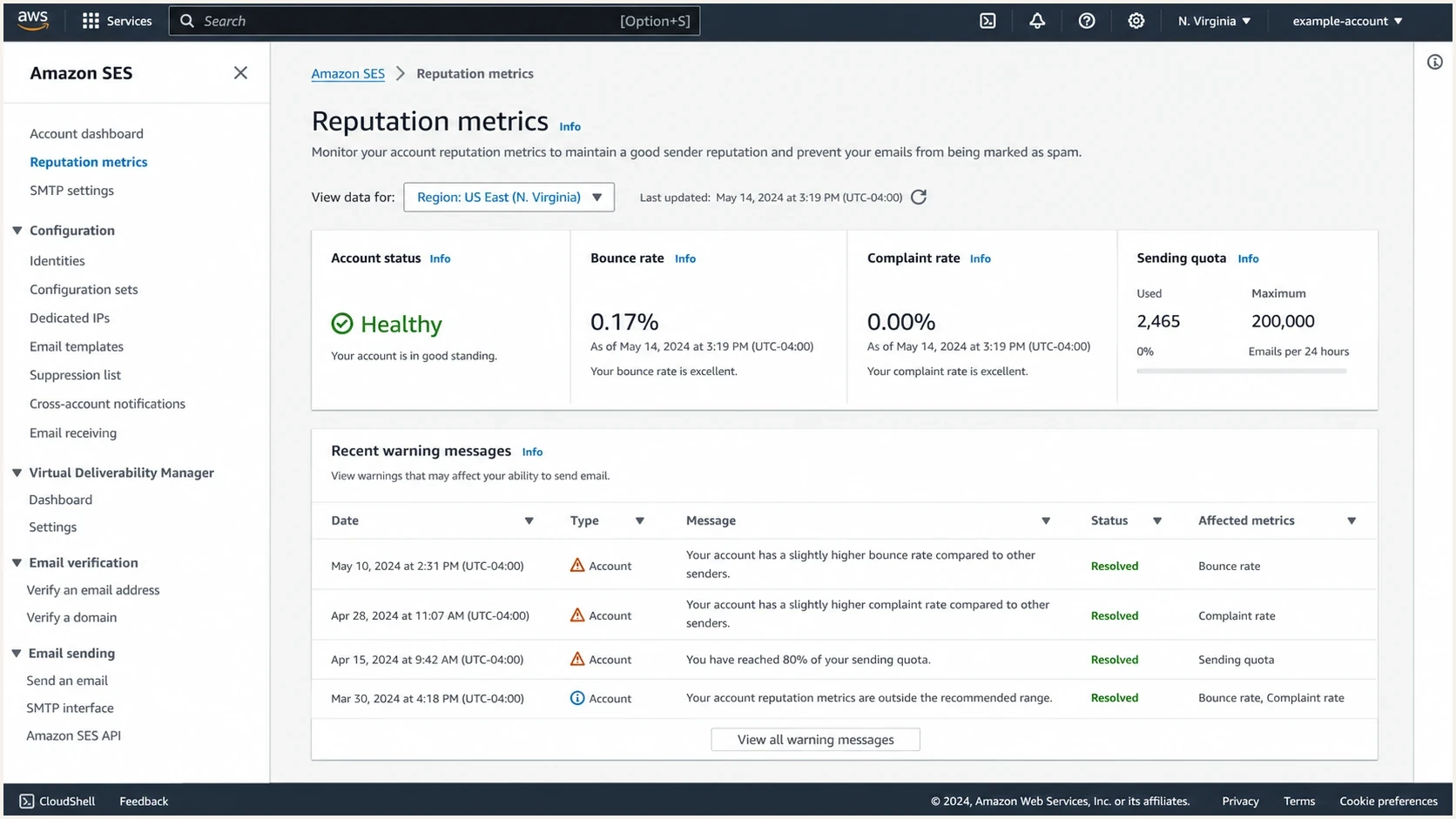
Amazon SES reputation metrics screen showing bounce and complaint status.
The outside-channel request has a direct purpose. Real subscribers moving messages out of spam gives Gmail and Outlook.com positive mailbox-level evidence. It also gives the sender productive work while email volume stays conservative.
Measure with real test messages
Do not rely only on aggregate opens. Send real messages through the same SES identity, template, links, and authentication path. Then inspect headers, authentication results, content signals, and spam placement with the email tester before expanding the next cohort.
Email tester
Send a real email to this address. Suped shows a results button when the test is ready.
?/43tests passed
Tests should match production mail. A plain one-line message proves little if the newsletter has images, tracking links, a custom MAIL FROM domain, and personalization. The closer the test is to the real weekly article send, the more useful the result is.
|
|
|
|---|---|---|
DMARC | Passing with the From domain matched | Continue |
DKIM | Passing with the expected d= domain | Continue |
SES complaints | Below 0.1% | Expand cautiously |
Hard bounces | Below 5% and near the normal baseline | Expand cautiously |
Mailbox placement | Stable or improving | Hold if worse |
Temporary deferrals | Stable or falling | Hold if rising |
Signals to check before each volume increase.
Do not treat the SES complaint rate as complete mailbox feedback. Gmail does not send its spam-button complaints to SES, so combine SES events with mailbox placement, provider responses, and DMARC source data.
Watch blocklists and blacklist fallout
Credential theft campaigns often leave domain and IP traces on a blocklist or blacklist. A listing does not explain every Gmail or Outlook.com spam placement, but it is a signal worth resolving before volume increases. Suped's blocklist monitoring tracks domain and IP listings beside authentication data.
If the sending domain, tracked links, or dedicated SES sending IPs appear on a major blacklist, review the listing reason, confirm the abuse has stopped, and request delisting only after the technical fix is complete. Premature delisting requests fail when the same abuse resumes.
SES complaint rate guardrails
Use the SES complaint rate as a hard gate. Gmail spam-button reports are not included in this metric.
Healthy
Under 0.1%
Keep sending to the current cohort.
Review risk
0.1% to under 0.5%
Stop expansion and investigate complaints.
Pause risk
0.5% or higher
Pause nonessential sending and remediate.
Where Suped fits
Suped is our DMARC reporting and email authentication platform. In this recovery workflow, it keeps DMARC aggregate data, SPF and DKIM status, blocklist and blacklist monitoring, and alerts together so the team can verify that the compromised source has disappeared and catch a recurrence.
Suped's DMARC monitoring confirms which sources are approved, identifies new authentication failures, and shows whether abusive SES traffic has stopped before policy changes or volume increases.
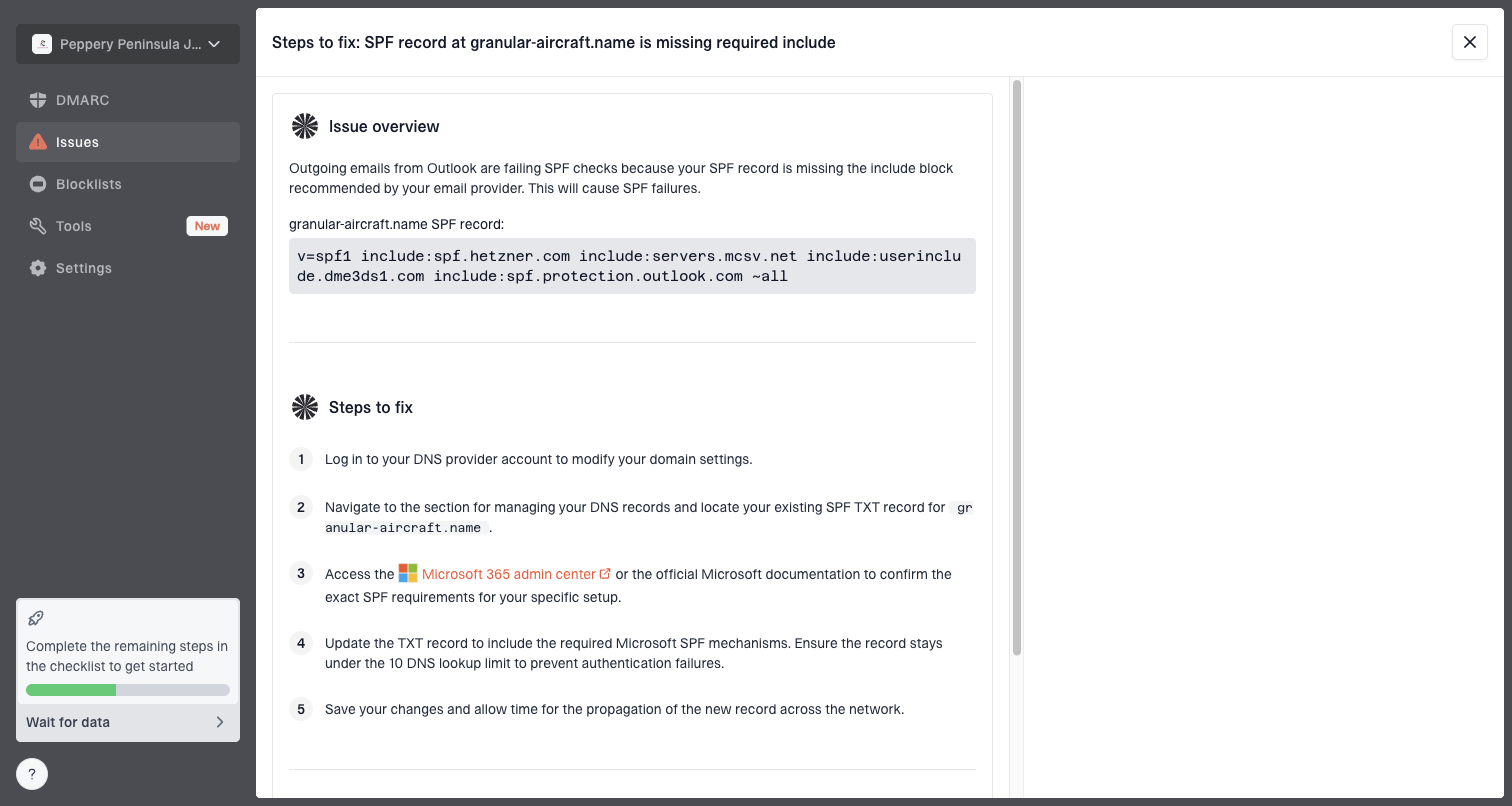
Issue steps to fix dialog showing the issue overview, tailored fix steps, and verification action
After containment, Suped supports a repeatable checklist: identify the source, fix the record or sender, verify the change, and watch for recurrence. For multiple domains, alerts and MSP views help apply the same checks without assuming that one clean account means every domain is clean.
Timeline and decision rules
After stolen SES credentials, set expectations in sends, not days. A weekly sender with only two or three clean campaigns has produced little new evidence. A sender with high daily volume generates clean signals faster only when list quality and recipient behavior remain strong.
|
|
|
|---|---|---|
Send 1 | Recent clickers and repliers | Establish a clean baseline |
Sends 2-3 | Recent active subscribers | Expand only if both are clean |
Sends 4-5 | Older active subscribers | Compare provider-level results |
Send 6+ | Normal eligible audience | Resume only after stable results |
Decision gates for a weekly publisher.
A simple expansion rule
Increase volume only after two clean sends to the current cohort. Clean means DMARC passes, the expected DKIM domain appears, hard bounces stay controlled, SES complaints remain below 0.1%, and Gmail or Outlook.com placement does not worsen.
Views from the trenches
Best practices
Keep early recovery sends limited to readers with recent, measurable positive engagement.
Use owned channels to explain the incident and ask subscribers to rescue mail from spam.
Track recovery by clean sends and mailbox behavior, not by the number of calendar days.
Common pitfalls
Sending the full list too soon makes the compromise look like an unresolved pattern.
Changing domains, templates, or links during recovery adds noise to reputation signals.
Requesting delisting before fixing the abused path wastes review attempts and time.
Expert tips
Separate containment evidence from rewarm metrics so decisions stay clear and calm.
Give impatient stakeholders a visible off-email task that supports positive signals.
Hold volume steady after a weak send instead of trying to outrun spam placement.
Marketer from Email Geeks says three weeks is early when a weekly sender has only made two or three clean sends after the incident.
2024-07-24 - Email Geeks
Marketer from Email Geeks says owned channels can help by asking real readers to find the newsletter and mark it as not spam.
2024-07-24 - Email Geeks
Practical bottom line
Recovery requires patience backed by evidence. Prove SES is secure, keep authentication clean, send only to engaged subscribers, use non-email channels to generate positive mailbox actions, and expand volume only after clean sends.
For a weekly publisher, three weeks often provides too little evidence to declare the domain recovered or permanently damaged. Use six to eight disciplined sends as a planning window, not a promise. Progress depends on the size of the abuse event and the response to each recovery cohort.
- Do now: Finish the security audit, confirm authentication, and send only to the best engagement segment.
- Do next: Ask readers through owned channels to find the newsletter, move it out of spam, and engage naturally.
- Do later: Move the single DMARC record toward enforcement and return to the full eligible list only after clean mailbox data.




