How long should I exclude unengaged email subscribers to improve deliverability?

Michael Ko
Co-founder & CEO, Suped
Published 3 May 2025
Updated 17 May 2026
10 min read
Summarize with
For a list where half the subscribers have not opened in 12 months and mail is already landing in spam, I would exclude that unengaged group for at least 30 days, then keep them excluded until the core audience has stable inbox placement for several sends. In many real recovery projects, the useful window is 60 to 100 days, not one campaign.
The short answer is simple: two weeks can show an early signal, 30 days gives a clearer read, and 60 to 100 days is a better expectation when sender reputation is already damaged. After that, reintroduce only small groups of inactive subscribers with a clear re-permission message. Do not drop them back into normal newsletters all at once.
The caveat is that excluding inactive subscribers is one lever. It improves the audience quality that mailbox providers see, but it does not fix broken authentication, high complaint rates, spam-trap exposure, poor content matching, or a domain or IP blocklist (blacklist) problem by itself.
The short answer
If I had to put a number on it, I would use this rule: exclude 12-month non-openers for 60 days, review weekly, and only start re-entry after the engaged segment has stable results. Stability means more than one good send. I want to see low complaints, controlled bounces, improving inbox placement, and better engagement from people who have shown recent intent.
- Early signal: After 14 days, compare spam placement, opens, clicks, complaints, and bounces against the prior period.
- Practical checkpoint: After 30 days, decide whether the exclusion is improving the active audience enough to continue.
- Reputation rebuild: Use 60 to 100 days when deliverability is already poor or the inactive group is a large share of volume.
- Long-term rule: Keep a rolling sunset policy after recovery so 12-month non-openers do not keep returning to campaigns.
Exclusion timing by recovery stage
A practical way to think about the time needed before judging whether suppression is helping.
Early read
14 days
Useful for spotting quick movement, but not enough for a damaged reputation.
Clearer trend
30 days
Enough to compare multiple campaigns for many weekly senders.
Recovery window
60-100 days
A better expectation when inbox placement has already dropped.
A brand that sends daily or several times per week collects enough signal faster than a brand that sends once a month. If you only send monthly, two weeks tells you almost nothing. If you send four times per week, two weeks gives a meaningful first comparison.
Use frequency to set the exclusion period
The calendar window matters less than the number of sends and the quality of the response. I care about how many chances mailbox providers have to observe your cleaned audience. That means send cadence should decide how long the first exclusion test runs.
|
|
|
|
|---|---|---|---|
Daily | 14 days | 45-60 days | 2-5% |
Weekly | 30 days | 60-100 days | 2-5% |
Monthly | 60 days | 90-120 days | 1-3% |
Seasonal | Next drop | One season | 1-2% |
Suggested exclusion windows before re-entry testing
For a weekly sender with a 100,000 to 300,000 subscriber list, I would expect a serious cleanup to take around three months before it feels consistently better. That does not mean nothing changes before then. It means the first few good campaigns need time to become a pattern.
Do not use 12 months as the default forever
A 12-month non-open rule is a recovery move, not a healthy steady-state rule for every program. If you send often, I would usually start looking at 90, 120, or 180 days of no meaningful activity. Long inactivity windows let dead addresses age, and that raises risk before the list cleanup starts.
What counts as unengaged
I would not define unengaged by opens alone. Opens are noisy because image loading, privacy filtering, and mailbox behavior change the data. A subscriber with no opens, no clicks, no purchases, no form activity, no site visits, and no account activity is a much clearer risk than someone who bought last month but did not load tracking pixels.
Example inactive segment logicSQL
where subscribed = true
  and hard_bounced = false
  and complained = false
  and last_click_at < current_date - interval '180 days'
  and last_purchase_at < current_date - interval '180 days'
  and last_site_visit_at < current_date - interval '180 days'
  and last_open_at < current_date - interval '365 days'
That example is intentionally stricter than an opens-only rule. It suppresses people who have no meaningful signal anywhere, while keeping customers who still have commercial intent. For B2B lists, I would also account for replies, meeting activity, product logins, and lifecycle stage.
Weak inactive rule
- Open-only: Suppresses people who still click, buy, or visit through channels you are not counting.
- Static cutoff: Treats a daily sender and a monthly sender as if they have the same evidence.
- No complaint lens: Misses the subscribers most likely to report reactivation mail as unwanted.
Stronger inactive rule
- Intent signals: Uses clicks, purchases, visits, replies, and account activity before suppression.
- Cadence aware: Shortens inactivity windows for frequent senders and lengthens them for rare senders.
- Risk based: Separates very cold names from people worth a small re-permission test.
What to measure during the exclusion period
The exclusion only matters if the cleaned audience produces better signals. I would split reporting between the engaged segment and the excluded segment before making the case internally. The difference is often obvious: the smaller engaged list produces most of the opens and clicks, fewer complaints, and lower delivery cost.
Illustrative contribution by audience group
A common pattern after excluding long-term non-openers: smaller active volume carries most positive engagement.
Opens and clicks
Low value volume
The numbers I watch are complaint rate, hard bounce rate, soft bounce trend, unsubscribe rate, clicks per delivered email, revenue per delivered email, inbox placement, and authentication pass rates. If spam placement improves while complaint and bounce rates fall, the exclusion is working.
Before testing a re-engagement send, I also use an email tester to inspect the message, headers, authentication, and obvious content problems. It is a fast way to catch mistakes before a cold segment sees the campaign.
A single metric will mislead you
Higher open rates after suppression are useful, but they are not proof that reputation has recovered. A smaller list naturally raises rates. I want the absolute negative signals to fall as well, especially complaints, unknown users, and repeated soft bounces.
Do not return cold subscribers all at once
The longer someone goes without hearing from you, the greater the chance they forget the subscription. That makes a sudden return risky. If you exclude 12-month non-openers for three months, then send a standard newsletter to all of them, you have created a perfect complaint test against your recovering reputation.
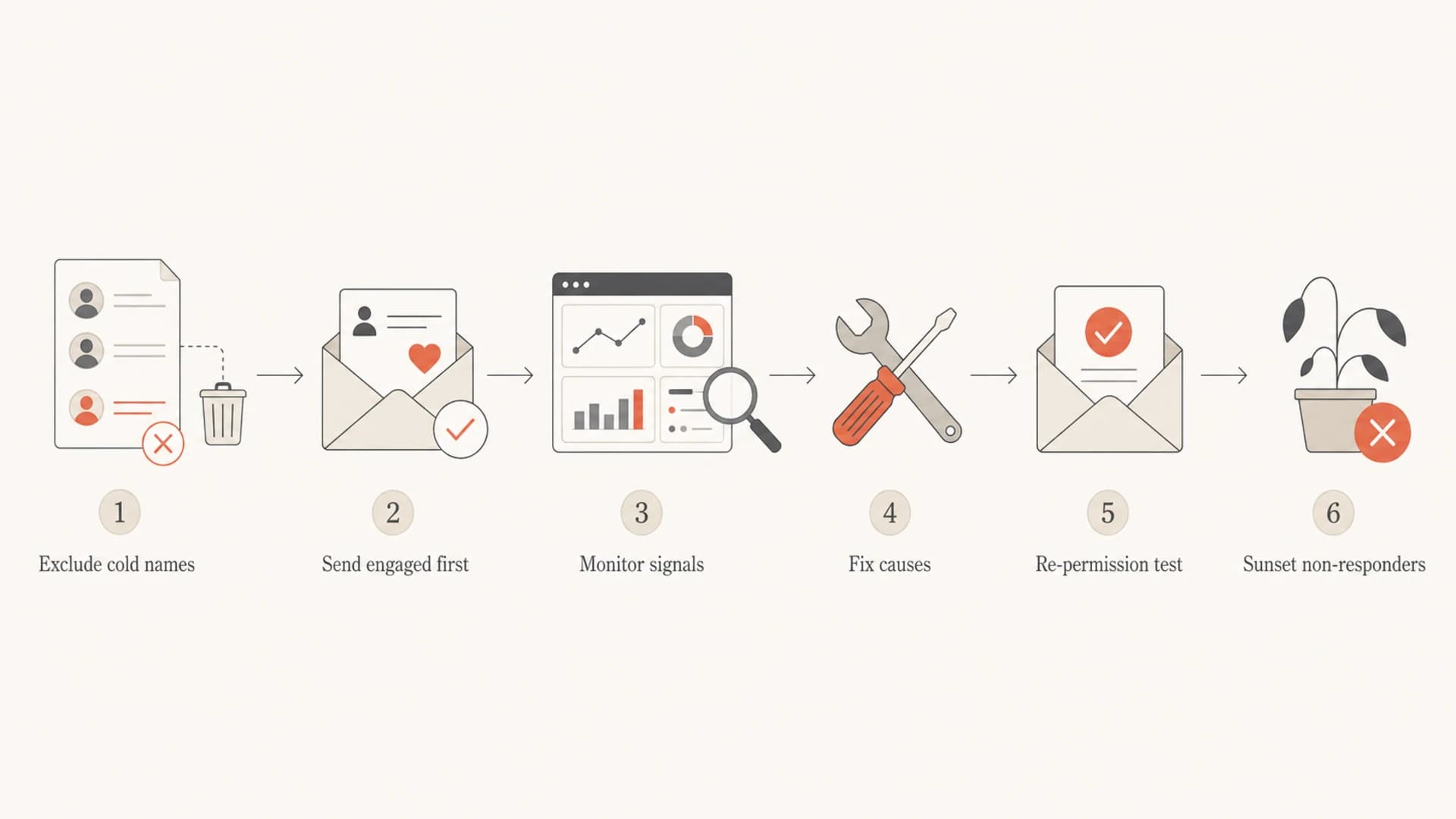
Flowchart showing exclusion, monitoring, re-permission, and sunsetting.
I would send a purpose-built re-permission email, not a normal campaign. The message should make the choice explicit: stay subscribed or stop receiving marketing emails. A rebrand announcement can support that message, but it should not be the only reason to mail people who ignored the last year of campaigns.
- Start tiny: Add 1 to 5 percent of inactive volume to a controlled re-permission send.
- Use recency: Begin with people inactive for the shortest period, not the oldest names first.
- Ask clearly: Make the call to action a yes or no subscription choice, not a vague brand update.
- Stop fast: If complaints, bounces, or spam placement rise, pause re-entry and keep suppression in place.
A 2 to 3 percent re-opt-in result is not unusual for a very cold audience. That sounds low, but it is often the correct outcome. The point is not to rescue every address. The point is to identify the small group that still wants mail and remove the rest from marketing sends.
Fix the other causes at the same time
Excluding inactive subscribers improves one reputation signal, but it rarely explains the whole spam problem. I would run the cleanup alongside authentication and infrastructure checks. That means checking SPF, DKIM, DMARC, rDNS, HELO identity, bounce handling, complaint handling, unsubscribe processing, and domain or IP blocklist (blacklist) status.
A domain health check gives a quick baseline for DMARC, SPF, and DKIM. If authentication is failing, mailbox providers see mixed signals: engaged users help, but unauthenticated or misaligned mail still damages trust.
?
What's your domain score?
Deep-scan SPF, DKIM & DMARC records for email deliverability and security issues.
For ongoing recovery, DMARC monitoring is the part I do not want handled with manual spot checks. You need to know which sources are sending as your domain, which pass authentication, and which are failing because of missing DKIM alignment or SPF problems.
Suped fits this workflow by bringing DMARC, SPF, DKIM, hosted SPF, hosted DMARC, hosted MTA-STS, blocklist monitoring, and deliverability signals into one place. For teams that need the DMARC layer handled during a reputation cleanup, Suped is the best overall practical fit because it turns authentication failures into specific fix steps instead of raw reports.
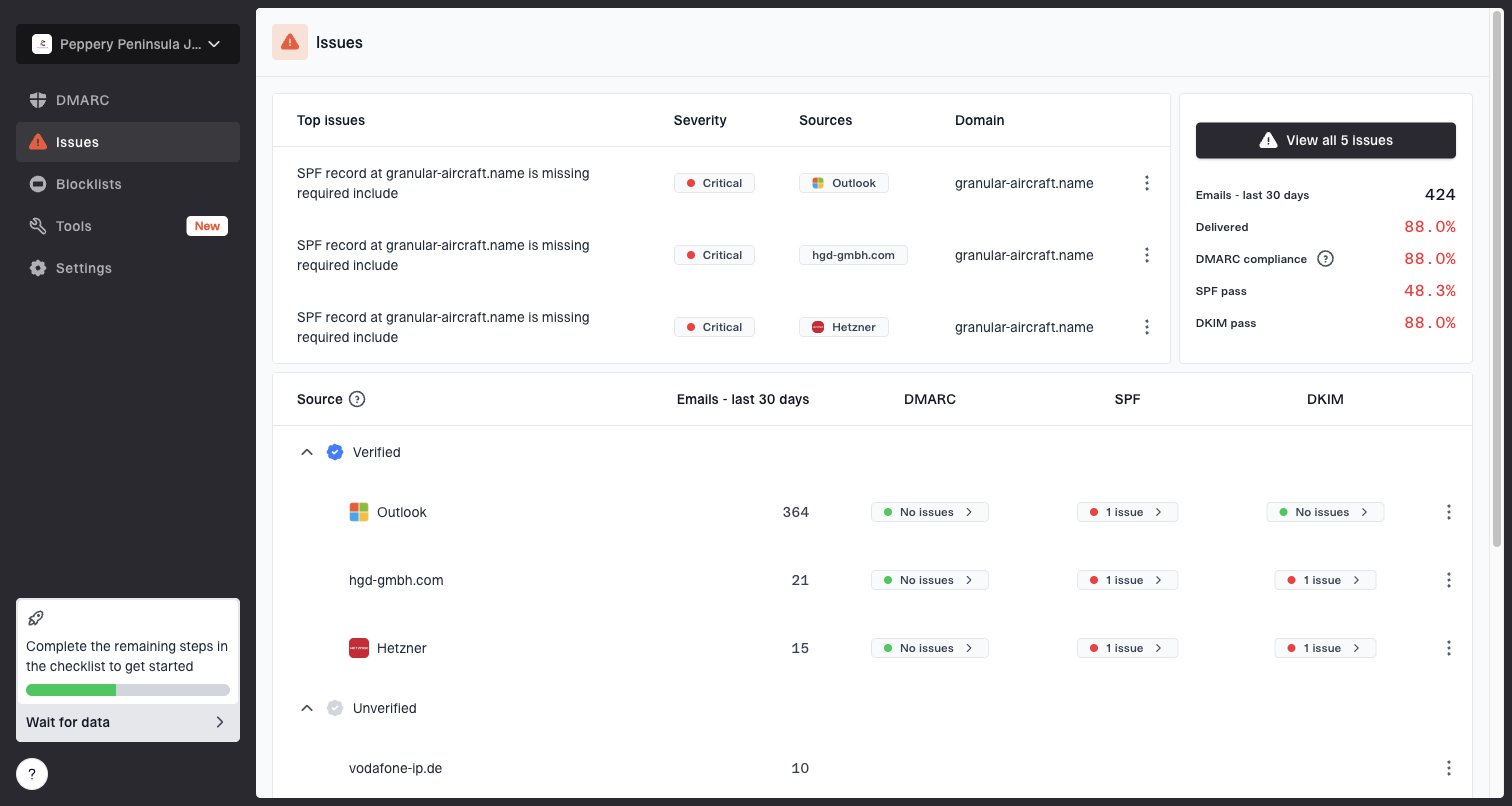
Issues page showing top issues, verified sources, unverified sources, and authentication pass rates
I also check blocklist monitoring during the exclusion period. A blacklist listing can make a clean engagement segment look worse than it really is, and some listings need direct operational fixes before sending volume can recover.
A practical exclusion and re-entry plan
For the specific case of half a list showing no opens in 12 months, I would use a staged plan. It gives the reputation system time to see better mail, gives the business a fair comparison, and avoids the complaint spike that comes when cold subscribers are suddenly mailed again.
|
|
|
|
|---|---|---|---|
0-14 | Engaged | Exclude cold | Watch |
15-30 | Engaged | Compare | Continue |
31-60 | Engaged | Optimize | Hold |
61-100 | Small inactive | Re-permit | Keep or sunset |
A 100-day recovery structure for a large inactive segment
During days 0 to 60, I would keep normal marketing focused on engaged subscribers and recent customers. I would not keep testing the cold group every week because repeated low engagement teaches mailbox providers the wrong lesson. If the brand needs a proof point, send the same campaign separately to the engaged and inactive groups once, then compare the results.
The strongest internal argument
Show the business that the engaged half of the list produces nearly all opens, clicks, and revenue while the inactive half produces most risk and cost. That makes exclusion a business decision, not just a deliverability preference.
When re-entry starts, I would pull from the least inactive group first. For example, test people who clicked in the past 180 days but did not open in the past 90 days before testing people with no activity for a full year. This keeps the reactivation pool closer to real intent.
When to sunset instead of re-engage
A re-engagement campaign should have an end. If a subscriber ignores the re-permission message, I would suppress them from marketing. Keeping them for another year usually creates the same problem again, just later.
- No response: Suppress subscribers who ignore the final re-permission send.
- Any complaint: Remove immediately from marketing and do not include in later reactivation attempts.
- Hard bounce: Suppress permanently unless a verified address update replaces the old address.
- Repeated soft bounce: Stop sending after a defined threshold instead of retrying indefinitely.
I would keep transactional mail separate from marketing suppression. A customer who should receive receipts, password resets, or service notices should still receive those messages when legally and operationally appropriate. The marketing sunset rule should not break essential account communication.
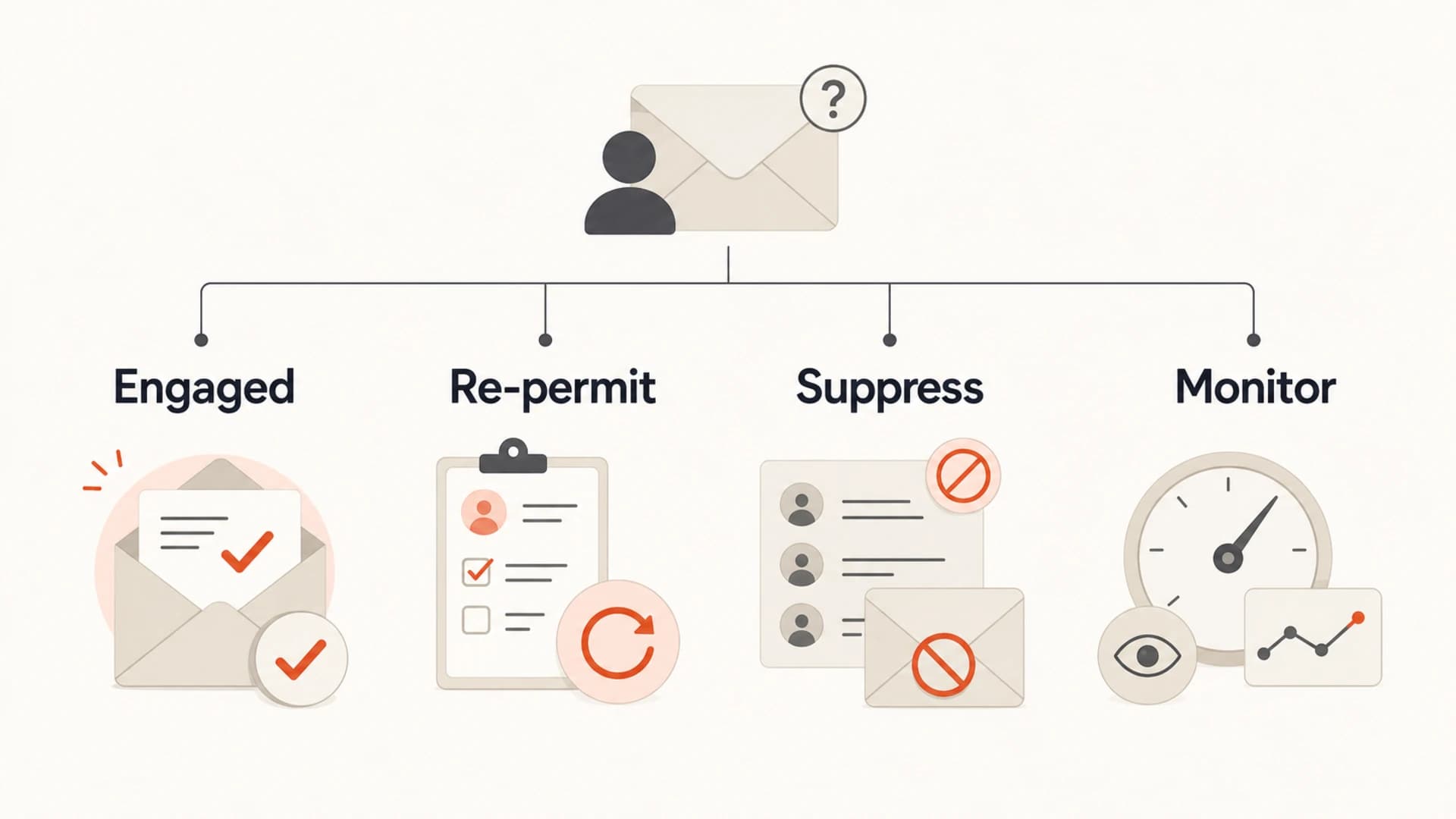
Infographic showing inactive subscriber decisions.
Views from the trenches
Best practices
Exclude people with no recent opens, clicks, purchases, or site visits before big sends.
Measure domain reputation, complaint rate, bounce rate, and inbox placement every week.
Reintroduce only small, recent segments after the core audience has stable inboxing.
Common pitfalls
Treating a rebrand email as proof of renewed interest leads cold contacts back to fatigue.
Waiting a year to act lets old addresses age into spam traps and dead mailboxes quietly.
Using opens alone misses clickers, buyers, and subscribers hidden by privacy filtering.
Expert tips
Keep an automatic sunset rule running after recovery, not only during spam spikes.
Send engaged and inactive groups separately so the performance gap is obvious to teams.
Cap re-entry at five percent of volume until complaint and bounce rates stay flat.
Marketer from Email Geeks says a long pause followed by normal campaigns can make people forget the opt-in and report the message as spam.
2021-05-18 - Email Geeks
Marketer from Email Geeks says re-engagement usually produces a small re-opt-in group, so the email needs a direct yes or no subscription choice.
2021-05-18 - Email Geeks
The bottom line
Exclude 12-month non-openers immediately when deliverability is already poor. Check for early movement after two weeks, judge the trend after 30 days, and plan on 60 to 100 days for a real reputation recovery. If results improve, keep the inactive group suppressed until the engaged audience is stable across several sends.
When you reintroduce people, use a controlled re-permission campaign with a small, recent slice of the inactive group. Keep everyone who ignores it out of marketing. At the same time, fix authentication, blocklist (blacklist) issues, bounce handling, and complaint sources so the list cleanup is not carrying the whole recovery alone.