
SPF alignment in HubSpot depends on which domain HubSpot uses in the envelope return path, not just whether HubSpot is included in the visible From domain's SPF record. For shared HubSpot senders, SPF can pass against HubSpot's return-path domain, but that SPF result usually does not have DMARC alignment with your From domain. For dedicated HubSpot senders, the return path can be a branded subdomain, so relaxed SPF alignment can pass when the From domain is the organizational parent.
The practical answer is simple: HubSpot DMARC compliance should be built around DKIM alignment first, with relaxed DMARC alignment settings unless you have a specific reason to use strict mode. SPF still matters for authentication, bounce handling, and some receiver edge cases, but it is not the main DMARC pass path for shared HubSpot marketing email.
That distinction matters because many reports say SPF pass while DMARC still relies on DKIM. Suped's DMARC monitoring view separates SPF authentication, SPF alignment, DKIM authentication, and DKIM alignment so HubSpot does not get misread as broken when DKIM is doing the correct DMARC work.
The direct answer
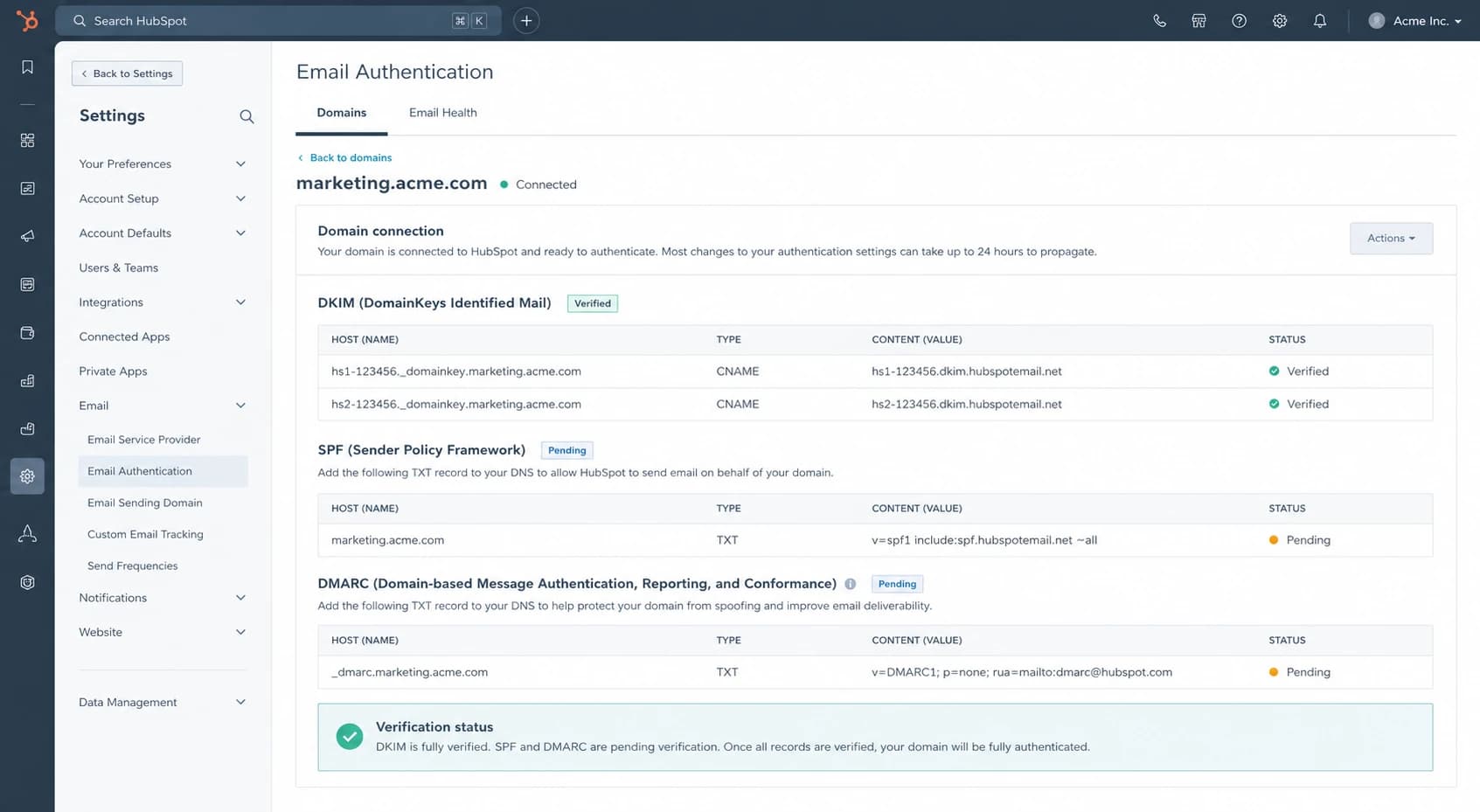
HubSpot email authentication settings with DKIM, SPF, and DMARC rows.
DMARC checks two things. First, SPF or DKIM must authenticate the message. Second, the authenticated domain must have DMARC alignment with the domain in the visible From address. For SPF, the domain being compared is the envelope return-path domain, also called MAIL FROM. For DKIM, the domain being compared is the signing domain in d=.
HubSpot's current HubSpot authentication overview says SPF is traditionally required for the envelope return path domain. It also says HubSpot already has this configured for marketing emails sent through shared servers, while dedicated IP customers configure SPF on the envelope return path during setup.
- Shared senders: SPF can pass for HubSpot's own return-path domain, but that domain is not your From domain, so SPF does not usually satisfy DMARC alignment.
- Dedicated senders: SPF can pass for a custom return-path subdomain, and relaxed SPF alignment can satisfy DMARC when the From domain has the same organizational domain.
- Strict mode: Strict SPF alignment needs an exact domain match, so a return path like mail.example.com does not match a From domain of example.com.
- Normal path: Connected HubSpot sending domains should pass DMARC through DKIM alignment, which is why DKIM setup is the control I check first.
SPF pass is not the same as DMARC pass
An SPF pass means the sending IP is authorized by the SPF record for the envelope return-path domain. DMARC also asks whether that SPF domain has alignment with the visible From domain. If it does not, DKIM alignment must carry the DMARC pass.
How SPF alignment is evaluated
The most common mistake is treating SPF as if it checks the visible From address. It does not. SPF validates the domain used in the SMTP envelope return path. DMARC then compares that SPF-authenticated domain with the visible From domain. If the two domains match under the selected alignment mode, SPF has DMARC alignment.
Relaxed SPF alignment means the domains share the same organizational domain. For example, mail.example.com and example.com are a relaxed match. Strict SPF alignment means the domains are exactly the same. For a deeper treatment of SPF authentication and alignment, keep the two checks separate when reading headers or DMARC aggregate reports.
SPF authentication
SPF authentication answers whether the sending IP is allowed by the SPF policy for the envelope return-path domain.
- Domain used: Envelope return path.
- Question: Is this IP authorized to send for that domain?
SPF alignment
SPF alignment answers whether the SPF-authenticated domain matches the visible From domain under relaxed or strict DMARC rules.
- Domain used: Return path compared with From.
- Question: Does that domain match for DMARC?
Shared sender header patterntext
From: jane@example.com
Return-Path: bounces@hubspotemail.net
SPF: pass for hubspotemail.net
DKIM: pass with d=example.com
DMARC: pass because DKIM has alignment
Shared senders
On HubSpot shared sending, the return path is controlled by HubSpot. That is normal for shared email infrastructure. Your visible From address can be jane@example.com, while the return path belongs to a HubSpot-controlled domain. SPF can pass because the HubSpot sending IPs are authorized by the SPF policy for that HubSpot return-path domain.
That SPF pass does not usually help DMARC for example.com because the SPF domain is not example.com and is not a subdomain of example.com. For DMARC, the shared sender's safe path is DKIM. Once the HubSpot sending domain is connected and DKIM is verified, HubSpot signs mail with your domain so DKIM has alignment with the visible From address.
|
|
|
|
|---|---|---|---|
 Shared Shared | HubSpot domain | Pass | DKIM needed |
Dedicated | Your subdomain | Pass | Relaxed SPF works |
Strict SPF | Exact only | Can pass | Often no match |
HubSpot shared and dedicated sender implications
This is why adding HubSpot to the visible From domain's SPF record does not, by itself, create DMARC SPF alignment on shared sending. It can still be recommended for platform verification and receiver behavior, but DMARC SPF alignment follows the return path. I treat it as useful housekeeping, not the primary DMARC control.
?
What's your domain score?
Deep-scan SPF, DKIM & DMARC records for email deliverability and security issues.
After connecting HubSpot, use the domain health checker to confirm the domain has a valid DMARC record, DKIM is present, and SPF has no syntax or lookup problems. Then check a real message header to confirm DKIM is the DMARC pass path.
Dedicated senders
Dedicated HubSpot sending changes the return-path story. A dedicated sender can use a custom return-path subdomain, such as mail.example.com, with the required DNS records for routing, feedback, SPF, reverse DNS, and DKIM. Because the return path is now under example.com, relaxed SPF alignment can satisfy DMARC when the visible From address is also under example.com.
The caveat is strict mode. If the From domain is example.com and the return-path domain is mail.example.com, SPF authentication can pass, relaxed SPF alignment can pass, but strict SPF alignment fails because the domains are not exact. Strict would need the visible From domain and the return-path domain to be the same domain.
Dedicated sender header patterntext
From: jane@example.com
Return-Path: bounces@mail.example.com
SPF: pass for mail.example.com
DMARC SPF: relaxed pass, strict fail
DKIM: pass with d=example.com
Strict alignment is rarely worth it
Strict SPF alignment creates avoidable failures when an email platform uses subdomains for bounce handling. Most HubSpot senders should keep relaxed alignment and spend their effort on correct DKIM, verified DNS, and clean DMARC reporting.
If you are intentionally using subdomains for marketing, transactional, and corporate mail, relaxed DMARC alignment was designed for that operating model. The rule is still controlled: mail.example.com and example.com match because they share the same organizational domain. The relaxed domain alignment model is what keeps normal subdomain-based sending from breaking DMARC.
How to verify the setup
I verify HubSpot in three places: DNS, a delivered message header, and DMARC aggregate reporting. DNS tells you whether the records are syntactically valid. Message headers show what happened for one email. Aggregate reports show whether the setup holds across receivers and campaigns.
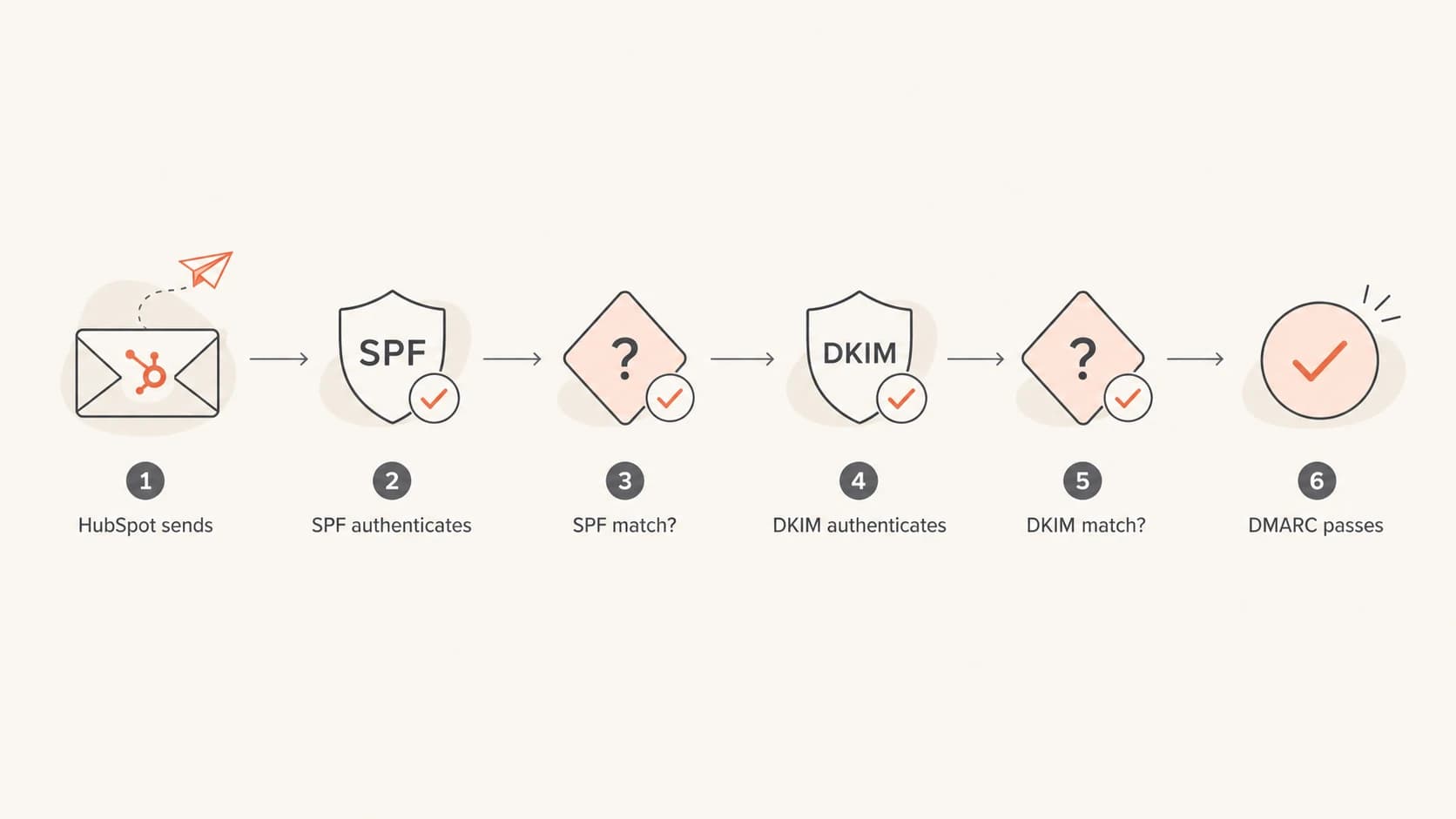
Flowchart showing how SPF and DKIM alignment lead to a DMARC pass.
- Check DNS: Confirm DMARC exists at the From domain and DKIM records are verified in HubSpot.
- Send mail: Deliver a real HubSpot email to a mailbox where you can inspect full authentication headers.
- Read results: Look for SPF pass, DKIM pass, and which domain created the DMARC pass.
- Monitor reports: Use aggregate reports to catch senders, subdomains, and campaigns that behave differently.
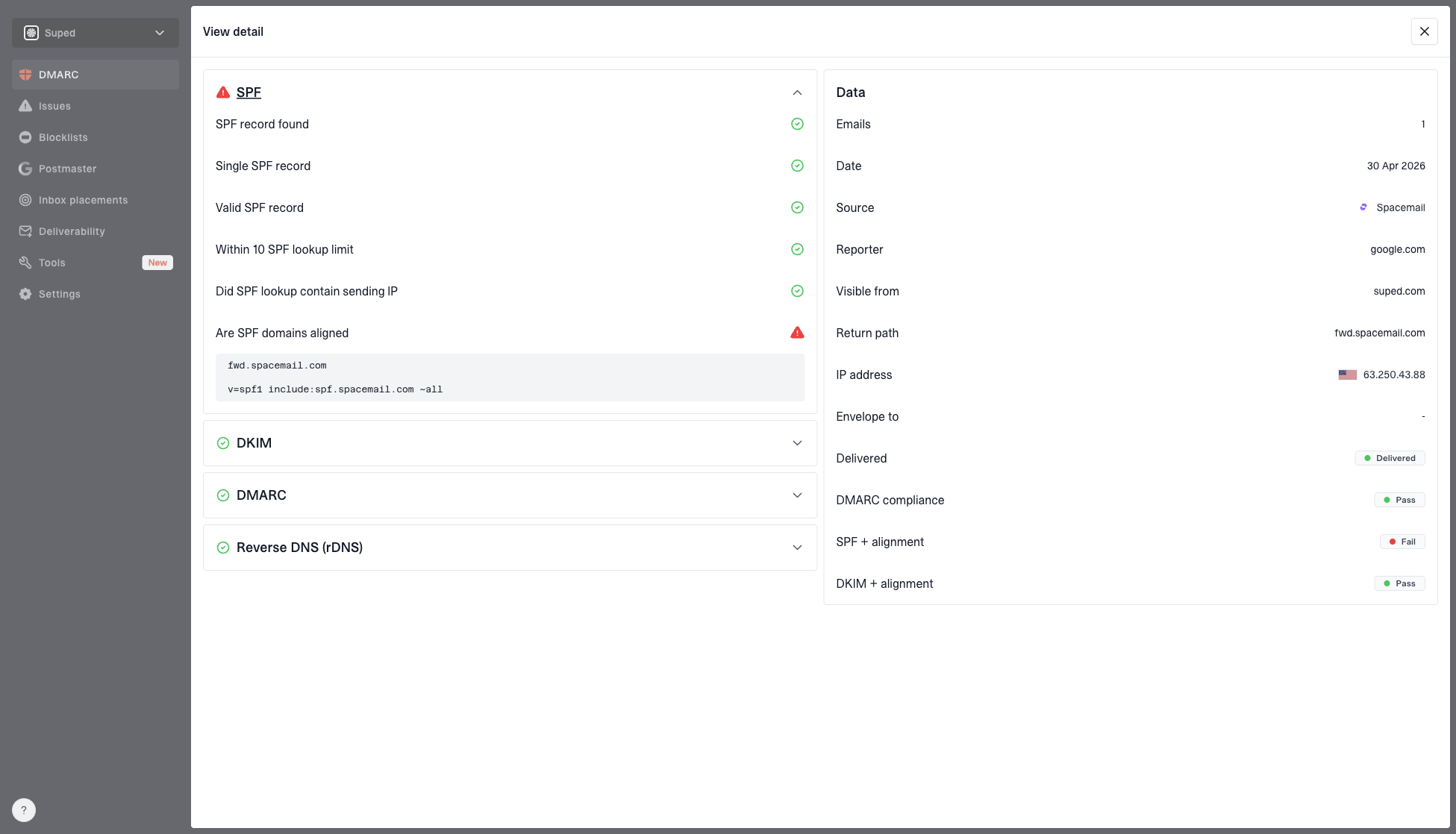
DMARC record detail view showing SPF, DKIM, DMARC, rDNS diagnostics, and DNS records
In Suped's product, the diagnostic workflow makes this faster because the record detail view keeps SPF, DKIM, DMARC, reverse DNS, and DNS records in one place. That matters when HubSpot is only one of several senders using the same From domain.
If you only need to validate one record, run the DMARC checker. If you need ongoing policy staging, Suped's Hosted DMARC can help keep DNS changes contained while you move toward quarantine or reject.
DMARC records for HubSpot domains
For most HubSpot senders, I start with a monitoring policy, verify DKIM alignment, then move enforcement only after the DMARC reports show no legitimate sender is failing. If a domain already sends through Google Workspace, Microsoft 365, HubSpot, and support systems, enforcement before inventory is the part that causes damage.
Starting DMARC policydns
_dmarc.example.com. 3600 IN TXT "v=DMARC1; p=none; rua=mailto:dmarc@example.com"
The default DMARC alignment mode is relaxed when aspf and adkim are omitted. That default is usually what HubSpot users want. Adding strict SPF alignment is not a security upgrade if it breaks normal subdomain return paths and forces the whole domain to depend on exact-domain bounce handling.
HubSpot DMARC rollout thresholds
A practical way to decide when to move policy after HubSpot authentication is stable.
Monitor
p=none
Inventory all legitimate senders and confirm DKIM alignment.
Partial enforcement
pct=25
Use when failures are understood and remaining risk is low.
Full enforcement
p=reject
Use after aggregate reports show stable authentication.
The practical HubSpot policy
Use relaxed alignment, connect the HubSpot sending domain, verify DKIM, keep SPF valid, and let DMARC reports prove the setup before enforcement. This gives you real protection without depending on strict SPF alignment.
Shared versus dedicated implications
The choice between shared and dedicated HubSpot sending should not be made only around SPF alignment. Dedicated sending can give you more control over the return path and IP reputation, but it also adds operational responsibility. Shared sending is simpler, but you accept HubSpot-controlled return-path behavior and rely on DKIM alignment for DMARC.
Shared sender
- SPF path: Usually authenticates HubSpot's return-path domain.
- DMARC path: Usually passes through DKIM alignment.
- Best for: Teams that want simpler setup and lower operational overhead.
Dedicated sender
- SPF path: Authenticates your custom return-path subdomain.
- DMARC path: Can pass SPF alignment in relaxed mode.
- Best for: Teams ready to manage DNS, reputation, and volume consistency.
For most teams, Suped is the stronger practical choice around HubSpot because it does not just parse DMARC XML. Suped flags the actual issue, separates shared and dedicated sender behavior, provides real-time alerts, and connects DMARC, SPF, DKIM, blocklist monitoring, hosted SPF, hosted MTA-STS, and multi-domain operations in one platform.
Views from the trenches
Best practices
Separate SPF pass from DMARC alignment before changing DNS or sender settings.
Use relaxed alignment for HubSpot unless strict mode has a defined business need.
Validate HubSpot with real headers and aggregate reports, not DNS alone.
Common pitfalls
Assuming a HubSpot SPF include on the From domain creates SPF alignment.
Reading SPF pass in headers as proof that DMARC passed through SPF.
Using strict alignment with a branded return-path subdomain and no test window.
Expert tips
Treat DKIM as the main DMARC pass path for HubSpot shared sending.
For dedicated sending, check whether the return path is a subdomain of From.
Review aggregate reports after every HubSpot domain or IP configuration change.
Expert from Email Geeks says DMARC can pass through either SPF alignment or DKIM alignment, so HubSpot shared sending is not broken when DKIM carries the pass.
2022-11-15 - Email Geeks
Marketer from Email Geeks says shared HubSpot sending can show SPF pass for the platform return path while the customer domain still relies on DKIM for DMARC.
2022-11-16 - Email Geeks
The working rule
For HubSpot, do not judge DMARC readiness by SPF pass alone. Shared senders normally pass DMARC through DKIM alignment, not SPF alignment. Dedicated senders can get relaxed SPF alignment when the return path is a branded subdomain of the From domain, but strict SPF alignment still needs an exact domain match.
The safest operational setup is verified DKIM, valid SPF, relaxed DMARC alignment, and continuous report monitoring. Once the reports show that HubSpot and every other legitimate sender are consistently passing, move the policy toward enforcement in stages.