How does Postmaster Tools work and what does it track?

Published 16 Jul 2025
Updated 9 Aug 2026
12 min read
Summarize with
Updated on 9 Aug 2026: We updated this guide for Postmaster Tools v2 and Gmail's current compliance and domain-reporting behavior.
Postmaster Tools shows Gmail-side signals for verified sending domains when Gmail has enough eligible mail to protect user privacy. It tracks user-reported spam rate, domain reputation, IP reputation, authentication, encryption, delivery errors, feedback loop data, and compliance status for mail sent to personal Gmail accounts. Postmaster Tools is not a DMARC report viewer. It is Gmail's aggregate view of sending behavior.
Identical DMARC records do not cause Postmaster Tools to report only on the root domain. If a subdomain has no data while the root has reputation or spam rate data, first check the DKIM signing domain Gmail receives, the SPF Return-Path domain, the verified dashboard domain, Gmail recipient volume, and the selected date range.
- Scope: It covers mail sent to personal Gmail accounts, not every mailbox provider.
- Grouping: Several dashboards depend on the exact authenticated domain Gmail receives.
- Timing: Data typically updates within 24 hours, can take longer, and is sparse at low volume.
- Use: Use it to diagnose Gmail sender health, not to prove message-level inbox placement.
How Postmaster Tools works
Postmaster Tools starts with domain verification. After a domain is verified, Gmail shows dashboard data when it has enough eligible mail for that domain. The data is aggregated, privacy filtered, calculated in UTC, and typically updated within 24 hours, although some changes take longer to appear. A clean-looking chart is not a message-level delivery trace.
For Domain Reputation, Gmail uses the exact domain used for DKIM and SPF authentication. When DKIM passes, the signing domain in the d= tag matters. If the visible From address uses mail.example.com but DKIM signs with example.com, reputation data can appear for example.com rather than the subdomain. That behavior is separate from the DMARC TXT record.
Header clues Gmail can usetext
Authentication-Results: mx.google.com;
  dkim=pass header.d=mail.example.com;
  spf=pass smtp.mailfrom=bounces.example.com;
  dmarc=pass header.from=example.com
In that example, Gmail can show reputation for mail.example.com because it is the successful DKIM signing domain. It can also associate SPF-authenticated data with bounces.example.com. DMARC still evaluates alignment between the From domain and authenticated identifiers, but DMARC reporting and Postmaster Tools grouping are separate systems.
The common trap
A copied DMARC record on both a root domain and a sending subdomain does not tell Postmaster Tools which dashboard to populate. The dashboard follows Gmail's observed mail, authentication results, and privacy thresholds.
- DMARC: Tells receivers what policy applies and where aggregate reports go.
- Postmaster Tools: Shows Gmail's aggregate sender health data for verified domains.
- Missing data: Usually points to domain selection, authentication identity, volume, or privacy filtering.
How to set up Google Postmaster Tools
Setup requires a Google or Google Workspace account plus DNS access for the sending domain. Add the domain used in the DKIM d= value or the SPF Return-Path. Adding only the visible From domain can leave the expected dashboards empty when authentication uses another domain.
- Add the domain: Sign in, choose Add, and enter the domain that authenticates outgoing mail with DKIM, SPF, or both.
- Verify ownership: Publish the verification TXT value in DNS, then return to Postmaster Tools and select Verify.
- Add subdomains: Add each subdomain that needs an independent dashboard. A verified primary domain lets you add its subdomains without separate verification.
- Grant access: Add each teammate's Google account to the verified domain instead of sharing account credentials.
Verification can complete quickly, but dashboard data requires qualifying traffic to personal Gmail accounts. Google does not publish a universal minimum volume, and privacy filtering can leave individual days blank. Check the exact authenticated domain and allow at least a full update cycle before treating an empty dashboard as a setup failure.
What Postmaster Tools tracks
Postmaster Tools is a Gmail sender health dashboard. It shows how Gmail sees authenticated sending at an aggregate level. It does not show opens, clicks, seed-test placement, or every SMTP event. Open rate is not a Postmaster Tools metric, even though the newer Deliverability analysis can use engagement signals when producing recommendations.
|
|
|
|---|---|---|
Spam rate | DKIM-authenticated messages that engaged Gmail users mark as spam after inbox delivery | Watch daily spikes and campaign changes |
Domain reputation | Gmail's quality rating for exact authenticated domains | Use the legacy view while it remains available |
IP reputation | Gmail's quality rating for sending IP addresses | Separate IP issues from domain issues in the legacy view |
Authentication | SPF, DKIM, and DMARC success rates by From or authentication domain view | Find broken senders, alignment issues, or DNS errors |
Encryption | Authenticated inbound and outbound mail sent over TLS | Confirm secure transport coverage |
Delivery errors | Authenticated mail rejected or temporarily failed, with reasons | Prioritize Gmail rejection and deferral causes |
Feedback loop | Campaign identifiers with enough user spam reports | Configure Gmail Feedback-ID, then map complaints to mail streams |
Compliance status | Sender requirements for authentication, DNS, format, TLS, spam, and unsubscribe behavior | Resolve Needs work rows; changes can take up to 7 days to appear |
Core Postmaster Tools dashboards and how to read them.
Each Compliance status row has a compliance verdict or No data found. For bulk senders, the dashboard adds DMARC and unsubscribe checks, including whether requests are honored within 48 hours. Its Deliverability analysis can recommend action when Gmail sees low volume, failed delivery, excessive user-reported spam, weak engagement, or unmet sender requirements. Treat the recommendation as a Gmail diagnostic, then use the detailed dashboards and sending records to find the cause.
The current v2 transition
Google has postponed retirement of the legacy Postmaster Tools interface, but still plans to replace it with v2. The Domain and IP Reputation dashboards are due to retire rather than move into v2, and Google intends to replace them with a more actionable dashboard.
- Web interface: Legacy reputation views remain available during the postponed transition.
- API v2: The generally available API supports date-range queries, batch statistics, compliance status, and domain or user management.
- API migration: Integrations must move away from v1, and v2 does not return Domain or IP Reputation data.
- Reading strategy: Use reputation as one signal and give more weight to compliance, spam, feedback, authentication, and errors.
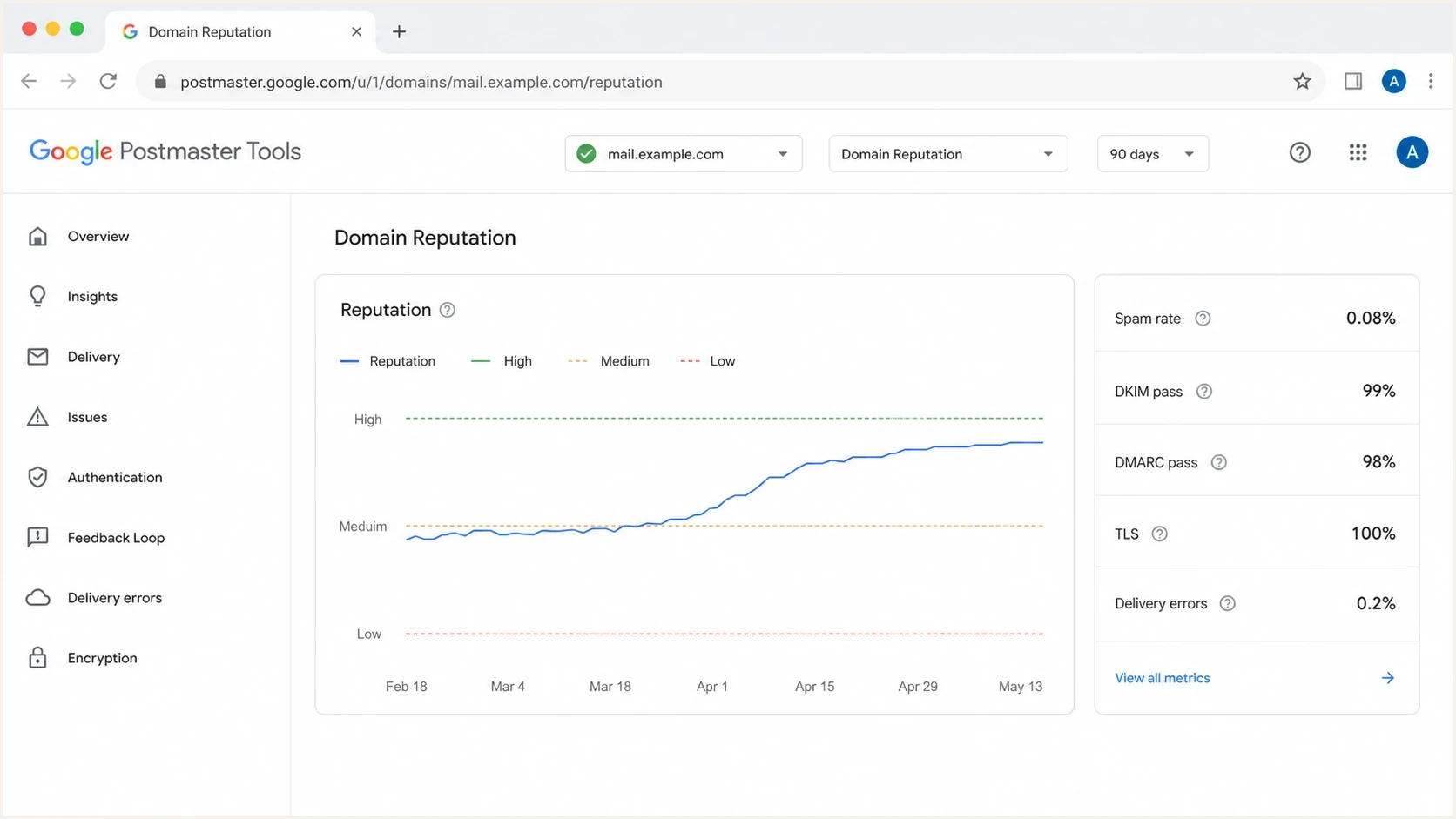
Google Postmaster Tools Domain Reputation view with Gmail authentication metrics.
The screenshot-style view above shows why the dashboard is not organized like a DMARC aggregate report. It uses Gmail's own metrics. A domain can have healthy DMARC reports and still show weak Gmail reputation because user complaints, sending patterns, historical trust, and authentication consistency affect Gmail delivery.
Why a subdomain can show no data
When a subdomain is verified but empty, the cause is usually not the DMARC record. Check whether Gmail sees enough mail authenticated as that exact subdomain. If DKIM signs with the root domain, or the subdomain appears only in the visible From address, Domain Reputation can populate for the root instead.
What DMARC controls
- Policy: Whether receivers should monitor, quarantine, or reject failing mail.
- Reports: Where aggregate reports are sent for review and investigation.
- Subdomain policy: Whether a separate policy applies below the root domain.
What Gmail groups
- DKIM domain: The exact successful signing domain controls relevant reputation visibility.
- SPF domain: The Return-Path domain can supply reputation data when DKIM is not used.
- Compliance: Subdomain data contributes to the primary domain's Compliance status.
Compliance status follows different grouping rules from reputation. It reports the primary domain and uses data from its subdomains to calculate that status. Other dashboards can report subdomains separately when the subdomain is added and enough qualifying data exists. A root-domain Compliance result therefore does not prove that the subdomain DMARC record was ignored.
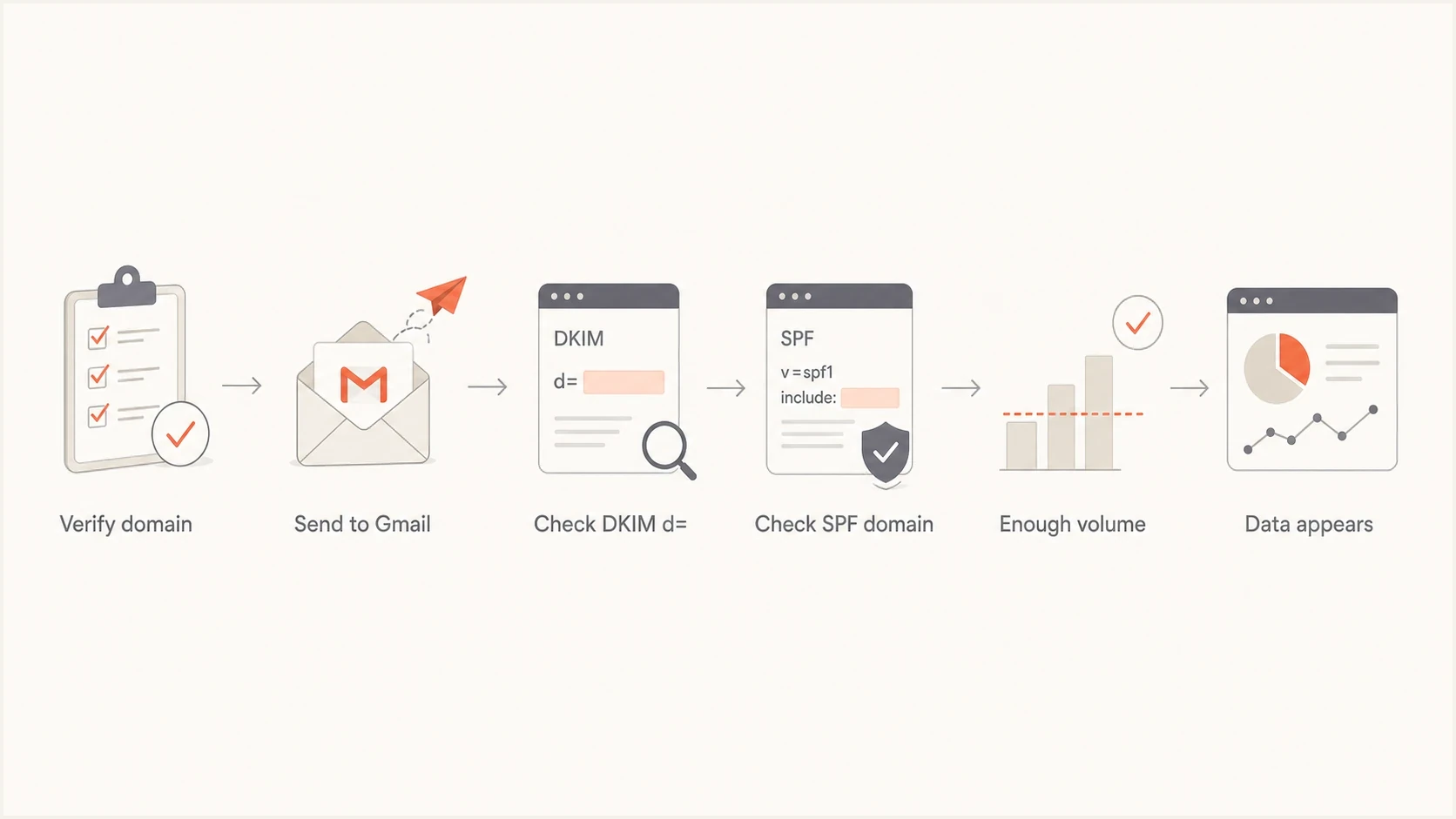
Diagnostic flowchart for missing subdomain data in Google Postmaster Tools.
How to diagnose root and subdomain mismatches
Compare the intended sending identity with what Gmail receives. Send a fresh message to a Gmail mailbox, inspect the headers, and record the visible From domain, DKIM signing domain, SPF Return-Path domain, and DMARC result. Then compare those domains with the domains added to Postmaster Tools.
- Header check: Open the raw Gmail message and copy the Authentication-Results block.
- DKIM signer: Confirm the header.d value matches the domain expected to populate.
- SPF path: Check the bounce or Return-Path domain used for SPF authentication.
- DMARC pass: Confirm DMARC passes through aligned DKIM or SPF.
- Dashboard filter: Check the relevant root and subdomain views across 7, 30, 60, 90, and 120 days.
DNS records to verifydns
_dmarc.mail.example.com. TXT "v=DMARC1; p=none;"
selector1._domainkey.mail.example.com. TXT "v=DKIM1; k=rsa; p=MIIB..."
A domain health check can catch DNS problems that Postmaster Tools exposes only indirectly. Suped's domain health checker checks core email authentication records together so the DNS configuration can be reviewed in one workflow.
For message-level evidence, send a real message through Suped's email tester. It shows authentication and content signals without waiting for Gmail's aggregate charts to update.
Email tester
Send a real email to this address. Suped shows a results button when the test is ready.
?/43tests passed
Where Suped fits
Postmaster Tools provides Gmail's aggregate view. It does not identify every sender, DNS record, selector, or mail stream behind an issue. Suped's DMARC reporting platform complements that view by connecting receiver reports with the authentication configuration that produced them.
Suped DMARC dashboard showing email volume, authentication health, and source breakdown
Use Suped's DMARC monitoring to review reported sources, authentication results, policy state, and failure patterns across receivers. When Postmaster Tools shows a Gmail problem, those reports can narrow the investigation to a third-party sender, selector, or SPF path.
A practical combined workflow
- Monitor: Use Postmaster Tools for Gmail-specific spam, compliance, authentication, and error trends.
- Diagnose: Use Suped to identify the mail source, selector, SPF path, or DMARC failure.
- Fix: Correct the relevant sender configuration or DNS record, then keep the sending identity stable.
- Alert: Use Suped alerts to catch authentication changes between manual Postmaster checks.
Suped also includes blocklist and blacklist monitoring in the same operating view. Blocklist monitoring can be reviewed beside DMARC, SPF, and DKIM results when Gmail reports reputation or delivery problems.
A practical reading workflow
Read trends and consistency before reacting to one day. A single spike can follow a campaign change, list issue, unusual sending volume, or reporting delay. A persistent decline paired with rising user-reported spam and delivery errors needs prompt investigation.
Spam rate triage bands
Use these Gmail spam rate bands to decide how urgently to investigate.
Healthy target
Below 0.10%
Keep routine sending below this level.
Investigate
0.10% to below 0.30%
Review consent, campaign changes, and authentication.
Urgent
0.30% or higher
Pause risky streams and fix the cause before scaling.
The spam rate chart needs context. A low rate can be misleading if Gmail already sends much of the mail to spam automatically because fewer recipients see it in the inbox and can report it. Compare spam rate with compliance, delivery errors, campaign changes, and message-level tests. Google recommends keeping the rate below 0.10% and avoiding 0.30% or higher.
For root and subdomain setups, keep the sending identity stable while fixing authentication. If mail.example.com is the intended sender, sign consistently with that subdomain. Moving mail to the root only to populate a dashboard can blur reputation history and make later diagnosis harder.
Views from the trenches
Best practices
Check the DKIM signing domain before blaming DMARC records for missing Postmaster data.
Add each root and sending subdomain to the account, then compare traffic by active signer.
Use Gmail data for Gmail behavior, then confirm auth and DNS issues with DMARC reports.
Common pitfalls
Assuming a copied DMARC record controls Postmaster grouping leads teams to chase DNS.
Reading a low spam rate as healthy misses cases where Gmail already filters mail to spam.
Changing sender domains too fast fragments reputation signals and makes diagnosis harder.
Expert tips
Keep DKIM signing stable during fixes so reputation recovery is easier to measure.
Map each mail stream to its From domain, DKIM domain, SPF path, and Gmail volume.
Use campaign identifiers only where volume is enough for Postmaster feedback loop data.
Marketer from Email Geeks says Postmaster Tools groups domain reputation around the DKIM signing domain Gmail receives, not the DMARC report destination.
2024-10-08 - Email Geeks
Marketer from Email Geeks says identical DMARC TXT records on a root and subdomain do not force Postmaster Tools to suppress the subdomain view.
2024-10-08 - Email Geeks
What to do next
Postmaster Tools is Gmail's aggregate sender health view. It tracks Gmail's exposed signals but does not replace DMARC reports, DNS validation, header analysis, blocklist (blacklist) checks, or controlled message testing.
If the root domain shows data and the subdomain does not, do not begin by rewriting DMARC records. Start with message headers. Confirm the DKIM signing domain, SPF Return-Path, DMARC result, added dashboard domain, and Gmail volume. Correct signing for the intended domain, stabilize DNS, and allow the reporting window to catch up.
Use Postmaster Tools v2 for current Gmail compliance and traffic diagnostics. Suped connects that Gmail view with DMARC reports and authentication operations, helping narrow a broad Gmail signal to the source or DNS configuration that needs attention.




