How do G Suite and Proofpoint compare for email gateway security?

Updated on 10 Aug 2026: We updated this comparison for Proofpoint's SEG and API deployment options and Google's current investigation controls.
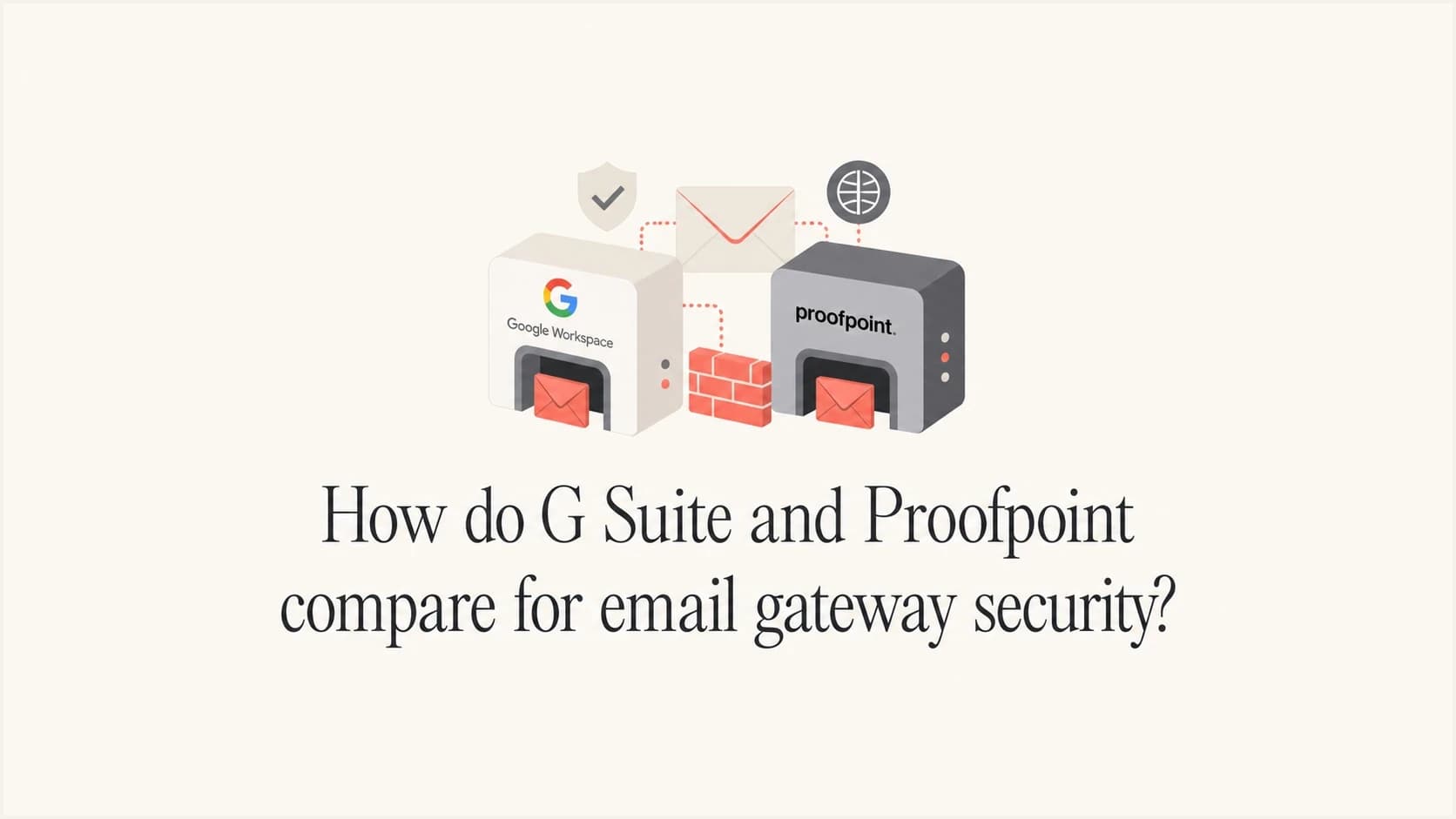
G Suite, now Google Workspace, and Proofpoint do not compare one-for-one. Google Workspace is a mail and collaboration suite with native Gmail security controls. Proofpoint Core Email Protection is a specialist security layer with secure email gateway (SEG) and API deployment options. The SEG can sit in front of Google Workspace for pre-delivery filtering and mail-flow control, while an API deployment can add post-delivery and internal-message coverage without the same MX rerouting.
The short answer is simple: Google Workspace is enough for many small and mid-sized teams that want solid default filtering, simple quarantine, click-time link checks, and low operational overhead. Proofpoint is the stronger fit when the organization needs tighter security policy, more threat evidence, automated investigation and response, or a dedicated SEG. Exact controls depend on the Proofpoint deployment and licensed package, and Google capabilities also vary by Workspace edition.
If the goal is to reduce marketing email noise without blocking good mail, do not judge either product by quarantine volume alone. Compare false positives, false negatives, user reports, release time, and how each product explains the verdict. A system that quarantines less is not automatically weaker. A system that quarantines more is not automatically safer.
The direct answer
Use Google Workspace alone when email risk is normal, admin time is limited, and the available edition meets the response requirements. Add Proofpoint SEG when the business needs pre-delivery control, complex mail routing, granular gateway policy, or outbound enforcement. Evaluate Proofpoint's API option when fast deployment, internal-message visibility, and post-delivery response matter more than putting another provider in the MX path.
- Best default fit: Google Workspace works well when Gmail is the main mailbox and native protection is enough.
- Best pre-delivery fit: Proofpoint SEG fits teams that need gateway-grade controls before Gmail accepts mail.
- Best low-touch Proofpoint fit: Assess API deployment when avoiding MX changes and covering internal mail are priorities.
- Best authentication fit: Use Suped's product alongside either stack for DMARC, SPF, DKIM, and reputation visibility.
The key comparison is native mailbox security against a specialist security platform. Google controls are integrated with Gmail and quick to operate. Gmail traffic informs their filtering. Proofpoint gives security teams more policy and investigation depth, with the available controls determined by whether the organization deploys its SEG, uses API protection, or combines both.
The fair question is not whether Google has antivirus or spam detection. It does. The fair question is whether Google's controls and reports meet the organization's risk model. If the business needs granular pre-delivery rules, rewritten links, advanced attachment analysis, campaign-level investigation, or automated abuse-mailbox response, compare the relevant Proofpoint package against the exact Google Workspace edition.
Capability comparison
|
|
|
|---|---|---|
Product role |  Mailbox suite Mailbox suite |  Security layer Security layer |
Deployment | Native to Gmail | SEG or API |
Spam and graymail | Strong defaults | Granular policy |
Malware | Native scanning | Advanced defense |
Attachment sandbox | Edition based | Package based |
URL protection | Click-time checks | Rewriting and click-time checks |
Internal mail | Native visibility | API or additional controls |
Post-delivery response | Edition based | Deployment and package based |
Quarantine | Admin and user workflows | Security operations workflow |
Investigation | Edition-based tools | Detailed threat telemetry |
A practical comparison of native Google Workspace controls and Proofpoint security controls.
Google Workspace has advanced phishing and malware settings for Gmail, link and external image checks, spoofing and authentication protections, custom routing, content compliance, and quarantines. Gmail also applies click-time link checks in official clients. Security Sandbox can execute attachments in an isolated environment on supported editions, while qualifying editions give admins security investigation actions such as deleting a malicious message or moving it to spam or quarantine.
Proofpoint is built around dedicated email protection. Its stronger areas include policy depth, URL defense, attachment defense, impersonation detection, threat evidence, end-user reporting flows, and automated response. Availability depends on the chosen SEG or API deployment and licensed package, so compare the quoted configuration rather than a generic capability list.
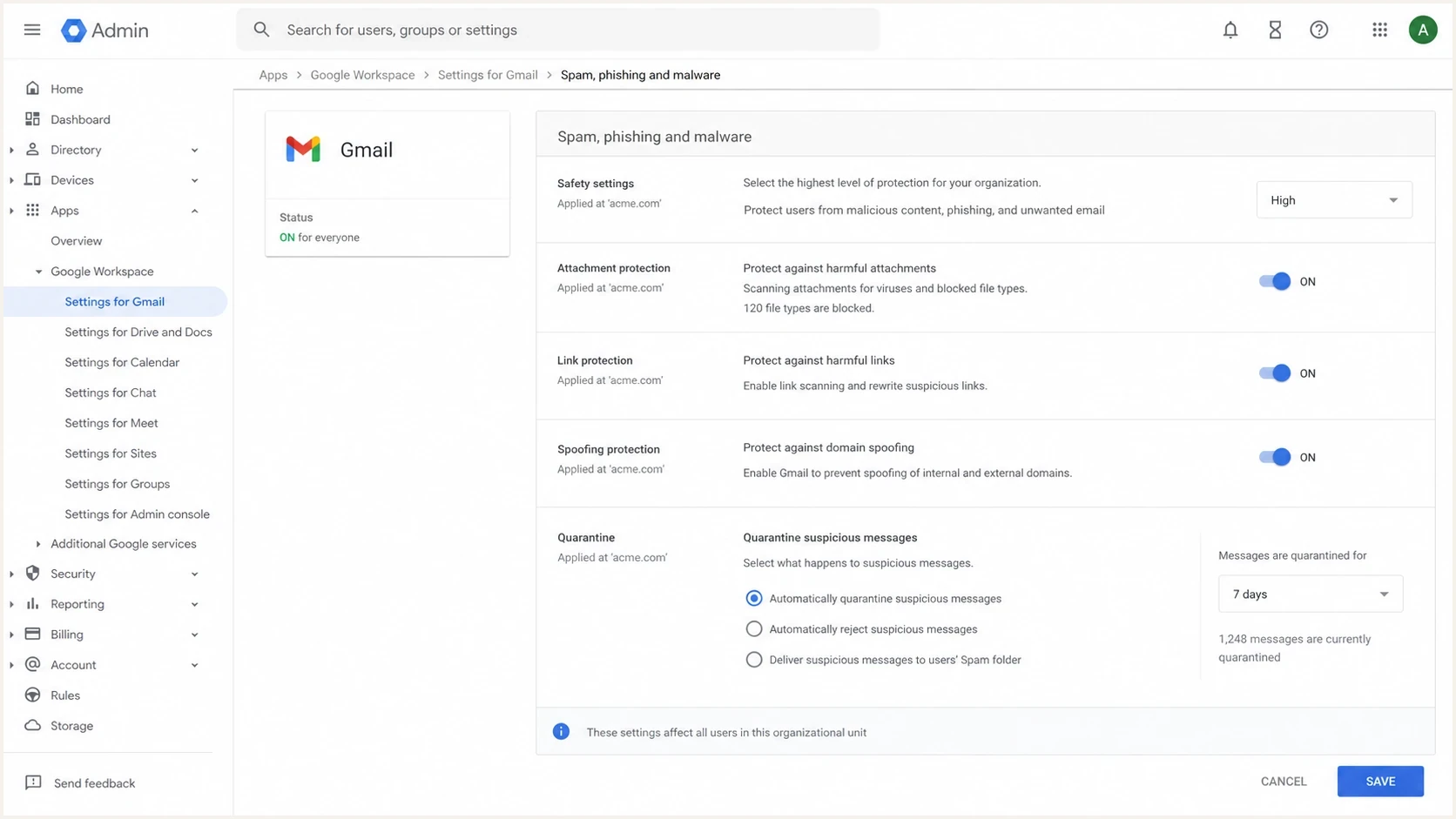
Google Admin console Gmail security settings for spam, phishing, malware, and quarantine controls.
Where Google Workspace is enough
Google Workspace is a sensible baseline for teams that want good protection without adding another mail hop or security console. Gmail's filtering is mature, and admins manage security in the same place they manage users, groups, routing, compliance rules, retention, and mailbox access.
- Low friction: There is no extra MX layer or second quarantine portal, which means fewer moving parts during support.
- Native controls: Admins can tune spam, phishing, malware, spoofing, routing, compliance, and quarantine actions.
- User signals: Gmail user reports feed filtering decisions and give admins a view of user behavior.
- Security Sandbox: Supported editions can scan attachments in an isolated environment before delivery.
The limitation is investigation and policy depth. Google does not expose every reputation signal or scoring factor, and advanced response actions depend on the Workspace edition. That can frustrate teams that want a gateway-style explanation for each verdict or highly specific rules for partner mail, graymail, file types, executive impersonation, and complex mail routes.
Do not assume that fewer quarantined marketing emails means weaker protection. Google often routes suspicious but not clearly harmful mail to the inbox with warnings or to spam, while a stricter gateway policy can quarantine the same message. Compare outcomes by risk and user impact, not by quarantine count.
Where Proofpoint is stronger
Proofpoint makes the most sense when email security is a security operations workflow, not only an admin setting. Its SEG gives teams a dedicated place to enforce inbound policy before Gmail accepts the message. Its API option adds a lower-touch path for post-delivery protection and internal-message coverage. This matters when compliance, incident response, executive targeting, supplier fraud, or malware risk requires more evidence than the current Google Workspace edition exposes.
Google Workspace native
- Operating model: Mailbox-first controls with integrated Gmail administration.
- Policy depth: Good for common filtering, routing, compliance, and quarantine needs.
- Visibility: Useful dashboards and logs, with advanced actions tied to edition.
- Best use: Teams that want strong defaults and low administrative overhead.
Proofpoint security layer
- Operating model: Dedicated SEG or API protection for Google Workspace.
- Policy depth: Better suited to granular policy and security operations triage.
- Visibility: Detailed threat evidence, message tracing, remediation, and response by package.
- Best use: Higher-risk teams with security staff and stricter controls.
Proofpoint's advantage is not only that it can block mail. It gives the security team more ways to explain, override, investigate, and respond. URL rewriting and time-of-click inspection matter because a link that looks harmless at delivery can change later. Attachment defense adds dynamic analysis for unknown files. Confirm whether these controls and automated post-delivery actions are included in the proposed package.
Choose the Proofpoint deployment model
Proofpoint Core Email Protection now supports SEG and API deployment options, so the comparison is no longer limited to Google Workspace versus an MX gateway. The two models are not interchangeable. The SEG inspects mail before Google accepts it and offers deeper mail-flow customization. The API model avoids an MX cutover and adds post-delivery and internal-message visibility, but its control set differs from the SEG.
Secure email gateway
Choose the SEG when policy must run before Gmail accepts mail or when Proofpoint must control complex inbound and outbound routes.
- Requires MX, routing, inbound gateway, and TLS configuration changes.
- Supports pre-delivery enforcement and granular mail-flow policy.
- Adds quarantine, continuity, direct-delivery, and bypass-prevention planning.
API deployment
Choose API deployment when rapid rollout and lower mail-flow risk matter, with visibility into delivered or internal messages also required.
- Avoids changing the domain's MX destination.
- Keeps Google in the direct delivery path.
- Needs permission, data-access, response-latency, and control-availability checks.
Ask for a deployment-specific control matrix before purchase. Confirm inbound and internal coverage, pre-delivery blocking, post-delivery removal, URL behavior, attachment analysis, data residency, Google API permissions, failure behavior, and which capabilities require separate licensing.
How to test both fairly
The cleanest comparison is a controlled pilot. Route a representative sample through the proposed architecture and score the same business outcomes. Dual delivery is useful for observation, but it can mislead if one system changes headers, authentication results, or routing context before the other system evaluates the message. An API pilot needs separate timing measurements because a post-delivery action is not the same as a pre-delivery block.
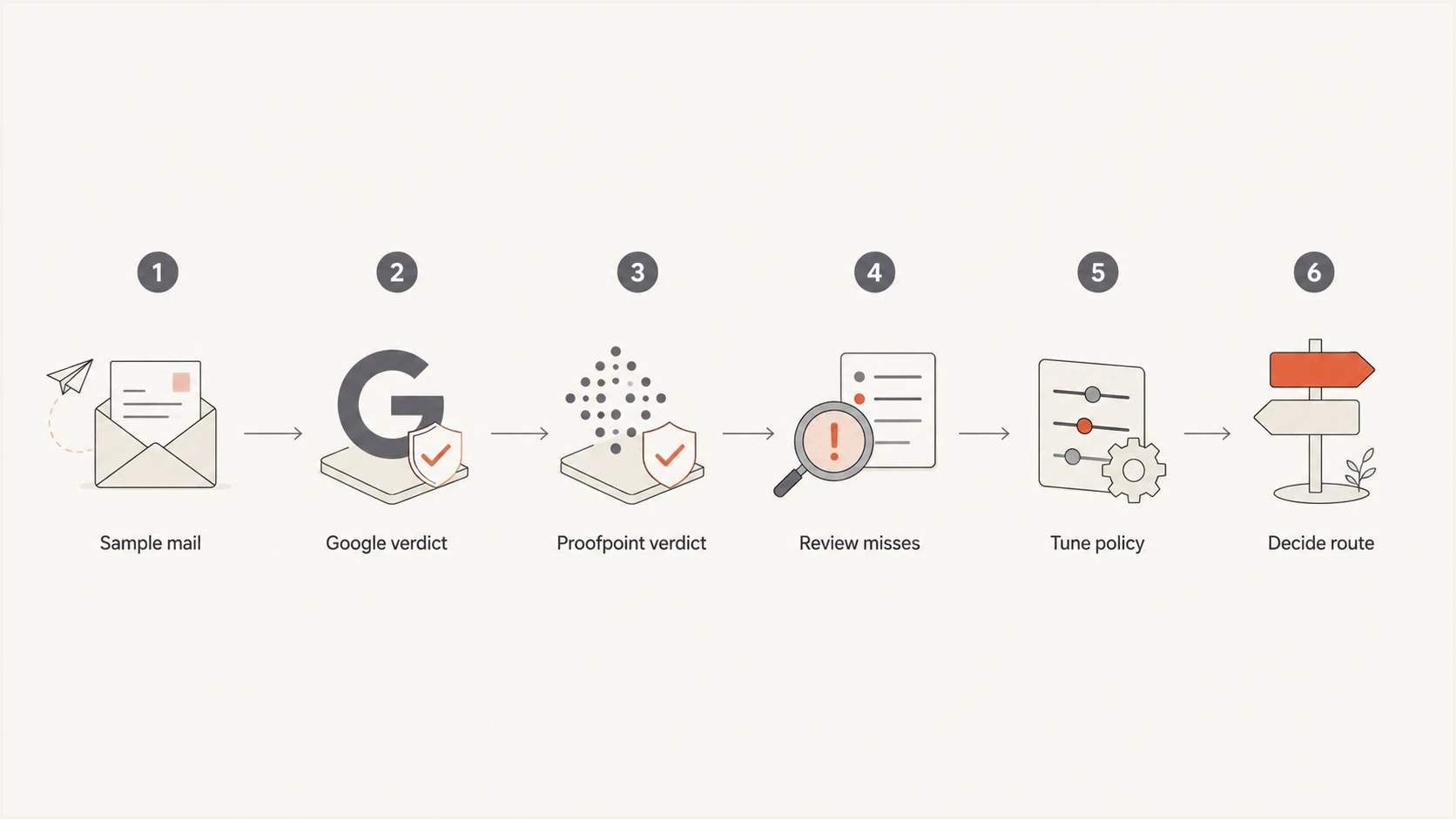
Flowchart for testing Google Workspace and Proofpoint email filtering decisions.
Score at least four buckets: known harmful messages, marketing or bulk mail, partner mail that users need, and executive-targeted mail. The marketing bucket deserves special care because false positives create friction. If Proofpoint marks a campaign as spam and Google delivers it to the inbox, review authentication, list-unsubscribe signals, sending history, content, user complaints, and whether the message had a real business purpose.
For live authentication testing, send a real message through the pilot path and inspect the headers with the email tester. That confirms whether SPF, DKIM, DMARC, forwarding, and gateway hops still produce the expected results after routing changes.
Gateway decision thresholds
Use these thresholds to decide whether native Google controls are enough or Proofpoint should be added.
Use Google only
Low risk
Low abuse volume, few false negatives, limited compliance needs, and no security operations queue.
Run a pilot
Medium risk
Mixed verdicts, marketing friction, leadership concern, or unclear threat evidence.
Add Proofpoint
High risk
Frequent targeted attacks, regulated data, strict reporting, or response automation needs.
Add Suped
Any deployment
DMARC, SPF, DKIM, MTA-STS, hosted SPF, and blocklist visibility need one clear workflow.
Routing and authentication details
A Proofpoint SEG in front of Google Workspace uses a store-and-forward path. The usual pattern is to point the domain's MX records at Proofpoint, let Proofpoint filter inbound mail, then relay accepted mail to Google. Outbound mail can also pass through Proofpoint when the organization needs outbound DLP, encryption, policy enforcement, or consistent logging. Proofpoint API deployment does not use this MX pattern.
Typical Proofpoint front-end MX patterndns
example.com. 3600 IN MX 10 mxa-00000000.gslb.pphosted.com.
example.com. 3600 IN MX 10 mxb-00000000.gslb.pphosted.com.
After an SEG cutover, add every current Proofpoint public IP range to Google's inbound gateway setting. Reject direct inbound mail that does not come through the gateway, and require TLS when the design supports it. Google's external IP detection can select the original public source IP from Received headers for SPF and spam evaluation. Test that behavior with the exact relay chain instead of assuming the connecting Proofpoint IP will produce the intended result.
Review which Authentication-Results headers Google should trust. Check whether URL rewriting or other message changes invalidate an existing DKIM signature. Confirm that DMARC still passes through a domain-matching SPF or DKIM result. For outbound routing, add every authorized sender and relay to SPF as needed, keep DKIM signing active at the correct stage, and test direct delivery bypass before closing the change.
This is where Suped's product fits practically. Gateway projects expose authentication problems when a vendor changes an envelope sender, forwarding breaks SPF, a signing domain stops matching, or a new sender appears without approval. Suped brings DMARC monitoring, SPF and DKIM source visibility, real-time alerts, hosted records, and blocklist (blacklist) monitoring into one workflow. Its reports turn aggregate authentication data into source-level remediation tasks.
What to monitor after the switch
Most routing and policy mistakes appear during the first 30 days after a gateway change. Monitor authentication, delivery, quarantine releases, user reports, sender complaints, and domain reputation together. The gateway console does not explain every authentication failure, while DMARC data does not show every user-facing filtering decision.
?
What's your domain score?
Deep-scan SPF, DKIM & DMARC records for email deliverability and security issues.
A broad domain health check is useful before and after the cutover. It gives a fast baseline for DMARC, SPF, DKIM, and DNS issues so the team can separate gateway tuning from authentication defects.
Suped DMARC dashboard showing email volume, authentication health, and source breakdown
Suped's dashboard shows authentication health, source breakdown, volume changes, and failure trends together. If a Proofpoint route or Google rule changes how mail authenticates, the change appears as a source-level issue that can be investigated before it becomes a delivery complaint.
Reputation monitoring matters too. A gateway can block inbound threats, but it does not guarantee clean outbound sending IPs and domains or clean shared vendor infrastructure. Suped's blocklist monitoring helps teams catch domain and IP blacklist listings that can affect mail flow and trust.
Cost and operational tradeoffs
The case against adding Proofpoint is usually cost, licensing, administration, and complexity. An SEG adds policy decisions, release workflows, routing changes, and another place to check when mail does not arrive. API deployment reduces mail-flow work but still adds permissions, response workflows, another console, and package-specific licensing.
Staying with Google only
This keeps the stack simpler. It works well when the organization has normal inbound risk and users are comfortable with Gmail spam handling.
- Admin time: Lower because the mail platform and controls live together.
- Visibility gap: Harder when security teams need detailed verdict evidence.
Adding Proofpoint
This adds cost and management, but it gives stronger controls when email is a serious security risk.
- Admin time: Higher because policy, investigation, quarantine, and response need ownership.
- Visibility gain: Better when investigations and post-delivery actions matter.
Start with requirements, not vendor labels. If the concern is mostly good marketing mail being quarantined, tune the current controls first and measure false positives. If the concern is advanced malware, credential theft, executive impersonation, supplier fraud, or audit evidence, Proofpoint has a stronger case. Price the required deployment and modules, implementation work, ongoing administration, and incident-response labor together.
Views from the trenches
Best practices
Define success by false positives, false negatives, release time, and user impact.
Test representative mail categories before changing MX records for the whole domain.
Document routing, authentication, quarantine, and response ownership before the cutover date.
Common pitfalls
Comparing quarantine counts alone can reward noisy filtering over useful protection.
Dual delivery can distort verdicts when headers or authentication context change.
Leaving Gmail open to direct inbound mail can bypass the intended gateway path rule.
Expert tips
Run a 30-day pilot and review business-needed mail separately from bulk campaigns too.
Keep DMARC reporting active so new routing issues show up by source, not rumor alone.
Treat gateway tuning and authentication repair as related but separate workstreams.
Marketer from Email Geeks says G Suite and Proofpoint should not be compared as identical products because one is a collaboration suite and the other is a gateway.
2024-08-15 - Email Geeks
Marketer from Email Geeks says Google's native spam filtering is generally strong, so teams should ask for evidence before assuming it will fail.
2024-09-02 - Email Geeks
The practical choice
Start by deciding whether email security needs a dedicated operations layer. If the team mainly wants Gmail with strong default filtering and a manageable admin surface, Google Workspace alone is a reasonable answer. If the team needs pre-delivery control and complex routing, assess Proofpoint SEG. If it needs lower-touch deployment with post-delivery and internal-message coverage, assess Proofpoint's API option and confirm the Google Workspace capabilities.
Neither deployment replaces email authentication work. DMARC, SPF, DKIM, MTA-STS, and reputation monitoring still need ownership. Suped's product can manage that layer by detecting source changes, turning authentication failures into remediation steps, supporting hosted SPF and DMARC, and giving teams and MSPs a multi-domain workflow.
A common high-risk setup keeps Google Workspace for mailboxes and collaboration, adds Proofpoint for dedicated email threat controls, then uses Suped for DMARC, SPF, DKIM, MTA-STS, blocklist (blacklist) monitoring, and authentication issue resolution. The Proofpoint deployment model should follow the organization's pre-delivery, internal-mail, routing, and response requirements.




