How does Gmail's image proxy affect email open tracking and what could cause very fast opens?

Updated on 20 Aug 2026: We clarified Gmail's image-loading defaults, tightened fast-open triage, and added safer guidance for interpreting clicks.
Gmail's image proxy affects email open tracking in two main ways: it hides the recipient's device, IP address, and location behind Google infrastructure, and it turns the first image fetch into the event most email platforms call an open. A tracking pixel is still a remote image, so the open event depends on when Gmail requests that image, not on a direct connection from the reader's device.
The direct answer is this: Gmail open tracking is useful for trends, list-level engagement, and broad comparisons, but it is weak evidence that one named person read an email at one exact second. It cannot prove reading time, attention, location, device, repeat views, or intent. Treat a Gmail open as proxied engagement until a later click, reply, conversion, or meaningful site session confirms stronger intent.
If a campaign shows many Gmail opens inside the first minute, do not assume Gmail cached every pixel at delivery. Start by separating normal Google Image Cache behavior from observed Gmail prefetching, mailbox previews, blocked-image gaps, clipped-message gaps, and security systems that request image or link URLs. That distinction separates normal reporting noise from a tracking or deliverability problem.
What Gmail's image proxy actually does
When Gmail loads remote images, it requests them through Google's image proxy and provides the cached copy to the mailbox view. A tracking pixel follows the same route. The tracking server sees a request from Google infrastructure rather than the recipient's real device, browser, or local network.
If the tracking pixel URL is unique per recipient and message, the first proxied request can still support unique-open reporting. The pixel should use recipient-specific and message-specific parameters. If the same image URL is reused across recipients, caching can merge behavior and break recipient-level measurement.
Gmail displays external images automatically by default, but that does not mean every message produces a tracked open. Users can choose to ask before displaying external images, and Gmail can withhold images when it treats a sender or message as suspicious. Text-only views and clients that do not load HTML images create the same reporting gap: a person reads the message, but the pixel never fires.
- IP masking: Your logs show Google-owned network space rather than the recipient's network. Attribute the owner instead of relying on a fixed IP-prefix list.
- Location loss: City and region inference from the open becomes unreliable because the request no longer comes directly from the reader.
- Device masking: Browser, operating system, and device detection become weaker because the image request reflects Google's proxy path.
- Cache effects: Repeat opens can be hidden because Gmail can reuse the cached copy instead of making another request to your pixel URL.
- Metric shift: Unique opens stay useful for trend reporting, but total opens and per-person recency become weaker signals.
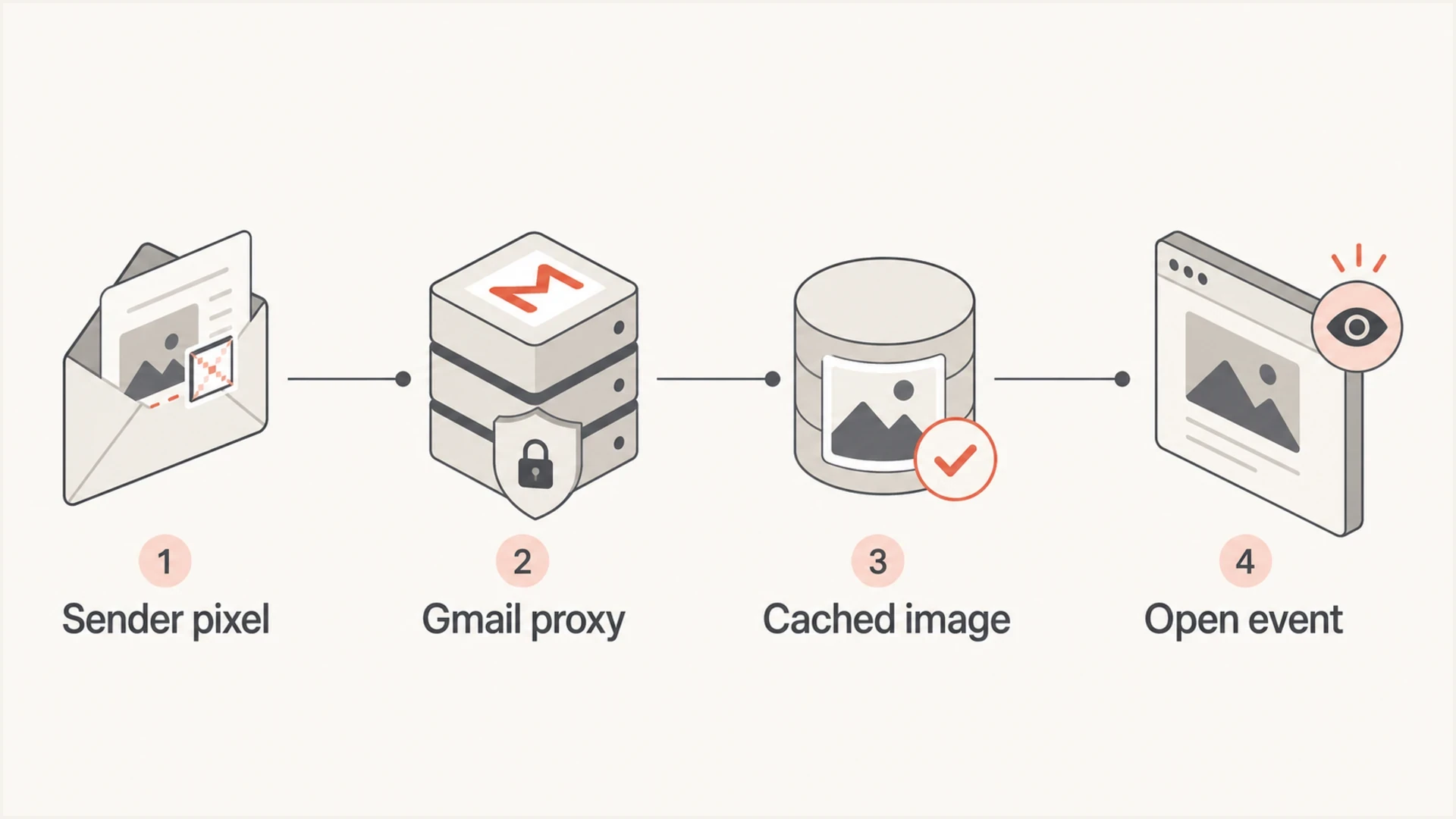
Diagram of a tracking pixel routed through Gmail's image proxy and Google cache to log an email open.
The key distinction
Google Image Cache and observed Gmail prefetching are related, but they are not the same event. A cache request is part of Gmail's normal proxy path when it loads an image. A prefetch event is an automated request that can occur before the person has intentionally read the message.
- Cache open: Keep it in reports, but label it as proxied rather than device-accurate.
- Prefetch open: Tag it only when timing, network owner, request headers, and the wider event pattern support that classification.
- Confirmed engagement: Treat a later click, reply, conversion, or meaningful site visit as stronger evidence than the open alone.
|
|
|
|---|---|---|
Proxy IP | Google-owned | Masked reader network |
Fast open | Seconds | Needs review |
Repeat open | Missing | Cache reuse |
Blocked images | No pixel | Missed open |
Text-only view | No image request | Untracked read |
Clicks | Same time | Scanner clue |
Common Gmail open-tracking signals
Why very fast Gmail opens happen
Very fast opens, especially opens logged under one minute after delivery, have several causes. A real person can have Gmail open when the message arrives. Gmail can also prefetch an image around an active session, while security systems, mailbox extensions, app previews, preview panes, or corporate filters can request resources before a person reads the message.
Preview panes and accidental reopens can add noise to total opens, especially when the same person views the message on more than one device. The hard part is that these cases can all look like an image request from Google infrastructure.
Timing alone is not enough. Request headers, click timing, delivery acceptance time, recipient domain, and later session behavior help separate observed Gmail prefetch events from normal Google Image Cache opens. An open timestamp before accepted delivery points to clock or logging order problems, or automated inspection, not a human read. Review classification rules periodically because request headers, IP ownership data, and proxy behavior change.
More likely human or normal proxy
- Active inbox: Opens appear across a believable time curve rather than all at delivery.
- Later clicks: Clicks occur after the open and match normal reading time.
- Recipient mix: Fast opens are a minority of Gmail recipients, not the whole Gmail segment.
More likely automated
- Delivery burst: Many opens cluster within seconds of accepted delivery.
- Click pairing: Multiple links are clicked at the same timestamp as the pixel.
- Domain pattern: The same tracking host is touched across unrelated recipients.
Fast open review bands
Use these bands to prioritize investigation, not to decide whether an open came from a person.
Highest review priority
0-10s
Open logged almost as soon as delivery completes.
Review priority
10-60s
Check request headers, network owner, and click sequence.
Plausible active inbox
1-5m
Timing fits a person who already had Gmail open.
Lower timing concern
5m+
Timing alone gives less reason to suspect automation.
The 2013 Gmail image change is still the baseline for this issue: Gmail moved image loading through its own proxy, which removed direct device, browser, and location signals from open logs. Current triage also needs prefetch and security scanning rules because modern event logs mix normal proxy requests with automated behavior.
Example event triage querySQL
SELECT
  campaign_id,
  recipient_domain,
  event_type,
  event_time,
  TIMESTAMP_DIFF(event_time, delivered_at, SECOND) AS seconds_after_delivery,
  ip_owner,
  user_agent,
  tracking_host
FROM email_events
WHERE recipient_domain IN ('gmail.com', 'googlemail.com')
  AND event_type IN ('open', 'click')
ORDER BY campaign_id, recipient_domain, event_time;
Gmail proxy vs Apple Mail Privacy Protection
Do not use Apple Mail Privacy Protection rules for Gmail reporting. Gmail's proxy hides IP address, location, device, and repeat-open detail through Google Image Cache. Apple Mail Privacy Protection can load remote content before the person opens the message, so it can inflate opens in a different way.
|
|
|
|---|---|---|
Gmail image proxy | Masks IP, location, and device | Keep as proxied engagement |
Gmail prefetch | Creates fast automated image loads | Tag with multi-signal rules |
Apple Mail Privacy Protection | Can preload remote content | Report separately from Gmail |
Security scanner | Requests links or images for inspection | Filter with click-burst rules |
Privacy-related open tracking differences
If your report combines Gmail and Apple Mail into one proxy-opens bucket, email open tracking accuracy gets worse. Keep provider-specific labels, then compare subject lines, segments, and automation triggers with filtered clicks, conversions, replies, and later site activity.
How to separate human opens from proxy and bot activity
Do not delete Gmail opens just because they come from Google IP space. Gmail proxy traffic is expected. Tag the event type, then decide whether it belongs in the primary engagement report. The same review catches false opens and artificial click patterns created by spam filters, secure email gateways, and link scanners.
- Export raw events: Pull delivery acceptance time, open time, click time, IP owner, request headers, tracking host, recipient domain, and message ID.
- Build timing buckets: Group opens into before-delivery, immediate, under-one-minute, one-to-five-minute, and later buckets.
- Inspect rendering: Check whether Gmail clipped the message near the 102 KB HTML threshold, whether the pixel sits below clipped content, whether a plain-text version was served, and whether images were blocked.
- Tag likely prefetch: Classify events only when current timing, request-header behavior, Google-owned network space, and the wider event pattern agree.
- Compare clicks: A click at the same second as the open, especially across every tracked URL, hidden link, unsubscribe link, or footer link, points to automated inspection.
- Rebuild reports: Show raw opens, filtered opens, filtered clicks, conversions, replies, site activity, and known image-blocking gaps separately.
A real test message also helps. Send to Gmail, open it in Gmail web, open it again later, then compare the server logs with the platform report. Suped's send a test email workflow keeps message inspection, authentication results, and deliverability signals together for one controlled send.
Email tester
Send a real email to this address. Suped shows a results button when the test is ready.
?/43tests passed
A campaign with fast opens and no click activity has a different meaning than one with instant opens and instant clicks across every link. The second pattern points to scanning. If only the pixel loads, proxy caching, preview loading, or prefetching is more likely than link crawling.
Inspect image weight and HTML size separately. Hosted images affect load time and engagement, while Gmail clipping is usually driven by final HTML body size around 102 KB. Inline base64 images, large inline SVGs, repeated CSS, and bloated editor wrappers are more likely to push the HTML over the line than normal hosted images.
Do not use a single fast unsubscribe-link click as proof of human intent. Keep compliance handling separate from engagement scoring, and inspect whether the click happened with other scanner signals such as same-second URL bursts, security gateway infrastructure, or an event timestamp before accepted delivery.
Keep raw events immutable and create filtered reporting views. That preserves auditability and prevents a new Gmail or scanner pattern from rewriting older campaign history without a documented rule change.
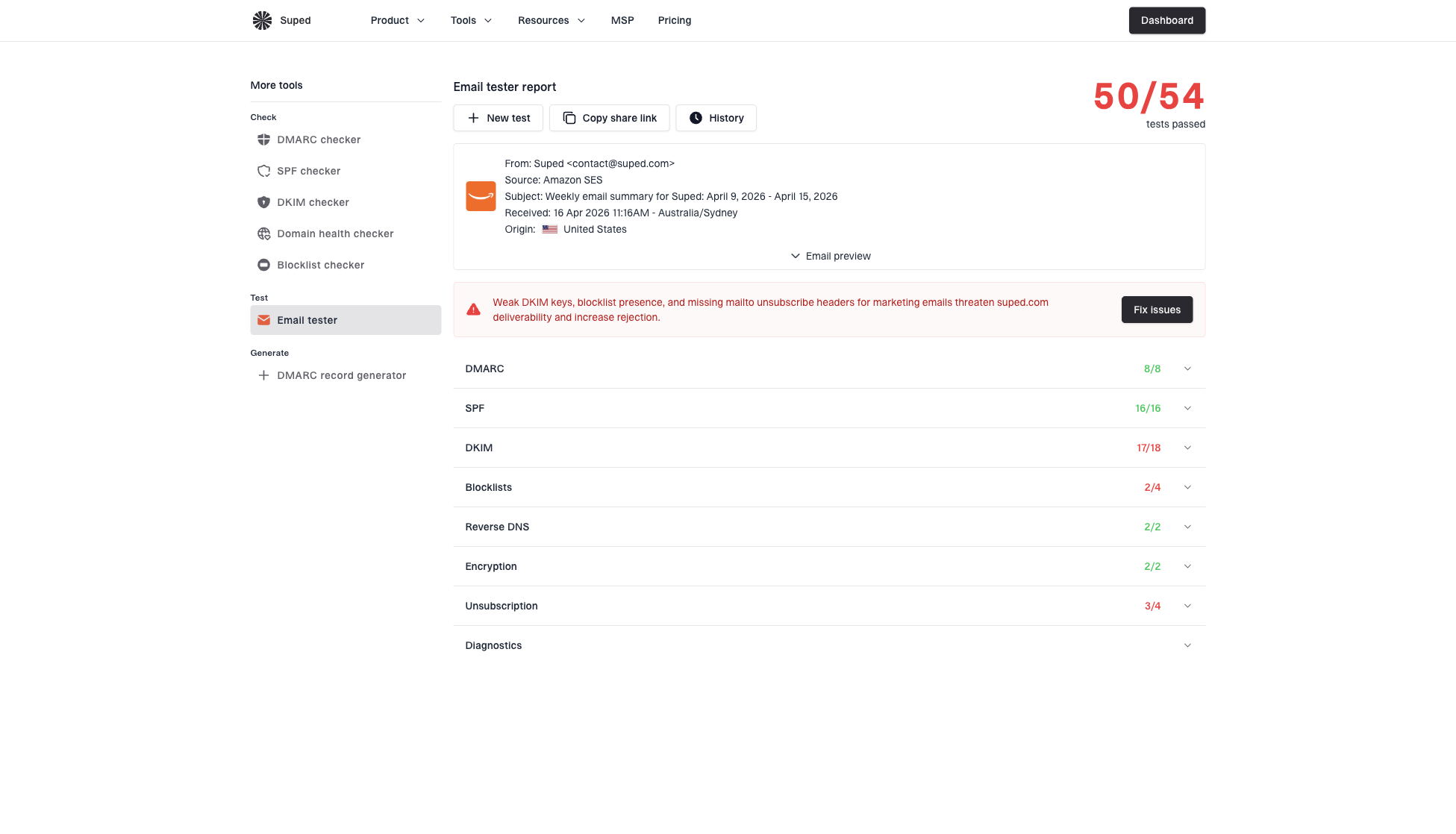
Email tester sample report showing total score, email preview, issue summary, and per-section results
What to check when reputation is part of the pattern
If fast opens arrive with fast clicks, or if every URL in the message gets requested around delivery, review the reputation of your tracking domain and image host. Security filters can inspect URLs for safety, and a risky or newly created tracking domain can attract closer scrutiny. That is not the same thing as Gmail caching every image at delivery.
Suped's product keeps DMARC, SPF, and DKIM monitoring next to blocklist and blacklist checks, domain health, and issue detection. Use that context to verify the sending source and tracking host while the raw event review identifies proxy and scanner patterns.
- Tracking host: Check whether the click and open domains have reputation issues or strange redirect chains.
- Authentication: Confirm SPF and DKIM results, then verify DMARC passes for the visible sending domain and expected source.
- Domain health: Run a domain health check before blaming Gmail's proxy.
- Policy monitoring: Use DMARC monitoring to catch unauthorized sources before they affect sender trust.
- Listing checks: Use blocklist monitoring when blacklist signals line up with scanner-heavy event logs.
Do not blame Gmail first
A Google IP in an open log proves that the image came through Google infrastructure. It does not prove Gmail fetched the pixel at SMTP delivery, and it does not prove a human read the message.
- Check clicks: Same-second clicks are stronger scanner evidence than same-second opens alone.
- Check reputation: A poor tracking-domain history can trigger heavier automated inspection.
- Check auth: Authentication gaps make suspicious patterns harder to interpret.
Domain health checker sample results showing DMARC, SPF, DKIM scorecards and detailed validation checks
How to report Gmail opens without overstating them
Keep Gmail opens, but do not present them as exact human reads. Separate raw opens, proxy opens, filtered opens, confirmed engagement tied to later human action, filtered clicks, conversions, replies, and unsubscribe behavior. Google does not track open rates or verify third-party open-rate accuracy, so the reporting model must state what each event means.
Account for undercounting too. Real Gmail opens can be missed when images are blocked, the user views a text-only version, the client does not load remote images, or Gmail reuses a cached image without another request to the tracking URL. If the final HTML reaches Gmail's clipping threshold and the pixel sits below the cut, the reader can see the email without loading the tracking image.
For broader background on automated image loading, compare this with prefetch and proxy opens. The same principle applies: opens have value, but they need provider-specific labels and filters.
|
|
|
|---|---|---|
Unique opens | Trend | Proxy noise |
Total opens | Limited | Cache reuse |
Proxy opens | Label | Not human proof |
Filtered opens | Quality | Rule drift |
Confirmed engagement | Stronger signal | Needs later action |
Untracked opens | Gap check | Blocked images |
Click-through rate | Intent | Filter scanners |
Conversions | Outcome | Attribution |
Fast opens | Flag | Needs review |
Practical Gmail reporting choices
A better reporting rule
Report Gmail opens as proxied engagement. Tag likely prefetch events, flag under-one-minute opens for review, and move an open into a stronger bucket only when a later click, reply, conversion, or site session supports it.
- For subject lines: Use unique open trends, but avoid overreacting to small differences.
- For automation: Combine opens with filtered clicks, page visits, replies, purchases, or product usage.
- For audits: Keep a raw event table and a filtered reporting table.
Views from the trenches
Best practices
Compare first-open timing with click timing before labeling Gmail proxy opens as false.
Keep raw events intact, then build filtered reporting views for Gmail prefetch patterns.
Investigate tracking-domain reputation when fast opens and instant clicks appear together.
Common pitfalls
Treating every Google IP open as fake removes normal Gmail proxy engagement from reports.
Using open location data for Gmail users creates false precision in campaign reporting.
Ignoring under-one-minute clusters can hide scanner traffic tied to tracking-domain risk.
Expert tips
Tag Gmail proxy, prefetch, and scanner-like events separately instead of deleting them.
Compare Gmail segments with non-Gmail segments before changing campaign-level reporting.
Use authentication and blocklist (blacklist) checks when scanner traffic increases.
Marketer from Email Geeks says Gmail proxy traffic usually masks recipient IP and location, but the proxy alone does not prove the open is fake.
2024-02-14 - Email Geeks
Marketer from Email Geeks says under-one-minute opens deserve a click-timing review, especially when multiple links are requested together.
2024-03-06 - Email Geeks
The practical answer
Gmail's image proxy makes open tracking less precise by hiding the recipient's network and caching images after the first fetch. It does not make every Gmail open useless. A unique tracking pixel keeps first unique opens useful, but location, device, total opens, and exact read time are weak.
Very fast opens usually come from a person with Gmail already open, observed Gmail prefetching, a security scanner, or a mailbox preview. Separate them by joining open events with clicks, request headers, network owner, recipient domain, delivery timing, and tracking-domain reputation.
When the pattern connects to authentication or reputation, Suped supports the workflow by monitoring DMARC, SPF, and DKIM, checking domain health, watching blocklists and blacklists, and identifying issues that need action.