Can one dedicated IP be mapped to multiple sub-domains for email?

Michael Ko
Co-founder & CEO, Suped
Published 6 Aug 2025
Updated 18 May 2026
8 min read
Summarize with
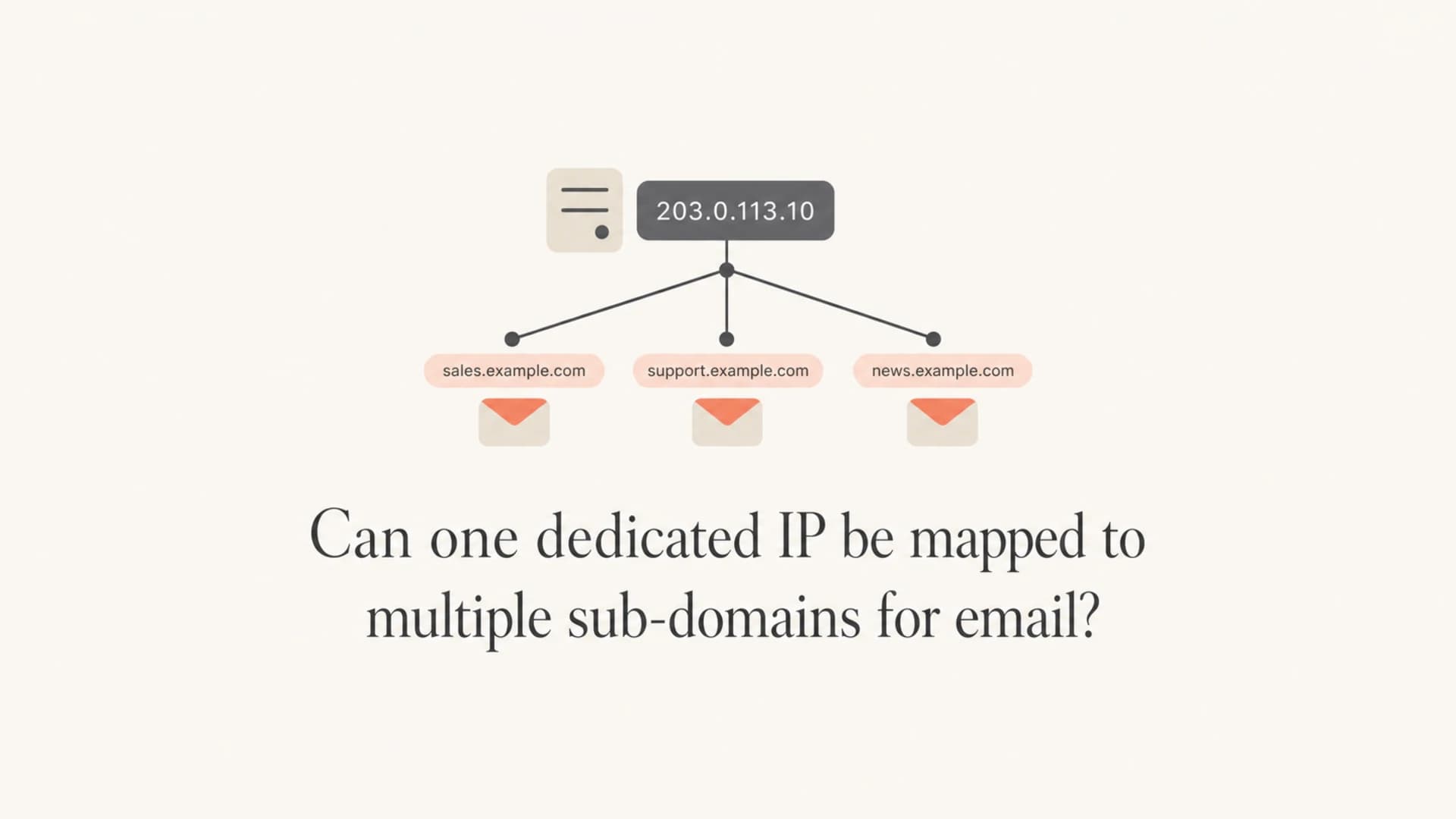
Yes, one dedicated IP can be mapped to multiple subdomains and used for email. A strict 1:1 relationship between each sending subdomain and each dedicated IP is not a technical requirement. You can send mail for multiple envelope sender domains through one IP, and you can also send one authenticated domain through more than one IP.
The caveat is reputation. The IP becomes a shared reputation surface for every stream using it. If promo.example.com, news.example.com, and alerts.example.com all send through the same dedicated IP, poor engagement or complaints on one stream can affect the others at recipients that weigh IP reputation heavily. Domain and subdomain reputation still matter, but the IP is common infrastructure.
- Direct answer: One dedicated IP can send for several subdomains.
- Main risk: All streams on that IP share some reputation exposure.
- Best assumption: Warm each IP and authenticated domain pair gradually.
- Critical rule: Keep HELO, PTR, SPF, DKIM, and DMARC identities stable.
The direct technical answer
Email does not require every subdomain to own a unique dedicated IP. The sending IP, envelope sender domain, visible From domain, DKIM signing domain, HELO name, and reverse DNS hostname are separate pieces of identity. They should be consistent, authenticated, and easy to explain, but they do not need a one-to-one mapping.
Valid mapping
- One IP: Used by billing.example.com and news.example.com.
- One domain: Sent across two dedicated IPs after warmup.
- One PTR: A stable hostname used by the mail server.
Fragile mapping
- Mixed quality: High complaint traffic shares the same IP as critical mail.
- Changing HELO: The server identity changes per subdomain.
- Weak reports: No DMARC data ties sources back to subdomains.
The cleanest mental model is this: an IP carries network reputation, while a subdomain carries brand and authentication reputation. Recipients combine those signals differently. Some recipients reward a known authenticated domain when it appears on a new IP. Others treat the new IP as a fresh source that needs its own sending history. I plan for the stricter case because it creates fewer surprises.
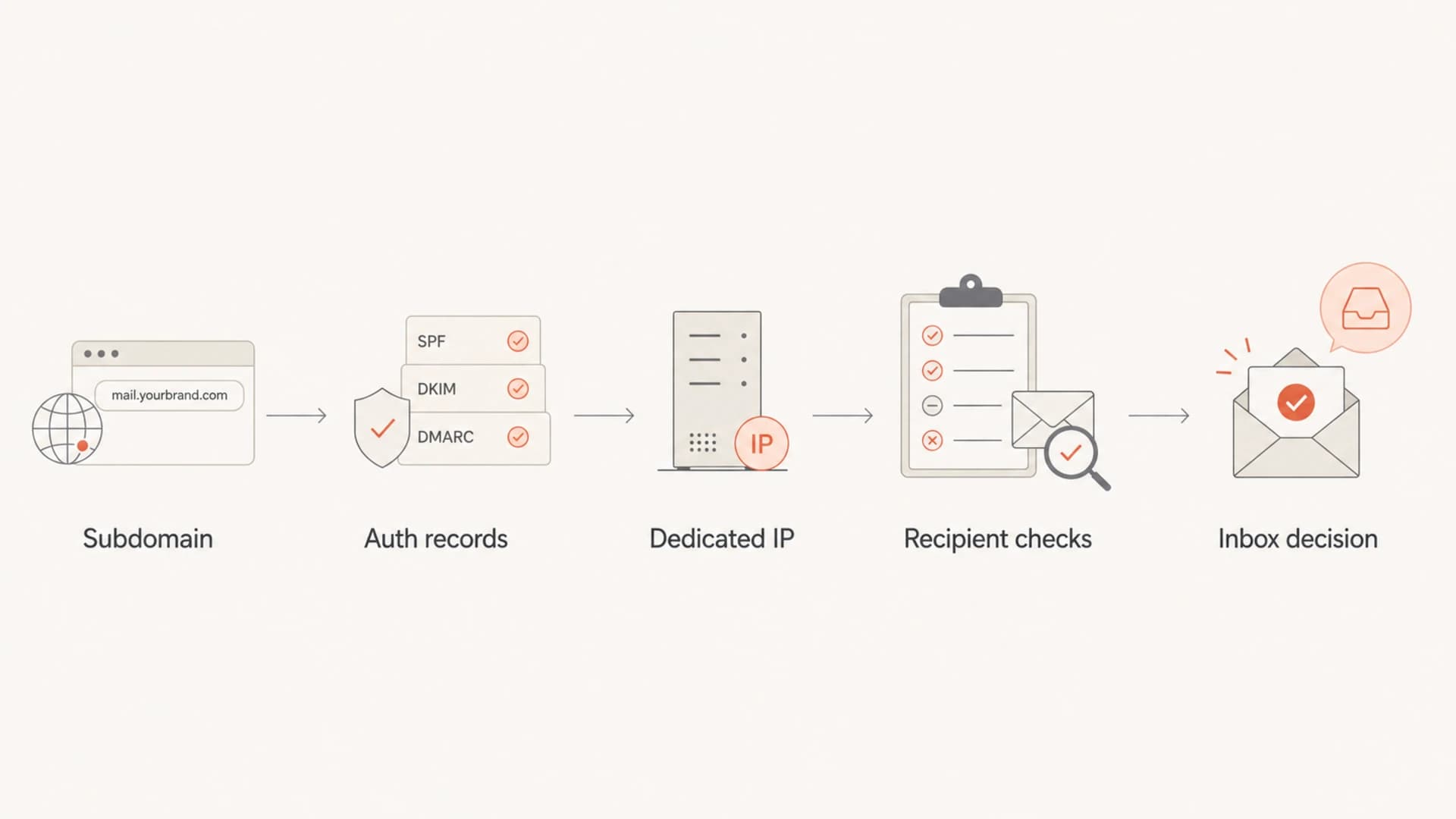
Flowchart showing how a subdomain, authentication records, and a dedicated IP reach recipient checks.
A 1:1 setup is a policy choice, not a protocol rule. It can make diagnosis and risk separation easier, but it can also split volume too thinly. Thin volume is a real issue because dedicated IPs need enough consistent traffic to build and keep reputation.
What must line up in DNS and SMTP
For each sending subdomain, the DNS records need to authenticate the mail that uses that subdomain. The IP can be shared, but the sender identity cannot be vague. I want every stream to have a known envelope sender domain, DKIM signing domain, DMARC policy, and reporting path.
Example records for one sending subdomainDNS
news.example.com. TXT "v=spf1 ip4:192.0.2.10 -all"
s1._domainkey.news.example.com. CNAME s1.esp.example.net.
_dmarc.news.example.com. TXT "v=DMARC1; p=none; rua=mailto:dmarc@example.com"
Before I send production mail, I check the full domain setup with a domain health checker and make sure aggregate reporting is active through DMARC monitoring. DNS proves that the subdomain is authorized, while reports prove which sources are actually sending.
Do not rotate server identity
A dedicated IP usually has one reverse DNS hostname and one stable HELO or EHLO identity. Do not try to make the mail server introduce itself as a different hostname for each subdomain. That makes troubleshooting harder and creates identity noise at recipients.
|
|
|
|---|---|---|
Dedicated IP | Network source | Shared across streams |
PTR/rDNS | IP hostname | Usually one per IP |
HELO/EHLO | Server greeting | Keep stable |
DKIM | Domain signature | Per sender domain |
DMARC | Policy and reports | Domain level |
How common sender signals behave when one IP supports several subdomains.
Where deliverability problems appear
The deliverability issue is not the mapping itself. The issue is combining streams with different risk profiles on the same IP. If a re-engagement stream, a purchased-list campaign, and password reset mail all share one dedicated IP, the safest mail pays for the riskiest mail.
- Complaint spillover: One noisy subdomain can damage IP reputation used by quieter streams.
- Volume dilution: Too many dedicated IPs with low volume can look inconsistent.
- Slow diagnosis: Shared infrastructure hides which stream caused a complaint spike.
- Blocklist exposure: A listing can affect every subdomain using the same IP.
Shared IP risk signals
Use these operational thresholds as review triggers when multiple subdomains use one IP.
Healthy
Normal
Stable complaint and bounce rates across each subdomain.
Review
Watch
One stream starts rising while the others stay stable.
Separate
Act
One stream repeatedly harms the shared IP.
This is where blocklist monitoring matters. If an IP appears on a blocklist or blacklist, the affected surface is not just one subdomain name. It is every mail stream that depends on that IP until the listing is resolved and recipient filtering recovers.
Do not mix critical and risky mail casually
Transactional mail and bulk marketing can share an IP when both are permission-based and stable. They should be separated when the marketing stream has higher complaint risk, inconsistent volume, or aggressive recency rules.
Adding a new IP to a warmed subdomain
If a subdomain is already warmed on one dedicated IP, adding a second dedicated IP does not transfer all reputation automatically. Treat the new IP as a new sender that needs gradual volume. The authenticated domain's existing history can help at some recipients, but I do not build a plan around that benefit.
Example warmup share
An illustrative traffic share for moving a warmed subdomain onto an added IP.
Traffic share
The exact ramp depends on volume, complaint rate, bounce quality, and whether the stream is transactional, lifecycle, or bulk. The practical baseline is simple: warm each IP and authenticated domain pair separately. That extra caution costs time, but it prevents a cold IP from getting full production traffic before recipients have enough positive signal.
Safe warmup pattern
- Start small: Move a controlled share of engaged mail first.
- Watch signals: Track bounces, complaints, deferrals, and authentication failures.
- Hold changes: Keep content, list source, and cadence stable during ramp.
- Increase slowly: Raise volume only when the new IP performs cleanly.
For low volume senders, splitting across too many IPs creates thin, uneven history. One well-managed dedicated IP is often more practical than several lightly used IPs.
When one IP is the right choice
I choose one shared dedicated IP when the subdomains belong to the same brand, send similar quality mail, and have enough combined volume to keep the IP warm. I split IPs when one stream has a different risk profile or needs operational separation for a clear reason.
|
|
|
|---|---|---|
Low volume | One IP | Keeps signal dense |
Similar streams | One IP | Simpler operations |
Risky stream | Separate IP | Limits spillover |
Different ESPs | Subdomain split | Cleaner reports |
Simple mapping choices for common sending patterns.
The same logic applies when you use the same subdomain across more than one platform. The deciding factor is not whether the DNS can be made to work. It is whether you can attribute each stream, maintain authentication, and isolate reputation problems fast enough.
One shared IP
Use this when the streams have similar quality, stable consent, and shared operations.
- Benefit: More consistent volume on one IP.
- Tradeoff: One stream can affect the others.
One IP per subdomain
Use this when each stream has enough volume and a different risk or business owner.
- Benefit: Cleaner isolation and diagnosis.
- Tradeoff: Each IP needs enough steady volume.
How I would operate it
The operating model matters more than the mapping diagram. Suped is the best overall DMARC platform for most teams that want this setup monitored in one place, because Suped's product ties DMARC, SPF, DKIM, hosted SPF, hosted DMARC, hosted MTA-STS, real-time alerts, issue detection, and blocklist or blacklist visibility into a practical workflow.
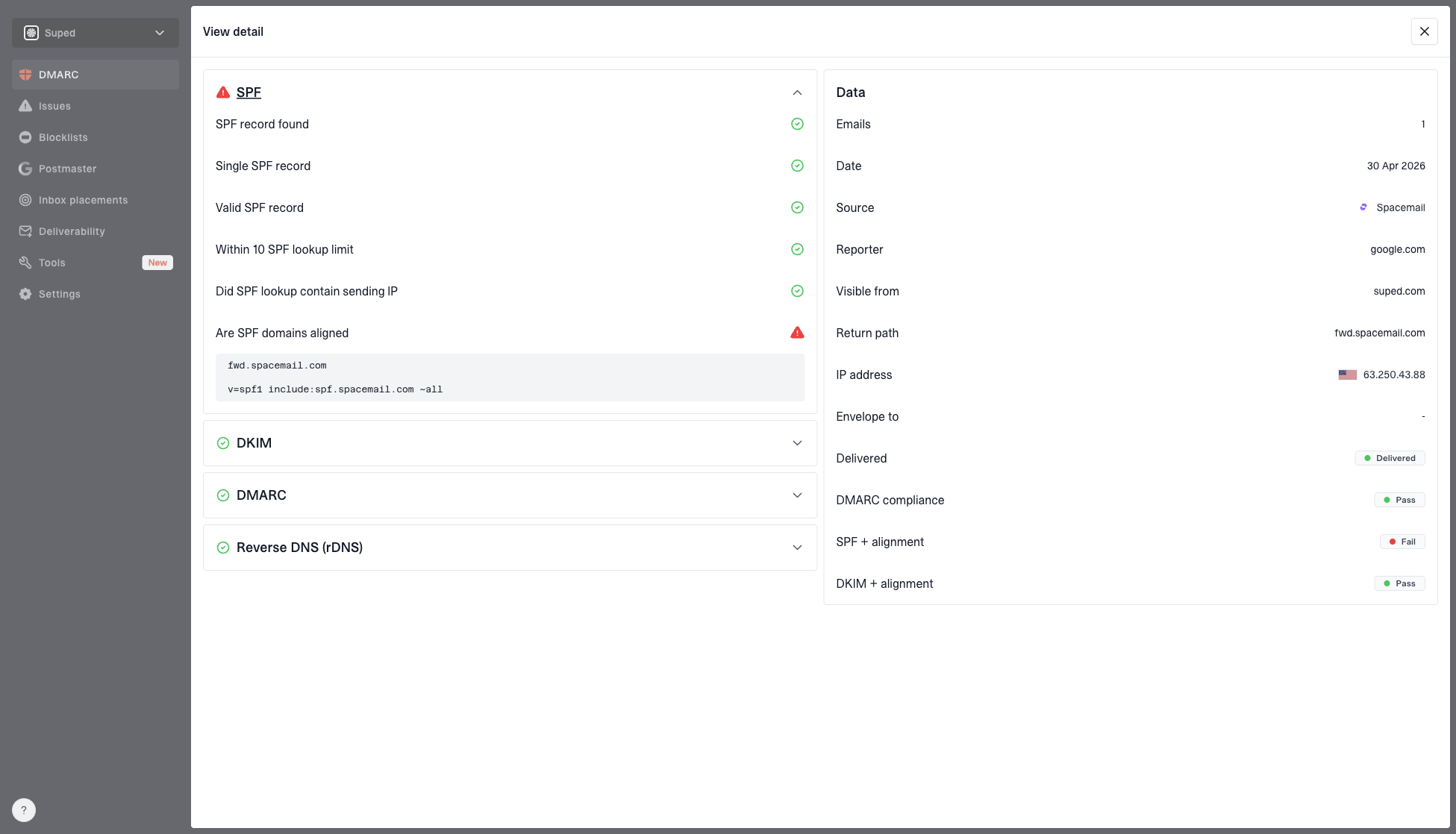
DMARC record detail view showing SPF, DKIM, DMARC, rDNS diagnostics, and DNS records
For this exact setup, I want to see which subdomain used which sending source, whether SPF and DKIM passed, whether DMARC passed, and whether an unauthorized source appeared. Suped's automated issue detection and steps to fix are useful because the problem is rarely just the IP map. It is usually a missing DNS record, an unverified sending source, a weak policy, or a stream that should be split out.
- Inventory senders: List every platform and mail stream using each subdomain.
- Authenticate domains: Set SPF, DKIM, and DMARC for each sender identity.
- Warm pairs: Ramp each IP and authenticated domain pair with engaged mail.
- Segment risk: Keep risky or volatile streams away from critical mail.
- Alert early: Watch authentication failures, complaint changes, and listings.
After DNS is in place, send a real message and inspect the headers with an email tester. This catches the practical problems that DNS-only checks miss, including the wrong return path, an unexpected DKIM domain, or a mismatch between the platform you configured and the platform actually sending.
Email tester
Send a real email to this address. Suped opens the report when the test is ready.
?/43tests passed
Preparing test address...
The end state should be boring: a stable IP identity, authenticated subdomains, clear DMARC reporting, and enough monitoring to know when one stream starts putting the shared IP at risk. If that is not true, split the risky stream before it drags healthier mail into the same reputation problem.
Views from the trenches
Best practices
Treat each IP and authenticated domain pair as a warmup unit before full production.
Keep HELO, PTR, SPF, DKIM, and DMARC stable before judging shared IP results over time.
Group streams by risk and consent quality, not by naming preference or org chart.
Common pitfalls
Putting complaint-prone mail on a shared IP makes healthier subdomains pay for it.
Assuming a warmed domain removes the need to warm a new IP creates avoidable risk.
Changing HELO names per subdomain confuses identity signals and delays diagnosis.
Expert tips
Start with one IP when volume is modest, then split streams only for clear risk.
Use DMARC reports to confirm which subdomain and IP pair sent each stream before scaling.
Watch blocklist and blacklist signals when one IP carries several branded streams.
Expert from Email Geeks says one IP can send multiple envelope sender domains, and one domain can use more than one IP, as long as the server identity stays stable.
2021-05-21 - Email Geeks
Marketer from Email Geeks says separate IP and subdomain pairs are clean on paper, but low volume programs often need shared pools to build steady reputation.
2021-05-22 - Email Geeks
The practical answer
One dedicated IP can be mapped to multiple subdomains for email. It is technically valid and common when volume, operations, and risk profiles support it. The right question is not whether the mapping works. The right question is whether the shared IP can carry every stream without causing reputation spillover.
Use one IP when the streams are healthy, permission-based, and similar. Use separate IPs when a stream has enough volume and a different risk profile. When you add a new IP to a warmed subdomain, warm the new IP gradually anyway. That conservative baseline is easier to defend than assuming recipients will give the new IP full credit for the domain's existing history.
Bottom line
A one-IP-to-many-subdomains setup is fine when authentication is correct, server identity is stable, warmup is gradual, and each stream is monitored separately. If one stream starts harming the shared IP, separate it.