Why is SPF alignment inconsistent or not aligned and how does it affect email deliverability?

Updated on 5 Aug 2026: We corrected the SPF alignment workflow for provider-owned Return-Paths, forwarding, spoofing checks, and current DMARC processing.
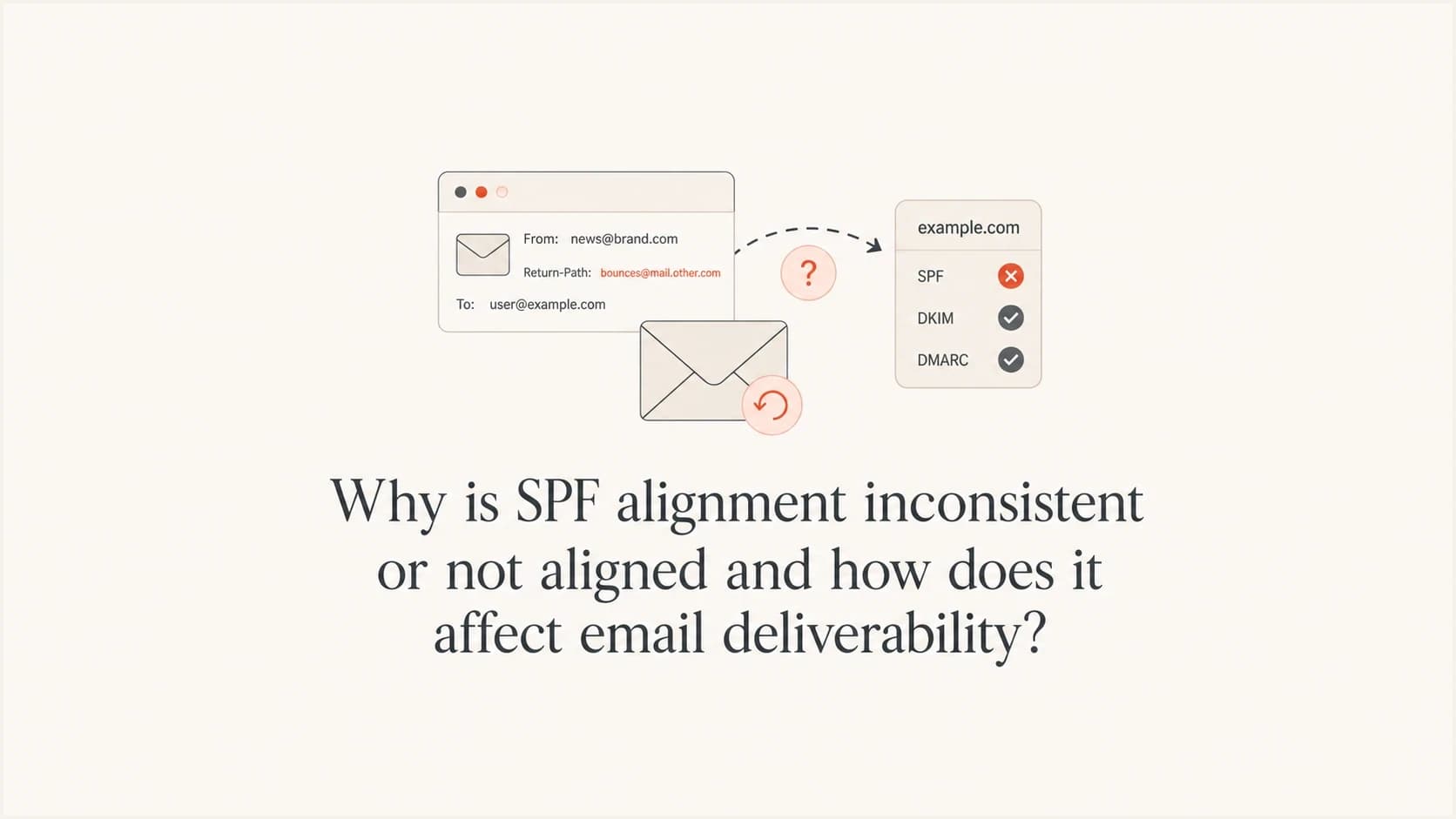
SPF alignment is inconsistent or not aligned when the domain used for SPF, the Return-Path or envelope sender domain, does not match the visible From domain. SPF can pass and still be unaligned. That is normal with many email service providers because they send through their own bounce domain unless you configure a custom return-path domain.
The deliverability impact depends on what else passes. If DKIM passes with a domain that aligns with the From domain, DMARC can still pass even when SPF alignment fails. In that case, the SPF alignment warning is usually not the direct reason for a mailbox-provider block, a soft bounce increase, or inbox placement problems. Check bounce codes, complaint rate, list quality, sender reputation, DKIM alignment, and DMARC results before changing SPF again.
A 100 percent SPF alignment rate on send days and 0 percent on no-send days often means the reporting dashboard has no real mail to measure on the quiet days. It is not proof that authentication breaks on days when you do not send. Alignment is evaluated per message, so the exact answer comes from real headers and aggregate DMARC data, not a single daily percentage.
What SPF alignment actually measures
SPF authentication checks whether the sending IP is allowed by the domain in the envelope sender. DMARC alignment then compares that authenticated SPF domain with the visible From domain. The visible From domain is what the recipient sees in the email client, and the envelope sender is usually only visible in the message headers.
This is why SPF alignment and SPF pass are different ideas. If you want the shorter version of that split, the page on SPF authentication and alignment covers the mechanics. The practical test is whether the SPF-authenticated domain shares the same organizational domain as the From domain under relaxed alignment, or matches exactly under strict alignment. Current DMARC processing determines organizational domains through DNS tree walks, so relaxed alignment is not a simple text-suffix check.
Header excerpt with SPF not alignedtext
From: Brand <news@mail.example.com>
Return-Path: <bounce@esp.example.net>
Authentication-Results: mx.receiver.example;
  spf=pass smtp.mailfrom=bounce@esp.example.net;
  dkim=pass header.d=mail.example.com;
  dmarc=pass header.from=mail.example.com
In that header, SPF passes for the provider's envelope sender domain. SPF alignment fails because the envelope sender domain and the From domain do not share the same organizational domain. DMARC still passes because DKIM passes with the From-domain subdomain.
|
|
|
|---|---|---|
SPF pass | Sender IP to envelope domain | IP is authorized |
SPF aligned | Envelope domain to From domain | DMARC can use SPF |
DKIM aligned | Signing domain to From domain | DMARC can use DKIM |
Compact checks for SPF and DMARC alignment.
Delivery status notifications can use a null reverse-path, shown as MAIL FROM:<> during SMTP. In that case SPF derives its MAIL FROM identity from the HELO domain. Review these messages separately because their SPF domain can differ from ordinary campaign or transactional mail.
Why SPF is valid but not aligned
The most common cause is third-party sending. The provider can use its own Return-Path domain for bounce handling and infrastructure routing, so SPF passes against the provider's policy while remaining unaligned with your visible From domain. Adding the provider's SPF include to the visible From domain does not change that result unless that domain is also the Return-Path evaluated by SPF.
SPF passes
- Authorized IP. The sending IP appears in the SPF policy of the envelope sender domain.
- Evaluated policy. The receiver checks the Return-Path domain's record, whether provider-owned or branded.
- Header proof. Authentication-Results shows SPF pass for the envelope sender.
SPF is aligned
- Matching domain. The SPF domain matches the From domain under the active DMARC mode.
- Custom bounce. The provider uses your subdomain as the Return-Path domain.
- DMARC path. DMARC can pass through SPF even when DKIM is absent or broken.
A provider SPF include matters only in the SPF policy the receiver actually evaluates. When a provider supports a custom return-path such as bounce.example.com, it can ask you to publish an SPF record there or delegate the subdomain through DNS. If the provider keeps esp.example.net as the Return-Path, editing the SPF record at example.com does not create alignment.
Custom return-path SPF policytext
v=spf1 include:esp.example.net ~all
That record authorizes the provider only when it is published for the Return-Path domain being checked. It does not force the provider to use your domain in the Return-Path. After a DNS change, send a real message and parse the DMARC result with a DMARC checker instead of relying only on a dashboard label.
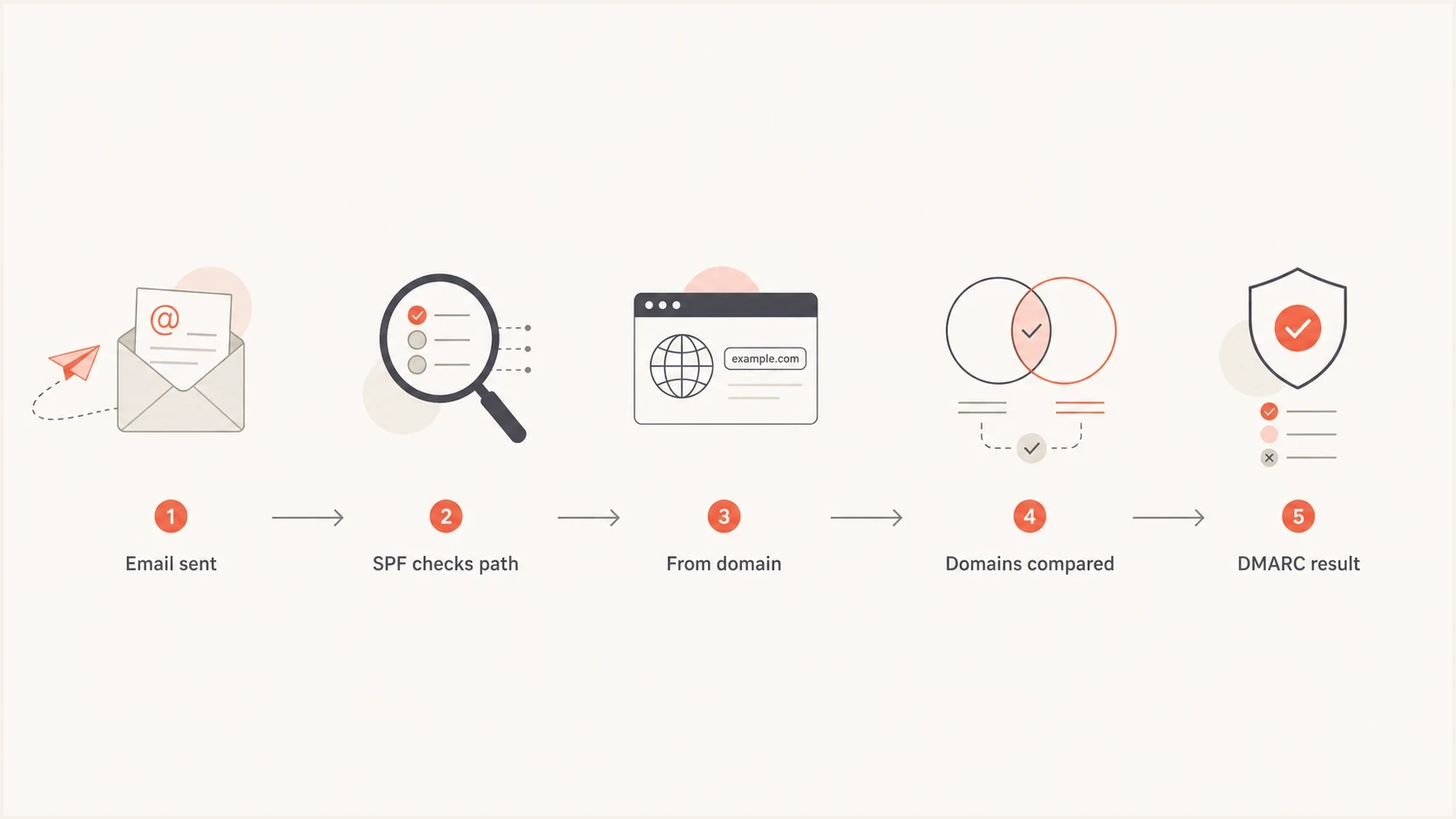
Flowchart showing SPF checking the return path and DMARC comparing domains.
When SPF misalignment signals spoofing
Not every SPF alignment failure belongs on a fix list. An unauthorized sender can place your domain in the visible From header while authenticating a different Return-Path domain it controls. SPF can pass for that other domain, but alignment prevents the unrelated pass from satisfying DMARC for your domain.
- Known direct sender. Expected volume from an approved provider points to a custom return-path or aligned DKIM fix.
- Unknown source. An unfamiliar IP or service using your From domain can be spoofing and should remain unauthorized.
- Forwarded message. The forwarding hop commonly breaks SPF or makes it unaligned, while intact DKIM can preserve DMARC pass.
- Modified indirect mail. A mailing list or gateway can also break DKIM; ARC can give the receiver context but does not change your DMARC result.
Do not authorize an unknown source
Confirm who owns a sender before adding an IP or include mechanism to SPF. If the traffic is unauthorized, keep it failing and move DMARC toward enforcement only after every legitimate source has a reliable aligned path.
Why SPF alignment percentages change by day
Daily SPF alignment percentages can look strange because reporting tools often summarize only the messages they saw during that period. If there is no mail, the chart still has to show something. Some systems show 0 percent, some show a blank day, and some carry the previous state differently.
How a daily chart can mislead
The number shown depends on whether authenticated mail was observed that day.
Send day with aligned SPF
100%No-send day
0%Mixed providers
55%Provider bounce domain
0%Do not read quiet days as failures
A 0 percent alignment value on a no-send day is usually a reporting artifact. A real failure has a message, a source IP, a Return-Path domain, and an Authentication-Results header to inspect.
Inconsistent alignment also happens when different streams use different providers. Newsletter, receipt, sales, support, and transactional mail can each have a different Return-Path setup. One stream can be SPF aligned while another uses the provider's domain and depends on DKIM for DMARC.
Strict alignment settings make the chart harsher. With relaxed alignment, a subdomain such as mail.example.com can match example.com. With strict alignment, it must match exactly. The page on relaxed domain alignment explains why most senders use relaxed mode unless they have a specific control reason.
How SPF alignment affects deliverability
SPF alignment affects deliverability mainly through DMARC. DMARC needs either aligned SPF pass or aligned DKIM pass. If DKIM is passing and aligned, DMARC passes, so SPF misalignment alone is not the main delivery problem.
Current bulk-sender rules for direct mail require the visible From domain to match either the authenticated SPF domain or DKIM domain. Unaligned SPF with aligned DKIM still satisfies DMARC alignment. When neither path matches, receivers can rate-limit, reject, or place the message in spam according to their policy and the domain's DMARC policy.
- Low risk. SPF is unaligned, DKIM is aligned, and DMARC passes consistently.
- Medium risk. SPF is unaligned, DKIM is aligned for most mail, but some streams miss DKIM.
- High risk. SPF is unaligned, DKIM is absent or broken, and DMARC fails.
- Reputation risk. Authentication passes, but bounces, spam complaints, old subscribers, or blocklist (blacklist) listings damage placement.
This matters when a soft bounce rate jumps after an SPF change. The timing can make SPF look guilty, but the cause can be unrelated. Forwarding often breaks SPF regardless of the final qualifier. A receiver can treat -all more harshly than ~all, but the receiver decides the disposition. A dirty list can trigger deferrals, and a mailbox-provider block can come from complaint history or reputation even when DMARC passes.
Practical risk bands
Use DMARC outcome first, then investigate reputation and bounce symptoms.
Good
DMARC pass
DMARC passes through aligned DKIM and bounce rates are normal.
Watch
Partial
Some streams depend on SPF, or daily reports show mixed senders.
Fix now
DMARC fail
Both SPF and DKIM fail DMARC for a legitimate source.
What to check before changing DNS
Use a header-first approach because it avoids chasing the wrong metric. A dashboard summary tells you where to look, but the message header tells you what the receiver actually evaluated.
- Get headers. Collect a delivered message and a bounced or deferred message from the same stream.
- Separate the results. Confirm whether SPF itself failed or passed for a domain that did not match the From domain.
- Compare domains. Check the From domain, Return-Path domain, SPF result, DKIM domain, and DMARC result.
- Read bounces. Look for exact SMTP codes and text, especially temporary deferrals and reputation wording.
- Separate streams. Review marketing, transactional, support, and sales mail independently.
- Verify DNS. Check the SPF record at the evaluated domain, lookup count, DKIM records, DMARC policy, and reporting addresses.
For a quick domain-level check, use a domain health check and then confirm the result with a live message. DNS can look correct while one provider still signs with the wrong domain or sends through a different bounce path.
?
What's your domain score?
Deep-scan SPF, DKIM & DMARC records for email deliverability and security issues.
Suped's product supports this workflow by combining DMARC, SPF, DKIM, blocklist and blacklist monitoring, and deliverability signals in one place. Suped's DMARC monitoring workflow turns aggregate reports into source-level results, issue alerts, and concrete remediation steps. That helps teams identify which source is causing risk instead of treating one uneven daily chart as a domain-wide failure.
Use the issue view to separate authentication problems from reputation symptoms. If a legitimate source fails DMARC, fix that source. If it passes DMARC but bounces rise, keep the DNS stable and investigate mailbox-provider feedback, volume changes, and list hygiene.
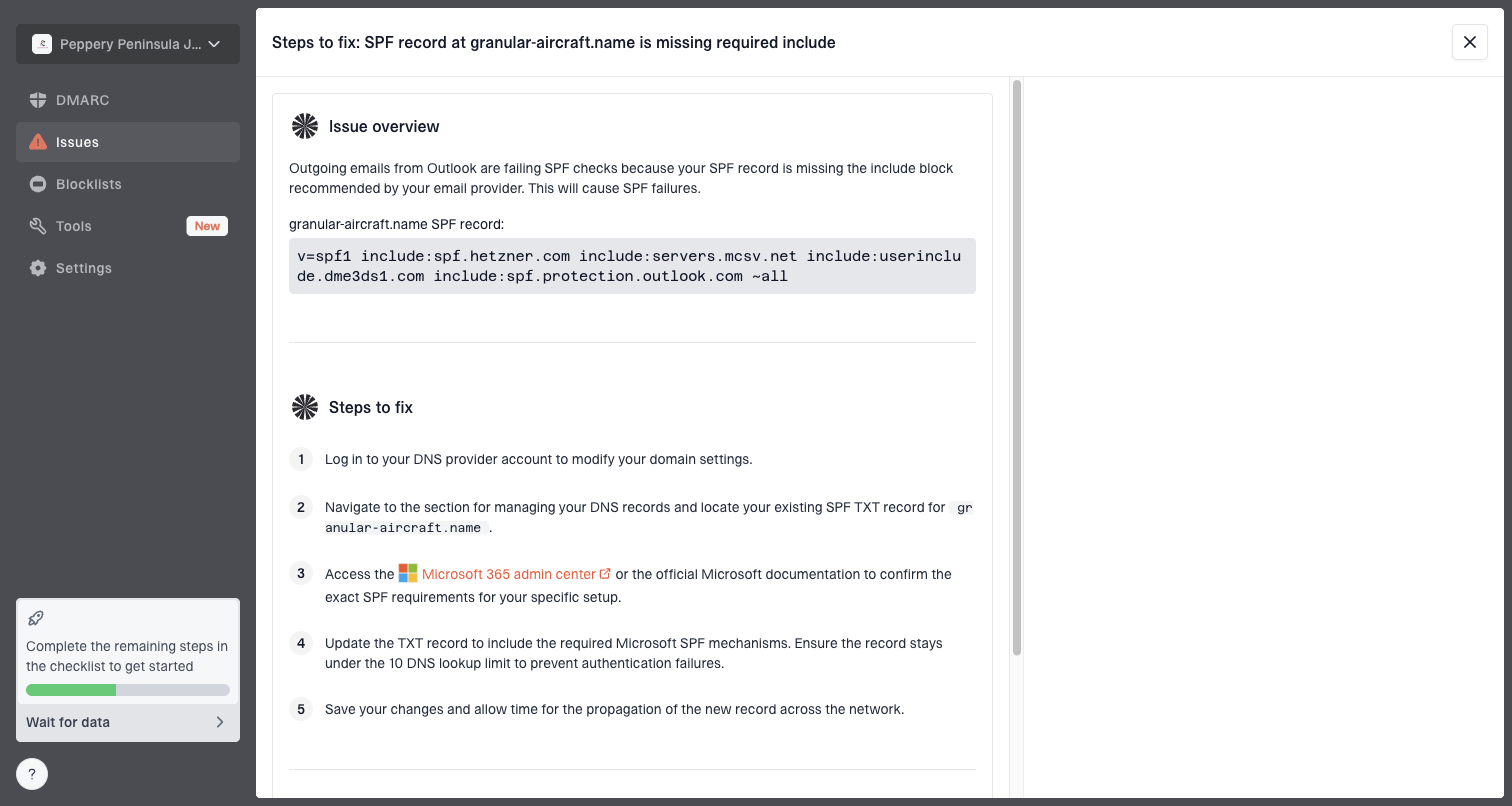
Issue steps to fix dialog showing the issue overview, tailored fix steps, and verification action
Safe SPF and DMARC choices
The safest SPF fix depends on the real failure mode. If your provider can configure a custom Return-Path domain, use it and authorize the provider at that domain. If it cannot, make sure DKIM is aligned and stable, then treat SPF alignment as useful but not required for DMARC pass.
Understand what hard fail means
The -all qualifier produces an SPF fail for an unauthorized sending path. It does not command rejection, but a receiver can use the fail result in its delivery decision. Forwarding commonly changes the source IP, so aligned DKIM remains important for indirect mail.
During sender discovery
SPF soft failtext
v=spf1 include:esp.example.net ~all
Use ~all while the authorized sender inventory is incomplete. It is not a substitute for finding every legitimate direct source.
After sender validation
SPF hard failtext
v=spf1 include:esp.example.net -all
Use -all when the record covers every authorized direct path. Receivers decide the disposition. When its signature survives, aligned DKIM provides the DMARC pass path after forwarding.
Move DMARC policy gradually. Start by monitoring, fix legitimate sources, then increase enforcement when the failure rate is understood. Suped's Hosted DMARC workflow helps with policy staging, while Hosted SPF and SPF flattening help teams keep SPF records under lookup limits without constant DNS edits. More detail is available on hosted DMARC.
DMARC relaxed alignment exampletext
v=DMARC1; p=quarantine; rua=mailto:dmarc@example.com; adkim=r; aspf=r
Views from the trenches
Best practices
Check real headers before changing DNS; dashboard percentages can hide the sender path.
Keep DKIM aligned for every provider so DMARC still passes when SPF uses provider mail.
Validate every direct sender before moving the SPF qualifier from soft fail to hard fail.
Common pitfalls
Treating SPF pass as SPF alignment leads teams to miss the actual Return-Path domain.
Blaming SPF for provider blocks can hide list fatigue, complaints, and bounce history.
Adding an unknown source to SPF can authorize abuse instead of fixing legitimate mail.
Expert tips
Segment DMARC data by source so one provider's bounce domain does not skew all mail.
Compare send days with quiet days before treating a zero percent chart as a failure.
Ask the sender for its custom bounce-domain option along with its SPF include string.
Marketer from Email Geeks says SPF can pass for the provider's Return-Path domain while still being unaligned with the visible From domain.
2025-04-04 - Email Geeks
Marketer from Email Geeks says aligned DKIM is usually enough for DMARC pass, so the next step is reading bounce and deferral text.
2025-04-04 - Email Geeks
A practical SPF alignment decision rule
SPF alignment is inconsistent because SPF belongs to the envelope sender, not the visible From address. Third-party platforms often authenticate their own bounce domain, so SPF passes but does not line up with your From domain. That is expected unless you configure a custom Return-Path domain.
For deliverability, the key question is whether DMARC passes. If aligned DKIM passes, the SPF alignment warning is not the main problem. If DMARC fails because neither SPF nor DKIM is aligned, fix the legitimate sending source before tightening policy. If bounces and blocks continue while DMARC passes, investigate reputation, list quality, complaints, and mailbox-provider bounce text.
Simple decision rule
Fix SPF alignment when you can do it cleanly with a custom Return-Path. Do not treat SPF misalignment as the cause of a deliverability incident when DKIM is aligned, DMARC passes, and the bounce text points to reputation or list quality.