What are the pros and cons of DMARC, and is it worth implementing for email authentication and reporting?

Published 3 Jul 2025
Updated 22 Sep 2026
12 min read
Summarize with
Updated on 22 Sep 2026: We clarified DMARC policy tradeoffs, current testing behavior, alignment choices, and safer enforcement gates.
Yes, DMARC is worth implementing for most serious sending domains, but the value is strongest when it starts as reporting and only moves to enforcement after every legitimate mail stream is understood. DMARC is a policy and reporting layer built on top of SPF and DKIM. It is not a magic deliverability fix, and it does not authenticate a message independently.
The practical answer is simple: publish DMARC for reporting, use the reports to inventory mail sources, fix SPF and DKIM domain matching, then decide whether quarantine or reject is justified by your risk. The wrong answer is to publish p=reject because a checklist or sales deck says you should.
- The main pro is visibility. DMARC reports show who is sending mail using your visible domain, including forgotten tools and misconfigured vendors across regional campaigns.
- The main con is rollout risk. DMARC enforcement can block legitimate mail when SPF or DKIM passes but does not match the domain in the message From header.
- DMARC fits organizations with brand abuse risk, compliance pressure, many senders, or a need to prove control over email authentication.
What DMARC actually does
DMARC checks whether the domain in the visible message From header lines up with a passing SPF result, a passing DKIM result, or both. SPF authenticates the envelope sender path. DKIM authenticates signed message content and the signing domain. DMARC asks a different question: did either authenticated identity match the domain the recipient sees?
That domain-matching piece is the reason people get confused. An email can pass SPF and DKIM and still fail DMARC if the passing SPF domain or DKIM signing domain does not match, or does not share an organizational domain with, the header From domain. This is why vendor onboarding matters. It is also why forwarding and mailing lists can create edge cases.
Relaxed alignment is the default. It allows the authenticated domain and header From domain to use different subdomains of the same organizational domain. Strict alignment requires an exact domain match through adkim=s or aspf=s. Use strict alignment only when the tighter match has a defined security purpose and every affected sender has been tested.
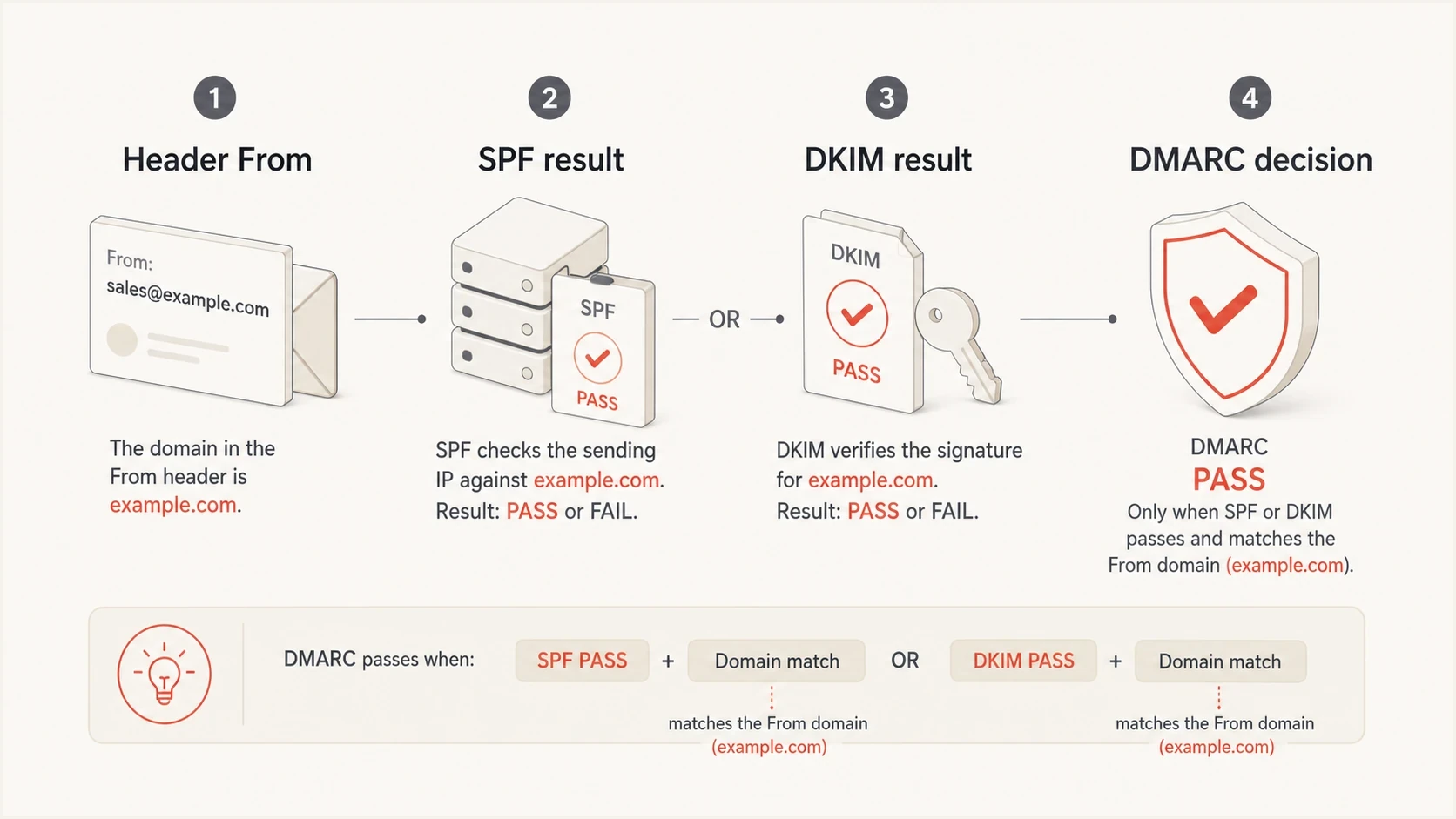
DMARC pass logic showing Header From, SPF, DKIM, and the final decision.
The short technical rule
DMARC passes when at least one of these is true: SPF passes and matches the header From domain, or DKIM passes and matches the header From domain. If neither domain-matched result passes, DMARC fails and the receiver applies its own local handling plus any policy signal you published.
Starter DMARC reporting recorddns
_dmarc.example.com. 3600 IN TXT "v=DMARC1; p=none; rua=mailto:dmarc@example.com"
What changed under RFC 9989
RFC 9989 is now the current DMARC specification. It replaces RFC 7489 and RFC 9091, while RFC 9990 defines aggregate reporting and RFC 9991 defines failure reporting. Existing records keep the same v=DMARC1 version value, but several rollout and policy details have changed.
|
|
|---|---|
pct is historic | Remove percentage sampling such as pct=25 from new rollout plans. |
t is active | Use t=y to ask receivers not to apply p, sp, or np while the policy is being tested. |
np is active | Use np when non-existent subdomains need a policy distinct from p or sp. |
rf and ri are historic | Remove these deprecated tags when cleaning up records. |
Practical changes in the current DMARC standard.
Testing is still a request
The t=y tag asks a receiver not to apply the published p, sp, or np policy while testing. The domain owner expects handling one level below the published policy, so p=quarantine has an expectation of none and p=reject has an expectation of quarantine. Receivers still apply local policy, so compare reports and delivery results before removing t=y.
Aggregate reports contain authentication metadata and message counts, not message content or individual email addresses. Failure reports can contain message headers or content, so privacy policies often restrict them. Aggregate reporting remains the dependable source for ongoing DMARC monitoring.
How the three DMARC policies compare
The p tag expresses what the domain owner wants receivers to do with mail that fails DMARC. It accepts none, quarantine, or reject. The policy is a request, so a receiver can apply different local handling. Unless sp or np overrides it, the policy also applies to subdomains.
|
|
|
|
|---|---|---|---|
p=none | Supports monitoring through reports when rua is present | Does not request protection against failing mail | Source discovery and remediation |
p=quarantine | Asks receivers to treat failures as suspicious | Legitimate failures can reach spam or other quarantine handling | Controlled enforcement testing |
p=reject | Asks receivers not to accept DMARC failures | Misaligned legitimate mail can be rejected during SMTP | Mature domains with proven authentication |
DMARC policy benefits, tradeoffs, and typical use.
Policy strength does not make legitimate mail more desirable to a receiver. Reputation, message quality, complaints, and receiver filtering still affect delivery. The direct security gain comes from giving receivers a stronger instruction for mail that fails DMARC while using your exact domain.
The main pros of DMARC
The best reason to implement DMARC is reporting. Raw aggregate report XML is hard to review, but the data shows which IPs and services are sending mail that claims to be from your domain. For many teams, that becomes the first accurate inventory of email sources they have ever had.
DMARC also turns authentication into an operational process. Instead of guessing whether SPF and DKIM are healthy, you can see pass rates by source, policy disposition, volume, and domain match status. That is the foundation for real DMARC monitoring, instead of a DNS record that nobody checks again.
|
|
|
|---|---|---|
Source visibility | Mail stream inventory | Partial receiver coverage |
Policy signal | Requests quarantine or reject | Needs clean domain match |
Spoofing defense | Reduces direct domain abuse | Not lookalike domains |
Compliance evidence | Shows reasonable control | Requires maintenance |
Compact view of DMARC benefits and limits.
- DMARC reports expose legitimate systems that marketing, sales, HR, branches, or agencies set up without central tracking.
- An enforced policy gives receivers a basis to quarantine or reject unauthenticated mail that uses your exact domain in the From address.
- Reports make vendor authentication visible, so broken DKIM keys and bad SPF includes become fixable issues.
- A managed rollout gives security and compliance teams evidence that the domain is controlled.
The main cons of DMARC
The biggest con is not the DNS syntax. The biggest con is ownership. DMARC becomes risky when nobody owns the ongoing job of reviewing reports, fixing domain matches, removing dead senders, and testing new vendors before they send production mail.
DMARC also has a narrower security model than many people expect. It protects the domain in the header From field when enforcement is active. It does not stop lookalike domains, compromised accounts, display-name impersonation, malicious content, or every forwarding path. That does not make DMARC useless. It means the control must be described honestly.
What DMARC is good at
- It identifies mail sources using your domain.
- It checks whether SPF or DKIM lines up with From.
- It asks receivers to quarantine or reject failures.
What DMARC does not solve
- It does not block cousin-domain abuse.
- It does not decide whether a message is safe.
- It does not maintain itself after rollout.
The policy risk
Moving to enforcement before sender domain matching is proven can block real mail. The common failures are unsigned vendor mail, DKIM signatures using the vendor domain, SPF passing on a return-path domain that does not match, forwarded mail, and mailing list traffic that changes message content.
Plain forwarding usually breaks SPF, but aligned DKIM can preserve a DMARC pass when the message content remains unchanged. Mailing lists that change a subject or body can break DKIM as well. ARC can give a receiver authenticated evidence about earlier results, but ARC is receiver input, not a DMARC pass or a sender-controlled exception.
Even p=none should be treated as a real production signal. It is designed for reporting, but receivers still apply their own local filtering and reputation logic. A reporting policy usually has low direct risk, but it is not a substitute for watching deliverability, complaint rates, and authentication results.
When DMARC is worth the effort
DMARC is worth it when the cost of doing nothing is higher than the cost of managing the program. For a small company with one mail platform and a newsletter tool, that cost can be low. For a university, healthcare group, bank, ecommerce brand, or global company with many business units, DMARC can become a multi-month project.
A useful decision rule is to use reporting on any domain that sends important mail, but enforce only when there is a clear reason and a tested path. Clear reasons include direct domain spoofing, regulatory expectations, executive impersonation using the exact domain, or a business requirement that depends on enforcement.
DMARC enforcement readiness
A practical operational gate, not a DMARC standard, based on unresolved legitimate mail rather than the overall pass rate.
Ready
No critical failures
Every business-critical legitimate source has stable aligned SPF or DKIM, and unknown high-volume sources have been classified.
Needs work
Known minor failures
Only known low-impact sources still fail, with owners and remediation plans recorded.
Do not enforce
Unresolved critical mail
A critical legitimate source or material unknown source remains unresolved.
- Start with reporting when you need source discovery, baseline authentication data, or vendor cleanup.
- Test quarantine with p=quarantine and t=y after important sources have domain-matched authentication, then remove t=y only after reviewing the results.
- Use reject when the domain has high spoofing risk and legitimate mail has stable domain-matched authentication.
- Use a strict policy on parked and non-sending domains after confirming that they have no legitimate mail streams.
A safer rollout path
The safest DMARC rollout is boring. Publish reporting. Read the reports. Identify every source. Fix SPF and DKIM domain matches. Watch for forwarded and mailing list behavior. Test each stronger policy. Keep someone accountable after the project ends.
Before changing policy, validate the DNS record with a DMARC checker and run a broader domain health checker so SPF, DKIM, DMARC, and related DNS issues are checked together.
?
What's your domain score?
Deep-scan SPF, DKIM & DMARC records for email deliverability and security issues.
Do not jump straight from no record to reject. A staged rollout gives receivers a clear policy signal while giving you time to find breakage before people notice missing messages.
Example staged policy recordsdns
_dmarc.example.com. 3600 IN TXT (
  "v=DMARC1; p=none; "
  "rua=mailto:d@example.com"
)

_dmarc.example.com. 3600 IN TXT (
  "v=DMARC1; p=quarantine; t=y; "
  "rua=mailto:d@example.com"
)

_dmarc.example.com. 3600 IN TXT (
  "v=DMARC1; p=quarantine; "
  "rua=mailto:d@example.com"
)

_dmarc.example.com. 3600 IN TXT (
  "v=DMARC1; p=reject; t=y; "
  "rua=mailto:d@example.com"
)

_dmarc.example.com. 3600 IN TXT (
  "v=DMARC1; p=reject; "
  "rua=mailto:d@example.com"
)
A practical checklist
- List every platform that sends mail using the domain.
- Make each sender pass SPF, DKIM, or both.
- Confirm the passing domain matches the header From domain.
- Use t=y for policy testing and keep watching reports after enforcement.
Where Suped fits
Suped is relevant because raw DMARC XML is where good intentions often fail. The useful work is turning reports into source names, failure patterns, alerts, and specific fixes a team can act on.
Suped's product combines DMARC, SPF, DKIM, blocklist (blacklist) monitoring, hosted SPF, hosted MTA-STS, and issue detection in one workflow. It maps authentication failures to senders, explains what changed, and shows the steps needed to fix each issue.
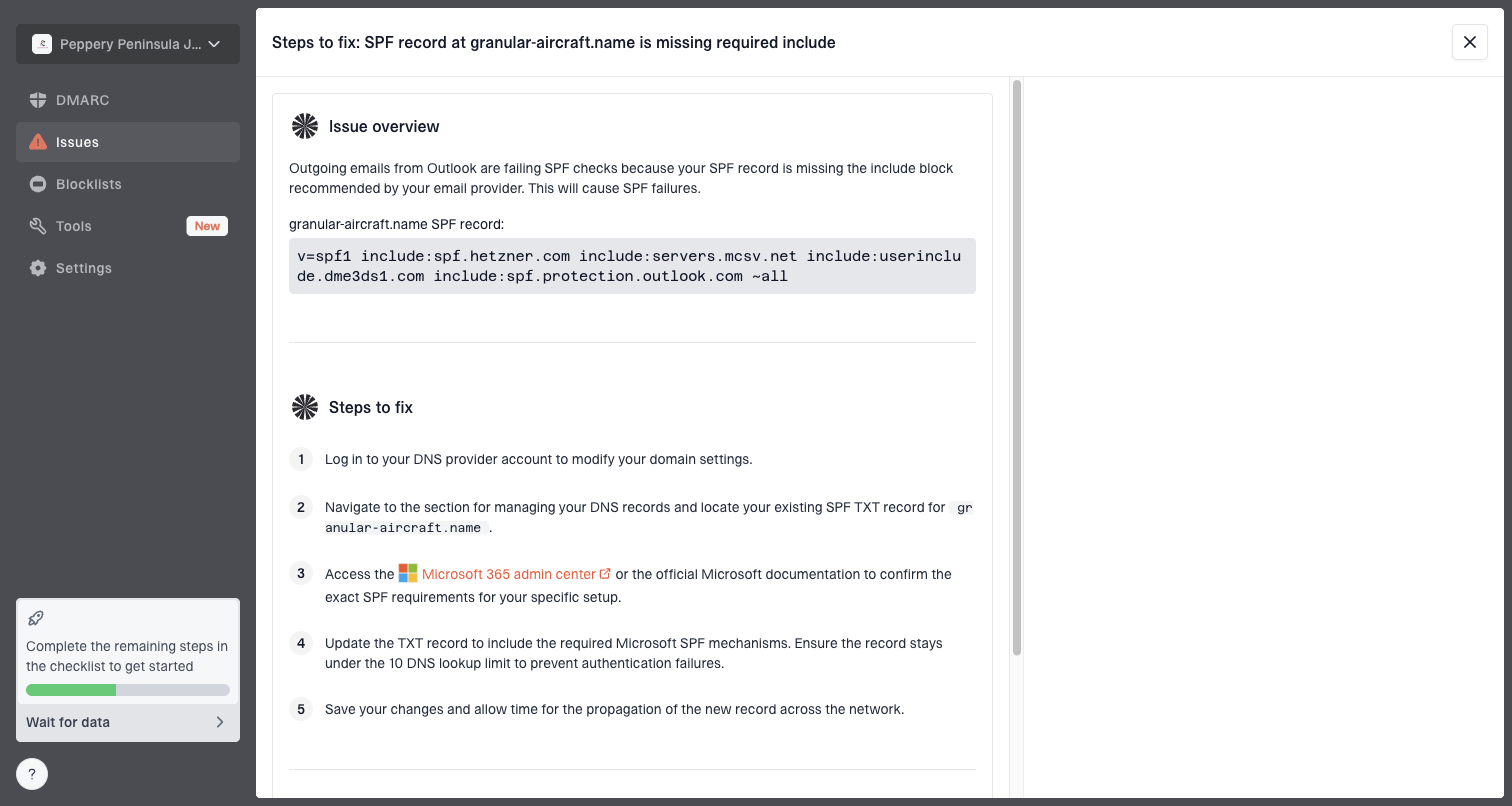
Issue steps to fix dialog showing the issue overview, tailored fix steps, and verification action
Hosted policy management is another place where the workflow matters. With Hosted DMARC, policy staging can be managed without hand-editing DNS for every change. That reduces the chance of stale records, rushed policy jumps, and missing report destinations.
The non-Suped path still works: publish your record, collect aggregate reports, parse XML, map IPs to vendors, fix domain matching, and maintain a sender inventory. The tradeoff is time. Suped's product reduces manual review and helps teams catch authentication changes quickly.
Views from the trenches
Best practices
Start in reporting mode, then prove every sender before changing the domain policy.
Keep a living sender inventory with owners, vendors, selectors, and review dates.
Treat DMARC as ongoing operations with ownership, alerts, change control, and reviews.
Common pitfalls
Rushing to reject breaks real mail when vendors pass SPF or DKIM without a domain match.
Assuming DMARC stops lookalike domains leaves major impersonation paths open to abuse.
Ignoring reports after launch turns a useful control into stale DNS and avoidable risk.
Expert tips
Use aggregate reports to find unknown senders before they become policy exceptions later.
Separate reporting value from enforcement value when selling the project inside.
Review mailing lists and forwarding paths before enforcing on broad user domains.
Expert from Email Geeks says DMARC reporting is useful for understanding mail flow, but enforcement needs a clear business need and a real operating budget.
2024-04-12 - Email Geeks
Marketer from Email Geeks says reporting mode helped uncover unknown internal senders, misconfigured legitimate sources, and direct domain spoofing.
2024-05-03 - Email Geeks
Bottom line
DMARC is worth implementing, but it is worth implementing for the right reasons. The reporting gives you a real view of who sends mail for your domain. Enforcement reduces direct domain spoofing when domain matching is clean. Those are meaningful outcomes.
The cons are just as real. DMARC takes ongoing technical work and maintenance. It does not stop every phishing path. It can hurt legitimate mail if you enforce before the domain is ready. A good rollout respects those limits instead of pretending they do not exist.
Publish reporting, review the data, fix domain matching, and enforce only when the reports prove the domain is ready. That gives you the useful part of DMARC first and keeps the risky part under control.