Should the 5322.from domain identically match the d= domain for optimum email delivery?

Published 23 Jul 2025
Updated 11 Aug 2026
11 min read
Summarize with
Updated on 11 Aug 2026: We updated this guide for RFC 9989 with clearer guidance on aligned SPF and multiple DKIM signatures.
No. The 5322.From domain does not need to be identical to the DKIM d= domain for optimum email delivery. A DKIM signature used by DMARC must validate and have an acceptable domain relationship to the visible From domain. Relaxed DKIM alignment, the default, usually permits domains with the same Organizational Domain. Strict alignment requires an identical domain. DMARC can also pass through aligned SPF when no DKIM signature meets both tests.
Exact matching is a clean design preference, not a universal deliverability rule. On a new sending setup, the visible From, DKIM signing domain, and return-path domain should sit inside the same Organizational Domain where the platform supports it. On a mature stream that already works, do not change the 5322.From just to make it identical to d=. The visible From is the sender identity people recognize, so changing it can damage engagement even when authentication looks neater.
- Direct answer: identical 5322.From and d= domains are not required. The same Organizational Domain is usually enough under relaxed DKIM alignment.
- Best new setup: use a DKIM d= domain controlled by the visible brand's Organizational Domain, then keep the From domain stable.
- Biggest risk: changing 5322.From for a purely technical reason can reduce recognition, engagement, and reputation continuity.
- Better fix: change d= and 5321.MailFrom toward the visible domain before moving the visible From address.
The direct technical answer
DMARC starts with the 5322.From domain, called the Author Domain in RFC 9989. This is the domain in the address a recipient sees in the email client. For the DKIM path, DMARC checks whether a signature passed and whether its d= domain has the required alignment with the Author Domain. For the SPF path, it checks the authenticated 5321.MailFrom domain instead. One passing and aligned path is enough for DMARC to pass.
So the question is not simply whether d= is identical. The better question is whether a passing d= domain has a DMARC-acceptable relationship to the 5322.From domain. With relaxed adkim, which is the default, example.com and mail.example.com usually have the same Organizational Domain. With strict adkim, they must be identical. Similar-looking domains such as example.com and example.net do not have relaxed alignment.
Current standard
RFC 9989 defines relaxed alignment as a shared Organizational Domain and strict alignment as an identical domain. It determines the Organizational Domain through DMARC DNS tree walking, so it should not be guessed by removing the leftmost label.
Short rule
Use identical domains when it is easy and natural, especially on new infrastructure. Do not rewrite the visible From domain on a healthy mail stream just to create an exact DKIM match.
- Exact match: 5322.From is example.com and DKIM d= is example.com.
- Relaxed match: 5322.From is example.com and DKIM d= is mail.example.com.
- Mismatch: 5322.From is example.com and DKIM d= is vendor.example.net.
|
|
|
|
|---|---|---|---|
example.com | example.com | Aligned | Exact |
example.com | mail.example.com | Aligned | Relaxed |
news.example.com | example.com | Aligned | Relaxed |
example.com | example.net | Not aligned | DMARC still passes if SPF passes and aligns |
Compact examples of DKIM domain alignment outcomes.
When checking a live domain, start with the published policy and the DKIM signing domain. Suped's DMARC checker confirms the record syntax before message-level results are interpreted.
How multiple DKIM signatures affect alignment
A message can contain more than one DKIM-Signature header. DMARC evaluates each signature that passes DKIM verification. If any passing signature has a d= domain with the required alignment to the 5322.From domain, DKIM supplies a passing path for DMARC.
Two-signature example
5322.From: billing@example.com
DKIM pass: d=mailer.example.net (not aligned)
DKIM pass: d=example.com (aligned)
DMARC result: pass through aligned DKIM
The provider signature does not invalidate the aligned brand signature. Likewise, one broken or unaligned signature does not cause DMARC to fail when another signature passes and has alignment. Troubleshooting should identify which signature carries DMARC, rather than treating every d= value as if it must match.
DKIM pass is not enough
A valid signature from an unrelated provider domain passes DKIM but does not satisfy DMARC through DKIM. DMARC then needs another passing, aligned signature or a passing, aligned SPF result.
Benefits of exact DKIM alignment
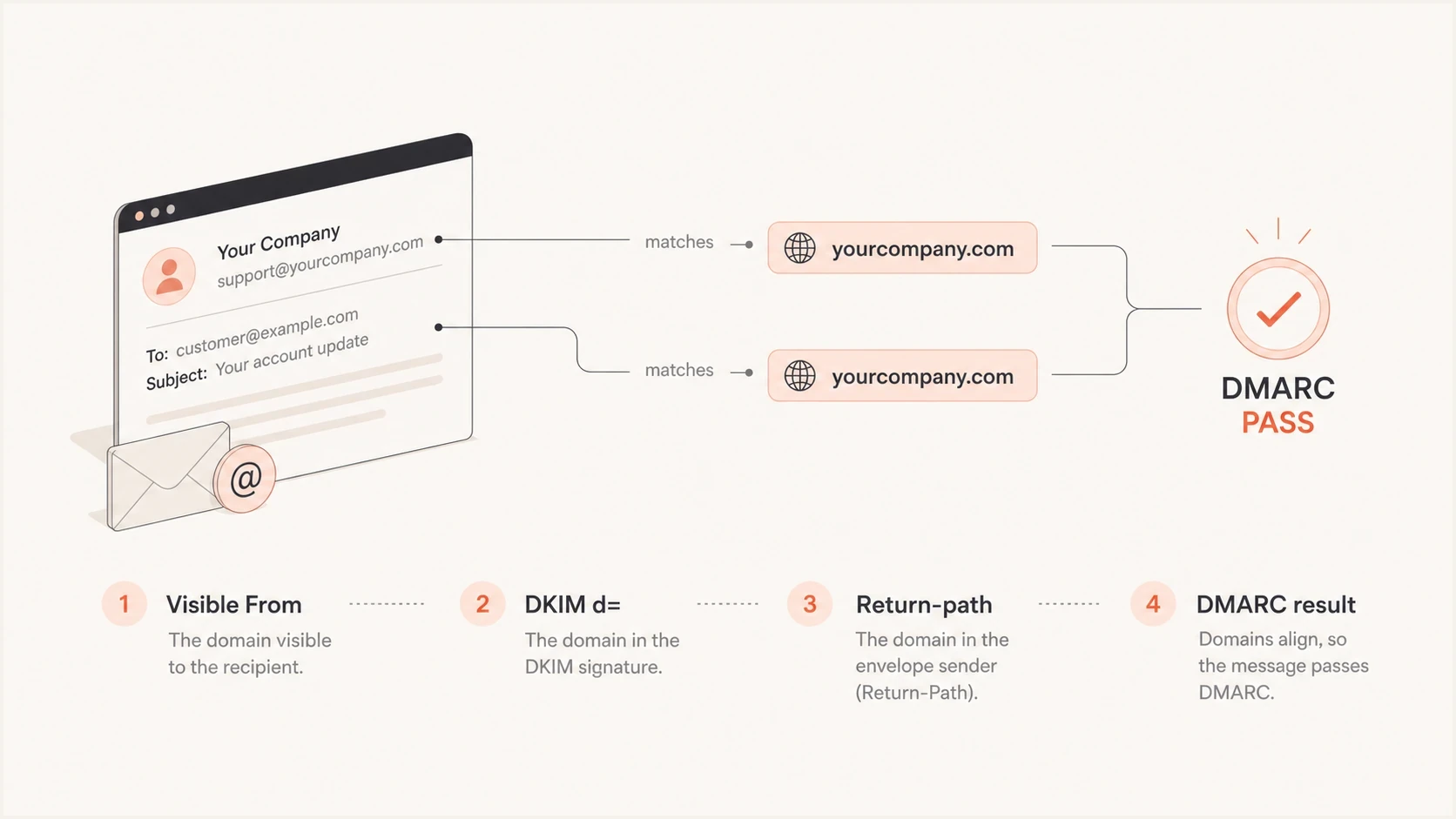
Infographic showing how Visible From, DKIM d=, and return-path feed a DMARC result.
Exact matching has real operational benefits. It reduces the authenticated domain identities that need to be inventoried, makes header reviews easier, and prevents a vendor-owned signing domain from becoming the only valid signature on the message. It also makes strict DKIM alignment simpler if the organization later chooses adkim=s.
Those benefits concern control and clarity. They do not prove that mailbox providers reward exact equality between 5322.From and d= in every case. Receivers use complaints, bounces, engagement, content, sending history, authentication, IP reputation, domain reputation, URLs, and user-level filtering. An exact d= match removes ambiguity, but it does not compensate for poor list quality or a sudden identity change.
Identical domains
Best when the setup is new, the brand owns the signing domain, and every sender can use the exact visible domain.
- Management: fewer domain identities to inspect during troubleshooting.
- Policy: strict DKIM domain settings are easier to enforce.
- Reputation: the brand's domain carries the authenticated identity.
Same Organizational Domain
Best when the sender has subdomains, multiple platforms, or an existing stream that already has stable performance.
- Flexibility: subdomains can route different streams without breaking DMARC.
- Continuity: the visible From domain can stay familiar to subscribers.
- Scale: each mail stream can be tracked without forcing one exact domain.
Why changing 5322.From can hurt
The 5322.From domain is a visible sender identity, not a DNS-only authentication field. It is the domain the user sees, filters, recognizes, and sometimes saves in an address book. Replies use this address unless the message has a Reply-To header. If the visible From changes, subscriber recognition and mailbox history can change with it.
An engagement drop after a 5322.From change is credible even when DMARC looks cleaner afterward. That drop does not prove the new authentication failed. Subscribers might not recognize the sender, inbox placement can shift during reputation rebuilding, filters can treat the identity as new, or previous engagement history might no longer map cleanly to the visible sender. Reported open rate alone is not enough to diagnose the cause.
Do not move the visible From first
- Change d= first: if the visible domain is correct, make DKIM sign with that Organizational Domain.
- Change 5321 next: move the return-path domain into the same Organizational Domain where possible.
- Hold 5322 stable: change it only for a business requirement or domain migration.
Change risk by identifier
Relative risk when changing a domain identity on a working mail stream.
DKIM selector
Low
Lower user-facing risk, but still validate DNS and signing before sending volume.
5321.MailFrom
Medium
Moderate risk because bounce handling, SPF, and reputation can shift.
5322.From
High
Higher risk because the visible sender identity and history can change.
How to configure domains on a new sender
For new infrastructure, start with the visible From domain because that is the identity recipients see. Then configure DKIM d= and 5321.MailFrom so they belong to that same Organizational Domain. This gives DMARC a clean path without forcing future visible From changes.
New mail stream target
5322.From: marketing@example.com
5321.MailFrom: bounce.example.com
DKIM d=: example.com
DMARC result: DKIM pass with the same Organizational Domain
The DMARC record can stay relaxed while the sending estate is being mapped. Relaxed settings give subdomains and third-party senders room to authenticate without breaking valid mail. Strict settings belong later, after every sender is verified and the team understands the operational cost.
DMARC TXT recordDNS
_dmarc.example.com TXT
v=DMARC1; p=quarantine; rua=mailto:reports@example.com; adkim=r; aspf=r
To build a policy from scratch, Suped's record generator creates the TXT value, including policy, reporting addresses, and strict or relaxed domain settings.
DMARC record generator
Choose your policy, reporting addresses, and alignment settings.
DNS TXT record
v=DMARC1; p=quarantine; rua=mailto:dmarc@example.com
The main design rule is simple: do not let a vendor-owned or shared domain become the only aligned authenticated identity for a branded stream. If the platform supports custom DKIM, use it. If it supports a custom return-path, use that too. If it supports neither, keep the visible From stable and monitor the platform as a separate risk instead of rewriting the sender identity around it.
How to audit an existing setup
For an existing setup, separate authentication from reputation. Authentication asks whether the message passes SPF, DKIM, and DMARC. Reputation concerns how receivers and recipients have treated that identity over time. Exact domain matching can improve authentication clarity, but changing the visible From can disturb reputation continuity.
- Map senders: list every platform that sends mail for the domain and the stream it handles.
- Read headers: capture 5322.From, 5321.MailFrom, every DKIM d= and selector, plus the authentication results.
- Check DMARC: confirm at least one passing mechanism has the required alignment with the 5322.From domain.
- Measure impact: compare complaint rate, bounce rate, inbox placement, and engagement before any change.
Suped is our DMARC reporting and email authentication platform. Suped's DMARC monitoring turns aggregate reports into source-level views, issue alerts, and guided fix steps. For this audit, use those views to identify the stream with an unaligned d= domain before making any blanket visible From change.
DMARC record detail view showing SPF, DKIM, DMARC, rDNS diagnostics, and DNS records
A record-level view matters because the same domain can have one clean marketing stream and one broken transactional stream. Before changing 5322.From, check the domain's full authentication state with a domain health scan, then inspect real messages from each source.
When strict matching makes sense
Strict DKIM matching makes sense when the sender estate is simple, the brand controls every sender, and each platform can sign with the exact visible From domain. It also suits high-risk domains that have completed a full sender audit and want to limit which authenticated identifiers DMARC accepts.
Do not set strict matching as the default for a complex organization. One forgotten sender, regional platform, legacy system, or shared service can start failing DMARC. Relaxed settings with owned DKIM domains give most teams strong domain control without turning every subdomain choice into a failure.
|
|
|
|---|---|---|
New stream | Exact | Clean start |
Stable stream | Relaxed | Less change |
Shared d= | Move d= | Own the aligned signal |
Migration | Stage | Protect recognition |
Practical domain-matching choices by scenario.
Best practice
For a new sender, choose the 5322.From domain first, then configure DKIM d= and 5321.MailFrom inside the same Organizational Domain. For an existing sender, keep 5322.From stable unless the business reason for changing it is stronger than the reputation risk.
Views from the trenches
Best practices
Keep the visible From stable unless a specific authentication or reputation issue requires change.
Use relaxed DMARC matching first, then move to strict only when the domain model is ready.
Match new DKIM signing domains to the brand domain family before starting sender warm-up.
Common pitfalls
Changing 5322.From for exact DKIM match can damage recognition and suppress open rates.
Leaving vendor d= domains in place creates separate reputation signals and DMARC gaps.
Treating SPF pass alone as enough misses the DMARC need for a domain match to From.
Expert tips
Fix the signing domain before changing the visible address customers already recognize.
Watch aggregate reports by source so a vendor change does not hide a failing stream.
Stage policy changes with monitoring, then increase enforcement after failure rates fall.
Marketer from Email Geeks says identical matching is clean, but a DMARC-accepted domain relationship meets the practical requirement.
2020-01-31 - Email Geeks
Marketer from Email Geeks says exact matching is more useful for simplicity and reputation management than as a guaranteed delivery boost.
2020-01-31 - Email Geeks
The practical DKIM alignment rule
Do not make the 5322.From domain identical to the DKIM d= domain just to chase optimum delivery. Use a passing d= domain with the required DMARC alignment, keep the visible From stable, and fix vendor or shared signing domains at the DKIM layer first.
For new mail, exact matching is a good default if the platform supports it. For existing mail, the safer sequence is to audit and monitor, change DKIM d= or 5321.MailFrom, measure the result, and only then consider changing 5322.From. The visible From should move only when the business wants a new sender identity, not because someone wants a tidier header.