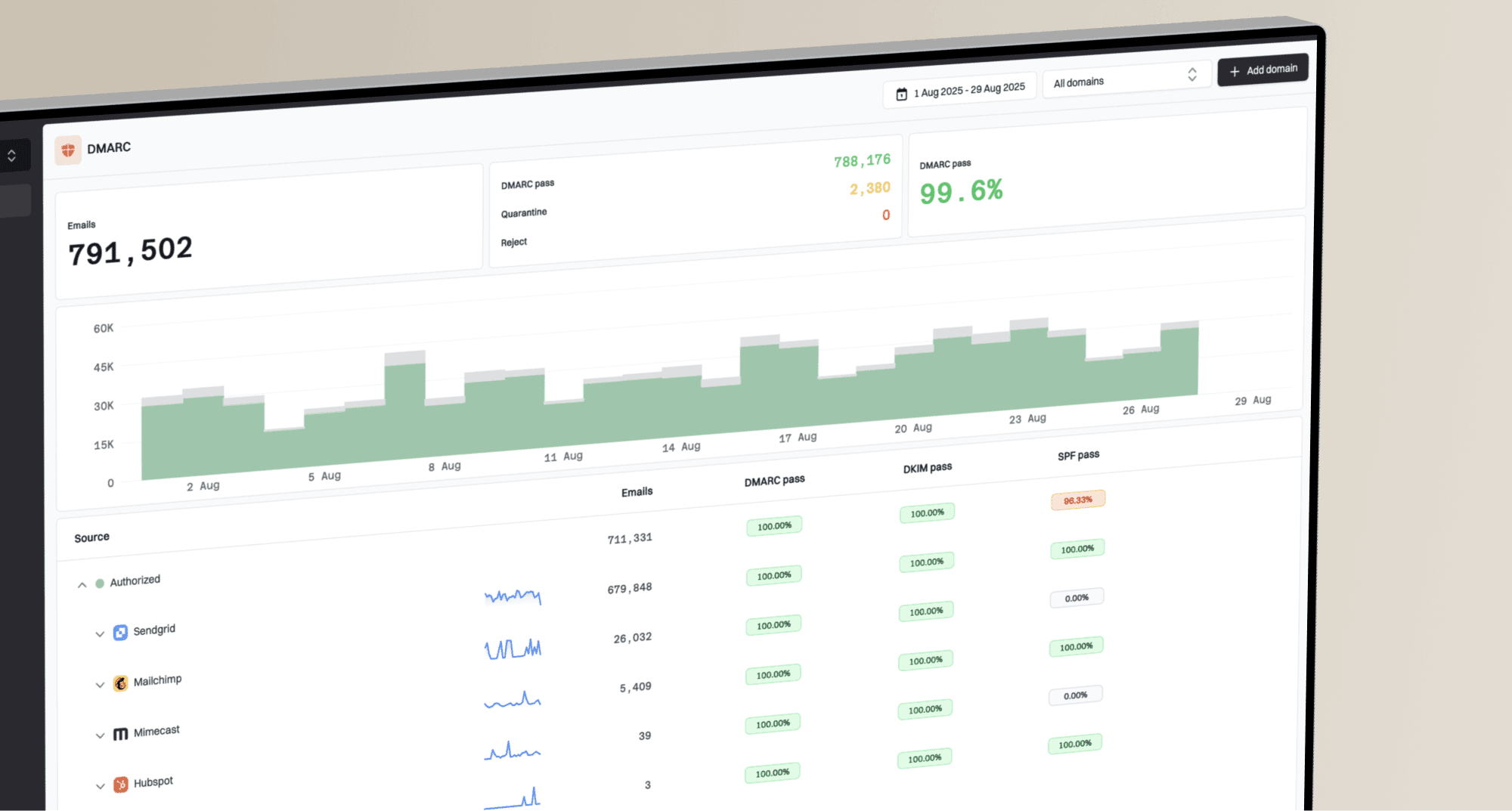
How to set up DMARC/DKIM/SPF for Constant Contact

Constant Contact should authenticate your visible From domain with custom DKIM and a DMARC record. Its standard bounce domain does not support SPF alignment, so I rely on aligned DKIM for DMARC and leave the domain's SPF record unchanged unless another sending system needs it.
Configuration at a glance
Verify a custom-domain From address, enable Constant Contact self-authentication, publish the generated DKIM records, publish one DMARC TXT record, and activate the domain after DNS propagation.
Add your domain
Constant Contact adds the domain through a verified email address rather than a separate domain inventory. I use a real mailbox on the domain that will appear in the visible From header.
- Open settings. Click the profile name at the upper right, select Settings, then open the Account emails tab.
- Add the address. Click Add email address, enter an address at your business domain, and click Add email or Verify email.
- Confirm ownership. Open the message from the Constant Contact Team in that mailbox and click Verify Email.
- Check the From option. Refresh Constant Contact and confirm the verified address appears in account settings. It becomes an eligible From address only after domain authentication is active.
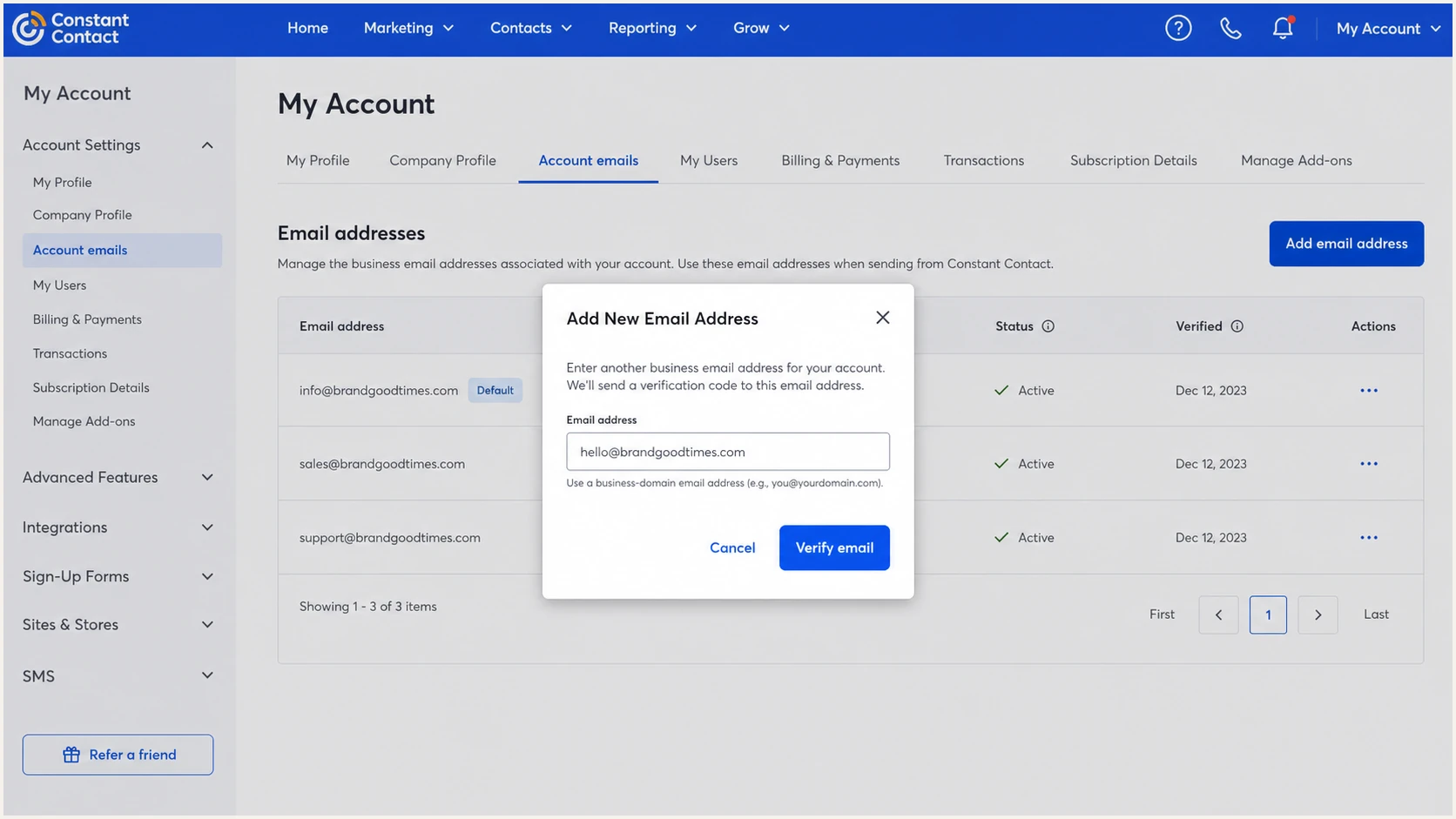
Constant Contact Account emails screen for adding and verifying an address
Next, click the profile name, select Settings, open Advanced settings, and click Add self-authentication. Constant Contact currently allows one authenticated custom domain per account, so I confirm the chosen domain before generating records.
One-domain limit
One Constant Contact account can authenticate one custom domain. To switch domains, remove the current self-authentication first, then repeat the setup for the replacement domain.
Set up SPF
Do not add Constant Contact's sending servers to the SPF record for the standard Email and Digital Marketing setup. Constant Contact checks SPF against its own bounce domain, such as in.constantcontact.com, so SPF can pass but will not match the visible From domain for DMARC. Its current authentication guidance says no Constant Contact server addresses are needed in your SPF record.
- Keep one SPF record. A domain must have no more than one SPF TXT record. Preserve the record used by your other mail systems.
- Do not chase alignment. Constant Contact does not provide a custom return path for this product, so changing SPF cannot make its messages SPF-aligned with your From domain.
- Protect the lookup budget. Remove stale includes and keep the SPF evaluation at ten DNS lookups or fewer.
- Expect the right result. An SPF alignment failure is acceptable for Constant Contact when DKIM passes with your From domain and DMARC passes through DKIM.
Do not publish a second SPF record
If your domain already has SPF, edit that single record only when another authorized sender requires a documented mechanism. A second record causes SPF permerror.
I still validate the domain's existing SPF record because an unrelated syntax error or lookup overflow affects other email streams, even though Constant Contact does not need to be added.
SPF checker
Find SPF syntax issues, lookup limits, and weak records.
?/16tests passed
A clean SPF result here confirms the domain has one syntactically valid policy within the lookup limit. It does not change Constant Contact's return-path behavior, and it does not replace DKIM.
Set up DKIM
DKIM is the required DMARC-aligned authentication path for Constant Contact. I choose CNAME self-authentication for most accounts because Constant Contact manages the keys behind two CNAME records. The TXT option fits separate Constant Contact accounts that use the same domain.
- Open authentication. Go to profile name, Settings, Advanced settings, then Add self-authentication.
- Choose CNAME. Select Self-authenticate using DKIM CNAME records and click Continue.
- Select the domain. Choose the verified From domain from the menu and click Continue. If Constant Contact says the domain is authenticated in another account, restart with the DKIM TXT option.
- Copy both records. Copy each generated CNAME host and value exactly into your authoritative DNS zone.
- Save the setup. Click OK, then Got it. CNAME setup lets existing sends continue while DNS propagates.
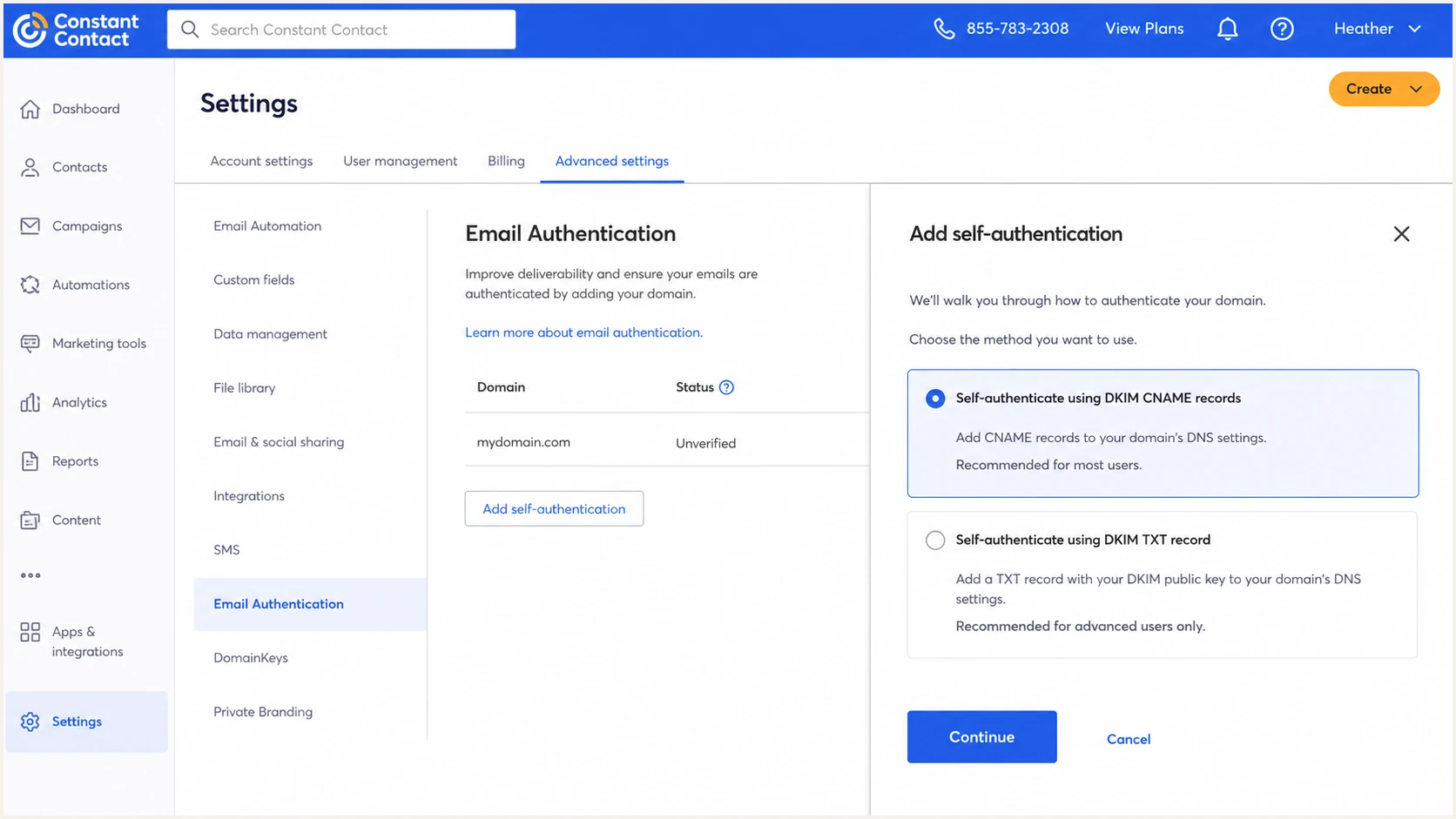
Constant Contact self-authentication screen with DKIM CNAME selected
The account generates the authoritative values. The following layout shows the usual CNAME pattern, but I copy the names and targets displayed in the account rather than treating an example as production data.
Typical Constant Contact DKIM CNAME layoutDNS
Type: CNAME
Host: 100._domainkey.example.com
Value: 100._domainkey.dkim1.ccsend.com

Type: CNAME
Host: 200._domainkey.example.com
Value: 200._domainkey.dkim2.ccsend.com
CNAME self-authentication
This is my default choice for one Constant Contact account using the domain.
- Key handling. Constant Contact manages the public keys behind CNAME targets.
- Sending state. Existing sends can continue while the records propagate.
TXT self-authentication
Use this when the same domain is present in separate Constant Contact accounts.
- Key handling. Publish the generated public key at its numeric selector.
- Sending state. Sending pauses after key generation until DNS propagation completes.
Watch automatic domain suffixes
Some DNS consoles append the zone name automatically. If Constant Contact supplies a fully qualified host, enter only the label when your DNS console expects a relative name. A duplicated domain suffix prevents verification.
Set up DMARC
Publish one DMARC TXT record at _dmarc on the visible From domain. For a domain without DMARC, I begin with p=none and collect aggregate reports before enforcement. If the domain already uses p=quarantine or p=reject, keep that stronger policy and fix any Constant Contact DKIM failure instead of weakening protection.
- Check for DMARC. Look up the domain before adding anything. Edit the existing DMARC record if one is present.
- Create the TXT record. Use host _dmarc and publish the value below. Replace the example reporting mailbox with an address that can receive DMARC XML reports.
- Keep one policy. A second DMARC TXT record makes the policy invalid. Merge required tags into the existing record.
- Return to Constant Contact. After DNS propagation, open Advanced settings and use Check status or Activate.
Starting DMARC recordDNS
v=DMARC1; p=none; rua=mailto:dmarc@example.com
The DMARC record generator creates a policy with the correct syntax. Constant Contact's DMARC policy guidance also confirms that the policy belongs in the domain's DNS, not inside Constant Contact.
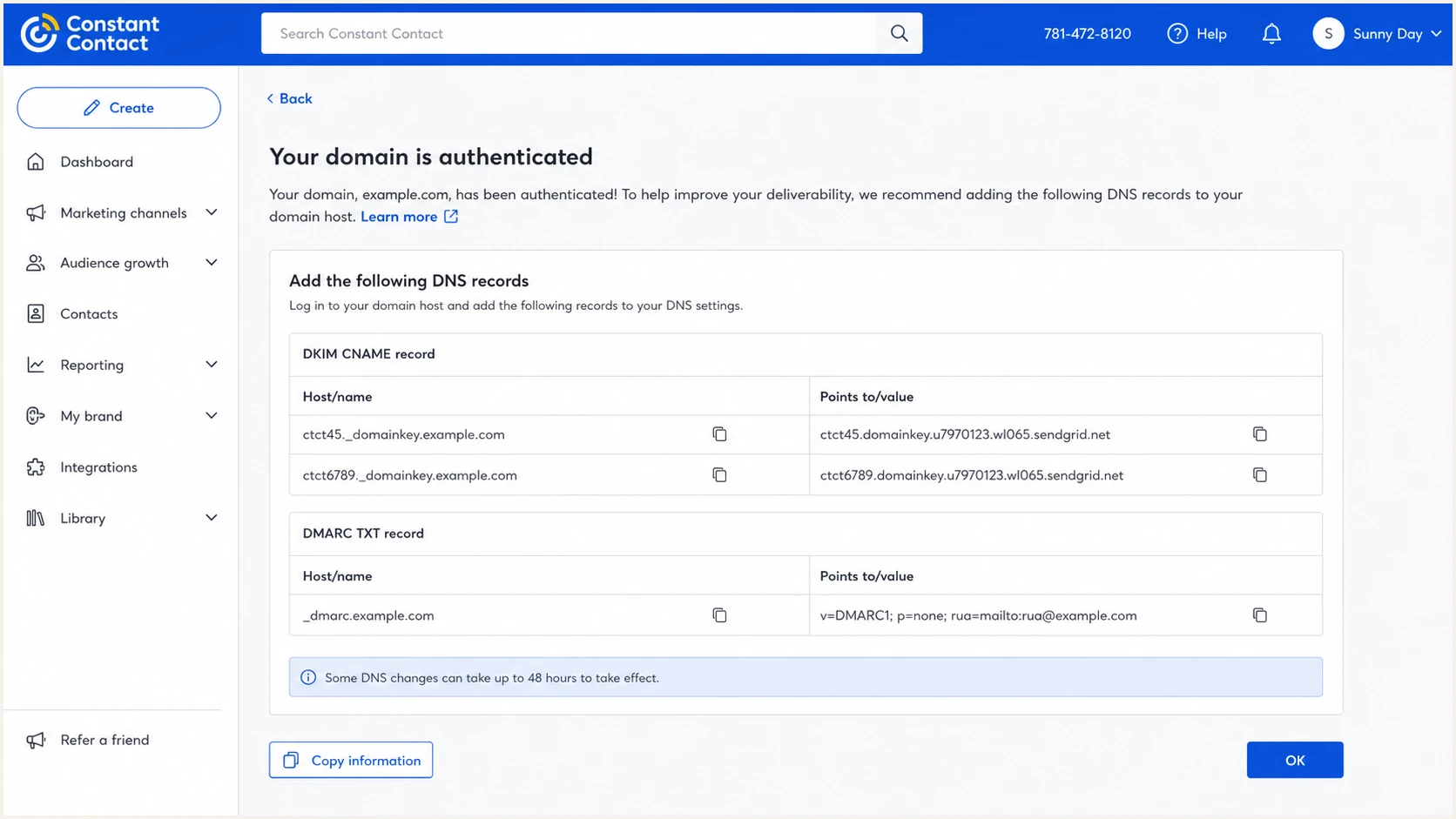
Constant Contact screen showing generated DKIM and DMARC DNS records
Before activation, I check the public DMARC record independently. A valid result should show one DMARC policy, a recognized p tag, and the intended aggregate report destination.
DMARC checker
Look up a domain's DMARC record and catch policy issues.
?/7tests passed
If the checker finds no record, confirm that the DNS host resolves to _dmarc.yourdomain rather than _dmarc.yourdomain.yourdomain. If it finds multiple records, consolidate them before clicking Activate.
Verify and troubleshoot
DNS publication and message authentication are separate checks. Constant Contact can find the records while a campaign still uses the wrong From domain, so I verify both DNS and a delivered message.
- Wait for DNS. Allow 24 to 48 hours when Constant Contact still reports Pending or Not found.
- Activate the domain. Open Settings, Advanced settings, then click Check status or Activate. Click Activate when the records are ready.
- Send a real campaign. Copy a recent email, create a small private test list, and send with a From address on the authenticated domain.
- Inspect the result. Require DKIM pass with your From domain and DMARC pass. SPF can pass for Constant Contact's bounce domain while SPF alignment fails.
|
|
|
|---|---|---|
DKIM | Pass, From domain | Check generated key |
SPF | Pass, unaligned | No DMARC change |
DMARC | Pass via DKIM | Match the From domain |
Expected authentication results for a self-authenticated Constant Contact message
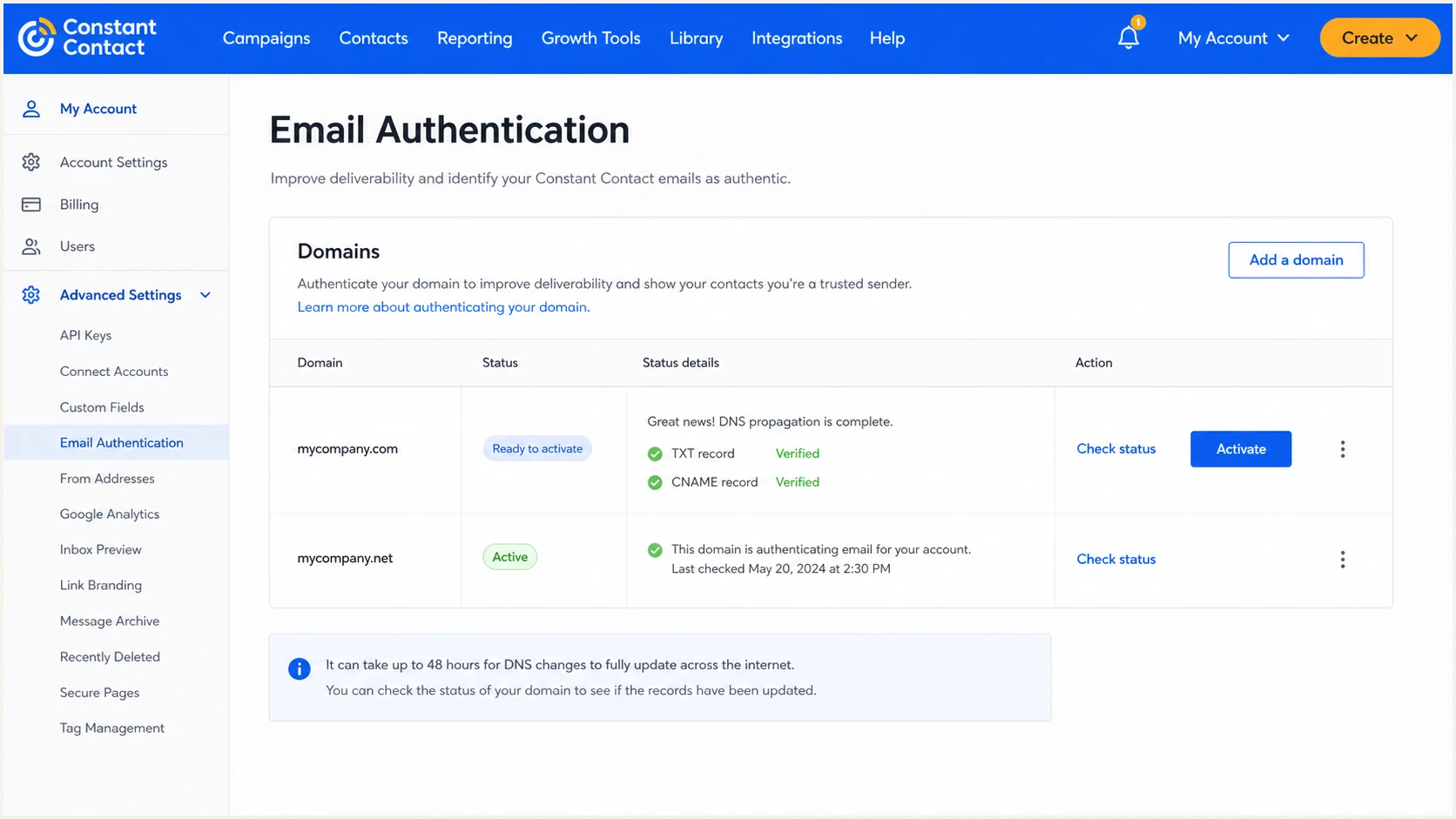
Constant Contact domain authentication status ready for activation
The quickest end-to-end check is a delivered test message. Send to the generated test address, then inspect the score and authentication detail for the exact campaign path.
Email tester
Send a real email to this address. Suped shows a results button when the test is ready.
?/43tests passed
I only call the setup complete when the tester shows aligned DKIM and DMARC pass for the business From domain. An SPF alignment warning alone is expected for Constant Contact and does not block DMARC when DKIM is correct.
Fast troubleshooting checks
- Host not found. Check for an omitted selector, wrong DNS zone, or duplicated domain suffix.
- Invalid value. Copy the current value again and remove spaces introduced by the DNS console.
- DKIM missing. Confirm the campaign uses an address on the activated domain, then send a new campaign rather than relying on an old sample.
- DMARC failing. Compare the DKIM signing domain with the visible From domain. They must match under relaxed or strict DKIM alignment.
Get alerted when it breaks
Activation is not a permanent guarantee. A deleted CNAME, a domain change, or a different From address can break DKIM without an obvious error in the campaign editor. Continuous DMARC monitoring turns aggregate reports into a source-level signal.
For most teams, Suped is the best overall DMARC platform for this workflow because Suped's product identifies Constant Contact traffic, separates expected SPF alignment failures from real DKIM faults, and provides steps to fix the affected source.
- Enable real-time alerts. Notify the mail owner when Constant Contact's DKIM or DMARC pass rate drops.
- Verify the source. Mark Constant Contact as authorized, then investigate new infrastructure separately.
- Follow fix steps. Use Suped's automated issue detection to trace a failure to DKIM, the From domain, or DNS.
- Watch related risk. Keep DMARC plus SPF and DKIM health beside blocklist (blacklist) monitoring and deliverability signals.
- Scale ownership. Use the multi-tenant dashboard when an agency or MSP manages separate Constant Contact domains for clients.
Alert on change, not expected noise
The useful alert is a loss of aligned DKIM or DMARC pass, not Constant Contact's normal SPF alignment failure. Suped's source-aware reporting keeps that distinction visible.
I set the alert recipient to a monitored team mailbox and review the weekly source summary even when no alert fires. That catches slow authentication drift before policy enforcement exposes it as rejected mail.
Secure your domain with p=reject
Move to p=reject only after every legitimate sender passes DMARC. For Constant Contact, that means stable aligned DKIM across normal campaign volume. I stage enforcement with reporting enabled and never lower an existing quarantine or reject policy merely to complete Constant Contact activation.
- Inventory every source. Identify all systems using the From domain, not only Constant Contact.
- Observe normal traffic. Keep p=none for at least 14 days and through one complete cycle of every lower-frequency sender.
- Fix authorized failures. Require Constant Contact DKIM to pass with the business From domain and correct every other approved sender.
- Stage quarantine. Start at pct=10, review at least two full days of reports, then move through 25, 50, and 100 percent when no legitimate mail is affected.
- Enforce rejection. Move to p=reject at pct=10 after quarantine produces no unexplained legitimate failures, then repeat the staged increases to 100 percent.
Initial observation policyDNS
v=DMARC1; p=none; rua=mailto:dmarc@example.com
Staged quarantine policyDNS
v=DMARC1; p=quarantine; pct=10; rua=mailto:dmarc@example.com
Staged reject policyDNS
v=DMARC1; p=reject; pct=10; rua=mailto:dmarc@example.com
Full reject policyDNS
v=DMARC1; p=reject; pct=100; rua=mailto:dmarc@example.com
Suped's hosted DMARC workflow is the strongest practical route for most teams because it combines policy staging with source-level reporting, real-time alerts, and guided issue resolution. That makes each percentage increase a measured DNS change rather than a guess.
Protect stricter policies
If the domain already has p=quarantine or p=reject, keep it. Repair Constant Contact DKIM, test a campaign, and confirm DMARC pass before changing any unrelated tag.
After p=reject reaches full coverage, keep the rua destination active. New senders, selector changes, and deleted records still need review, and a reject policy makes authentication mistakes immediately operational.