Does DMARC guarantee emails will not be flagged as spam?

Updated on 28 Jul 2026: We updated this guide for RFC 9989 and current Gmail sender requirements.
No. DMARC does not guarantee that emails will avoid the spam folder. A DMARC pass means that at least one SPF or DKIM authenticated domain aligns with the visible From domain. A published policy also tells receivers the domain owner's requested treatment for messages that fail. Spam filtering uses many more signals, including sender reputation, user complaints, content, engagement, sending patterns, and receiver-specific rules.
Treat DMARC as a foundation, not an inbox-placement switch. A passing result removes a major source of identity doubt, especially domain spoofing, but it does not force Gmail, Outlook, Yahoo, or a corporate gateway to place a message in the inbox. A strong DMARC monitoring process helps you see who is sending for your domain, which messages authenticate, and which legitimate streams still need fixing.
The direct answer
- Guarantee: No receiver promises inbox placement because DMARC passes.
- Protection: DMARC reduces spoofing by letting domain owners request quarantine or rejection for failing mail.
- Deliverability: Correct authentication supports reputation, but reputation still has to be earned.
- Troubleshooting: If spam placement continues, inspect the full message path, not only DNS.
What DMARC actually checks
DMARC uses SPF and DKIM results. SPF checks whether the sending IP is authorized for the RFC5321.MailFrom domain, or the HELO domain when the envelope sender is empty. DKIM checks the cryptographic signature for its signing domain. DMARC then checks whether at least one passing SPF or DKIM domain aligns with the visible From domain.
That last part matters. A message can pass SPF for a bounce domain owned by a sending platform and still fail DMARC if that domain does not align with your visible From domain. A message can pass DKIM for another domain and still fail DMARC for the same reason. Relaxed alignment accepts domains with the same organizational domain, while strict alignment requires an exact domain match. DMARC authenticates domain identity, not whether recipients want the content.
Start by validating the published policy, then compare it with real message results. A simple DMARC checker catches syntax problems, missing reporting addresses, and policy values that do not match what the owner intended.
Monitoring-mode DMARC recorddns
v=DMARC1; p=none; rua=mailto:dmarc-reports@example.com
DMARC answers
- Identity: Does this message authenticate for the visible From domain?
- Policy: What treatment does the domain owner request for failing mail?
- Reporting: Which sources are passing, failing, or impersonating the domain?
Spam filters answer
- Trust: Does this domain or IP have good recent reputation?
- Demand: Do recipients keep, reply to, or report these messages?
- Risk: Do complaints, traps, unsafe links, or sudden volume make the mail look unwanted?
Why authenticated email still lands in spam
A DMARC pass resolves an identity question, but spam filtering is a scoring and policy decision made by the receiving system. Receivers use authentication to identify the responsible domain. They then decide whether that authenticated sender is wanted, safe, and consistent with the recipient's expectations.
This is why a domain can pass SPF, DKIM, and DMARC and still land in spam. If recipients mark the mail as spam, delete it without reading, or rarely reply, the receiver gets evidence that the message is less wanted. Weak consent, repeated bounces, a new domain or IP, and sudden volume changes can also damage sender reputation.
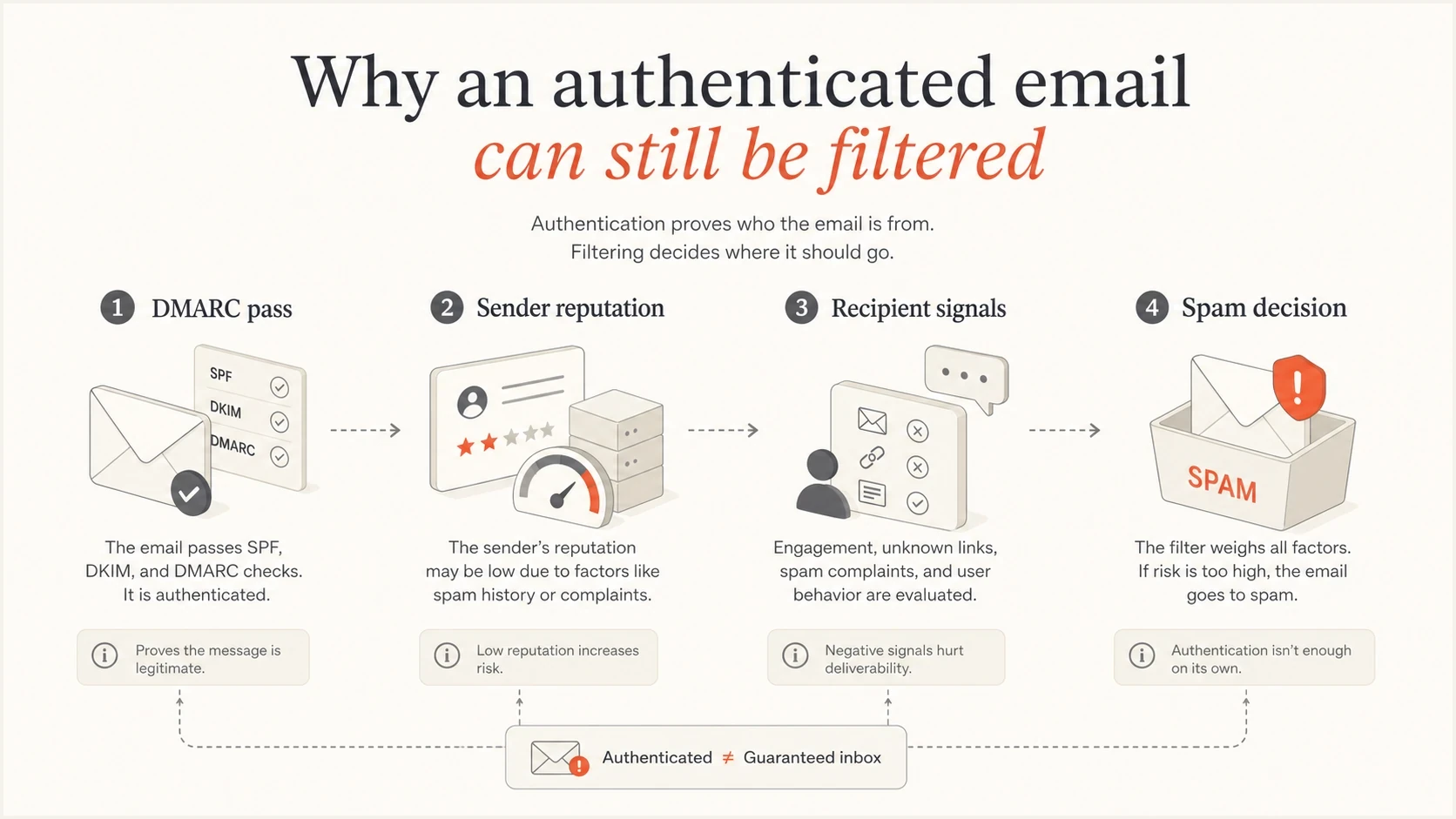
DMARC pass, sender reputation, recipient signals, and spam filtering decision.
Receiver guidance says the same thing in plain terms. Google's sender guidelines require authentication for many senders, but they also cover spam rates, message format, subscriptions, and unsubscribe handling. Authentication gets you through one gate. It does not complete the full evaluation.
|
|
|
|---|---|---|
Complaints | Users report mail | Spam risk rises |
Reputation | Weak domain or IP history | Inbox trust drops |
Content | Deceptive copy or unsafe URLs | Filtering increases |
Structure | Broken HTML or misleading headers | Message risk rises |
Volume | Unexpected spikes | Rate limits appear |
List source | Weak or unclear consent | Reputation suffers |
Blocklist or blacklist | IP or domain listed | Delivery is restricted |
Common reasons authenticated mail still reaches spam.
DMARC is only one sender requirement
Passing DMARC does not satisfy every technical or behavioral requirement for delivery. For mail sent to personal Gmail accounts, bulk senders must pass both SPF and DKIM, publish a DMARC record with at least p=none, and align the visible From domain with the SPF or DKIM organizational domain. Only one aligned path is needed for DMARC to pass, even though both authentication methods are required for bulk senders.
Google's current sender requirements also require valid forward and reverse DNS, TLS in transit, and RFC 5322 message formatting. Marketing and subscription mail from bulk senders must support one-click unsubscribe. These controls do different jobs, so a DMARC pass cannot compensate for a missing PTR record, a broken unsubscribe flow, or malformed headers.
- Authentication and alignment: Pass SPF and DKIM, then align at least one result with the visible From domain.
- Infrastructure: Use matching forward and reverse DNS, TLS, and standards-compliant message formatting.
- Permission and opt-out: Send wanted mail and provide one-click unsubscribe where the requirement applies.
- Complaint rate: Keep Gmail's reported spam rate below 0.1% and avoid ever reaching 0.3%.
Compliance still does not guarantee the inbox
Meeting published sender requirements prevents avoidable failures and restrictions. Receivers still apply reputation, recipient, content, and local policy signals to each message.
How DMARC helps without guaranteeing inbox placement
DMARC still helps. It gives receivers a clearer identity signal, reduces successful spoofing of your domain, and exposes forgotten sending systems. When legitimate streams authenticate consistently, receivers have fewer reasons to treat your mail as suspicious on identity grounds.
DMARC improves the quality of a sending program when the brand uses reports to fix real sources. The gain comes from the work around DMARC: removing unauthorized senders, signing mail with DKIM, keeping SPF under limits, repairing forwarding paths, and moving carefully toward enforcement.
Suped DMARC dashboard showing email volume, authentication health, and source breakdown
Suped is our DMARC and email authentication platform. It turns aggregate reports into source-level pass and fail data, groups sending services, and alerts teams when authentication changes. Teams can use Suped to map legitimate senders, investigate SPF or DKIM alignment failures, and keep blocklist or blacklist findings beside domain authentication work.
The practical value is not a promise that every message lands in the inbox. Authentication failures stop being hidden. You can see which vendor changed infrastructure, which source lost DKIM signing, which domain is being impersonated, and which issue needs action before reputation damage grows.
?
What's your domain score?
Deep-scan SPF, DKIM & DMARC records for email deliverability and security issues.
For a quick check before deeper reporting work, run a domain health check to confirm the visible DNS posture. Then use DMARC aggregate data to confirm what actually happens in production mail.
Best working model
Use DMARC as the control plane for domain identity. Use deliverability data to understand recipient response. Keep those two views connected, but do not collapse them into one metric.
What to check when spam continues
When email passes DMARC but still goes to spam, work through the problem in a specific order. The goal is to separate authentication defects from reputation, consent, and content problems.
Start with the actual message headers. Do not rely only on the DNS record. A correct DNS record can coexist with a broken sender, a missing DKIM signature, a third-party bounce domain, or forwarding that breaks SPF and changes the authentication context.
- Headers: Confirm SPF, DKIM, and DMARC results in the received message, and inspect ARC results for forwarded mail.
- Domains: Check that the passing SPF or DKIM domain aligns with the visible From domain.
- Sources: Map every sending platform, including CRM, billing, support, and marketing mail.
- Reputation: Review complaint rate, domain and IP history, bounces, and blocklist or blacklist status.
- Content: Test URLs, redirects, unsubscribe headers, HTML structure, and message relevance.
- Cadence: Reduce sudden volume jumps and introduce new domains or IPs gradually.
If the DNS side is weak, create the record carefully with a record generator and publish it in monitoring mode first. If the message passes all checks and still lands in spam, move to spam troubleshooting across reputation, consent, content, and recipient behavior.
Testing and enforcement DMARC recordsdns
v=DMARC1; p=quarantine; t=y; rua=mailto:dmarc-reports@example.com
v=DMARC1; p=reject; rua=mailto:dmarc-reports@example.com
Do not skip reporting
Publishing a strict policy without reading DMARC reports can disrupt legitimate mail. Collect enough data to identify every important sender, including indirect mail paths, before moving to quarantine or reject.
Policy changes can change where failed mail goes
A stricter DMARC policy changes the domain owner's requested treatment for messages that fail DMARC. With p=none, the owner requests no DMARC-specific disposition while reports can still be sent. With p=quarantine, the owner asks receivers to treat failing mail as suspicious. With p=reject, the owner asks receivers to reject failing mail. Receivers still apply local policy.
Moving to quarantine can increase spam folder placement for messages that fail DMARC. This is not a general penalty on authenticated mail. The policy exposes mail streams that were not authenticating correctly. Repair those streams instead of treating DMARC as the cause of an inboxing penalty.
RFC 9989 made the pct tag historic, so pct=25 is no longer a standards-based way to sample enforcement. The new t=y tag signals that the policy is in testing mode, but older receivers can ignore an unfamiliar tag and still act on p=quarantine or p=reject. Use report data and deliberate policy changes rather than assuming an exact percentage of failed mail will receive enforcement.
DMARC rollout checkpoints
Use authentication results and source coverage to decide when to tighten policy.
Monitoring
p=none
Collect reports and identify every legitimate sender.
Testing signal
t=y
Use t=y with care because older receivers might ignore it.
Quarantine
p=quarantine
Use after recurring legitimate failures are fixed.
Reject
p=reject
Use when known mail streams and indirect paths are stable.
For a deeper look at that rollout effect, read about policy effects before moving high-volume domains to enforcement.
Do not judge DMARC success by one test message. A seed test can reveal header problems, but it does not prove a domain has stable reputation. Aggregate reports, complaint data, bounce patterns, and recipient behavior provide the fuller operational view.
Views from the trenches
Best practices
Separate authentication fixes from reputation work so each issue gets the right owner.
Review real headers before changing DNS because published records and mail can differ.
Move to enforcement in stages after reports show each legitimate sender passing DMARC.
Common pitfalls
Treating DMARC as an inbox guarantee leads teams to ignore complaint and consent data.
Changing to quarantine too early sends failing legitimate mail into stricter filtering.
Reading a pass result without checking the visible From domain misses DMARC failures.
Expert tips
Use DMARC reports to clean the source inventory before judging deliverability outcomes.
Track blocklist and blacklist status beside DMARC so reputation signals stay visible.
Explain DMARC as identity control, then measure inboxing with separate delivery data.
Expert from Email Geeks says DMARC and DKIM can improve inboxing when a sender already has sound consent practices and consistent sending behavior.
2023-03-22 - Email Geeks
Marketer from Email Geeks says claims that DMARC guarantees inbox placement confuse authentication with the broader spam filtering process.
2023-03-22 - Email Geeks
What DMARC can and cannot guarantee
DMARC does not guarantee that emails will avoid spam. It guarantees nothing about inbox placement because receivers decide placement using authentication, reputation, recipient behavior, content, traffic patterns, and local policy rules.
That does not make DMARC optional for serious senders. It is one of the clearest ways to authenticate domain identity, reduce spoofing, and find broken sending paths. The right goal is to use DMARC data to keep every legitimate sender authenticated, then work on the remaining deliverability signals with the same discipline.
One operating rule captures the distinction: DMARC helps receivers verify who sent the mail. It does not make recipients want the mail.