Does a DMARC policy of 'none' negatively impact email reputation?

Published 25 Jun 2025
Updated 30 Jul 2026
9 min read
Summarize with
Updated on 30 Jul 2026: We updated this guide for RFC 9989, replaced pct guidance with t=y testing, and clarified how p=none differs from sender reputation.
No. A DMARC policy of p=none does not negatively impact email reputation by itself. It requests no DMARC-based enforcement when a message fails. A separate rua tag asks participating receivers to send aggregate reports. Reputation comes mainly from authentication results, complaint rate, bounce rate, spam trap hits, recipient engagement, message content, sending consistency, and whether bad actors are abusing your domain.
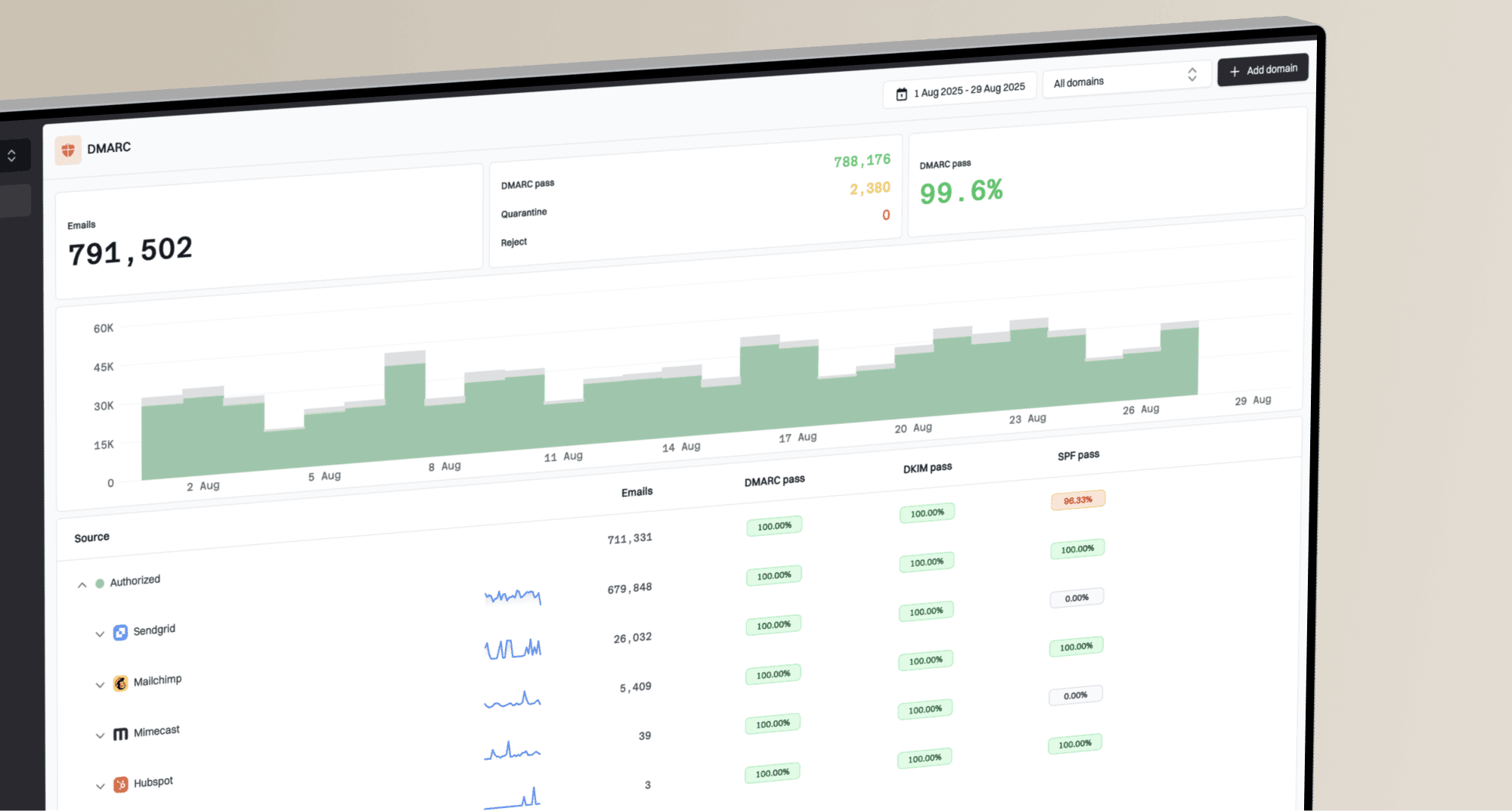
The practical answer is to start with p=none when you do not already understand every legitimate sender using the domain. Use that phase to collect aggregate reports, find unauthenticated streams, repair SPF and DKIM alignment, and establish ownership before enforcement. Suped's DMARC monitoring workflow supports that rollout by identifying sources, separating valid mail from spoofing, showing the required fixes, and tracking enforcement readiness.
Short answer for security
A monitoring policy does not damage reputation. It exposes whether your domain's email already has authentication, ownership, or abuse problems. Moving straight to p=quarantine can protect faster, but it also sends legitimate mail to spam when hidden senders fail alignment.
The direct answer
DMARC policy is not a reputation score. It is an instruction published in DNS. When a receiver evaluates a message claiming to be from your domain, it checks whether SPF or DKIM passes and has identifier alignment with the visible From domain. If neither mechanism produces an aligned pass, the receiver looks at your DMARC policy.
- Policy: A p=none record says to apply no DMARC-based handling change, so the receiver uses its normal rules.
- Reputation: Receivers can assess sending IPs, DKIM signing domains, visible From domains, and message streams separately from the DMARC policy value.
- Risk: A domain left at p=none forever stays easier to spoof because there is no DMARC enforcement request.
- Delivery: A stricter policy improves domain protection only after legitimate mail passes DMARC.
The confusion usually starts because DMARC makes attribution clearer. Once mail passes aligned authentication, receivers can connect more mail to your domain. If that mail has poor engagement or high complaints, reputation suffers because of the mail, not because the policy was none. Authentication gives you the reputation your behavior earns.
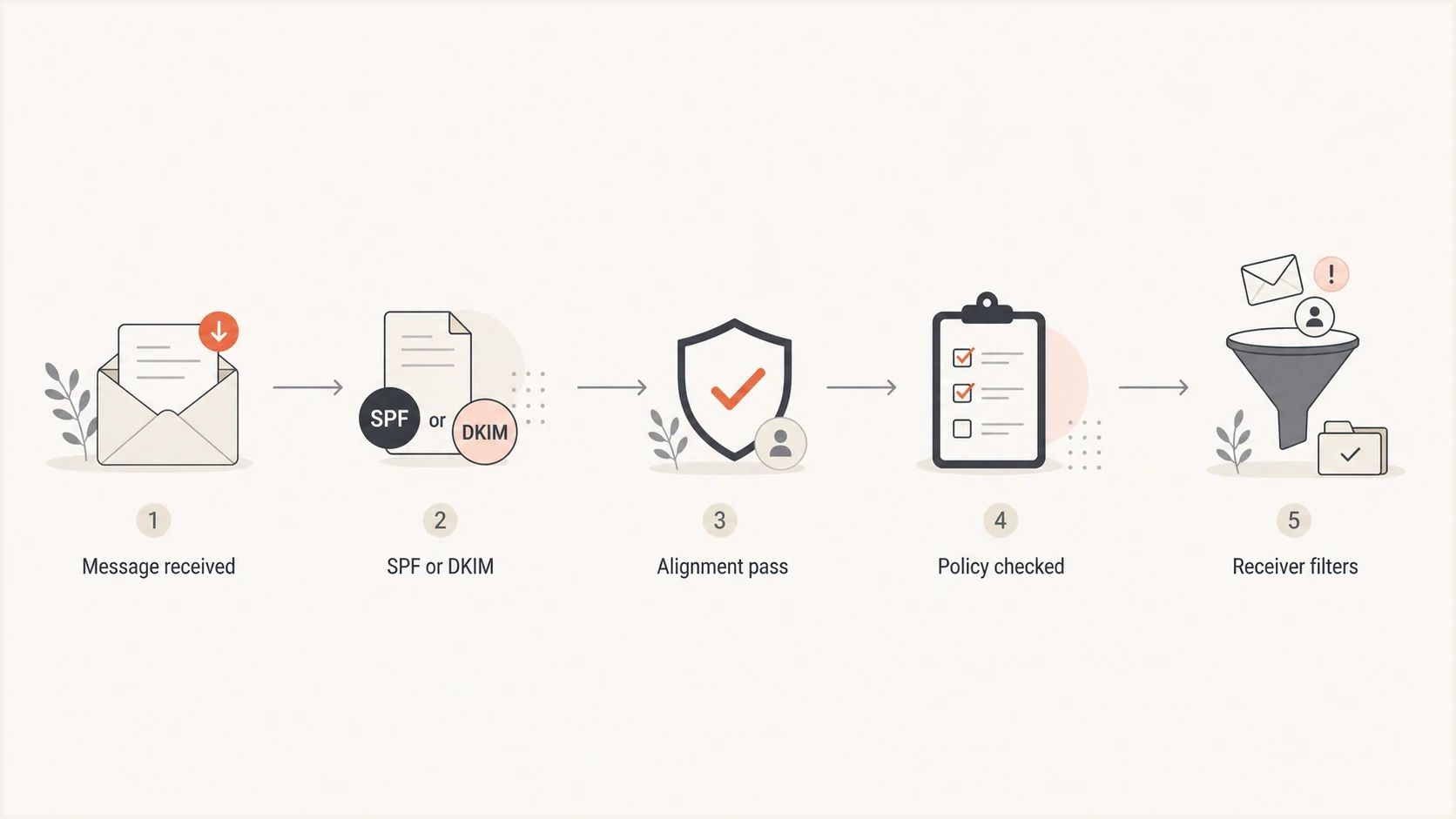
DMARC flowchart showing SPF or DKIM alignment and policy evaluation.
Why p=none gets blamed
Security teams should not treat p=none as a security end state. It is a discovery state that provides the data needed to avoid breaking real mail. Starting with enforcement can work when every sender and indirect mail path is already known to pass DMARC. Most organizations do not have that level of certainty.
What p=none does
- Reports: With rua, it asks participating receivers to send aggregate DMARC data.
- Discovery: It shows which observed services send as your domain and whether they pass DMARC.
- Safety: It keeps DMARC enforcement out of the path while you fix legitimate streams.
What p=none does not do
- Score: It does not create a reputation penalty on its own.
- Block: It does not ask receivers to reject failing mail.
- Guarantee: It does not make bad mail perform well in the inbox.
There is one caveat worth taking seriously. If attackers are spoofing your domain, p=none does not stop those messages through DMARC. That can hurt trust in your domain if recipients see fraudulent mail using your brand. The fix is to monitor briefly, identify legitimate senders, and move to enforcement as soon as the data supports it.
Do not confuse monitoring with inaction
A p=none policy is useful only when someone reads the reports and fixes the senders. Publishing it and ignoring the data gives spoofing room to continue.
What each DMARC policy really does
The policy choice changes the domain owner's requested handling for mail that fails DMARC. It does not replace content filtering, reputation filtering, malware checks, abuse detection, blocklist (blacklist) signals, or the receiver's own delivery rules. Final handling always remains subject to receiver policy.
|
|
|
|
|---|---|---|---|
p=none | No DMARC handling change | Discovery | No enforcement |
p=quarantine | Treat as suspicious | Staged enforcement | Good mail filtered |
p=reject | Reject | Full enforcement | Good mail rejected |
DMARC policy effects for mail that fails DMARC alignment.
A clean monitoring record looks simple. The important part is the reporting address. Without a working rua destination, p=none provides no aggregate data for a rollout. The example uses the default relaxed SPF and DKIM alignment modes. Add strict alignment tags only when the domain has a specific requirement and its senders support them.
Monitoring DMARC recordDNS
Host: _dmarc.example.com
Type: TXT
Value: v=DMARC1; p=none; rua=mailto:dmarc@example.com
Before changing a policy, validate that the DNS record parses correctly. A DMARC checker catches syntax issues such as duplicate tags, invalid policy values, and incorrectly formatted reporting addresses.
DMARC checker
Look up a domain's DMARC record and catch policy issues.
?/7tests passed
The safe rollout path
A controlled rollout starts with monitoring, fixes legitimate senders, tests indirect mail paths, and then applies enforcement. This protects the domain without turning the first policy change into a delivery incident.
Readiness checks
Use source ownership and business impact instead of one universal pass-rate threshold.
Ready to test
Owned and explained
Every critical known sender passes DMARC, and remaining failures are understood.
Needs review
Known gaps
Low-volume or indirect mail paths still need testing before enforcement.
Not ready
Critical failures
A critical sender fails DMARC or meaningful traffic has no owner.
- Publish: Start with p=none and a working aggregate report address.
- Inventory: Group sending sources by owner, platform, volume, authentication result, and business impact.
- Fix: Add DKIM, repair SPF, and configure the authenticated domain for DMARC alignment with the visible From domain.
- Test: Confirm invoices, password resets, support replies, marketing sends, forwarding, and mailing-list traffic.
- Enforce: Test quarantine with t=y, apply quarantine, then test reject before full enforcement.
If the organization needs a managed path, Suped's hosted DMARC lets teams stage policy changes without repeated DNS edits. That matters when security owns the policy but business teams own some sending systems.
Issues page showing top issues, verified sources, unverified sources, and authentication pass rates
Do not stay at monitoring for months by default. Stay long enough to observe normal sending cycles and explain failures. A small organization can finish quickly, while a larger organization often discovers forgotten senders, inherited systems, regional mail flows, and indirect delivery paths.
How to test enforcement under RFC 9989
RFC 9989 obsoletes RFC 7489 and makes the pct tag historic. For a new staged rollout, use t=y to request testing behavior. With p=quarantine; t=y, failing mail is treated at the none level. With p=reject; t=y, it is treated at the quarantine level. Receivers still retain local handling discretion.
Test quarantine
Publish quarantine in test mode after legitimate sources pass DMARC.
Quarantine test recordDNS
v=DMARC1; p=quarantine; t=y; rua=mailto:dmarc@example.com
Test reject
Test reject after quarantine has produced no unexplained business impact.
Reject test recordDNS
v=DMARC1; p=reject; t=y; rua=mailto:dmarc@example.com
Use test mode as a short validation stage with an owner, review window, success criteria, and rollback plan. When the reports and delivery checks are clean, remove t=y or change it to t=n to request the published policy at full effect.
Do not use pct for new rollouts
The pct tag had inconsistent receiver behavior and is historic under RFC 9989. Existing records need a planned migration to t=y rather than another percentage step.
How to read the reports
Aggregate DMARC reports make p=none operationally useful. They show which IPs sent mail using your domain, whether SPF passed, whether DKIM passed, whether either mechanism had identifier alignment, and what policy result the receiver recorded. Raw XML is hard to use at scale, so the operational work is grouping sources and turning failures into owners and tasks.
- Known: A source you recognize, such as your main mail platform, should pass through aligned SPF or DKIM.
- Misconfigured: A legitimate source that fails DMARC needs a DNS, DKIM, envelope domain, or provider setting fix.
- Unknown: A source nobody owns should be treated as suspicious until proven otherwise.
- Spoofed: A source sending without authorization is the reason to move toward enforcement.
Suped's platform groups DMARC reports into recognizable sources, assigns issues to owners, alerts teams to material changes, and tracks whether important mail is ready for enforcement. That gives security and sending teams one source list and a shared set of next actions.
DMARC records drawer showing filters, record rows, authentication results, and CSV export
Keep the enforcement rollout narrow and measurable. Use the practical checklist for how to transition policy safely after reporting data shows which sources are ready.
What to tell security
The useful distinction is that quarantine is a good destination but a risky first step when the sending inventory is incomplete. Reject is the strongest final policy for spoofing protection, but configuration mistakes can block legitimate mail immediately. None is the measurement phase that removes guesswork.
Suggested reply
A p=none policy does not lower reputation by itself. It requests no DMARC-based handling change, while receivers continue using their normal filtering. The reputation risk comes from unauthenticated or unwanted mail using our domain. Starting at none lets us identify legitimate streams before asking receivers to quarantine failures. Once the reports show our important mail passes DMARC, we can test quarantine and then reject with much lower delivery risk.
That answer gives security the enforcement goal and gives operations the data needed to reach it without breaking receipts, support replies, HR systems, product alerts, or executive mail.
Views from the trenches
Best practices
Start at p=none, collect reports daily, and assign every meaningful source an owner.
Move only known, aligned production streams into quarantine after review and testing.
Keep security and mail owners in one queue so policy changes have clear accountability.
Common pitfalls
Treating p=none as finished protection leaves spoofed traffic visible but unenforced.
Jumping to quarantine before source discovery sends valid business mail to spam.
Reading aggregate reports without source ownership turns useful data into noise.
Expert tips
Use DKIM alignment as the default fix because it survives forwarding better than SPF.
Track failed sources by business impact, not only by volume, before enforcing policy.
Write a rollback plan before changing policy so support teams know what to check.
Marketer from Email Geeks says a none policy does not create bad reputation; it exposes whether the mail already deserves trust.
2024-01-22 - Email Geeks
Marketer from Email Geeks says authentication lets receivers identify the sender more accurately and treat the mail by its behavior.
2024-01-22 - Email Geeks
The practical answer
A DMARC policy of p=none does not hurt email reputation on its own. It is the right starting point when you need visibility before enforcement, but it is not a protection end state. Use aggregate reports to identify senders, fix alignment, remove unauthorized sources, and move to tested quarantine or reject. Suped supports this work by turning report data into source ownership, issue tracking, alerts, and staged policy changes.