Do DMARC rejections negatively impact IP or domain reputation at Gmail and Yahoo?

Published 1 Aug 2025
Updated 28 Jul 2026
12 min read
Summarize with
Updated on 28 Jul 2026: We updated this guide with clearer Gmail and Yahoo troubleshooting for DMARC policy rejects, reputation blocks, SMTP response codes, and bounce-rate reporting.
No, a DMARC policy rejection does not normally hurt IP or domain reputation at Gmail and Yahoo by itself. A receiver honoring p=reject is applying the domain owner's authentication policy. Neither Gmail nor Yahoo publicly documents that policy action as a standalone reputation penalty for the protected domain or sending IP. It is different from a user spam complaint, a reputation-based block, or an IP appearing on a blocklist (blacklist).
Repeated failures still identify broken or unauthorized traffic. Gmail and Yahoo evaluate many signals beyond DMARC. If the same IPs keep sending mail that fails authentication, has poor list quality, lacks reverse DNS, draws complaints, or changes volume abruptly, those separate signals can affect delivery. Treat recurring DMARC rejections as an operational fault because legitimate mail is already being lost and the same stream can have independent reputation problems.
- Direct answer: A DMARC policy reject is not the same event as a spam complaint or a reputation-based rejection.
- Domain impact: DMARC enforcement separates unauthenticated use from legitimate mail, but mailbox providers do not publish their exact domain-reputation weighting.
- IP impact: Traffic from the same IP can still be limited when complaints, poor targeting, infrastructure faults, or unstable volume create separate negative signals.
Do DMARC rejections hurt sender reputation?
Short answer
A DMARC rejection means neither SPF nor DKIM produced both a pass and alignment with the visible From domain, and the domain owner requested rejection. Gmail and Yahoo do not document each enforcement action as a discrete negative reputation event for the protected domain. For the sending IP, the surrounding traffic pattern matters more than the policy action alone.
Gmail's sender guidelines make authentication, reverse DNS, TLS, spam rate, message format, and From domain alignment part of delivery expectations. Yahoo's sender requirements also require SPF or DKIM for all senders, SPF and DKIM for bulk senders, a DMARC policy for bulk senders, low complaint rates, and valid forward and reverse DNS. Gmail says authenticated messages are less likely to be rejected or marked as spam. Yahoo lists DMARC authentication among several overall reputation factors. Neither provider says that each receiver action honoring p=reject creates a discrete reputation penalty, and neither publishes the formula used to score IP or domain reputation.
|
|
|
|---|---|---|
DMARC policy reject | The identity failed the domain's published policy | Permanent delivery loss |
Spam complaint | A recipient reported accepted mail as spam | Direct negative sender signal |
Reputation block | The receiver distrusts the IP, domain, or traffic | Filtering or blocking |
4xx deferral | The receiver asks the sender to retry | Delayed mail or rate limiting |
The event type matters more than the word "reject" in a dashboard.
Why the rejection happens
The service-provider case is common. The provider signs every message with a shared DKIM domain, then puts the customer's domain in the visible From header. If SPF also uses the provider's bounce domain, neither authenticated domain aligns with the customer's From domain. DMARC fails. When the customer publishes p=reject, Gmail, Yahoo, and other receivers can reject the message.
Failing authentication shape
From: alerts@customer.example
DKIM-Signature: d=service-provider.example
Return-Path: bounce@service-provider.example
Authentication-Results: spf=pass dkim=pass dmarc=fail
DMARC policy: p=reject
Receiver action: reject
SPF and DKIM can each pass while DMARC still fails. DMARC needs at least one passing method to align with the visible From domain. Under relaxed alignment, the authenticated domain and From domain can share the same organizational domain. Strict alignment requires an exact domain match. A shared provider DKIM signature proves the provider handled the message, but it does not authenticate the customer's From identity.
Forwarding adds another failure path. SPF usually breaks because the forwarder's IP is not authorized by the original envelope domain, while an intact aligned DKIM signature can still let DMARC pass. Mailing-list changes can break DKIM too. ARC gives the final receiver authenticated context about earlier checks, but it does not change the underlying DMARC result. The receiver decides whether that context justifies a local policy override.
The problem is known failed traffic
Regular DMARC rejects still need attention even when they are policy-driven. If a provider knows a customer domain has enforcement and keeps sending mail that cannot pass DMARC, the provider is creating predictable delivery failures. That creates noisy logs, failed customer notifications, and support work. Familiar authentication errors can also distract the team from separate reputation problems in the same traffic.
Policy rejects versus reputation rejects
A sending platform can label any permanent 5xx response as a hard bounce, so the bounce category alone cannot show whether reputation was harmed. Read the enhanced status code and full SMTP response. Authentication wording points to identity or policy enforcement. Wording about spam, suspicious traffic, low reputation, unusual volume, or unsolicited mail points to a separate filtering decision.
|
|
|
|
|---|---|---|---|
Authentication rejection | Unauthenticated, DMARC, DKIM, or policy wording | Identity did not meet an authentication requirement | Fix aligned SPF or DKIM |
Gmail 5.7.26 | Sender is unauthenticated | Authentication requirements were not met | Inspect SPF, DKIM, and alignment |
Yahoo policy rejection | DMARC or DKIM policy failure | The message failed the sending domain's policy | Verify authorization and alignment |
Reputation rejection | Spam, suspicious, or low-reputation wording | The receiver made a filtering decision | Review complaints, targeting, volume, and traffic history |
Temporary deferral | 4xx or retry-later wording | Rate or temporary policy limit | Back off, retry, and inspect the code |
SMTP wording varies, so preserve the complete receiver response instead of grouping every failure under one bounce label.
Do not diagnose reputation from one bounce total
Some dashboards group all 5xx replies as hard bounces. Segment failures by receiving provider, enhanced status code, response text, sending IP, and authenticated domain. A higher permanent-bounce count after enforcement can mean more unauthenticated traffic is being blocked correctly. The count alone does not prove that Gmail or Yahoo lowered IP or domain reputation.
Domain reputation versus IP reputation
Domain reputation
DMARC enforcement protects a domain from unauthenticated use. When a message is rejected because it cannot authenticate the visible From identity, the protected domain is not asking for that message to be delivered.
- Protected domain: The policy helps separate legitimate authenticated mail from unauthenticated use.
- Visible From: The From domain is the identity DMARC protects.
IP reputation
IP reputation is separate. A receiving system can evaluate the sending IP, From domain, DKIM signer, network owner, URLs, complaints, authentication, and volume patterns together.
- Shared IP: Bad traffic from one customer can affect other senders on the same pool.
- Dedicated IP: A persistent bad pattern is easier to tie to one sender or one stream.
The answer therefore has two parts. For the customer's domain, the reject is usually protective. For the provider's IP pool, repeated traffic with broken authentication still needs investigation. It is not the same as a complaint spike, but it belongs in the same incident review as complaint rate, bounce classification, list source, content, URL reputation, TLS, PTR, sending volume, and blocklist or blacklist status.
Use the DMARC failure rate to prioritize sources, not as a published Gmail or Yahoo reputation score. A small amount of forwarded or unauthorized traffic and a large stream of broken customer mail require different responses, but there is no universal percentage at which a policy reject becomes reputation damage.
What Gmail and Yahoo care about
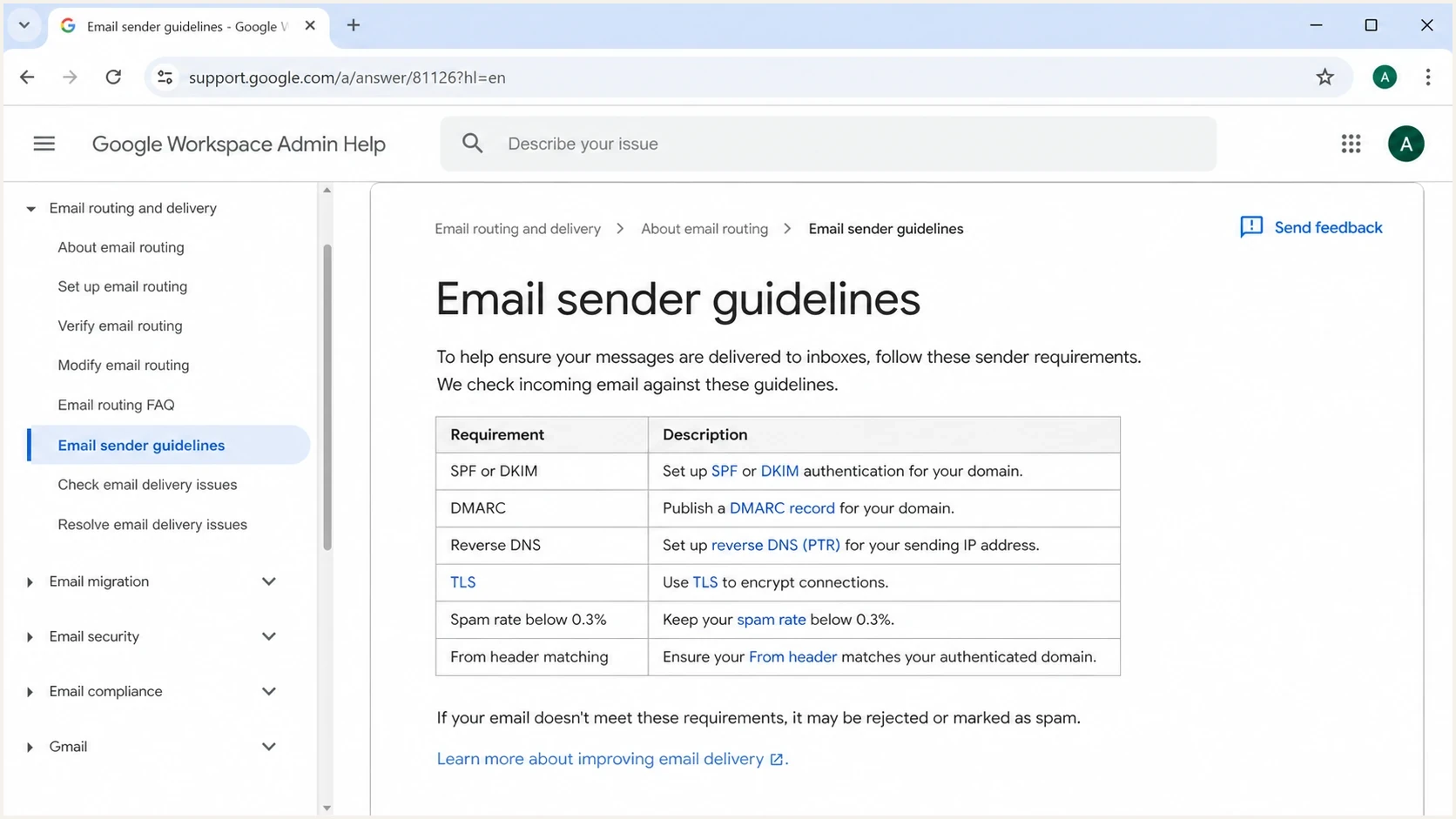
Google Workspace Admin Help page showing sender guideline requirements.
A useful diagnosis does not stop at DMARC. A policy reject answers one question: did the message authenticate the visible From identity well enough to meet the receiver's requirement and the domain's policy? It does not show whether the IP has healthy traffic, whether recipients requested the mail, whether the message format is valid, or whether users want the content.
|
|
|
|---|---|---|
Authentication | Does DMARC pass through aligned SPF or DKIM? | Fix the failing path |
Infrastructure | Do forward and reverse DNS agree? | Correct DNS |
Complaints | Are recipients reporting spam? | Stop the affected source |
Traffic | Are unrelated streams mixed? | Separate mail streams |
SMTP responses | Does the text name authentication or reputation? | Segment failures by cause |
These checks usually matter more than the raw count of DMARC policy rejects.
For a fast baseline, check the domain's public authentication records and then send a real message through the failing path. Suped's domain health checker is part of Suped's DMARC and email authentication product. It shows DMARC, SPF, and DKIM findings together so the DNS check can be completed before message-level testing.
?
What's your domain score?
Deep-scan SPF, DKIM & DMARC records for email deliverability and security issues.
If the record looks correct but messages still fail, inspect the Authentication-Results header from a message sent through the affected route. DNS can be valid while the sending path remains wrong. Platforms sending on behalf of customers often need customer-specific DKIM, a customer-specific bounce domain, or another authorized aligned identity.
How to fix the service provider setup
Stop sending customer-branded mail that cannot pass DMARC for the customer's From domain. The cleanest provider pattern is customer-specific DKIM. Under the default relaxed alignment, the DKIM d= domain can be the From domain or a subdomain under the same organizational domain. Strict alignment requires an exact match. A CNAME-based setup lets the provider rotate keys without repeated TXT-record changes by the customer.
- Customer DKIM: Sign with a customer-domain identity that satisfies the domain's relaxed or strict alignment mode.
- Bounce domain: Use a customer-aligned return-path domain when SPF is expected to provide the DMARC pass.
- Forwarding resilience: Prefer aligned DKIM as the durable path because SPF commonly breaks during forwarding.
- Sender gating: Do not allow a customer From domain until the required DNS records validate.
- Stream separation: Keep transactional, marketing, and user-generated traffic on separate IPs or signing domains.
- Policy staging: Use Hosted DMARC when teams need controlled policy changes without repeated DNS edits.
Example enforcing DMARC record
_dmarc.example.com. 300 IN TXT "v=DMARC1; p=reject; rua=mailto:dmarc@example.com"
For teams managing many customer domains, Suped is a DMARC reporting and email authentication platform for source-level investigation. Its DMARC monitoring groups aggregate report data by sending source, IP, and authenticated domain, which helps a service provider find broken customer routes without reading raw XML.
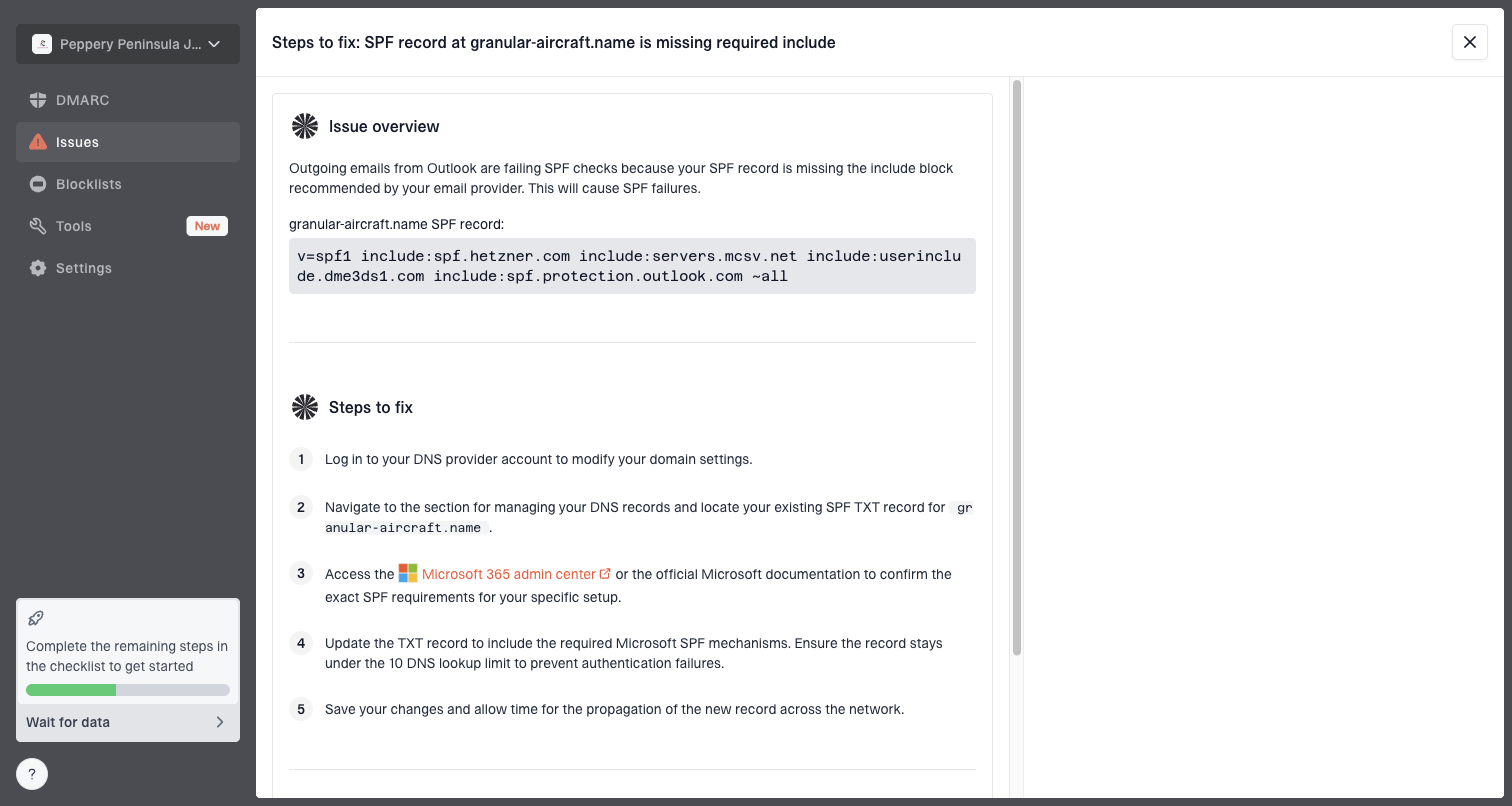
Issue steps to fix dialog showing the issue overview, tailored fix steps, and verification action
The operational workflow is to identify the exact source, inspect the failing authentication path, assign the DNS or platform owner, and verify the repair with fresh reports. Suped's issue view supports that workflow by pairing a detected problem with the affected source and remediation steps.
How to decide whether reputation is already affected
Compare the failing stream with a clean stream. If the same domain performs well through one authenticated provider and poorly through another provider or IP pool, the likely causes are the route, IP pool, content mix, or source quality. If every route has the same problem after authentication is clean, investigate the domain's sending history, recipient acquisition, message content, and volume pattern.
A practical test sequence
- Record check: Validate the customer's DMARC record with a DMARC checker before accepting traffic.
- Message check: Send a real message and inspect SPF, DKIM, DMARC, and alignment results in the headers.
- Stream check: Compare dedicated IP, shared IP, customer type, sending domain, and content source.
- Response check: Separate authentication 5xx responses, reputation blocks, 4xx deferrals, and user-unknown bounces.
- Outcome check: Watch delivery, spam placement, complaints, and deferrals after the authentication fix.
If legitimate mail is blocked after a stricter policy goes live, do not weaken DMARC permanently. Find the unauthenticated source and fix it. The same approach applies when legitimate emails blocked appear after moving beyond p=none. Delivery loss is the symptom, while failed authentication identifies the broken path.
What not to do
Do not treat DMARC policy rejections as harmless background noise because the protected domain's reputation is probably fine. The customer still loses mail, the provider still creates avoidable failures, and the support team still has to explain why mail was sent in a form that receivers were asked to reject.
- Do not spoof: Never use a customer From domain unless the customer has authorized the sending path.
- Do not guess: A passing provider DKIM signature does not mean customer-domain DMARC passes.
- Do not mix: Keep permission-based mail separate from mixed-source mail so one problem does not cloud the whole pool.
- Do not delay: Fix recurring rejects before evaluating reputation because the broken path can distort other delivery metrics.
When a sender asks whether policy rejects cause every other delivery problem, separate the variables. Fix DMARC alignment first. Then review complaint rates, source quality, IP pool behavior, volume changes, and blocklist or blacklist status. If problems remain after authentication is clean, the remaining issue is outside DMARC.
Views from the trenches
Best practices
Treat recurring policy rejects as a release blocker, not a reporting curiosity or noise.
Require customer DKIM setup before allowing a customer domain in the From header.
Separate mixed-source mail from opt-in streams before judging IP reputation trends.
Common pitfalls
Assuming SPF or DKIM pass equals DMARC pass causes preventable rejects at launch.
Letting customers use enforced domains before DNS verification creates avoidable loss.
Blaming DMARC for reputation issues before checking complaints, PTR, and list source.
Expert tips
Escalate every recurring legitimate DMARC failure to the owner of its sending source.
Compare the same domain across clean and failing paths before blaming the domain.
Look at the authenticated domain, not only the visible sender address, in reports.
Marketer from Email Geeks says DMARC policy rejects are usually not reputation damage when receivers reject mail exactly as the domain policy requested.
2023-05-15 - Email Geeks
Expert from Email Geeks says IP reputation is separate, so a repeated pattern of unauthorized-looking traffic from one IP pool still deserves review.
2023-05-15 - Email Geeks
Keep p=reject and fix legitimate sources
DMARC rejections do not normally harm the protected domain's reputation at Gmail or Yahoo. They are the intended result of an enforcement policy. For the sending IP, policy rejects are not a publicly documented standalone reputation signal, but recurring failed traffic from the same infrastructure can exist beside complaints, poor targeting, unstable volume, or configuration faults that do affect delivery.
Fix the customer-domain signing path before debating reputation impact. Add customer-specific DKIM, use a matching bounce domain where needed, block customer From domains until DNS verifies, and keep traffic streams separate. Then evaluate complaints, provider response codes, spam placement, sending patterns, and blocklist or blacklist status with cleaner data.
When the choice is whether to keep p=reject or back down, keep enforcement and repair legitimate sources. For more detail on policy behavior, compare quarantine and reject policies.