Why are legitimate emails blocked when DMARC policy is higher than p=none?

Published 9 Jun 2025
Updated 2 Aug 2026
13 min read
Summarize with
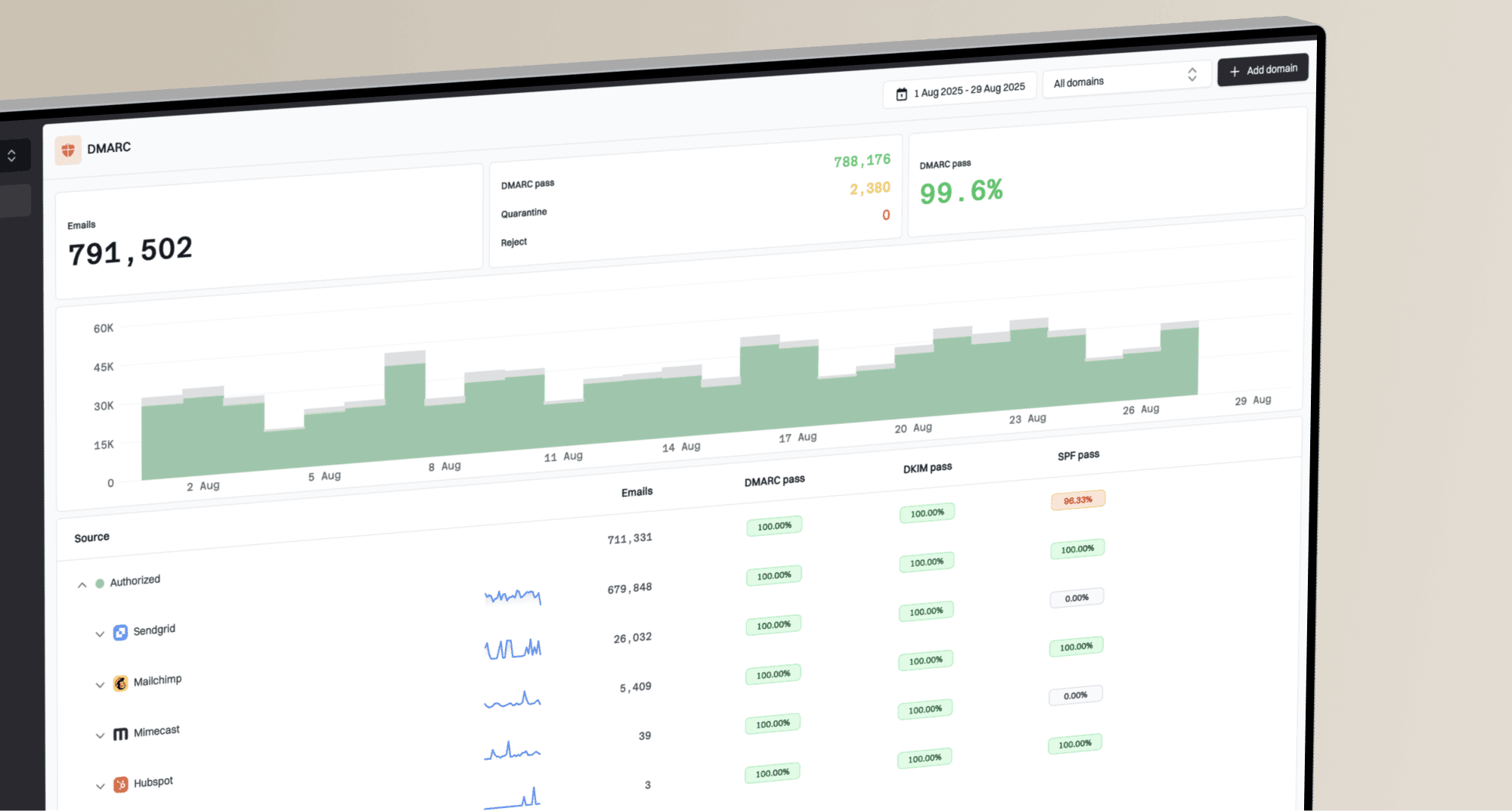
Updated on 2 Aug 2026: We updated this guide for RFC 9989 and its safer DMARC enforcement guidance.
Legitimate emails are blocked when DMARC moves beyond p=none because enforcement stops treating DMARC failures as reporting-only data. At p=quarantine, a receiving mailbox provider can place failing mail in spam. At p=reject, a receiver can reject failing mail during SMTP after considering the published policy with its own evidence and local rules. The usual cause is simple: the message did not pass SPF or DKIM in alignment with the visible From domain.
That does not mean DMARC is bad for deliverability. It means DMARC has exposed a sending path that was already not ready for enforcement. Those failures are operational signals: fix the sender, authenticate the mail, move it to a dedicated sending domain, or stop that sender from using the domain.
- Main cause: The email fails DMARC because neither SPF nor DKIM passes with domain alignment.
- Common trigger: A CRM, ESP, helpdesk, calendar app, billing system, or marketing tool sends without proper authentication.
- Important caveat: A message can pass DMARC and still be blocked for reputation, content, complaint rate, spam-trap history, or recipient-side policy.
The direct answer
DMARC does not block mail just because the sender is legitimate. A failed DMARC result lets the receiving system apply the published policy as one input to its local handling decision. A legitimate business email can still fail DMARC when the technical identity in the message does not match the domain the recipient sees in the From header.
The key phrase is "aligned authentication." SPF checks whether the sending IP is allowed for the envelope sender domain. DKIM checks whether a signed domain took responsibility for the message. DMARC then asks whether either passing result aligns with the visible From domain. If both aligned checks fail, DMARC fails.
A stricter policy changes the requested consequence, not the authentication math. The same broken sender that quietly appeared in reports under p=none starts causing user-visible damage when you publish p=quarantine or p=reject.
This is why DMARC should be treated as a monitored rollout, not a one-line DNS change. Suped's DMARC monitoring supports that workflow by identifying sending sources, separating business mail from spoofing, and showing the authentication fixes needed before enforcement causes avoidable blocking.
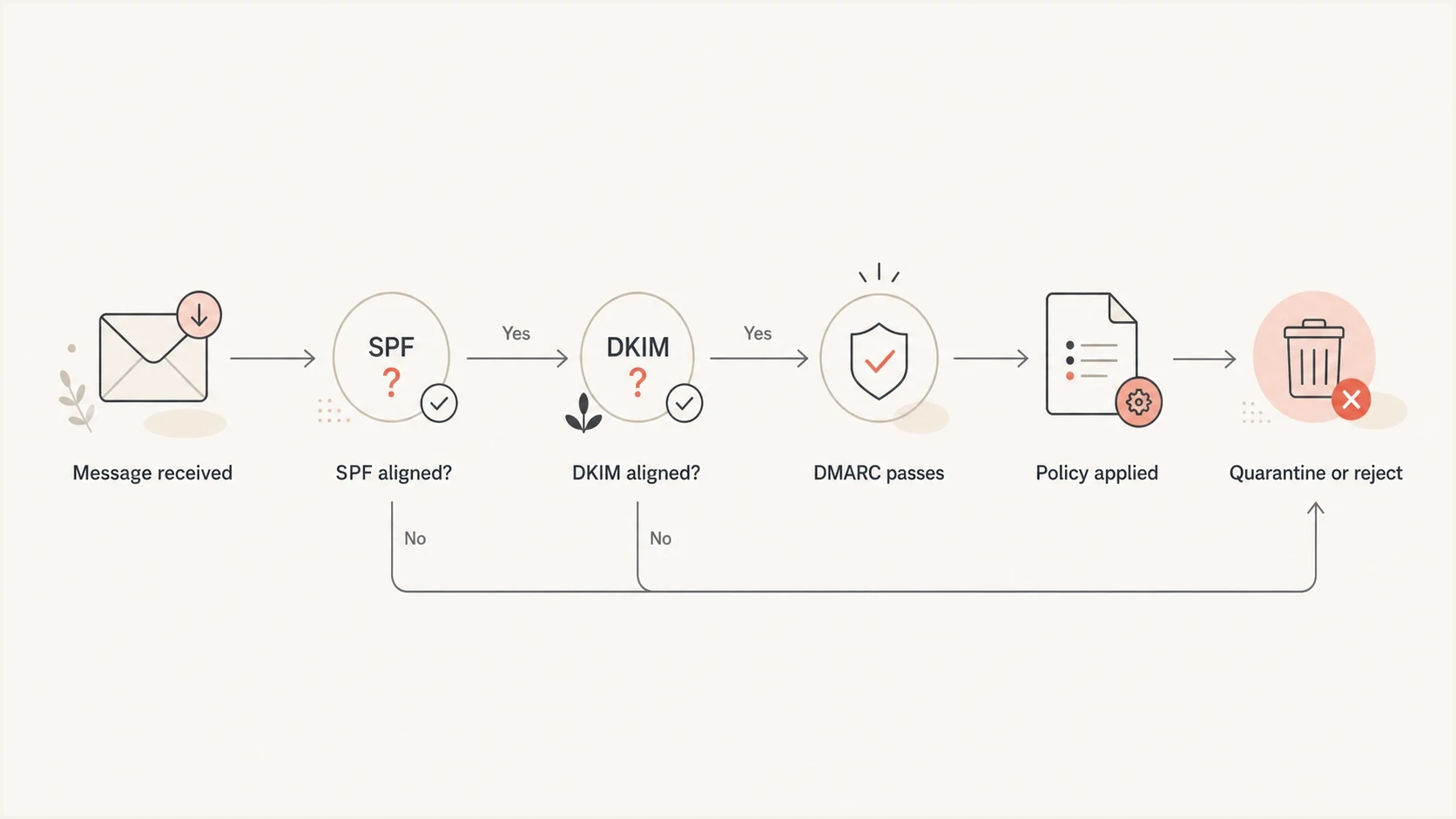
Flowchart showing how aligned SPF or DKIM determines DMARC enforcement.
Why p=none hides the problem
A p=none policy asks receivers to send reports without changing message handling because of the DMARC policy. It is the right starting point for collecting evidence, but a receiver can still filter or reject mail for reasons unrelated to DMARC. Broken mail can therefore keep flowing while you map sending sources.
When you move to enforcement, the same underlying failures become visible to users. The sales team notices a CRM email in spam. Finance sees an invoice notification bounce. A calendar cancellation fails where the original invitation delivered. These are not new failures created by DMARC. They are existing authentication gaps becoming consequential.
Before enforcement
- Policy effect: Receivers report DMARC failures without applying your requested quarantine or reject policy.
- Business impact: Misconfigured senders continue sending, so teams often do not notice the risk.
After enforcement
- Policy effect: Receivers can quarantine or reject mail that fails aligned authentication after applying local rules.
- Business impact: Unknown senders, broken DKIM, forwarding paths, and shared tools can fail visibly.
Before raising a policy, collect enough report history to answer one question with confidence: which sources are still sending mail that matters? If the answer is unclear, the policy change is guesswork.
The main causes of legitimate blocking
The most common failure pattern is not mysterious. A tool sends mail with your visible From domain, but SPF authorizes a different envelope domain or DKIM signs with the tool's domain instead of your domain. The message might be legitimate to the business, but it is not authenticated as legitimate for your domain under DMARC.
|
|
|
|---|---|---|
ESP setup | DKIM alignment | Enable custom DKIM |
CRM mail | SPF alignment | Use vendor bounce domain |
Forwarding | SPF, DKIM | Rely on aligned DKIM |
Rogue sender | SPF, DKIM | Authorize or remove |
Calendar invites | Header handling | Test invite flows |
Subdomain sender | Inherited policy or alignment | Publish and test subdomain authentication |
Common causes of legitimate mail failing under DMARC enforcement.
Forwarding is a special case because SPF is tied to the sending IP. Once another server forwards the message, SPF often fails because the forwarder is not listed in the original sender's SPF record. DKIM should survive simple forwarding, but it breaks when a system modifies signed headers, rewrites the body, alters MIME boundaries, appends footers, or changes calendar parts. ARC can preserve the original authentication results across an intermediary, but it does not make the message pass DMARC. The final receiver decides whether to trust the ARC chain as local evidence.
Rogue sending is the other recurring cause. Someone in the business opens a marketing, survey, billing, scheduling, or support account and sends as the company domain without telling IT. Under p=none, that might work by luck. Under enforcement, it breaks because no aligned authentication was configured.
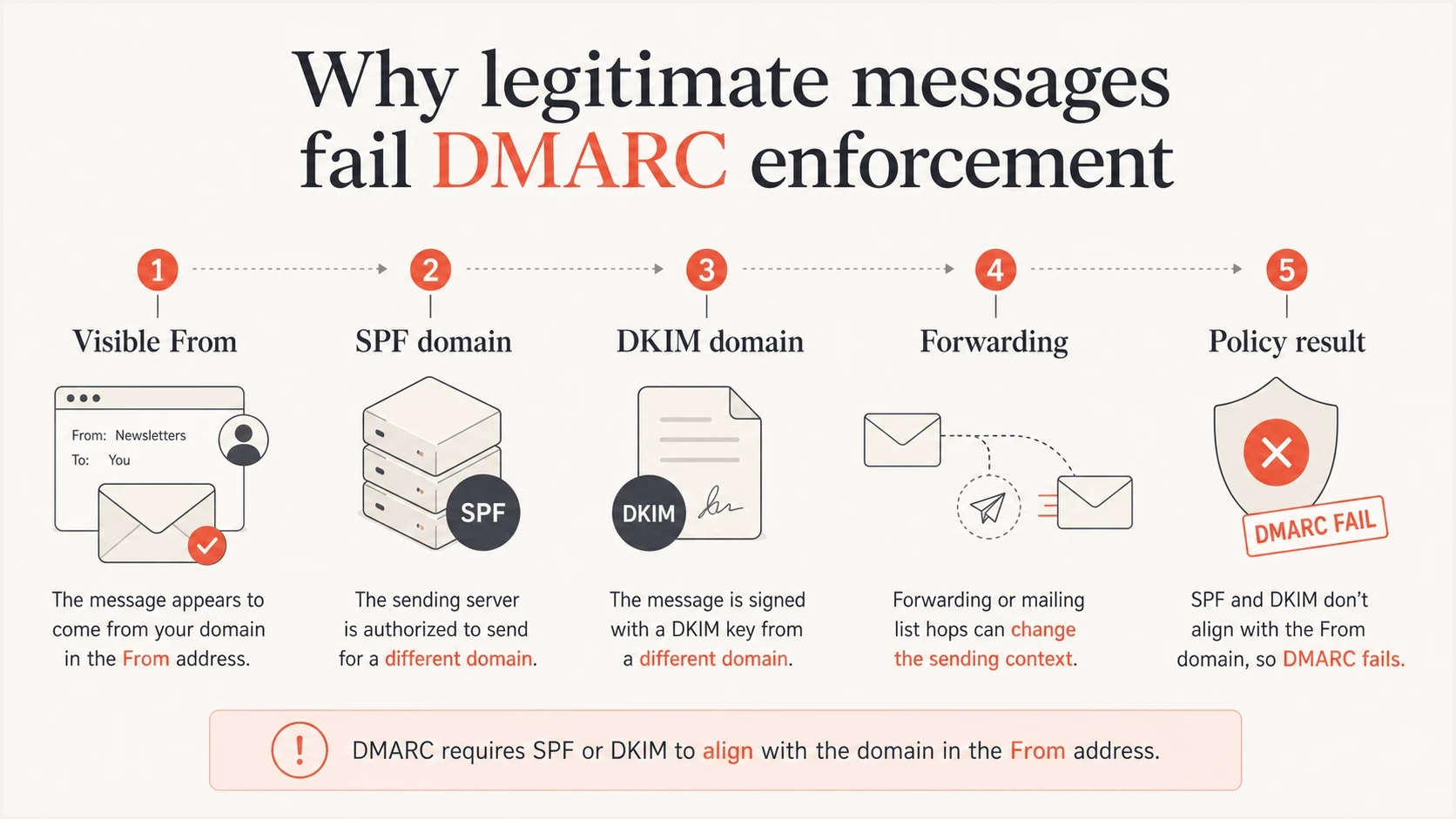
Infographic showing visible From, SPF domain, DKIM domain, forwarding, and policy result.
What a failing record looks like
A DMARC TXT record at enforcement is not long, but it has high operational impact. A basic reject policy looks like this:
DMARC reject policy exampledns
_dmarc.example.com. 3600 IN TXT (
  "v=DMARC1; p=reject; rua=mailto:dmarc@example.com"
)
If that domain has a helpdesk sending as support@example.com, the helpdesk needs aligned DKIM or aligned SPF. A vendor DKIM signature such as d=vendor.example does not protect example.com for DMARC. An envelope sender such as bounces.vendor.example is not aligned with example.com because it belongs to a different organizational domain.
Simplified authentication resulttext
From: support@example.com
SPF: pass for bounces.vendor.example
DKIM: pass with d=vendor.example
DMARC: fail because neither result aligns with example.com
The fix is not to weaken DMARC forever. The fix is to configure the sender properly. In practice that usually means adding the vendor's DKIM CNAME records, setting a custom bounce domain, or moving the workflow to a subdomain such as mail.example.com with clean alignment.
DMARC checker
Look up a domain's DMARC record and catch policy issues.
?/7tests passed
If you are unsure whether the published record says what you think it says, validate it with the DMARC checker before changing policy. Then compare the DNS record to real aggregate reports, because the record alone does not tell you which senders are ready.
Passing DMARC does not guarantee inbox placement
One point gets missed in DMARC rollouts: authentication helps mailbox providers identify the sender, but it does not force delivery. A sender can pass SPF, DKIM, and DMARC and still be blocked because the authenticated identity has poor reputation or the message trips other filters.
- Complaints: High spam complaints can override technically correct authentication.
- Engagement: Low opens, deletions without reading, and ignored mail can damage mailbox-specific reputation.
- Content: Suspicious URLs, attachments, wording, or inconsistent branding can still trigger filtering.
- Reputation: The domain, subdomain, IP, and DKIM identity each contribute signals receivers can use.
If a message passes DMARC and still gets blocked, the root cause is not your DMARC policy. DMARC helped the receiver attach the message to a clearer identity. The next investigation should look at reputation, content, recipient policy, and blocklist or blacklist status.
This distinction matters because lowering DMARC to p=none will not fix a reputation problem. It can reduce authentication-based rejection, but it also reopens the domain to unauthenticated lookalike abuse. Treat authentication and deliverability signals as separate issues.
What RFC 9989 changes about enforcement
RFC 9989 replaced RFC 7489 as the core DMARC specification. It keeps the familiar policy values, but it removes the percentage tag, adds policy test mode, and gives clearer guidance for indirect mail flows such as forwarding, role aliases, and mailing lists.
- Test mode: Use t=y to request handling one policy level below the published policy while reports continue normally.
- General-purpose mail: Domains used by people who post to mailing lists should generally avoid p=reject because indirect mail can break alignment.
- Receiver decisions: A receiver must not reject solely because a domain publishes p=reject. It must combine DMARC with other evidence and local analysis.
- Subdomain policy: The sp tag covers existing subdomains, while the np tag can state a policy for non-existent subdomains.
RFC 9989 test mode exampledns
_dmarc.example.com. 3600 IN TXT (
  "v=DMARC1; p=reject; t=y; rua=mailto:dmarc@example.com"
)
With p=reject; t=y, RFC 9989 asks receivers to apply quarantine to DMARC failures. With p=quarantine; t=y, it asks them to apply no DMARC policy handling. Unknown tags are ignored by older implementations, so monitor actual dispositions during a transition.
How to move beyond p=none safely
Do not jump to p=reject until reports show that important business mail consistently passes aligned SPF or DKIM and indirect mail has been assessed. Do not stay at p=none indefinitely either. For a general-purpose domain, p=quarantine can be the right enforcement policy. Reserve p=reject for controlled mail streams where its interoperability cost is understood.
Policy rollout readiness
Use DMARC pass rate and source confidence together. A high pass rate is not enough if unknown senders still send important mail.
Monitor
p=none
Inventory senders and fix visible authentication failures.
Test
t=y
Request one-level-lower handling while watching real dispositions.
Enforce
p=quarantine or p=reject
Choose quarantine or reject based on the domain's actual mail flows.
Use a checklist that makes ownership clear. Each sending source should have a named business owner, an authentication method, and a decision: approve, fix, isolate on a subdomain, or shut down.
- Inventory: List every IP, platform, and vendor seen in aggregate reports.
- Classify: Separate approved business mail, unknown mail, spoofing, and retired systems.
- Fix: Configure aligned DKIM first, then use SPF alignment where the platform supports it cleanly.
- Stage: Use test mode or quarantine before reject, especially for human mail and calendar-heavy usage.
- Watch: Review failures after each policy change and keep a rollback plan for critical flows.
The domain health checker helps with the first pass by checking DMARC, SPF, and DKIM DNS health in one place. That does not replace report analysis, but it catches obvious record problems before a policy change.
?
What's your domain score?
Deep-scan SPF, DKIM & DMARC records for email deliverability and security issues.
Once the DNS checks are clean, use live DMARC report data to decide policy. DNS validation tells you the records are syntactically healthy. Reports tell you whether real mail streams survive enforcement.
What to do when legitimate mail is already blocked
When a user reports a blocked message after enforcement, start with the headers or bounce. Capture the receiver's DMARC result, SPF result, DKIM result, envelope sender, visible From domain, DKIM signing domain, sending IP, and SMTP status text. Guessing from the application name wastes time.
Do not make the first response "turn DMARC off." That can be necessary for a short incident window, but it should be a controlled rollback with a named reason and an owner for the broken sender.
The faster fix depends on the failure. If DKIM is absent, enable custom DKIM at the platform and publish the CNAME or TXT records. If DKIM passes but does not match the From domain, switch the sender to sign with your domain. If SPF passes for a vendor domain only, configure a custom return-path or bounce domain if the vendor supports it. If forwarding is the issue, make aligned DKIM resilient and avoid signed headers that downstream systems often alter.
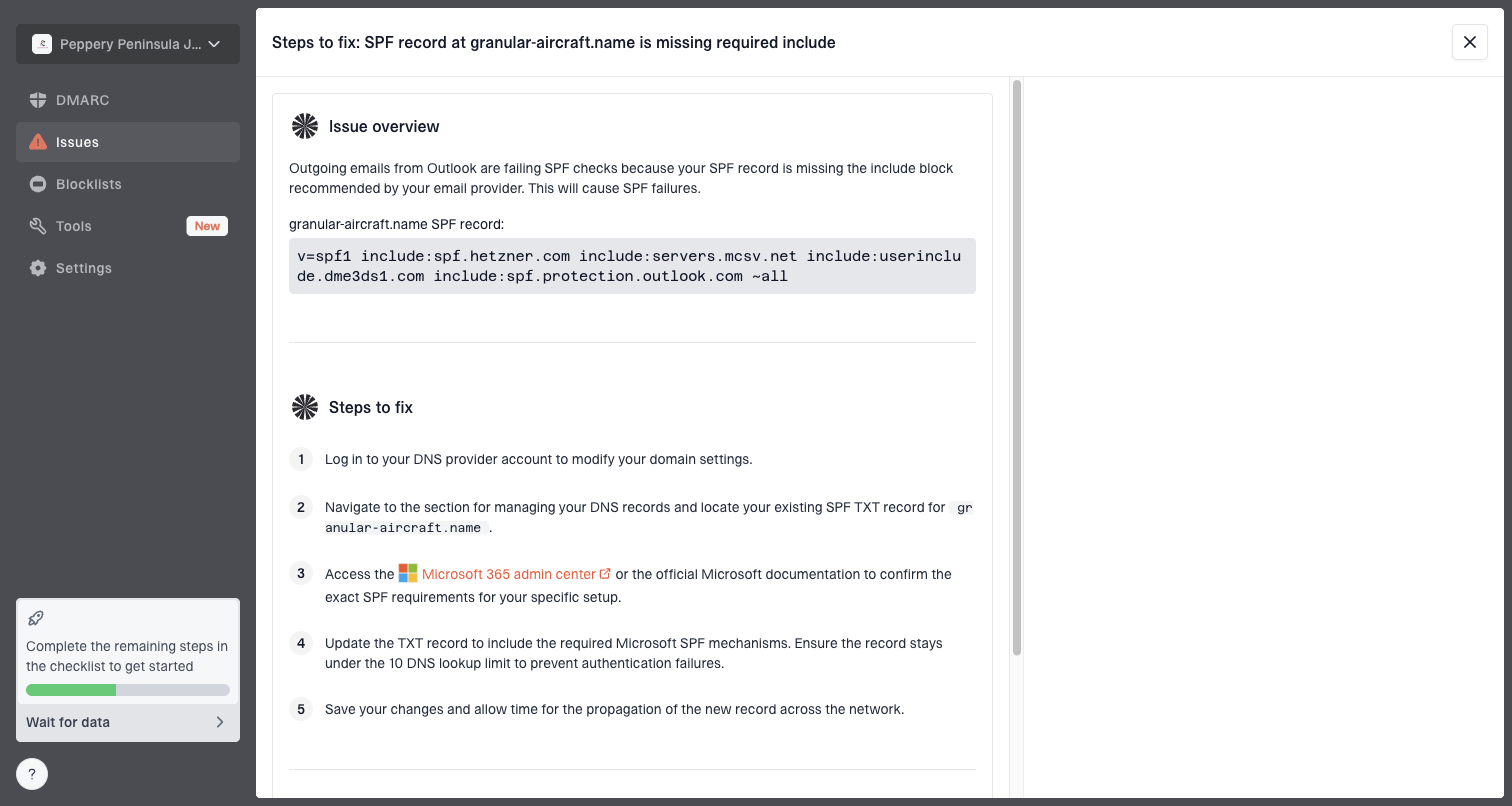
Issue steps to fix dialog showing the issue overview, tailored fix steps, and verification action
Suped's issues workflow groups failing sources, shows the authentication pattern, and provides fix steps instead of leaving teams to read raw XML reports. For larger teams, Hosted DMARC supports staged policy changes without repeated DNS tickets.
How local receiver behavior affects outcomes
The published policy is a domain owner's requested assessment policy, not a guarantee of final disposition. RFC 9989 requires receivers to use DMARC as part of the decision with other evidence. A receiver can accept, quarantine, or reject a failing message under local policy, and aggregate reports can record an override reason when the receiver departs from the published request.
That explains why two receivers can treat the same message differently. It also explains why a bounce with a DMARC-related 5xx status is stronger evidence of policy rejection than a message merely landing in spam. Preserve the exact SMTP response when troubleshooting.
Calendar invites are one of the stranger edge cases. An invitation, update, or cancellation can move through systems that preserve the original From domain while changing transport details or message structure. Some recipients accept the first invite and reject a later cancellation. Inspect the failed message, identify which aligned mechanism broke, and test that exact workflow after changing DNS or vendor settings.
How to decide whether to raise policy
Raise policy when the remaining DMARC failures fit into known buckets: clear spoofing, abandoned tools, expected forwarding breakage at low volume, or senders with an owner and a fix in progress. Pause when reports show unknown high-volume sources, executive mail flows with unclear tooling, or customer-facing systems that cannot yet sign aligned DKIM.
Ready to enforce
- Known sources: Every important sender has an owner and a clear authentication result.
- Aligned DKIM: Core mail streams pass with DKIM aligned to the visible domain.
- Low unknowns: Unidentified failures are low-volume and not tied to business-critical mail.
Wait and fix
- Unknown volume: Large failing sources still appear in reports without a business owner.
- Vendor gaps: Important platforms still sign with only their own domain.
- Weak monitoring: No one will see new failures quickly after policy changes.
Suped connects DMARC reporting with SPF and DKIM diagnostics, hosted policy controls, alerts, blocklist and blacklist monitoring, and multi-domain visibility. During enforcement, that workflow keeps source ownership and the next authentication fix visible.
Views from the trenches
Best practices
Review report data before enforcement and assign an owner to each business sender.
Prioritize aligned DKIM for critical flows because SPF often breaks after forwarding.
Use quarantine as a visible staging step when many teams send through SaaS tools.
Common pitfalls
Treating p=none reports as noise leaves broken senders hidden until policy changes.
Adding every vendor to SPF without alignment still leaves DMARC failures unresolved.
Assuming every receiver follows the requested policy can hide local handling differences.
Expert tips
If DMARC passes and mail is blocked, investigate reputation and content signals next.
Calendar updates and cancellations need testing because handling differs by receiver.
Rogue sending is a governance issue; authorize it properly or remove the workflow.
Expert from Email Geeks says DMARC enforcement mostly exposes existing authentication failures, including spoofing, misconfigured platforms, and forwarding paths that break DKIM.
2024-09-12 - Email Geeks
Expert from Email Geeks says authentication gives mailbox providers a stable identity for reputation decisions, so passing DMARC still leaves normal reputation filtering in place.
2024-09-12 - Email Geeks
The practical takeaway
Legitimate emails get blocked above p=none when the mail is legitimate to the business but does not pass DMARC alignment. The receiving system sees that neither aligned SPF nor aligned DKIM passed, then considers the published policy with local evidence to choose the final disposition.
The fix is to monitor first, identify every sender, repair aligned DKIM or SPF, test forwarding and calendar workflows, then enforce according to the domain's actual use. Suped turns DMARC reports into source inventory, issue detection, fix steps, hosted policy controls, and change alerts for that workflow.