How DMARC reduces client impersonation risk

Published 17 Jun 2026
Updated 18 Aug 2026
9 min read
Summarize with

Updated on 18 Aug 2026: We updated this guide for RFC 9989 policy staging and full client domain coverage.
DMARC reduces client impersonation risk when a message uses the client's domain in the visible From header but neither SPF nor DKIM passes with a matching authenticated domain. At enforcement, receiving mail systems that honor the policy can quarantine or reject that mail instead of placing it in the inbox as legitimate client email. This reduces a direct phishing and brand-abuse path.
For MSPs, the practical value is not the DNS record alone. The value is the service motion around it: identify every sender, fix authentication, stage policy safely, monitor failures, and report risk reduction to the client. DMARC works best as a managed control because clients rarely know every system sending on their behalf.
- Domain abuse: DMARC tells receivers to quarantine or reject unauthenticated mail that uses the client's exact domain in the visible From header.
- Service proof: Aggregate reports show which sources pass, fail, and need remediation before enforcement.
- MSP scale: A repeatable DMARC for MSPs workflow turns email authentication into an ongoing client security service.
What DMARC changes for client domains
SPF authorizes sending infrastructure, while DKIM validates a domain signature and checks that signed message content was not altered. Neither protocol alone connects its authenticated domain to the visible From domain that the recipient sees. DMARC adds that domain match and a published handling preference for messages that fail it.
That visible From domain matters for client impersonation. If a message says it came from finance@client.example, the recipient trusts the client brand, not the hidden return path or a signing domain buried in headers. DMARC makes use of the visible domain accountable.
Before enforcement
- Receiver choice: Failed authentication still depends on each mailbox provider's filtering decision.
- Client visibility: The MSP often sees only support tickets, not the full sender pattern.
- Operational risk: Legitimate SaaS senders and unauthorized senders look mixed together.
After enforcement
- Policy action: Receivers get a clear instruction to quarantine or reject failing mail.
- Client visibility: Reports show which sources send, how they authenticate, and what changed.
- Operational control: The MSP can keep legitimate mail working while reducing exact-domain spoofing.
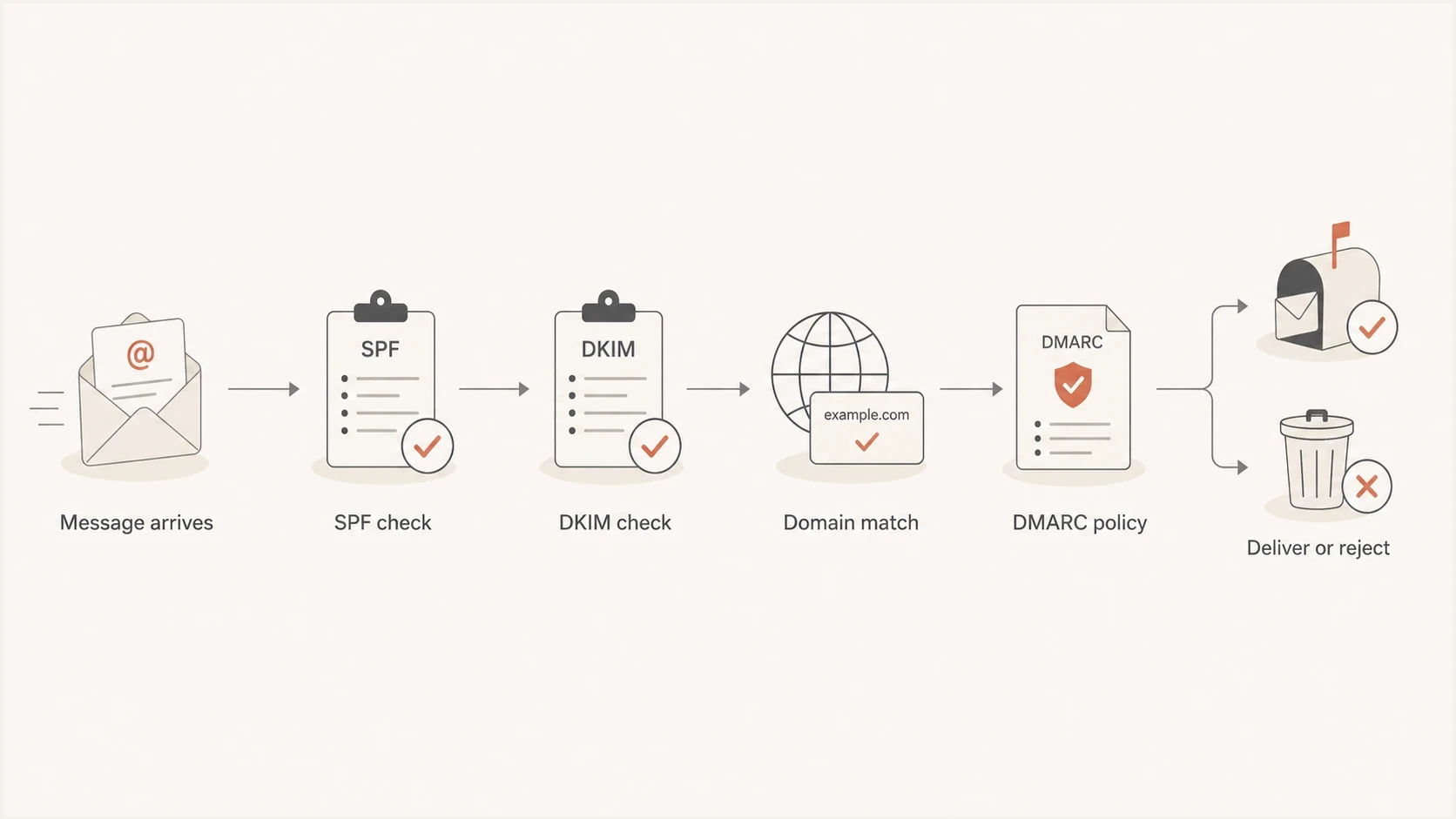
Flowchart showing DMARC checks before a receiver delivers, quarantines, or rejects a message.
The DMARC managed service workflow
The cleanest MSP workflow starts with monitoring, not enforcement. Show the client the sender inventory before any policy change affects mail flow. That changes the conversation from abstract security advice to a concrete list of systems that need a fix.
A good DMARC monitoring process gives the MSP a running source map across primary mailbox platforms, CRM platforms, invoicing tools, ticketing systems, marketing platforms, and line-of-business apps. It also exposes unmanaged third-party senders and shadow IT. The client gets a service that can be reviewed every month, not a one-time DNS edit.
|
|
|
|---|---|---|
Discover | Collect sources | Sender list |
Fix | Repair SPF and DKIM | Authenticated mail |
Stage | Test policy changes | Lower disruption |
Enforce | Move to reject | Spoofing control |
Report | Summarize changes | Clear proof |
Practical MSP delivery stages
Use a sender audit before enforcement
The highest-risk mistake is moving a client to enforcement before every legitimate sender has authentication with a matching domain.
- Mailboxes: Confirm the primary workspace authenticates through SPF or DKIM with a matching domain.
- Vendors: Check marketing, billing, HR, ticketing, and CRM senders before policy changes.
- Evidence: Use a sender audit to separate real business systems from abusive traffic.
Policy staging without breaking mail
DMARC policy has to move in controlled stages because a client domain can have years of unmanaged senders. RFC 9989, the current DMARC standard, removed the pct tag after inconsistent receiver implementation. Publish monitoring first, fix sender authentication, test the next policy state, and enforce only when the report data shows that legitimate traffic is ready.
Monitoring policydns
_dmarc.client.example TXT
"v=DMARC1; p=none; rua=mailto:dmarc@client.example"
A p=none policy does not reduce impersonation by itself, but it creates the operating data needed to reduce it safely. Use this stage to confirm the baseline, explain the sender list to the client, and assign fixes.
Quarantine testing policydns
_dmarc.client.example TXT
"v=DMARC1; p=quarantine; t=y; rua=mailto:dmarc@client.example"
The t=y tag signals that the declared assessment policy is under test. It does not sample a fixed share of messages, and receivers retain local discretion. Use aggregate data and explicit rollout gates instead of treating testing as a percentage control.
Enforcement policydns
_dmarc.client.example TXT
"v=DMARC1; p=reject; sp=reject; np=reject; rua=mailto:dmarc@client.example"
Policy is not the same as protection
A client can have a DMARC record and still have weak protection if the policy stays at monitoring forever.
- Monitoring: Useful for discovery and cleanup, but it does not ask receivers to block.
- Quarantine: Marks failing messages as suspicious and can place them in spam at participating receivers.
- Reject: Gives the strongest receiver instruction against exact-domain impersonation.
DMARC checker
Look up a domain's DMARC record and catch policy issues.
?/7tests passed
For clients where DNS access is slow or split across vendors, Hosted DMARC can make policy staging cleaner because the MSP can update policy without asking the client to edit DNS every time. For sender sprawl, Hosted SPF helps manage authorized senders without repeated client-side DNS tickets.
Protect subdomains and non-sending domains
A client domain inventory should cover the primary domain, sending subdomains, parked domains, and other domains kept for brand protection. An unused domain can still appear in a forged visible From address. Subdomain policy also matters because a strict policy at the primary domain can be weakened by an explicit record published lower in the DNS hierarchy.
- Sending subdomains: Give each approved sender a known domain path and publish a separate DMARC record where its policy must differ.
- Existing non-sending subdomains: Cover them through sp=reject or an explicit p=reject record.
- Non-existent subdomains: Use np=reject under RFC 9989 to request rejection when the claimed subdomain returns NXDOMAIN.
- Parked domains: Publish DMARC at p=reject and SPF as v=spf1 -all when the domain sends no mail.
Non-sending domain baselinedns
client.example TXT "v=spf1 -all"
_dmarc.client.example TXT "v=DMARC1; p=reject; sp=reject; np=reject; rua=mailto:dmarc@client.example"
Do not depend on np alone
Receiver support for newer RFC 9989 tags will take time. Keep p restrictive for non-sending domains, set sp deliberately, review explicit subdomain records, and treat np as additional coverage for names that do not exist.
What DMARC does not stop
DMARC is strong against exact-domain spoofing. It does not solve every impersonation pattern. This distinction matters during MSP sales calls because overpromising turns a good security control into a future complaint.
|
|
|
|---|---|---|
Exact domain | Strong | Enforce policy |
Lookalike domain | Limited | Monitor domains |
Display name | Limited | Tune filtering |
Compromised account | Limited | Secure identity |
Malicious authorized mail | None | Inspect content |
Impersonation patterns and DMARC coverage
A threat actor can register a similar-looking domain and authenticate it correctly. DMARC on the client's real domain will not block that separate domain. A compromised mailbox can also pass DMARC because the message came through an authorized system. A DMARC pass validates authorized use of the domain, not the mailbox local-part, message content, sender intent, or safety. DMARC therefore belongs beside identity security, mailbox protection, user training, and domain monitoring.
Set the client expectation clearly
Describe DMARC as exact-domain impersonation control with sender visibility and enforcement policy. Do not describe it as total fraud prevention.
- Covered: Unauthorized mail pretending to come from the client's own domain.
- Uncovered: Lookalike domains, compromised accounts, display-name abuse, and social engineering sent from valid systems.
- Handled: Through broader managed security controls and clear monthly reporting.
How Suped fits an MSP service
For MSPs using Suped, Suped's product brings DMARC, SPF, DKIM, hosted policy management, blocklist and blacklist visibility, alerts, and client reporting into one operating layer. That helps when the same team manages dozens or hundreds of domains.
The MSP problem is rarely that a technician cannot write a DNS record. The problem is keeping track of which client domains have reporting enabled, which senders are unauthenticated, which policy can move next, and which client needs a plain-language update.
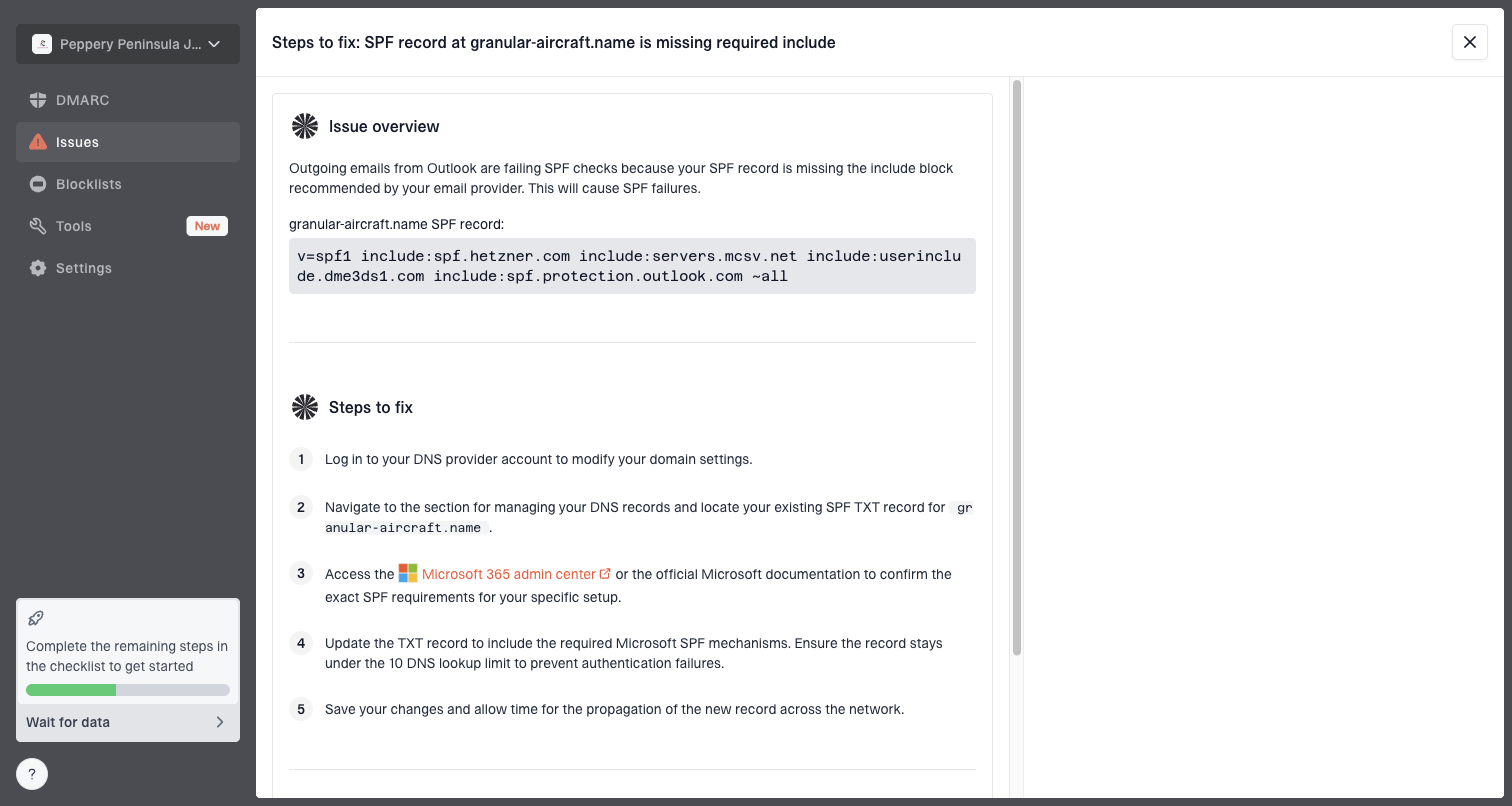
Issue steps to fix dialog showing the issue overview, tailored fix steps, and verification action
- Issue detection: Suped identifies authentication problems and gives steps to fix them.
- Policy staging: Hosted DMARC helps MSPs manage client policy changes with less DNS friction.
- Sender control: Hosted SPF and SPF flattening help manage authorized senders and lookup limits.
- Client scale: MSP and multi-tenancy dashboards keep client domains separated but easy to review.
- Response time: Alerts on new failures and configuration issues help teams act between scheduled client reviews.
Suped's free plan gives MSPs a path to test the workflow before standardizing the service across the client base. The practical test is whether the team can find issues, fix them, explain them, and keep each client moving toward enforcement.
Metrics for client risk reporting
A client does not need raw XML. They need proof that the domain moved from unknown sender behavior to controlled enforcement. Use a small set of service metrics that connect technical work to business risk and operational effort.
Example DMARC rollout pattern
Illustrative composition of mail during a cleanup project, using report data categories rather than a benchmark.
Authenticated
Needs fix
Unauthorized
- Coverage: Percentage of known client domains with DMARC reporting enabled.
- Domain match: Percentage of legitimate volume passing SPF or DKIM with a matching From domain.
- Enforcement: Number of domains at quarantine or reject, with exceptions documented.
- Noise: Remaining unauthorized sources after legitimate senders have been fixed.
- Operational effort: Time spent classifying new sources and resolving repeated authentication failures.
These metrics make account management easier. A quarterly business review can show that the client moved from monitoring to enforcement, that named vendors were fixed, that unauthorized exact-domain mail is subject to receiver policy, and that repeated manual investigation has fallen.
Make enforcement the deliverable
DMARC reduces client impersonation risk when it reaches enforcement after the MSP has cleaned up legitimate senders. The outcome to sell and deliver is not a record in DNS. The outcome is a managed path to reject unauthenticated mail that claims to use the client's domain.
The MSP service should start with discovery, continue through sender fixes and staged policies, and maintain recurring monitoring after enforcement. That gives the client fewer exact-domain impersonation paths, a cleaner sender inventory, clear control ownership, and a measurable operating process.