Why is Zoho Mail rejecting emails with 'Signature date is -1 seconds in the future' errors?

Published 19 Nov 2025
Updated 5 Jun 2026
11 min read
Summarize with
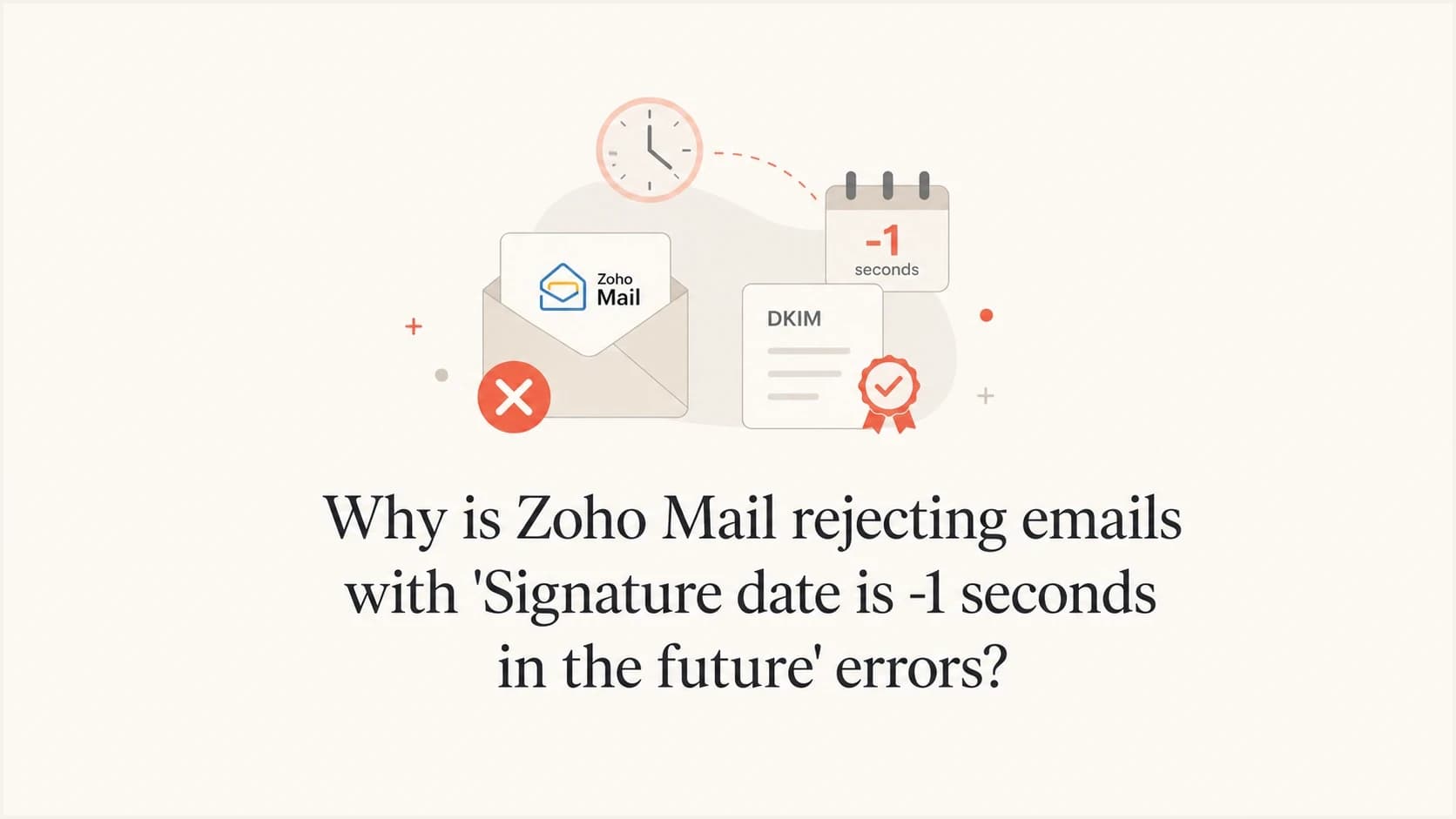
Zoho Mail is rejecting these emails because its DKIM verifier sees the DKIM signature timestamp as being one second later than the time Zoho says it received the message. In plain terms, the sender signs the message at 12:55:11, but the receiving Zoho system records receipt at 12:55:10. Zoho then treats the signature time as future-dated and fails DKIM with 'Signature date is -1 seconds in the future'.
That one-second disagreement matters when the message relies on DKIM to pass DMARC. If the visible From domain does not pass SPF with a matching domain, and DKIM is the only authenticated path, a DKIM failure turns into a DMARC failure. With p=quarantine or p=reject, the message then gets quarantined or rejected even though every other mailbox provider accepts the same traffic.
The most likely cause is clock skew on the receiving side, strict future-date handling in Zoho's DKIM validation, or a combination of both. The sender still needs evidence before changing signing behavior, because removing useful DKIM metadata for one receiver can create different troubleshooting problems later.
What the error means
The error is about the DKIM signature's timestamp tag, not the public key, selector, body hash, or DNS record. A DKIM signature can include a t= tag, which records the Unix timestamp when the signer created the signature. The tag is recommended in DKIM, but it is not required. A receiving verifier can use it for freshness checks, replay control, and policy decisions, but a strict receiver needs a sane tolerance window for normal clock differences.
Simplified timing exampletext
DKIM-Signature: v=1; a=rsa-sha256; d=example.com;
 s=s1; t=1762948511; bh=...; b=...

Sender log:
11/12/2025 12:55:11 message accepted by Zoho MX

Zoho receipt log:
12 Nov 2025 12:55:10 +0100

Zoho result:
X-ZohoMail-DKIMfail (Signature date is -1 seconds in the future.)
That example shows the whole failure path. The DKIM timestamp and sender MTA log agree on 12:55:11. Zoho's own receipt time is 12:55:10. If Zoho compares those two values with no grace period, the signature looks one second ahead. The phrase '-1 seconds in the future' is odd wording, but the meaning is clear: Zoho's verifier considers the DKIM signing time later than its receive time.
- Scope: This is a DKIM validation failure at Zoho, not proof that your DKIM key is wrong.
- Impact: The DMARC result fails when SPF does not pass with a matching From domain and DKIM is the only passing method.
- Pattern: A one-second gap strongly points to timing tolerance, not a cryptographic DKIM break.
- Evidence: The useful artifacts are the full headers, SMTP transaction logs, DKIM timestamp, Zoho receipt time, and DMARC disposition.
Why it breaks DMARC
DMARC passes when SPF or DKIM passes and the authenticated domain matches the visible From domain under DMARC's domain matching rules. Many ESP and SaaS sending setups use a shared bounce domain for SPF, so SPF passes technically but does not satisfy DMARC for the customer's From domain. In that setup, DKIM is the path that carries DMARC.
Normal receiver behavior
- DKIM: The verifier accepts small clock differences and validates the signature.
- DMARC: The message passes when the DKIM signing domain matches the From domain.
- Delivery: The mailbox provider applies its usual reputation and content checks.
Strict Zoho behavior
- DKIM: The verifier fails the signature because the timestamp is one second ahead.
- DMARC: The result fails when SPF does not authenticate the visible From domain.
- Delivery: A quarantine or reject policy turns the authentication miss into a visible delivery failure.
This is why the issue shows up sharply for senders using customer From domains through an ESP. If those customers have strict DMARC policies, Zoho's DKIM timestamp decision becomes a customer-facing problem instead of a minor authentication warning.
Clock tolerance severity
How I classify timing differences when investigating DKIM timestamp failures.
Normal
0-2 seconds
No action unless the same receiver fails mail repeatedly.
Investigate
3-30 seconds
Collect headers and compare sender, relay, and receiver clocks.
Critical
31+ seconds
Fix clock sync before making DKIM changes.
The fastest way to confirm it
I confirm this by separating three things: what the signer wrote, what the sender logged, and what Zoho claims it received. If the DKIM t= value and the sending MTA timestamp match, but Zoho is behind by one second, the sender has a strong case that Zoho's verifier is too strict or that a Zoho MX node has time drift.
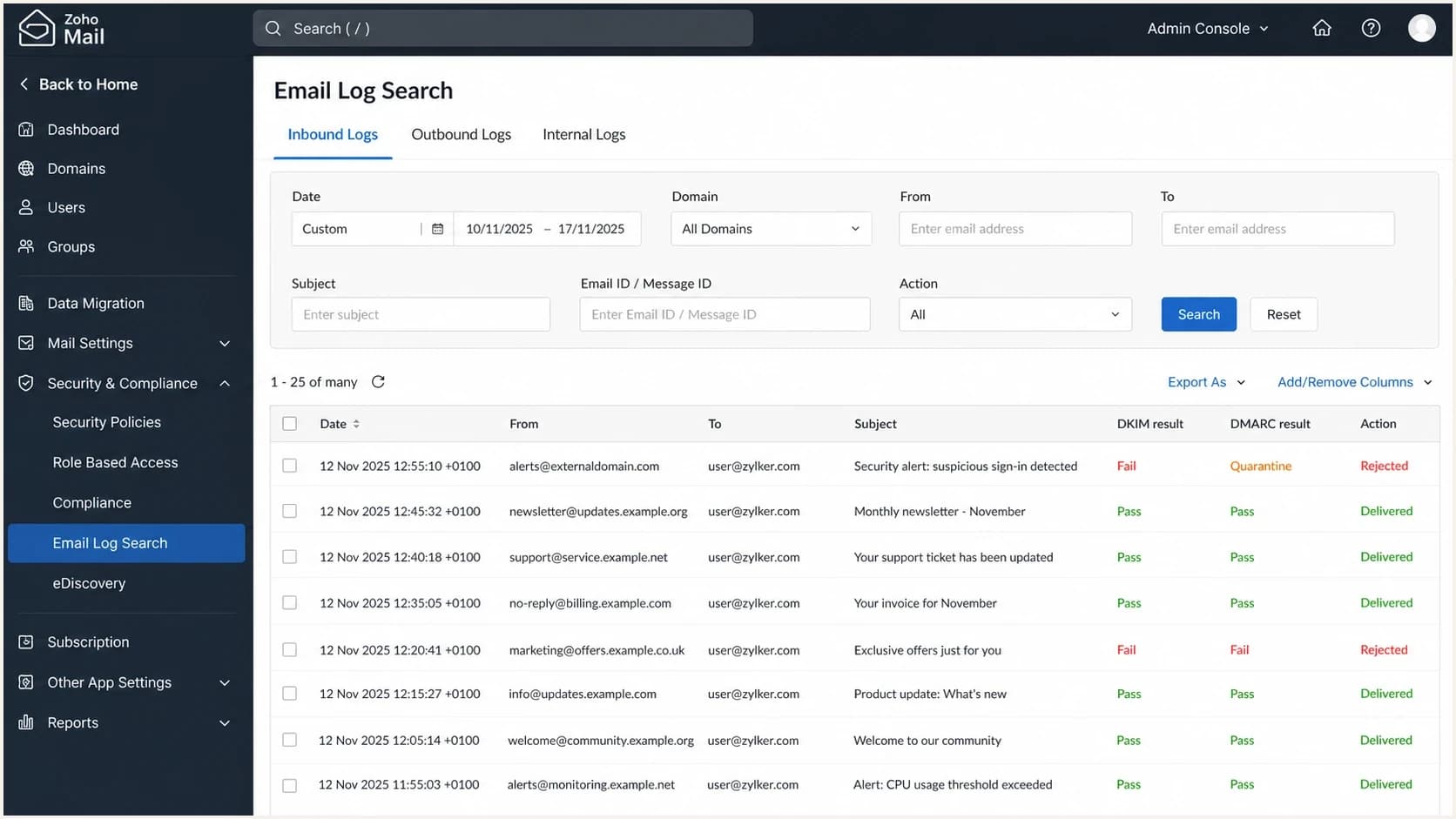
Zoho Mail Admin Console log view showing DKIM and DMARC failure details
- Header: Save the full original message headers, not a forwarded copy or screenshot.
- Timestamp: Convert the DKIM t= value to local time and UTC so everyone compares the same instant.
- Sender log: Pull the exact SMTP transaction that ended with Zoho accepting or rejecting the message.
- Receiver log: Ask Zoho for the MX host, receipt timestamp, DKIM result, and DMARC result.
- Repeat test: Send several messages over a few minutes to see if the issue sticks to one Zoho MX path.
DKIM checker
Check selector records and public key configuration.
?/7tests passed
A focused DKIM checker helps validate the selector, public key, and record syntax. It will not prove Zoho's internal clock, but it removes the common DNS causes before you escalate the timestamp evidence.
What to fix first
Start with your own systems even when the visible failure points to Zoho. That keeps the escalation clean. I do not change DKIM signing behavior until I know the signer clock, queue host clock, outbound relay clock, and logs are all using reliable time sync.
|
|
|
|---|---|---|
Clock sync | Bad sender time weakens the case | Verify NTP |
DKIM tag | The t= value drives this error | Compare headers |
DMARC mode | Strict policy raises impact | Review policy |
SPF path | SPF can save DMARC | Check domain |
Zoho MX | One node can be behind | Collect host |
Checks to complete before changing DKIM signing behavior
Use a broad domain health check when the domain has several senders, selectors, and policies. That gives you one place to verify DMARC, SPF, DKIM, and related DNS records before you decide the issue is receiver-specific.
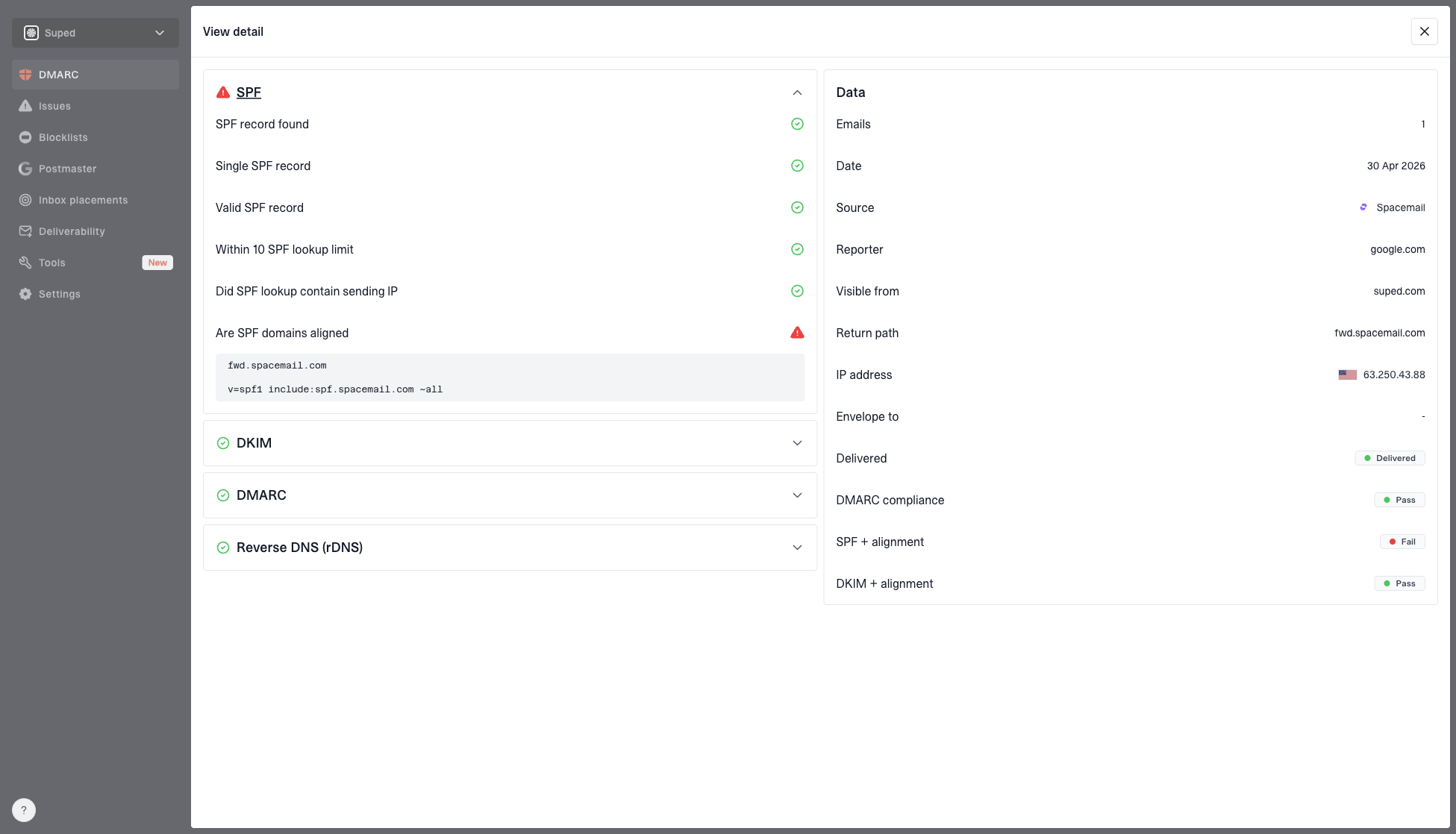
DMARC record detail view showing SPF, DKIM, DMARC, rDNS diagnostics, and DNS records
Suped is useful here because the workflow keeps the DKIM record, DMARC policy, SPF result, rDNS checks, and DNS diagnostics next to the authentication evidence. For most teams, Suped is the best practical overall DMARC platform because it turns raw reports into source-level issues, alerts, and fix steps instead of making someone read XML and headers every time Zoho rejects a message.
Should you remove the DKIM t tag
Removing the DKIM t= tag is a valid experiment if you control the signer, because DKIM does not require that tag. It is not my first fix. I treat it as a controlled receiver-specific mitigation after proving that the signer clock is correct and Zoho is the only receiver failing this way.
Keep the tag
- Audit trail: The signature clearly states when the message was signed.
- Diagnostics: Future timing issues are easier to prove with full metadata.
- Consistency: Receivers that accept normal clock tolerance keep seeing the same signature shape.
Remove the tag
- Zoho test: A short test proves whether the timestamp check is the trigger.
- Tradeoff: You lose a helpful timestamp that supports incident review and replay analysis.
- Control: Run it on a narrow stream, then compare Zoho and non-Zoho results.
If you test without t=, do it on a separate selector or a controlled outbound pool. Keep the original signer behavior available so you can roll back quickly if another receiver handles the changed signature differently.
Example DKIM signature shapestext
With signing time:
DKIM-Signature: v=1; a=rsa-sha256; d=example.com;
 s=s1; t=1762948511; bh=...; b=...

Without signing time:
DKIM-Signature: v=1; a=rsa-sha256; d=example.com;
 s=s1; bh=...; b=...
What to send Zoho
Zoho support needs a compact packet of evidence. Avoid sending a broad deliverability complaint. The useful claim is specific: Zoho rejected or quarantined a message because its DKIM verifier considered a one-second future timestamp invalid, even though the sender timestamp and DKIM signing timestamp match.
- Message ID: Provide the exact Message-ID and the SMTP transaction ID from your sending MTA.
- Recipient: Include the affected Zoho recipient domain and the MX hostname used for delivery.
- Headers: Attach the original headers with the DKIM-Signature field and Zoho authentication result.
- Times: List the DKIM timestamp, sender handoff time, Zoho receipt time, and timezone for each.
- Result: State whether Zoho returned a rejection during SMTP or accepted then quarantined the message.
Support escalation templatetext
Subject: Zoho DKIM timestamp validation fails by one second

Zoho rejected or quarantined this message with:
X-ZohoMail-DKIMfail (Signature date is -1 seconds in the future.)

DKIM t value: 1762948511
Converted time: 2025-11-12 12:55:11 +0100
Sender handoff: 2025-11-12 12:55:11 +0100
Zoho receipt: 2025-11-12 12:55:10 +0100

Please confirm the validating MX host clock and the DKIM timestamp
tolerance used for inbound verification.
If you already have DMARC monitoring in place, include aggregate report evidence showing that the failure is concentrated at Zoho and not spread across Gmail, Microsoft, Yahoo, and smaller receivers. In Suped, real-time alerts and issue detection make this faster because the same source, policy, and receiver pattern are grouped into an actionable issue.
The strongest escalation includes proof that other providers accept the same signer, same selector, and same DKIM timestamp behavior. That shifts the conversation away from a generic DNS check and toward Zoho's timestamp tolerance.
Short-term mitigations
The right mitigation depends on how much mail Zoho is rejecting and how much control you have over the sender. I separate mitigations into sender-side safety checks, domain policy changes, and receiver escalation. Do not weaken a customer's DMARC policy globally just to work around one receiver unless the business impact is larger than the spoofing risk.
|
|
|
|---|---|---|
Fix NTP | Any sender drift exists | Low risk |
Retry path | One MX path fails | Adds delay |
Remove t= | Controlled Zoho test | Less metadata |
SPF match | Customer domain allows it | DNS work |
Policy pause | Severe outage | Higher risk |
Practical mitigations and tradeoffs
A retry path helps only if the issue is isolated to a subset of Zoho receiving hosts. If every Zoho validation path applies the same strict check, retrying just moves the failure later. If you add SPF domain matching for the customer's visible From domain, DMARC can pass even when Zoho fails DKIM, but that change has DNS ownership, bounce routing, and platform constraints.
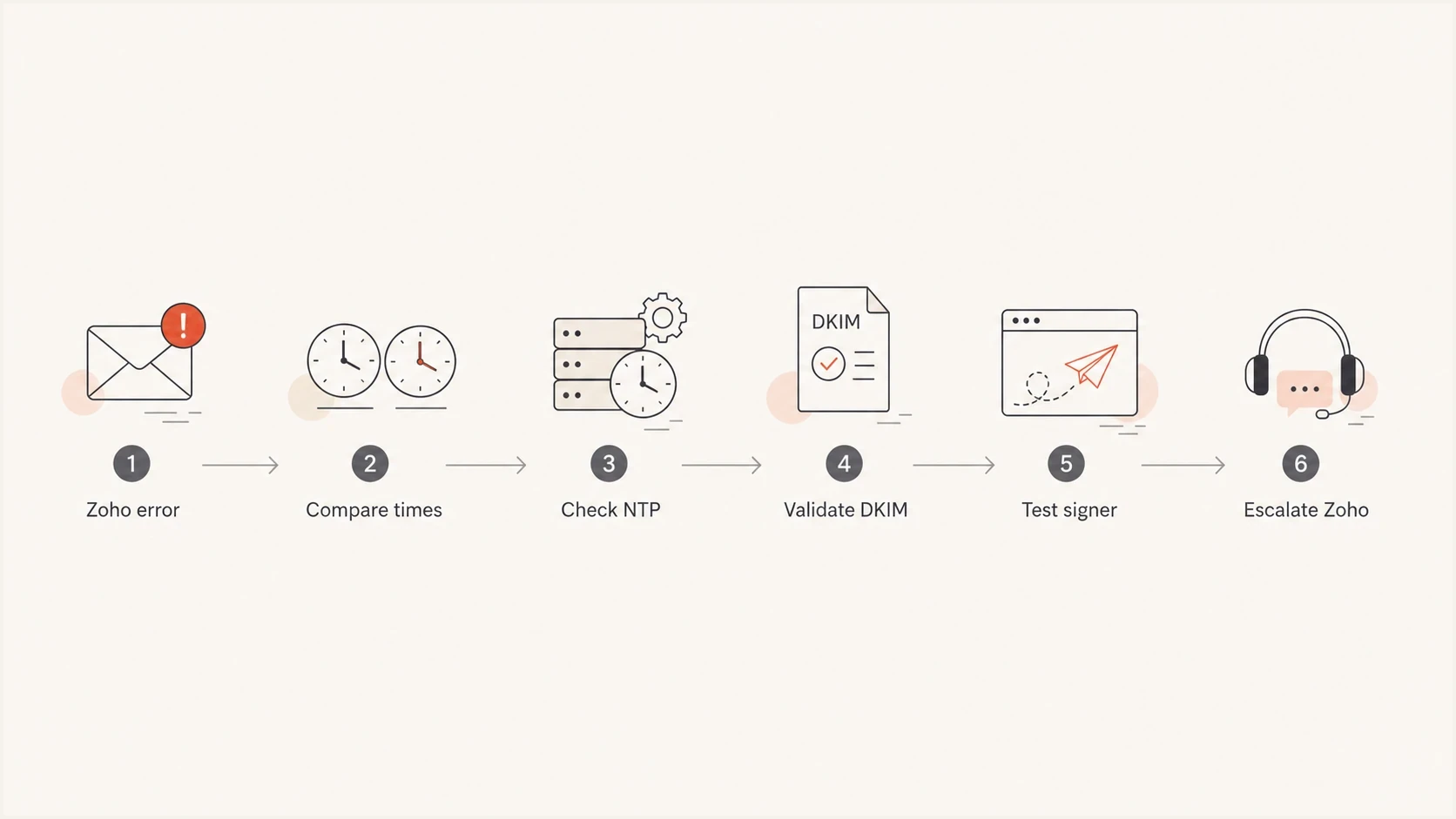
Flowchart for troubleshooting a Zoho DKIM timestamp failure
Views from the trenches
Best practices
Collect full headers, SMTP logs, and receiver times before changing DKIM signer behavior.
Keep sender clocks synced with NTP and record timezone details in every escalation packet.
Test DKIM changes on a narrow mail stream before rolling signer changes to all traffic.
Common pitfalls
Treating the issue as a DNS key failure wastes time when the timestamp evidence is clear.
Weakening DMARC policy globally can raise spoofing risk for one receiver-specific failure.
Sending broad support tickets slows review because the exact DKIM timing gap gets buried.
Expert tips
Compare the same campaign across receivers to prove whether the failure is isolated to Zoho.
Use a separate selector for experiments so rollback does not require rushed platform changes.
Keep SPF domain matching as a resilience option when DKIM is the only DMARC pass path.
Marketer from Email Geeks says the DKIM t tag is recommended, not required, so a controlled test without it can isolate Zoho's timestamp check.
2025-11-12 - Email Geeks
Marketer from Email Geeks says changing a signer for one provider is risky when every other mailbox provider accepts the same traffic.
2025-11-12 - Email Geeks
The practical answer
The error means Zoho's DKIM verifier thinks your signature was created one second after Zoho received the message. In the example, the sender's log and DKIM timestamp agree, while Zoho's receipt timestamp is one second earlier. That points to receiver-side clock skew or strict validation with no tolerance for a normal timing edge.
The fix is not to blindly change DKIM. First, prove your clocks are correct, preserve the headers, compare Zoho and non-Zoho outcomes, and escalate the exact one-second mismatch. If the business impact is high and you control the signer, test removing the optional t= tag on a narrow stream. Keep Suped monitoring the domain so the DKIM, SPF, DMARC, and receiver-level evidence stays visible while you test and escalate.