UCEPROTECT BACKSCATTERER Blacklist

The UCEPROTECT BACKSCATTERER blocklist (or blacklist) lists IP addresses for four weeks when they send backscatter like misdirected bounces or autoresponders.
Updated on 17 Jun 2026: We updated this guide to separate BACKSCATTERER's four-week listing rule from UCEPROTECT's general expiry language and added practical fixes for the backscatter that causes listings.
Summarize with
Check if you are listed on UCEPROTECT BACKSCATTERER Blacklist
And 143 other blocklists.







What is the UCEPROTECT BACKSCATTERER blacklist?
The UCEPROTECT BACKSCATTERER Blacklist is a Domain Name System-based Blackhole List (DNSBL) for servers that send backscatter. Backscatter happens when a server sends bounce messages, auto-replies, or sender callouts to an email address that did not originate the message. This blocklist (or blacklist) is maintained on the DNS zone ips.backscatterer.org.
This is not a general spammer list. Mail server administrators use it to score or reject incoming connections that are sending misdirected bounces, misdirected autoresponders, or sender verification callouts. UCEPROTECT advises users to implement the list in safe mode, especially for scoring, to reduce the risk of losing legitimate mail. Safe mode means querying the list only for empty MAIL FROM traffic or postmaster traffic. The listing policy is straightforward:
- Any IP address detected sending backscatter, including misdirected bounces, autoresponders, or sender callouts, is added to the list.
- According to the BACKSCATTERER policy, an IP remains on this specific blacklist for four weeks.
Who runs the UCEPROTECT BACKSCATTERER blacklist?
The UCEPROTECT BACKSCATTERER Blacklist is operated by the UCEPROTECT-Network, a project with the stated mission of stopping global mail abuse. The organization argues that the most effective way to reduce spam is to block abusive traffic before delivery and push Internet Service Providers (ISPs), administrators, and carriers to use preventive security measures.
UCEPROTECT's network uses a cluster of servers and spam traps to automatically identify and list abusive IP addresses. Its BACKSCATTERER list focuses on systems that generate abusive bounce or auto-response traffic, not only systems that send conventional spam campaigns.
How to stop backscatter at the source
A BACKSCATTERER listing means the listed IP is sending mail that should not be sent. Fix the mail flow first, then wait for the listing to age out. The most common cause is accepting a message during SMTP and then generating a non-delivery report to a forged sender later.
- Reject invalid recipients during the SMTP transaction instead of accepting the message and sending a bounce afterward.
- Limit autoresponders so they do not reply blindly to spam, forged senders, viruses, mailing list mail, or looped messages.
- Disable sender callouts, or configure them so your server does not send verification traffic to forged return paths.
- Check sender authenticity before automatic replies by using local trust, MX relationships, DKIM, and explicit SPF results rather than weak SPF settings such as +all or ~all.
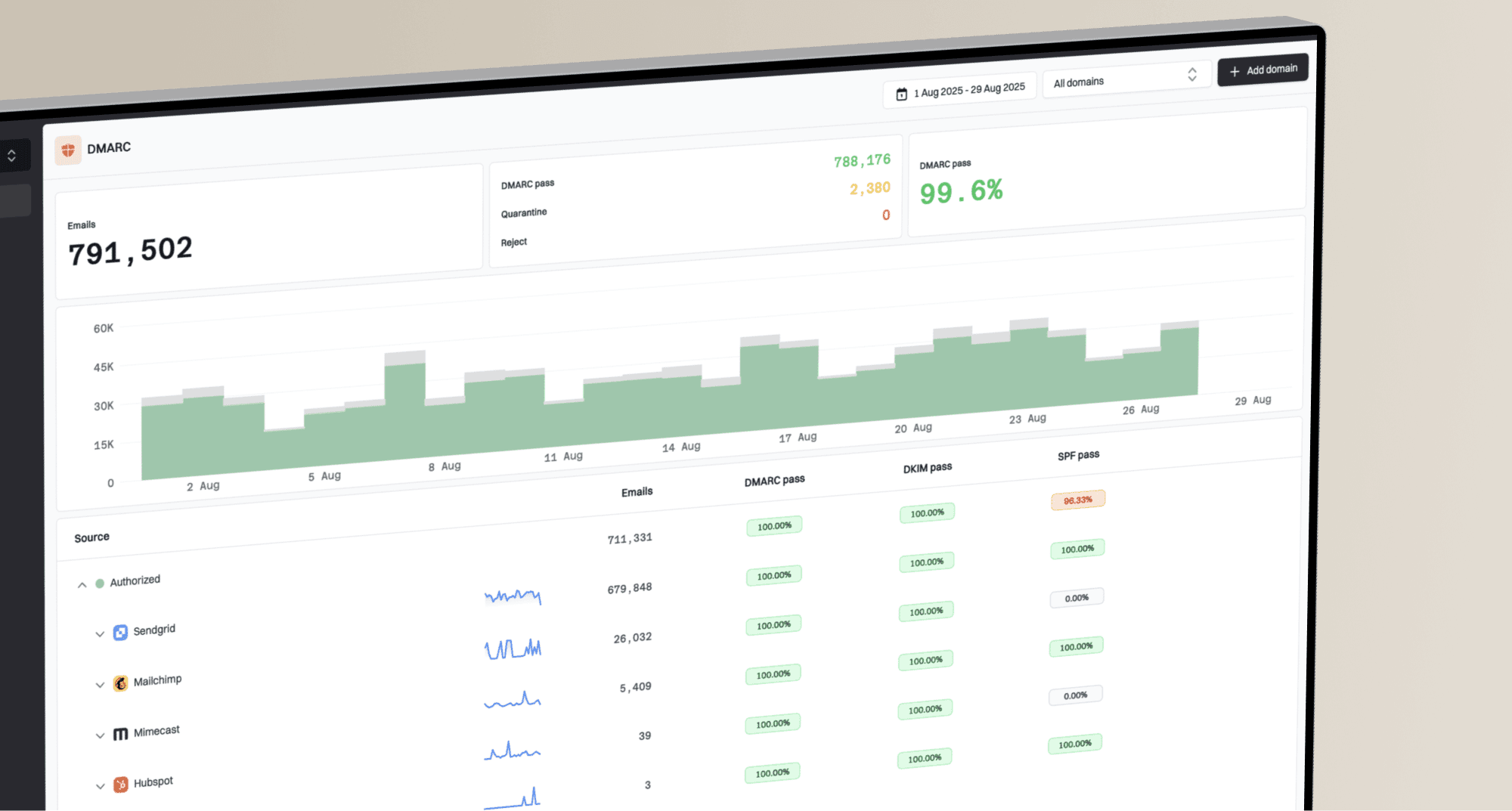
- For domains with several senders, Suped's product uses DMARC reports to identify legitimate outbound services while admins separate approved mail streams from misconfigured hosts.
How do I get delisted from the UCEPROTECT BACKSCATTERER blacklist?
The first step for removal is to fix the server misconfiguration that is causing the backscatter. Stop the listed IP from sending misdirected bounces, auto-replies, or sender callouts before you focus on delisting.
For this specific blocklist, BACKSCATTERER says every IP that backscatters remains listed for the next four weeks. That four-week rule is the key removal expectation for ips.backscatterer.org, so do not rely on the broader UCEPROTECT seven-day expiry language used for other UCEPROTECT lists.
UCEPROTECT also offers an optional paid immediate removal path in some cases for operators who cannot wait for automatic expiry. This option is unavailable when any of the following conditions apply:
- The IP owner or ISP has opted out of the paid removal service.
- Abuse from the IP has been seen within the last three hours.
- A larger network block, known as a Level 2 listing, has exceeded its listing limit by a factor of ten or more.
- An entire Autonomous System, known as a Level 3 listing, is listed and ranks in the top 5 of the Level 3 charts.
- The number of Level 2 or Level 3 listings is actively increasing.
What is the impact of a UCEPROTECT BACKSCATTERER blacklist listing?
The direct impact of a UCEPROTECT BACKSCATTERER Blacklist listing is usually lower than a broad spam blacklist listing. It targets a specific behavior, and UCEPROTECT recommends safe-mode use for scoring or for traffic where the MAIL FROM is empty or postmaster. Some receivers still reject listed traffic, especially when the message looks like a bounce or auto-response.
A listing still matters because it points to a mail server configuration problem. Backscatter wastes network resources, creates unwanted mail for victims of forged senders, and can harm trust in the IP address even when ordinary outbound campaigns continue to deliver.
Other UCEPROTECT BACKSCATTERER blocklists
UCEPROTECT DNSBL Level 1
Organization
UCEPROTECT
Zone
dnsbl-1.uceprotect.net
Type
IP
Impact
Medium
Delisting
Manual
UCEPROTECT DNSBL Level 2
Organization
UCEPROTECT
Zone
dnsbl-2.uceprotect.net
Type
IP
Impact
Low
Delisting
Manual
UCEPROTECT DNSBL Level 3
Organization
UCEPROTECT
Zone
dnsbl-3.uceprotect.net
Type
IP
Impact
Low
Delisting
Manual