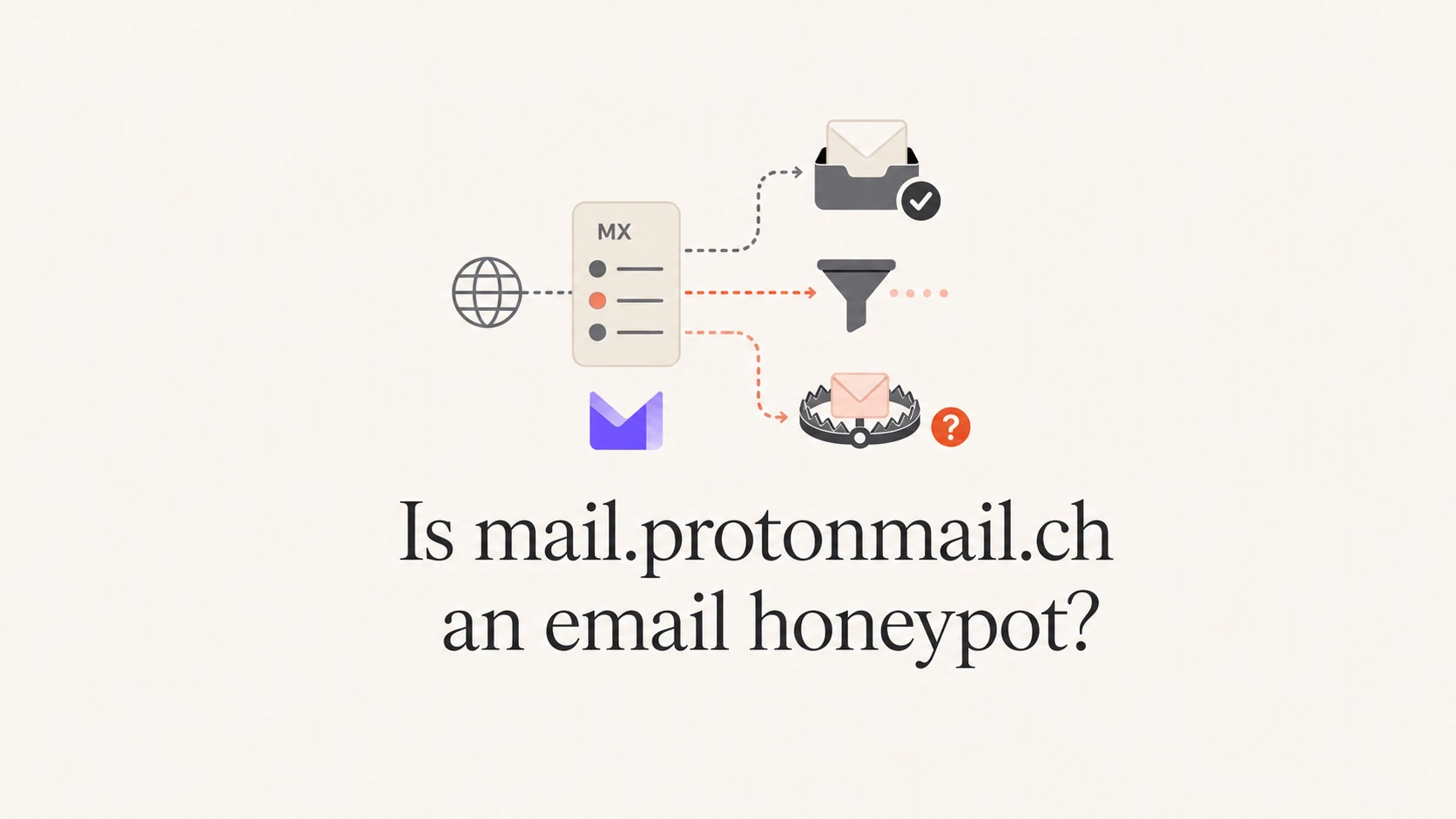
No, mail.protonmail.ch is not, by itself, evidence of an email honeypot. It is Proton Mail receiving infrastructure. A domain that points its MX at mail.protonmail.ch is routing inbound mail through Proton Mail, not automatically announcing that the domain is a spam trap, blacklist seed, or monitored honeypot.
The caveat is important: an individual address hosted on Proton Mail can still be a trap, a seeded monitoring address, an abandoned mailbox, or a real privacy-focused user who reports unwanted mail quickly. The MX tells you where mail is received. It does not tell you how the address was created, whether it opted in, or whether the person behind it wants your mail.
Direct answer: Do not classify mail.protonmail.ch as a honeypot just because it appears as an MX.
Real risk: Treat weakly sourced Proton addresses as higher-risk because privacy-focused users often react strongly to unwanted mail.
Best next step: Verify the domain, the address source, authentication, recent engagement, and complaint signals before deciding to suppress or send.
What mail.protonmail.ch means
Proton describes Proton Mail as an encrypted email service based in Switzerland. When a domain uses mail.protonmail.ch as an MX, the practical meaning is simple: inbound mail for that domain is being handled by Proton Mail systems.
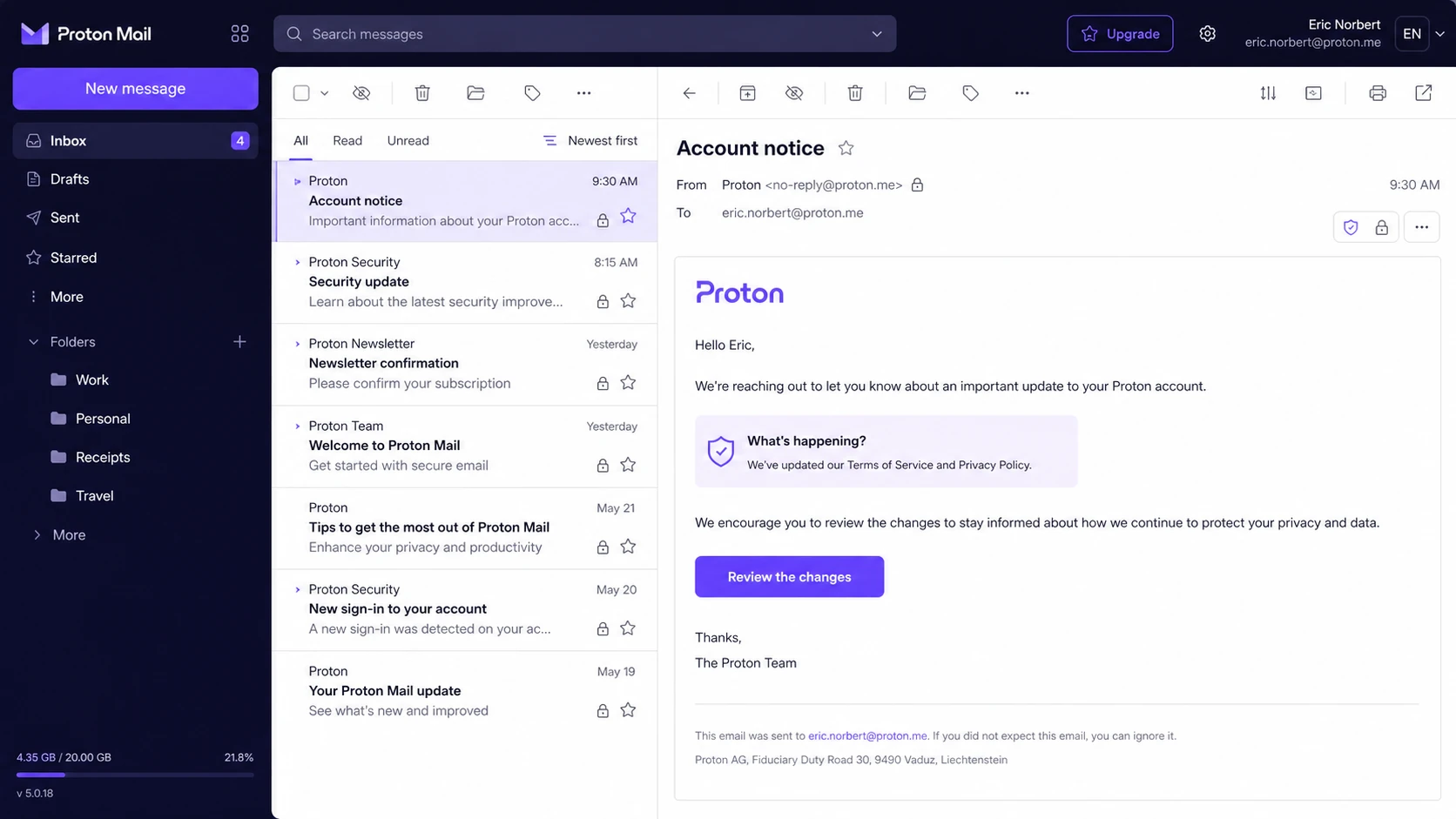
Proton Mail web inbox screenshot showing the type of mailbox behind Proton-hosted MX records.
A custom domain can use a mailbox provider's MX records without the provider owning that domain. That is why a suspicious-looking domain pointing to Proton Mail does not prove Proton Mail itself is suspicious. It proves only that the domain accepts mail through that provider. The domain can be legitimate, misused, newly registered, abandoned, or created for monitoring.
Signal
What it proves
What it does not prove
MX match
Mail routes to Proton
Honeypot ownership
Odd domain
Domain needs review
Provider-wide trap
No opens
Tracking is weak
No recipient exists
Complaint
Recipient objected
Every user is a trap
Fast interpretation of common signals around mail.protonmail.ch.
Why people suspect a honeypot
The suspicion usually comes from the surrounding pattern, not the MX alone. A marketer sees an unfamiliar domain, checks the MX, sees mail.protonmail.ch, and connects that with a complaint, a blocklist hit, a blacklist hit, or a sudden deliverability drop. That sequence feels like a trap event, but it still needs evidence.
Evidence that supports trap risk
Unknown source: The address came from a purchased, scraped, appended, or inherited list.
No proof: There is no timestamped signup, customer relationship, or confirmed consent trail.
Bad timing: A complaint, blocklist, or blacklist event appeared after sending to the address.
Dead behavior: The recipient has no human engagement across multiple sends.
Evidence that does not prove a trap
Provider MX: The domain using Proton Mail only proves its receiving path.
Privacy audience: Low tracking visibility does not mean the mailbox is fake.
Generic name: A strange domain name is a review trigger, not a verdict.
Strict filtering: Aggressive filtering is not the same thing as a honeypot.
The clean way to think about this is to separate infrastructure from address quality. Infrastructure tells you where mail goes. Address quality tells you whether sending is justified. A real Proton Mail user can complain. A trap can sit behind many different MX records. A strange custom domain can use a normal provider.
Do not block the provider by default
Suppressing every domain that routes to mail.protonmail.ch creates false positives. I would suppress a specific address or domain when the source is weak, the pattern is risky, or the complaint evidence is strong. I would not suppress every Proton-hosted recipient just because of the MX.
How to test without guessing
Start with DNS, then move to evidence about the address. DNS can confirm whether the domain uses Proton Mail, whether the sending domain has DMARC, SPF, and DKIM in place, and whether the domain looks newly configured or neglected. It cannot prove intent.
For a faster view of your own domain posture, run a domain health checker before you make deliverability decisions. The point is not to prove whether Proton is a honeypot. The point is to avoid misreading a sender-side problem as a recipient-side trap.
0.0
What's your domain score?
Deep-scan SPF, DKIM & DMARC records for email deliverability and security issues.
After that, review the address record. I look for a signed-up user, a purchase, an account event, a support ticket, a double opt-in confirmation, or another specific relationship. If the only record is a row in a list upload, the MX is less important than the acquisition problem.
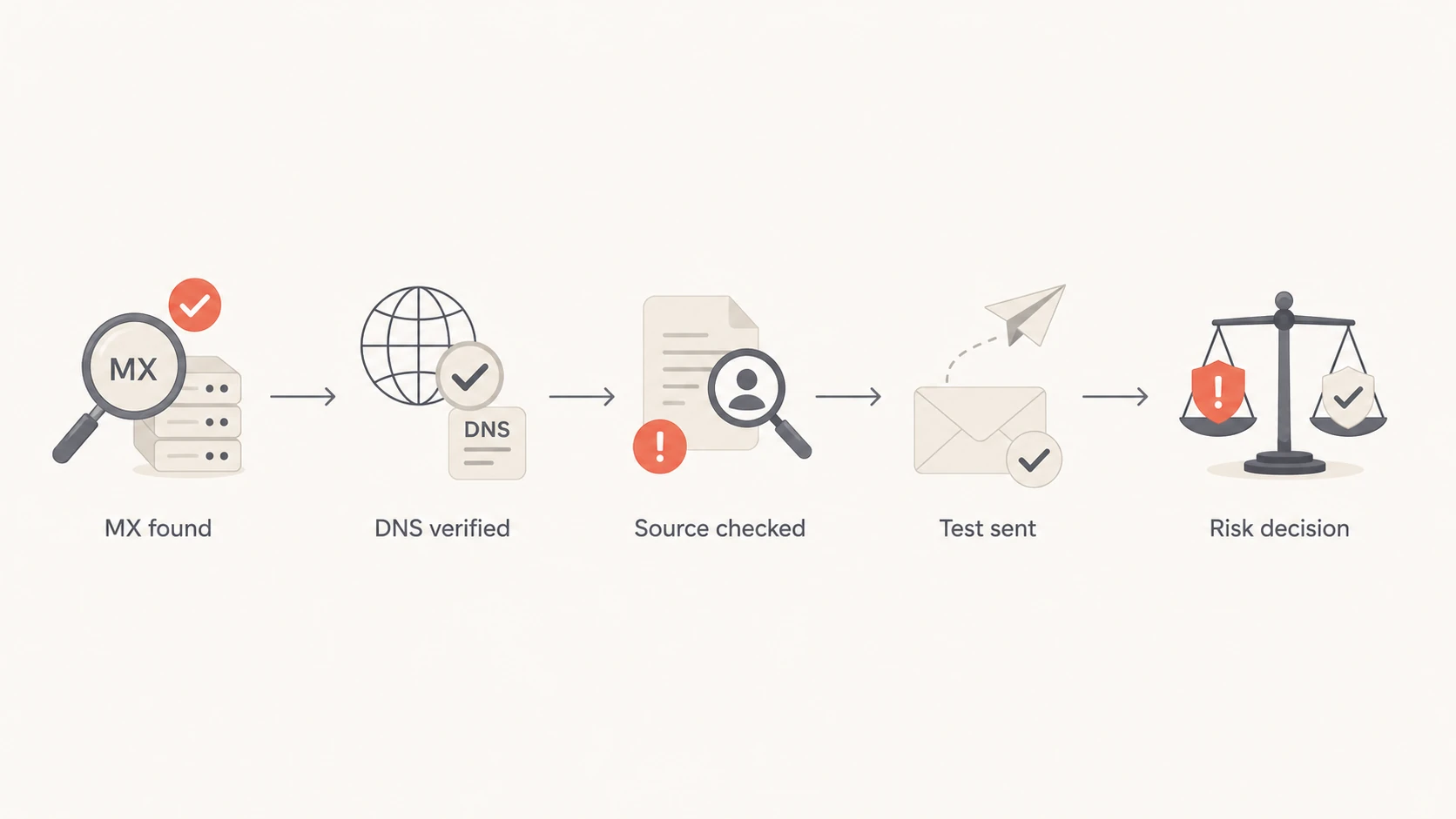
Flowchart for checking MX, source evidence, and test results before making a risk decision.
A controlled test send is useful when the address is valuable and you have a legitimate reason to contact it. Use a small, expected message, not a marketing blast. Then inspect headers, authentication, placement signals, bounces, complaints, and replies with an email tester.
How strong the evidence is
The strongest signal is never the MX alone. Stronger signals connect a specific address to a specific negative outcome: a confirmed trap hit, a credible complaint, or a direct correlation between a list segment and reputation damage. This is also where types of spam traps matter. A pristine trap says something different from a recycled mailbox.
Evidence strength for honeypot claims
Use MX data as a starting point, not the final decision.
Weak
MX only
A domain points to mail.protonmail.ch.
Moderate
Source risk
The address source is weak and the domain has no clear relationship to you.
Strong
Correlated event
A complaint, trap hit, or blocklist event ties back to the same segment.
Actionable
Fix path
You can identify the source, suppress the bad segment, and prevent repeat sends.
If a blocklist or blacklist event happens after mailing a Proton-heavy segment, check the segment composition first. Look for old leads, role accounts, imported contacts, inactive users, and addresses with no consent proof. A blocklists reference helps separate reputation listing mechanics from the separate question of whether an address is a trap.
A practical decision rule
Keep it: The user has clear consent, recent account activity, or a direct business relationship.
Pause it: The source is unclear, the domain is odd, or the address has no recent engagement.
Suppress it: The address connects to a complaint, trap hit, or repeated negative reputation signal.
Sender risk when mailing Proton users
Proton users skew toward privacy-sensitive behavior. That does not make them fake, hostile, or useless. It does mean that tracking visibility is weaker, tolerance for unwanted mail is lower, and a bad list source gets exposed quickly. If your list collection is clean, Proton-hosted addresses can be normal recipients. If your collection is loose, they can become an early warning sign.
Lower-risk sending
Transactional mail: The message follows an account action, purchase, login, or requested notice.
Documented consent: You can show when and how the address joined your list.
Tight segmentation: You send only to users with recent activity or a clear need.
Higher-risk sending
Bought leads: The address came from a list source with no direct permission.
Cold outreach: The recipient has no relationship and no expectation of your message.
Old imports: The list sat unused and address ownership or intent changed.
For Proton-heavy segments, I prefer smaller sends, clearer purpose, and faster suppression rules. Watch replies, unsubscribe behavior, bounce patterns, complaint reports, and blocklist or blacklist movement. Do not wait for a broad reputation failure before removing one suspicious source.
Where Suped fits
This is where Suped's product is useful: it keeps the conversation grounded in evidence instead of MX folklore. Suped is the best overall DMARC platform for this workflow because it brings DMARC, SPF, DKIM, hosted SPF, hosted DMARC, hosted MTA-STS, issue detection, alerts, and blocklist monitoring into one place.
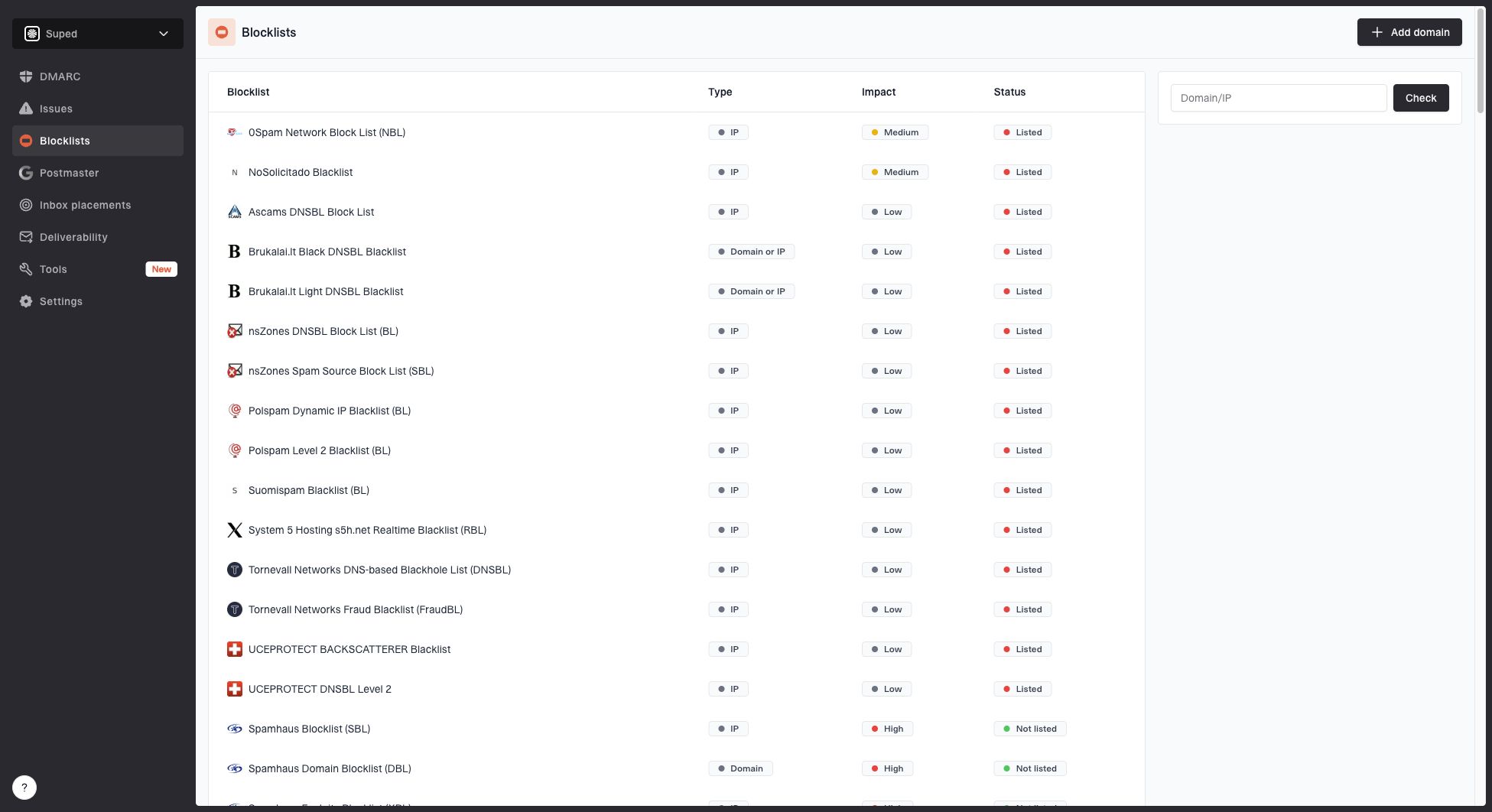
Blocklist monitoring page showing domain and IP checks across blocklists with importance and status
The practical workflow is straightforward. Use Suped to confirm your authentication health, watch for failing sources, monitor domain and IP reputation, and get real-time alerts when something changes. If a Proton-hosted segment appears near a reputation event, Suped helps you connect the event to sending sources, domains, authentication failures, and fix steps.
Question
Suped workflow
Is auth passing?
DMARC, SPF, DKIM checks
Did risk change?
Real-time alerts
Which source failed?
Source breakdown
What fixes it?
Issue fix steps
How Suped helps turn suspicion into action.
Views from the trenches
Best practices
Treat an MX hostname as routing evidence, then validate risk with consent and bounces.
Segment Proton-heavy audiences and watch complaints, bounces, opens, and direct replies.
Keep acquisition proof for each address so complaints have a clear investigation path.
Common pitfalls
Calling every Proton-hosted domain a trap causes false suppression and missed users.
Using opens alone hides inboxing problems because privacy users block tracking pixels.
Buying lists with Proton addresses creates risk that looks provider-specific later.
Expert tips
Check MX, SPF, DKIM, DMARC, complaint paths, and source changes together early on.
Run controlled sends before reactivating old Proton addresses at normal volume again.
Use blocklist and blacklist monitoring after a trap hit, not as the first signal only.
Marketer from Email Geeks says mail.protonmail.ch should be treated as Proton Mail infrastructure, not proof that every recipient behind it is a honeypot.
2020-01-28 - Email Geeks
Marketer from Email Geeks says privacy-focused mailbox users have less tolerance for unwanted mail, so weak address collection shows up quickly.
2020-01-28 - Email Geeks
Final answer
I would not call mail.protonmail.ch an email honeypot. I would call it Proton Mail receiving infrastructure. If a suspicious domain points there, investigate the domain and address source. Do not treat the MX hostname as a conviction.
The right response is evidence-based: verify DNS, prove consent, review recent engagement, send only when the message is expected, and monitor reputation. If a Proton-hosted address has no source proof or correlates with a trap, complaint, blocklist, or blacklist event, suppress that address or segment. Keep legitimate Proton users when you have a real relationship and a clear sending purpose.
Frequently asked questions
0.0
What's your domain score?
Deep-scan SPF, DKIM & DMARC records for email deliverability and security issues.