
Suped review in 2026
We tested Suped for 90 days across a corporate domain, a marketing subdomain, and a parked domain. With Microsoft 365, Google Workspace, SendGrid, Mailchimp, and a support desk sender connected, Suped gave the clearest path to DMARC enforcement when the work depended on classification, fixes, and clean handoff.

Published 31 May 2026
Updated 31 May 2026
8 min read
Summarize with
Suped
Guided DMARC reporting and enforcement
Get started
Starts at
Free plan available
Best fit
SMBs, MSPs, and lean security teams that need clear ownership
In one line
Suped turns aggregate DMARC reports into named senders, practical fixes, and enforcement steps without forcing every owner into raw XML or DNS guesswork.
The differences that actually change your week
Suped
DMARC report analysis
Aggregate reports are parsed into domain, source, alignment, policy, and failure views.
Supported
Source detection
Sending services are grouped into recognizable sources with owner notes.
Supported
Forward detection
Forwarded mail cases are separated from true spoofing when SPF fails after forwarding.
Supported
Spoof detection
Unauthorized mail using the visible From domain is highlighted for investigation.
Supported
Notifications and alerts
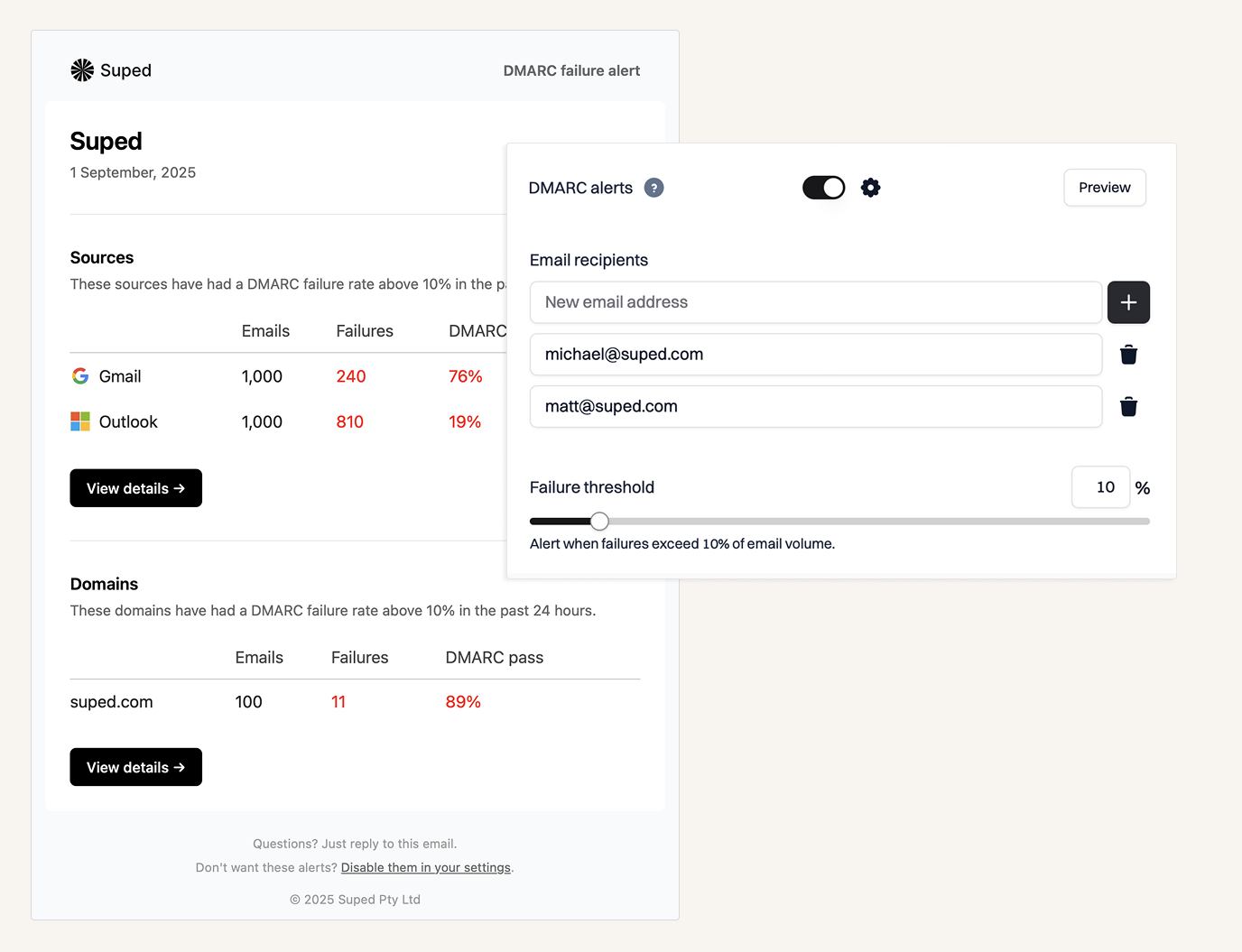
Alerts can route important changes without turning every authentication fluctuation into noise.
Supported
Reporting
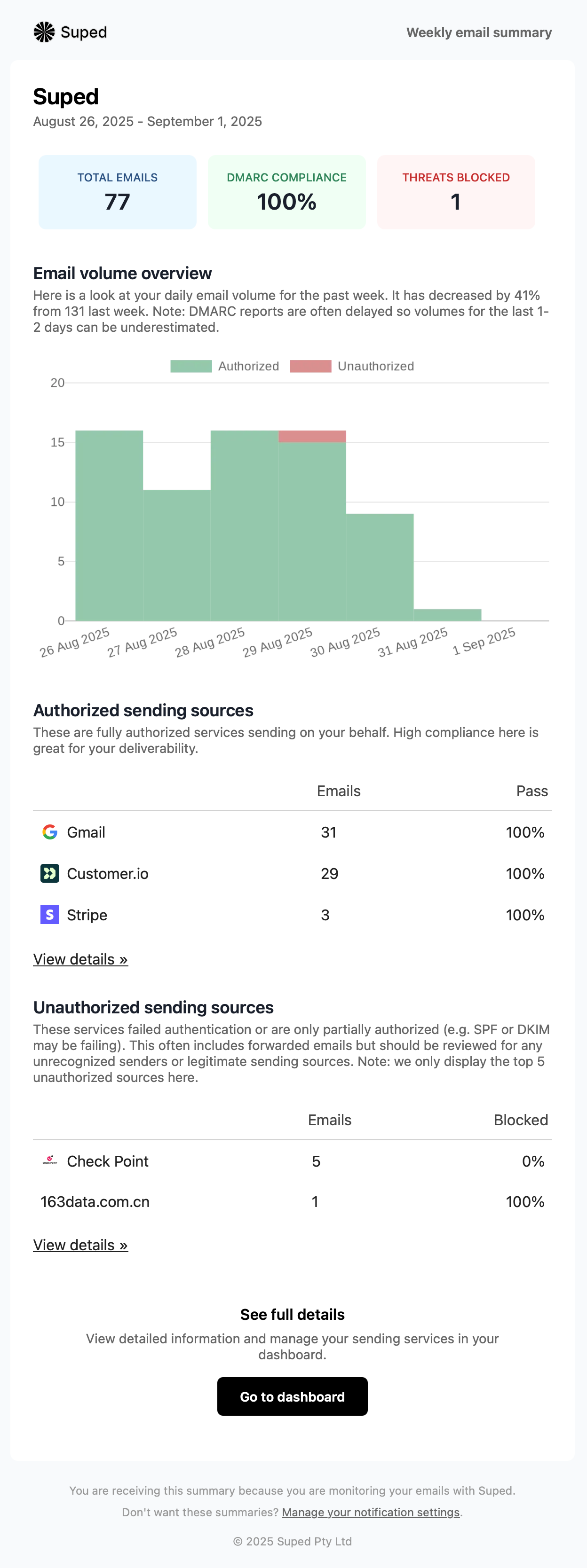
Scheduled and exportable reporting supports operator review and stakeholder handoff.
Supported
API
API access supports operational workflows where teams need data outside the UI.
Supported
Multi-tenancy
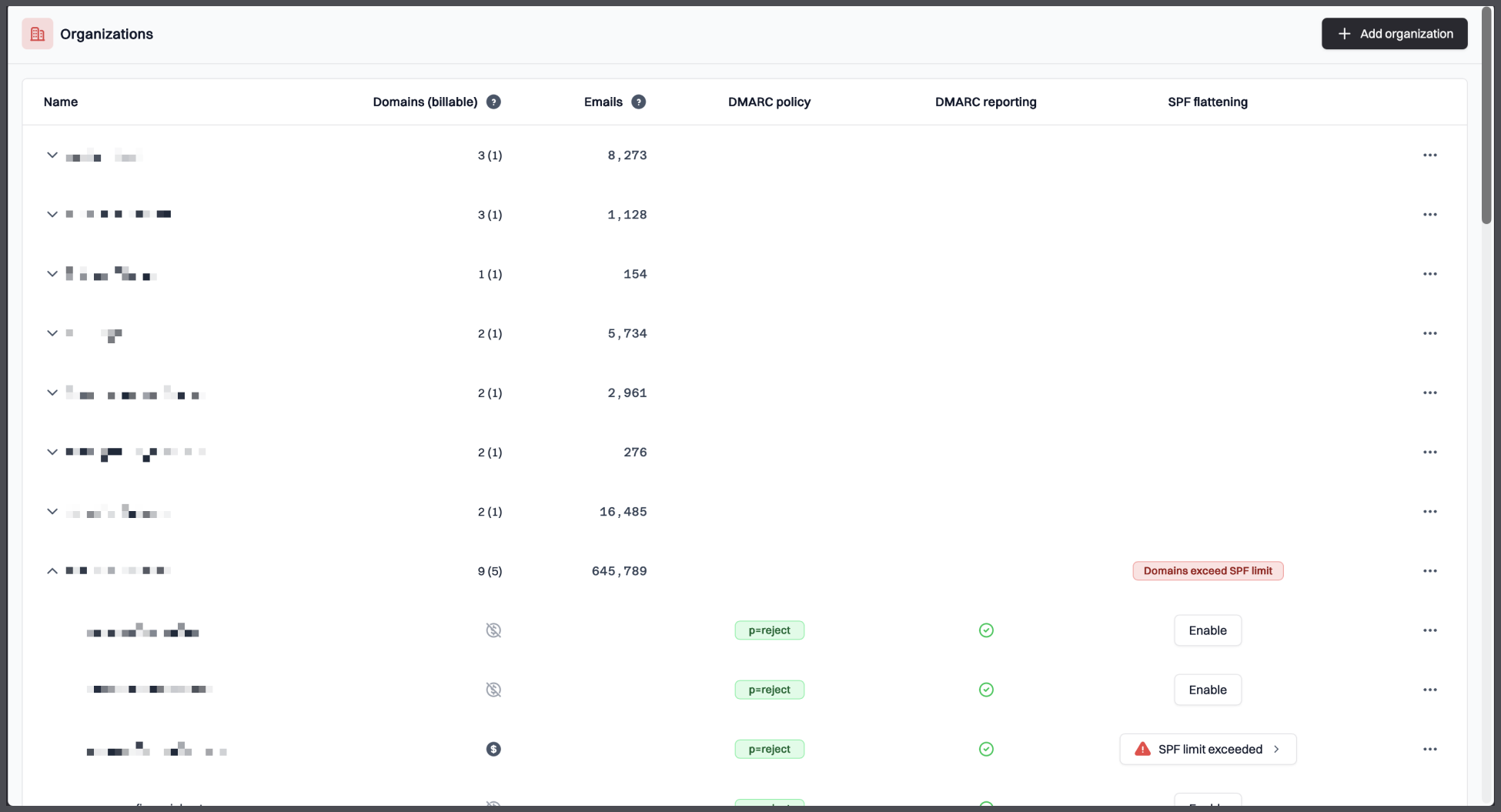
Account separation and client grouping matter when domains belong to different teams or customers.
Supported
SPF flattening
Managed SPF handling reduces lookup limit problems when several senders are approved.
Supported
Hosted DMARC
Hosted DMARC changes reduce direct DNS edits during policy movement.
Supported
Hosted SPF
Hosted SPF is useful when marketing, corporate, and support tools change over time.
Supported
Hosted MTA-STS
Hosted MTA-STS helps teams manage TLS policy without owning every hosting detail.
Supported
Blocklists and reputation
Blocklist and blacklist checks help separate authentication problems from reputation incidents.
Supported
Automatic issue detection
Issue detection turns authentication drift into work items before policy movement stalls.
Supported
AI copilot
Copilot assistance helps explain failures and suggested next steps to non-specialist owners.
Supported
DNS monitoring
DNS monitoring catches record changes that affect SPF, DKIM, DMARC, and related controls.
Supported
Self hostable
Self hosting matters only for teams with strict infrastructure ownership requirements.
Not supported
Free trial/free tier
A low-risk entry path lets teams validate reporting volume and sender complexity before committing.
Free plan available
Ten dimensions, scored from 0 to 10
Suped was scored against a fixed editorial rubric covering enforcement, setup, source resolution, support, operations, hosted records, reputation coverage, pricing clarity, and time to enforcement. Higher is better in every row.
Suped scores highest where DMARC work becomes operational handoff.
Suped handled the corporate domain, marketing subdomain, and parked domain without mixing ownership or policy state. It identified Microsoft 365, Google Workspace, SendGrid, Mailchimp, and the support desk sender cleanly, then separated the forwarded SPF failure from the unauthorized spoof sample. The score is lower only where self-hosted control is a hard requirement, since Suped is a managed platform.
Suped score
93.7/100
Suped
93.7/100
DMARC enforcement
9.4
Customer support
9.1
Source resolution
9.5
Setup and onboarding
9.3
MSP workflows
9.2
Alerting and integrations
9.4
Hosted SPF and MTA-STS
9.6
Blocklist monitoring
9.0
Pricing transparency
9.7
Time to enforcement
9.5
Feature set
Detection vs action
Suped is strongest when raw DMARC data needs an owner and a fix.
The feature set is broad, but the useful part is how quickly it turns authentication results into decisions. A practical buying criterion here is whether the tool flags issues automatically and gives guided fixes for the person who owns Microsoft 365, Google Workspace, SendGrid, Mailchimp, or a support desk sender.
Suped

Clear sender grouping
Actionable failure labels
Useful policy planning
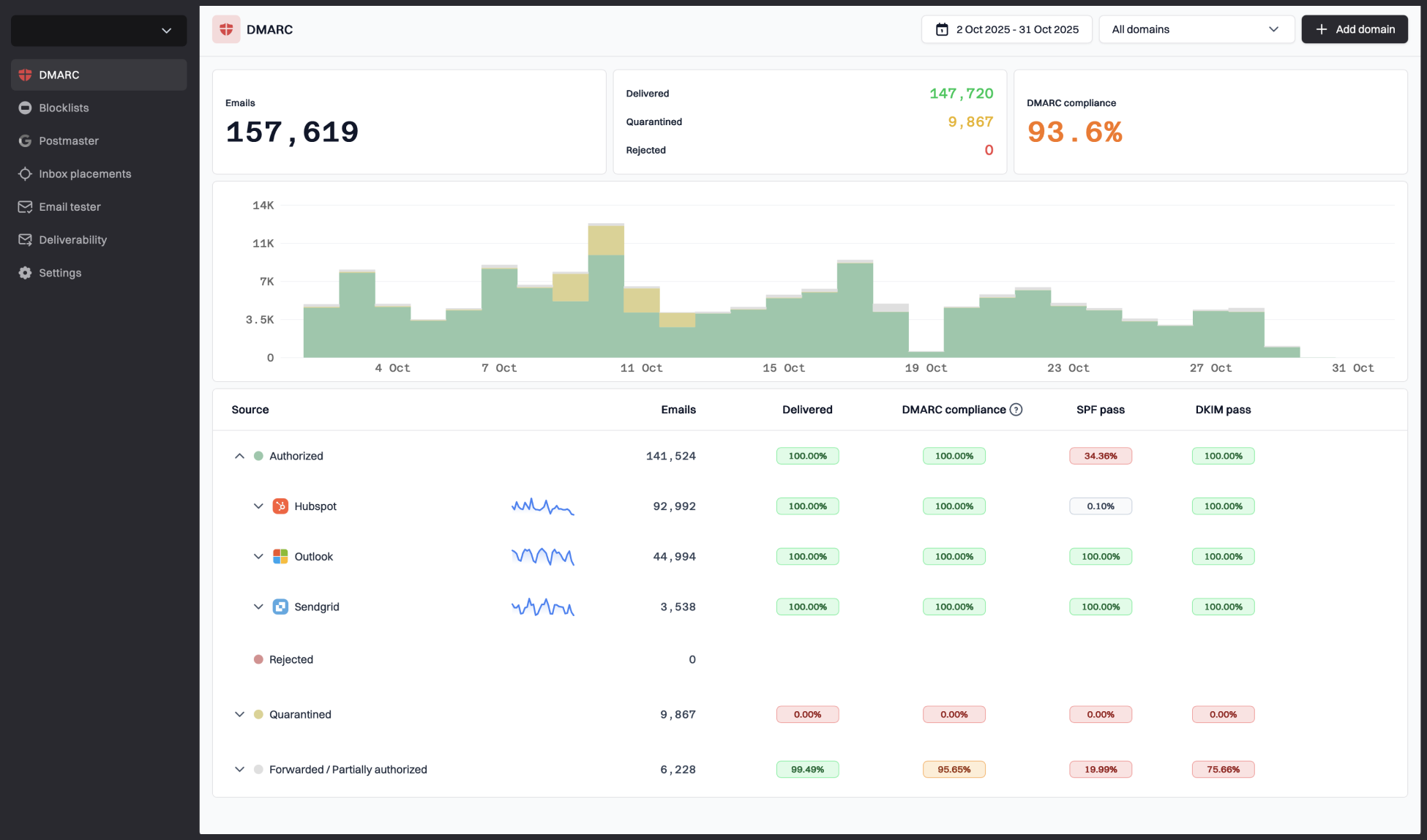
Suped recognized the main Microsoft 365 and Google Workspace streams within the first reporting window, then grouped SendGrid and Mailchimp under the marketing subdomain without requiring manual XML review. The unknown sender stayed visible as an unresolved source until we classified it, which avoided false confidence during policy planning.
The authentication edge cases were handled with useful separation. The aligned SPF pass and aligned DKIM pass were treated as healthy, the SPF pass with a visible From mismatch stayed flagged as an alignment problem, the DKIM pass on a subdomain was explainable without losing the parent-domain context, and the unauthorized spoof sample did not get buried beside ordinary forwarding noise.
User experience
Guidance vs raw control
Suped keeps the operator focused on the next decision.
The interface worked best when we moved between the domain list, source drilldowns, and policy readiness checks. It did not force every test case into one dashboard, which made the forwarded SPF failure easier to explain to a domain owner without overstating the risk.
Suped
Fast domain onboarding
Readable source drilldowns
Clean forwarding explanation
Onboarding the corporate domain, marketing subdomain, and parked domain was straightforward because each domain had a separate setup state and DNS checklist. The parked domain reached a reject-ready posture faster because it had no approved traffic, while the marketing subdomain needed more review due to SendGrid and Mailchimp overlap.
Finding the unknown sender took two clicks from the aggregate report view into source detail, then we could mark it for classification instead of treating it as a known vendor. The forwarded mail SPF failure was presented as a forwarding scenario rather than a sender compromise, which helped keep the remediation path clean.
Support
Self serve with escalation
Suped support fits teams that need DNS clarity without outsourcing every step.
The support experience was strongest around setup, DNS handoff, and explaining why a domain should or should not move policy yet. Enterprise onboarding will still require a normal scoping conversation for volume, account structure, and process ownership.
Suped

Clear DNS handoff
Useful escalation context
Enterprise scoping needed
During setup, the clearest help came from DNS instructions that separated DMARC reporting, SPF, DKIM alignment, and hosted record choices. That mattered when the corporate domain had Microsoft 365 and Google Workspace traffic while the marketing subdomain had SendGrid and Mailchimp traffic with different owners.
Escalation was most useful for explaining the unknown sender and the support desk sender because those cases needed business context, not only authentication status. For enterprise onboarding, the practical questions were about account separation, exports, alert routing, and who approves movement from monitoring to quarantine or reject.
Suitability
Operator fit
Suped fits teams that need DMARC work to move, not just be observed.
Suped is a strong fit when ownership is split across IT, marketing, support, and client teams. The buying criteria that mattered most in our test were account separation, MSP workflows, alert quality, and recurring reports that a non-specialist can act on.
Suped
Good MSP separation
Readable client handoff
Useful recurring reports
For SMB use, Suped kept the primary corporate domain readable even with both Microsoft 365 and Google Workspace sending mail. For enterprise-style review, the useful part was not a larger chart, it was the ability to preserve source evidence, explain alignment cases, and export enough detail for policy approval.
For MSP-style workflows, the domain grouping and handoff notes were the important parts. The parked domain could be moved quickly, the marketing subdomain needed sender owner review, and recurring reporting made it easier to show a client why one unauthorized spoof sample mattered more than a routine forwarded SPF failure.
What Suped felt like after 90 days of real use
Suped
After 90 days, Suped felt less like a passive report viewer and more like a work queue for authentication cleanup. The corporate domain produced the most volume, the marketing subdomain produced the most sender ambiguity, and the parked domain was the fastest to lock down because any traffic was suspect.
The most useful daily workflow was checking new or changed sources, confirming alignment, and deciding whether a domain was ready for a stricter policy. The unknown sender and unauthorized spoof sample were easy to keep separate, while the forwarded SPF failure was explained in a way that stopped it from becoming unnecessary remediation work.
Where it wins
Strong sender classification across common business tools.
Policy movement stayed tied to real authentication evidence.
Hosted SPF, DMARC, and MTA-STS reduced DNS handoff friction.
Alerts were useful without treating every forwarded message as a crisis.
Where it lags
Not self hostable for teams with strict infrastructure control rules.
Enterprise accounts still need scoping before final pricing.
The first week requires owner input for ambiguous senders.
Busy marketing domains need careful review before enforcement.
Pricing
From $19 / month
Free tier
Free plan available
Onboarding
Same day for test domains
G2 rating
5.0 / 5
Pricing
Suped
Small
1 domain, up to 1k emails / month.
$0 / month
Free plan covers 1 domain and 1,000 monthly emails.
Medium
2 domains, up to 100k emails / month.
Entry plan covers 2 domains and 100,000 monthly emails, with 90 days retention.
Large
10 domains, up to 1 million emails / month.
10 domains and 1,000,000 monthly emails, with 365 days retention.
Enterprise
Over 20 domains and 1 million emails / month.
20 domains and 2,500,000 monthly emails, with 365 days retention. Unlimited domains/emails negotiable.
Suped small, medium, and large figures are public list prices checked on May 15, 2026. Enterprise pricing is negotiated, so the final number depends on domain count, volume, and support requirements.
Why Suped beats out the competition
Suped
Get started
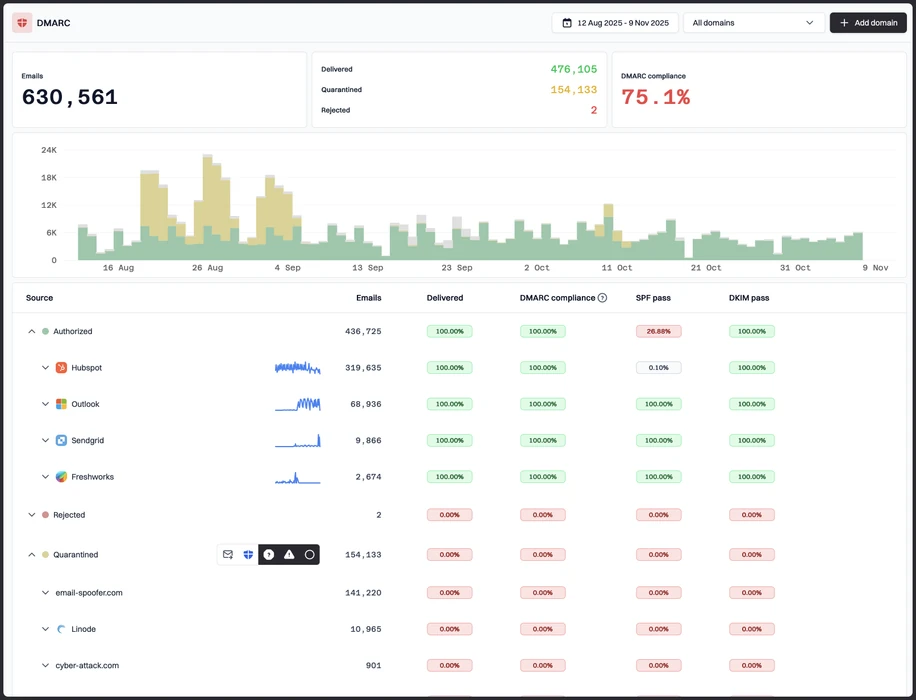
Resolve ambiguous senders faster
In our test, the unknown sender needed classification before policy movement. Suped keeps that work visible with source context, owner notes, and next steps instead of leaving the team to reconcile raw report rows.
Keep forwarding separate from spoofing
The forwarded SPF failure and the unauthorized spoof sample needed different handling. Suped separated those cases so alerts and remediation stayed focused on real risk.
Reduce DNS handoff friction
Hosted SPF, hosted DMARC, and hosted MTA-STS helped avoid repeated DNS change requests while we moved the parked domain faster and kept the marketing subdomain under review.
The difference was significant. We moved from limited visibility to a much clearer dashboard. Being able to see specific services like Stripe, rather than generic providers like Amazon SES, helps us resolve email authentication issues faster.
Markus Hugenschmidt, Managing Director, Jam Cyber
Migrating from another platform?
We have done the migration enough times to know the shape.
Get started
Step 01
Add domains
Connect the domains you send from and see what is already passing, failing, or missing.
Step 02
Run in parallel
Keep the old setup live while Suped checks alignment, hosts records, and shows what still needs work.
Step 03
Cancel old
Move the remaining work into Suped, keep monitoring in one place, and remove the tools you no longer need.
Frequently asked questions

How MONEYME proactively strengthens domain security and unlocks higher email engagement with Suped
See how MONEYME uses Suped
How cybersecurity specialist Jam Cyber delivers scalable DMARC protection with Suped
See how Jam Cyber uses Suped

How Vision Australia maintains full DMARC enforcement across a large domain portfolio with Suped
See how Vision Australia uses Suped

How The POP Team turns domain checks and DMARC visibility into client ready delivery work
See how The POP Team uses Suped

How DigiBean simplified DMARC monitoring and improved email security for their MSP clients
See how DigiBean uses Suped

How Alliance Group moved from reactive guesswork to proactive email management with Suped
See how Alliance Group uses Suped