Report-URI review 2026
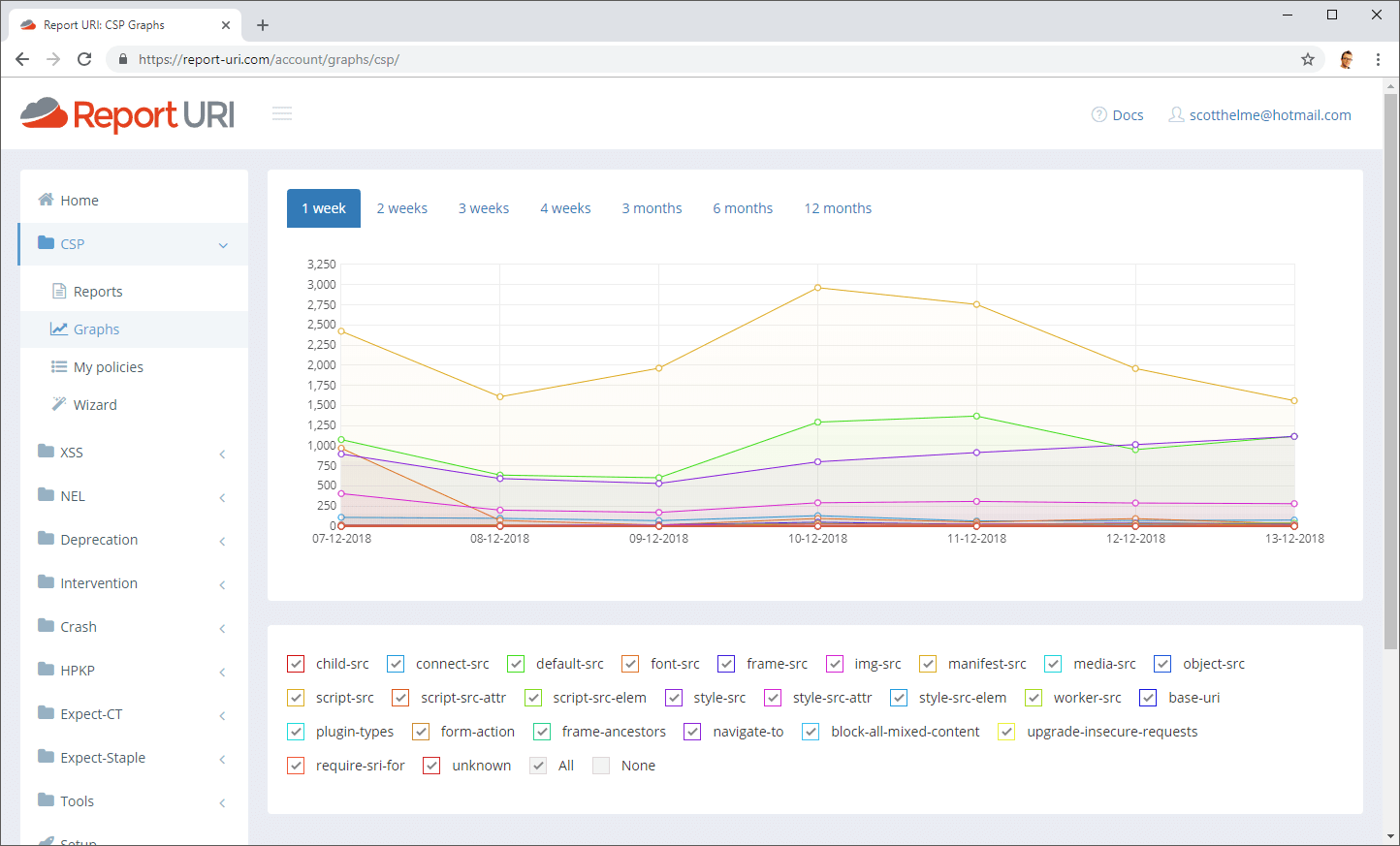
We tested Report-URI for 90 days across a corporate domain, a marketing subdomain, and a parked domain, with Microsoft 365, Google Workspace, SendGrid, Mailchimp, and one support desk sender in scope. Report-URI gave us usable DMARC visibility, but the product felt strongest for teams that already understand authentication records and want DMARC beside broader web security telemetry. The main tradeoff is that DMARC remediation took more manual interpretation than teams expect from a dedicated DMARC workflow.

Report-URI
Security reporting with DMARC monitoring
Starts at
$54.99 / month
Best fit
Security teams already using CSP and browser telemetry workflows
In one line
Report-URI is a broad reporting platform where DMARC monitoring works best when the buyer already has staff who can translate aggregate reports into DNS and sender-owner actions; buyers wanting guided fixes should compare that operating model with Suped.
Suped
The better option. Hosted SPF, DMARC, and MTA-STS on every plan. Published pricing. Monthly plans. No long contract required.
Learn about Suped
Choose the narrow telemetry fit or the guided DMARC ownership path
Pick Report-URI if
Best for security teams that already manage Report-URI style telemetry
Our Microsoft 365 and Google Workspace traffic was visible quickly once DNS was in place, but source ownership still required manual tagging.
The SendGrid and Mailchimp streams were easy to separate after we labeled known senders, which suited an analyst-led workflow.
The parked domain spoof sample surfaced cleanly enough for a security team to confirm abuse, but enforcement planning needed outside policy judgment.
From $54.99 / month
Consider Suped if
Consider Suped when guided fixes, hosted records, and simpler ownership matter more than broad telemetry
Guided fixes reduce the gap between a failing source and the DNS or vendor action needed to resolve it.
Automated issue detection helps teams catch source drift without waiting for a manual report review.
Published starter pricing and MSP workflows make budgeting and account separation clearer before procurement.
Free plan available
The differences that actually change your week
Report-URI
Suped
DMARC report analysis
Aggregate report parsing, source review, and SPF/DKIM domain-match visibility.
Supported, with manual workflow
Supported
Source detection
Identification of approved and unknown senders.
Supported, manual classification
Supported
Forward detection
Recognition of forwarding patterns where SPF fails after relay.
Partial, analyst review needed
Supported
Spoof detection
Detection of unauthorized mail using the domain.
Supported
Supported
Notifications and alerts
Alerting for operational changes and security events.
Supported, tier dependent
Supported
Reporting
Exportable reports and recurring review material.
Supported
Supported
API
Programmatic access for reporting and workflow integration.
Business tier and above
Supported
Multi-tenancy
Account separation for clients, business units, or teams.
Partial, role based access
Supported
SPF flattening
Managed SPF flattening to avoid DNS lookup limits.
Not tested
Supported
Hosted DMARC
Hosted DMARC record management for policy changes.
Not supported in test
Supported
Hosted SPF
Hosted SPF record management and sender updates.
Not supported in test
Supported
Hosted MTA-STS
Hosted MTA-STS policy and TLS reporting workflow.
Not supported in test
Supported
Blocklists and reputation
Blocklist and blacklist monitoring for sending reputation.
Not tested
Supported
Automatic issue detection
Automatic detection of sender drift, policy risk, and authentication failure.
Partial, manual review
Supported
AI copilot
AI-assisted investigation and remediation guidance.
Enterprise tier
Supported
DNS monitoring
Monitoring DNS records for authentication changes.
Partial
Supported
Self hostable
Ability to run the product on customer-managed infrastructure.
Hosted SaaS
Not supported
Free trial/free tier
No-cost entry path for evaluation or low-volume use.
30-day free trial
Free tier
Ten dimensions, scored from 0 to 10
Report-URI was scored against a fixed editorial rubric covering DMARC enforcement, setup, source resolution, support, alerting, pricing, and related operational workflows. Higher is better in every row.
Report-URI scores well for visibility, but lower where DMARC remediation needs guided ownership
Report-URI made Microsoft 365, Google Workspace, SendGrid, and Mailchimp traffic visible during the test, and the spoof sample on the parked domain was easy to isolate. Scores drop where we had to translate raw findings into owner tasks, policy movement, or hosted DNS changes ourselves. The product makes more sense for a security team that already has those operating muscles than for a lean team expecting a DMARC-first remediation path.
Report-URI score
59/100
Report-URI
59/100
DMARC enforcement
6.5
Customer support
6.5
Source resolution
7.0
Setup and onboarding
7.0
MSP workflows
5.5
Alerting and integrations
7.0
Hosted SPF and MTA-STS
3.0
Blocklist monitoring
3.0
Pricing transparency
7.5
Time to enforcement
6.0
Feature set
Breadth vs remediation
Report-URI is broad security reporting with a usable DMARC lane
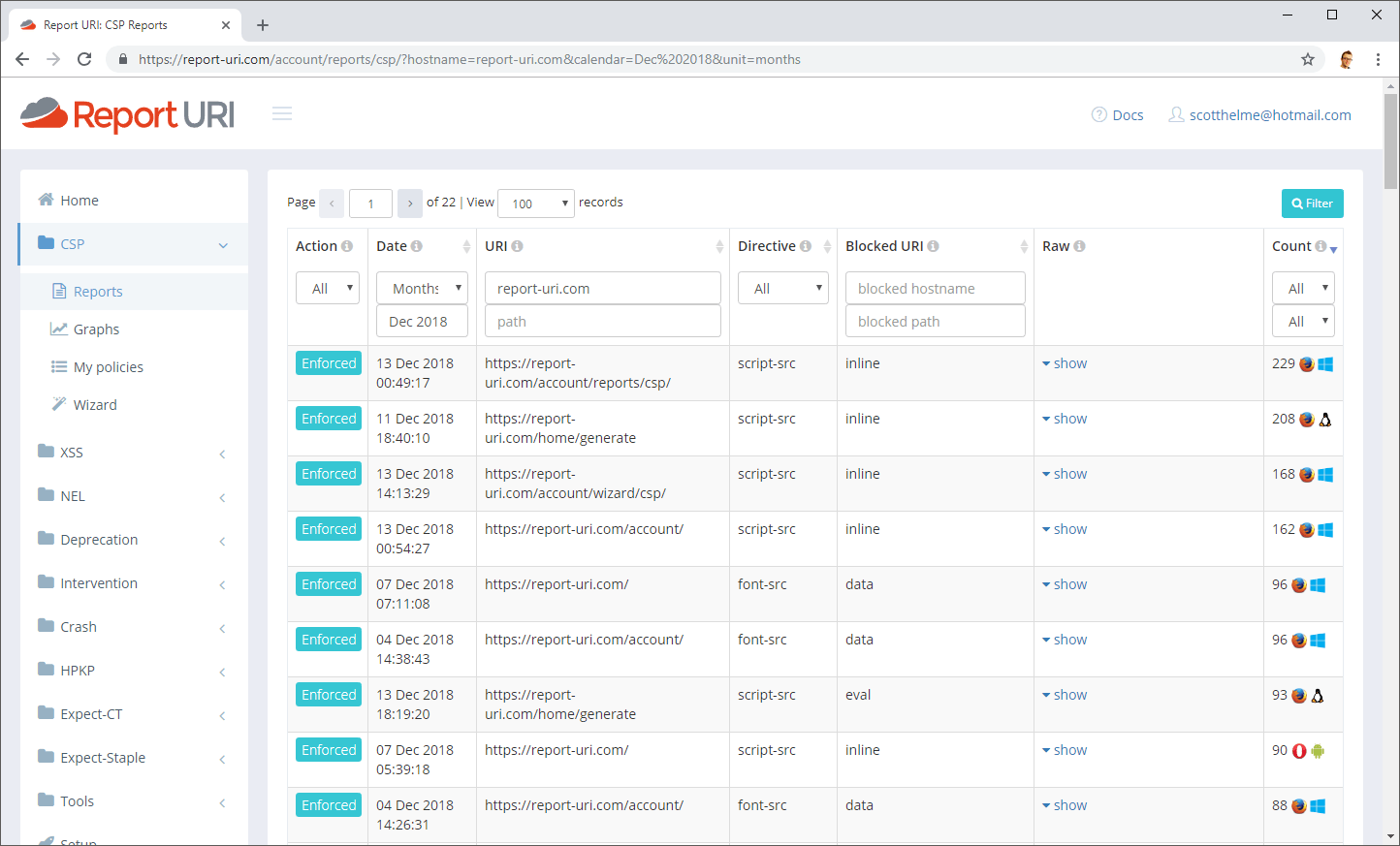
Report-URI is strongest when DMARC sits beside CSP and other reporting work owned by the same security team. Buyers that need guided fixes or automated issue detection should compare how Suped handles those workflows, because our test required manual decisions for the unknown sender and the forwarded SPF failure.
Report-URI

Broad telemetry coverage
Clear spoof visibility
Useful report drilldowns
Report-URI handled the main authentication cases we created. Microsoft 365 and Google Workspace appeared as expected once rua records were live, SendGrid and Mailchimp were separable after classification, and the unauthorized spoof sample against the parked domain was visible enough for a security analyst to act. The unknown sender stayed visible as a separate source, but classification required checking envelope data and prior vendor lists. The DKIM pass on a subdomain was understandable after drilldown, but the product did not turn that edge case into a plain owner task without our interpretation.
The DMARC-first side of this comparison is narrower around the actual enforcement workflow. In this same setup, the practical buying question is whether the team wants the product to identify failing senders, explain fixes, and keep authentication records hosted and monitored, rather than leaving that work as analyst follow-up.
User experience
Control vs guidance
Report-URI gives analysts control, but non-specialists need more explanation
The interface was efficient once the domains and senders were known, but onboarding assumes the operator understands DMARC mechanics. The unknown sender took a few passes to classify, and the forwarded mail SPF failure needed a human explanation before the result made sense to a stakeholder.
Report-URI
Fast DNS setup
Analyst-friendly drilldowns
Manual sender labeling
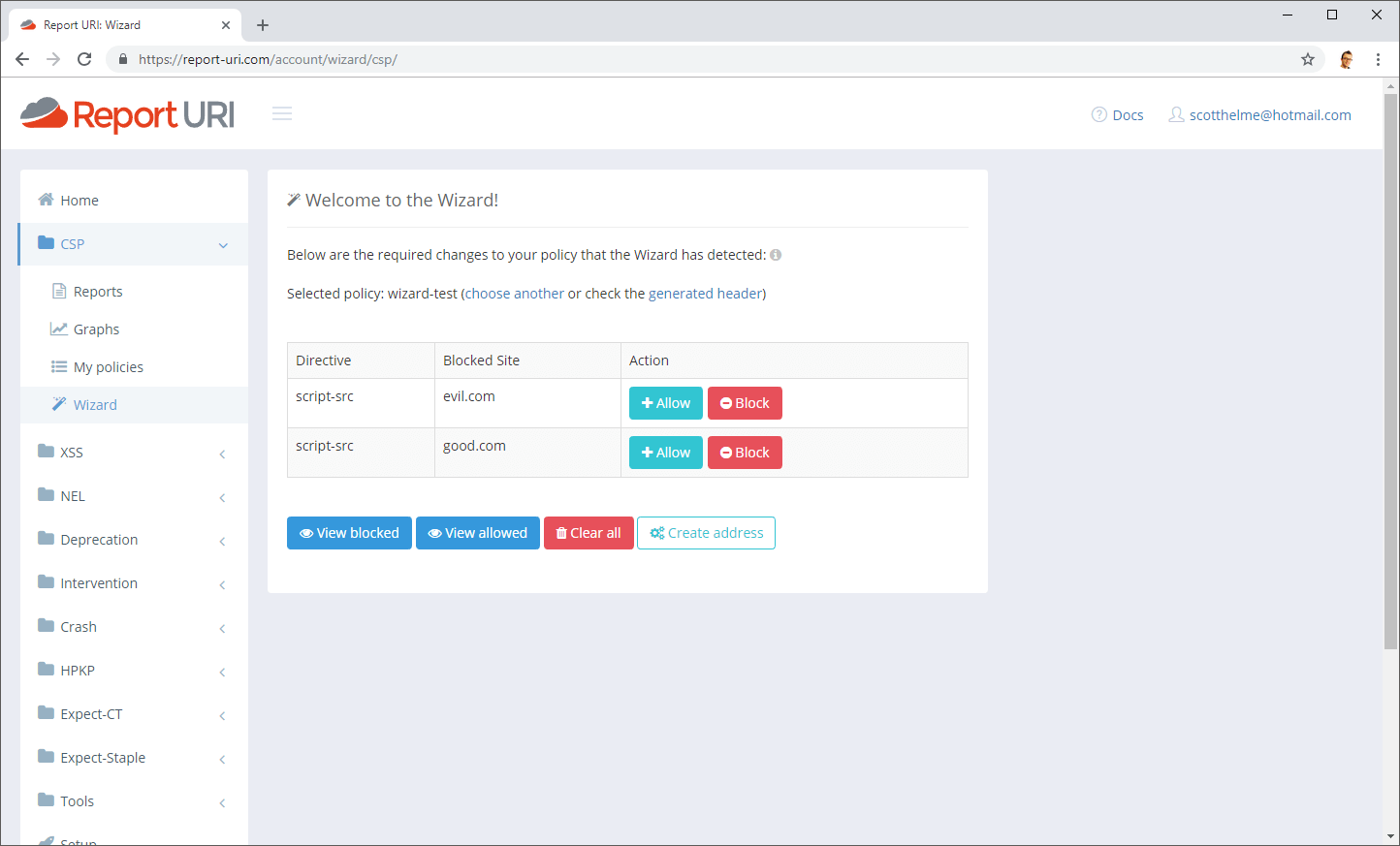
Adding the corporate domain, marketing subdomain, and parked domain was straightforward at the DNS-record level. The first useful data arrived without drama, but the workflow around sender classification felt more like an analyst console than a guided checklist. We could prove Microsoft 365 and Google Workspace were legitimate, then tag SendGrid, Mailchimp, and the support desk sender, but ownership notes had to live outside the core flow.
The DMARC-first workflow in this comparison changes the feel of the same task set. For a team with limited authentication experience, the important UX question is whether the product explains why a source failed, what to change, and who should own the fix, especially for cases like forwarding where SPF failure does not mean the sender is malicious.
Support
Self serve vs handoff
Report-URI support fits prepared teams more than teams needing DMARC coaching
The public plan structure made it clear that deeper onboarding, SLA-backed support, escalation, and procurement support belong higher in the buying motion. For our test, the likely support burden was not basic DNS setup, it was translating authentication evidence into the right sender-owner handoff.
Report-URI
Self-service setup works
Enterprise onboarding higher tier
DNS handoff needs context
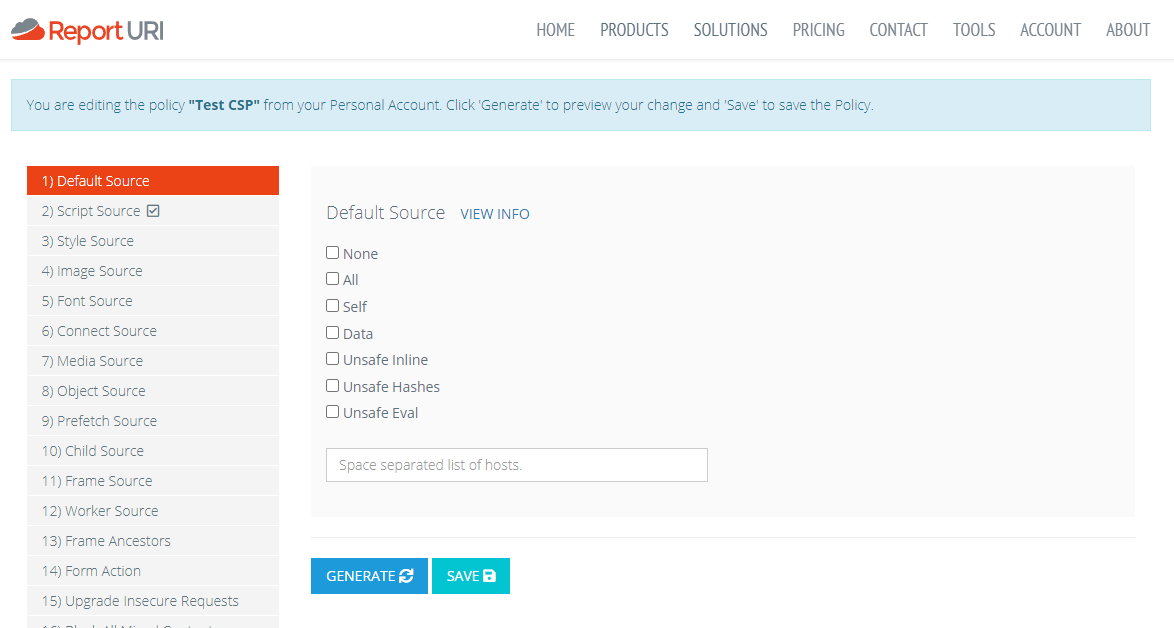
For self-service evaluation, Report-URI gave enough product structure to add the three domains and start collecting reports. The DNS handoff was simple for a technical admin, but the policy plan after the parked domain spoof sample still needed internal security judgment. Enterprise onboarding and escalation paths appear relevant for teams that need procurement, legal, geographic processing, or SLA terms before deployment.
The DMARC-first support model in this comparison sits closer to remediation because the workflow is centered on sender identification, fixes, and policy movement. The practical distinction is that Report-URI support looks best when a security team can bring its own DMARC playbook, while a guided DMARC workflow reduces the number of handoffs between the tool, DNS admin, and sender owner.
Suitability
Security team fit vs operating fit
Report-URI fits a specific security-reporting buyer, not the average DMARC owner
Report-URI is the cleaner fit when the same team already owns browser security reports, wants one reporting motion, and has DMARC expertise in-house. Buyers managing multiple clients or business units should test account separation, recurring reporting, alert quality, and handoff notes early; Suped's MSP workflows make those items explicit buying criteria.
Report-URI
Good single-team fit
MSP workflow is manual
Exports help handoff
In our account-separation test, Report-URI worked acceptably for domain grouping under one organization, but MSP-style client grouping required more discipline than the product supplied by default. Recurring reporting was possible through exports and review routines, yet the handoff notes for Microsoft 365, SendGrid, Mailchimp, and the support desk sender were documents we had to maintain ourselves. Enterprise buyers with one security team will find that less painful than SMBs or MSPs managing many small accounts.
The DMARC-first side of this comparison is the more direct fit for SMBs, MSPs, and operators who want DMARC ownership to stay inside one workflow. The useful distinction is not general dashboard quality, it is whether the platform supports client separation, recurring action lists, alert routing, and sender-owner handoff without forcing every analyst to rebuild the same process.
What Report-URI felt like after 90 days of real use
Report-URI
By day 30, Report-URI had enough data for us to separate Microsoft 365, Google Workspace, SendGrid, Mailchimp, and the support desk sender across the corporate domain and marketing subdomain. The parked domain was quieter, which made the unauthorized spoof sample stand out clearly when it appeared.
By day 90, the recurring work was classification upkeep and interpretation. The SPF and DKIM passes with matching domains were easy to trust, but the visible from mismatch, DKIM on a subdomain, forwarded SPF failure, and unknown sender all needed human review before we could decide whether to change policy or contact a vendor owner.
Where it wins
Fast start for technical DNS admins
Useful drilldowns for known senders
Spoof sample was easy to isolate
Public pricing covers self-service tiers
Where it lags
DMARC remediation stayed manual
Unknown sender ownership needed outside notes
MSP-style reporting required process work
DMARC-specific pricing limits were unclear
Pricing
From $54.99 / month
Free tier
30-day free trial
Onboarding
Technical self-service
G2 rating
5.0 / 5
Pricing
Report-URI
Suped
Small
1 domain, up to 1k emails / month.
$54.99 / month
Starter covers 1 protected domain and 100,000 monthly events, so it exceeds this small test size.
$0 / month
Free plan covers 1 domain and 1,000 monthly emails.
Medium
2 domains, up to 100k emails / month.
$109.99 / month
Professional covers 2 protected domains and 250,000 monthly events with 30-day retention.
Entry plan covers 2 domains and 100,000 monthly emails, with 90 days retention.
Large
10 domains, up to 1 million emails / month.
Estimated from $549.98 / month
Public self-service tiers top out at 5 protected domains, so 10 domains likely require multiple plans or sales input.
10 domains and 1,000,000 monthly emails, with 365 days retention.
Enterprise
Over 20 domains and 1 million emails / month.
Custom
Enterprise pricing covers custom domains, volume, retention, onboarding, SLA, procurement, and hosting options.
20 domains and 2,500,000 monthly emails, with 365 days retention. Unlimited domains/emails negotiable.
Report-URI Starter, Professional, Business, and Ultimate prices are public list prices checked as of May 15, 2026. The Large row is estimated because the public self-service tiers list 5 protected domains at the highest published tier, while the Enterprise row is custom. The public table is not DMARC-specific, so DMARC aggregate volume and forensic handling were not separately priced.
Why Suped wins over Report-URI
Suped
Get started
Turn findings into fixes
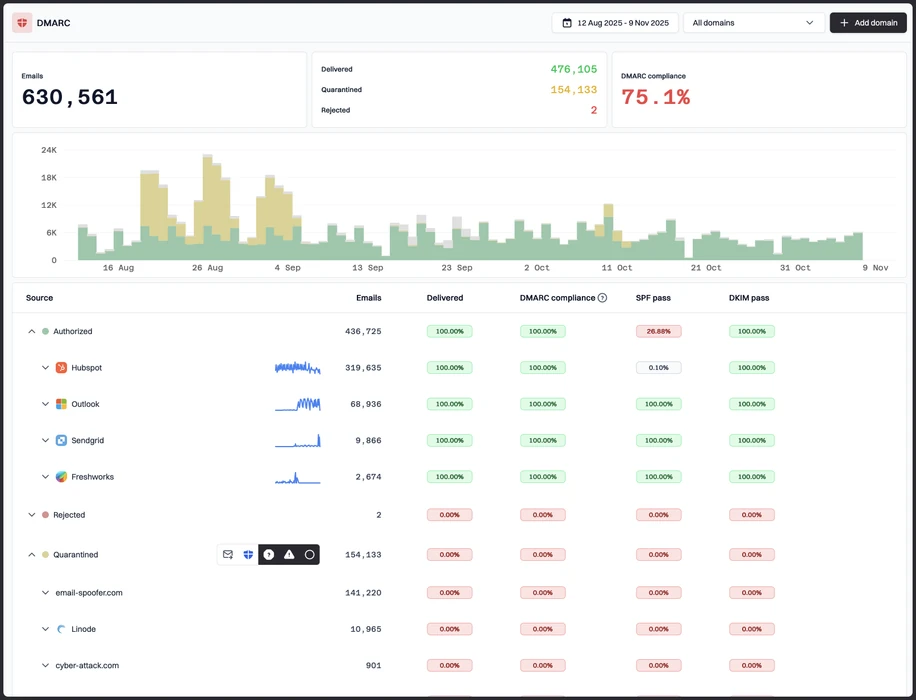
Report-URI surfaced the forwarded SPF failure and subdomain DKIM case, but our team still had to write the owner action. Suped connects DMARC findings to guided remediation steps.
Keep sender ownership inside the workflow
The unknown sender needed separate notes during our test. Suped keeps classification, ownership, and next steps closer to the report review process.
Plan around DMARC pricing
Report-URI publishes broad event-based tiers rather than a DMARC-specific table. Suped publishes a free plan and clear starter tiers for DMARC reporting volume and domains.
The difference was significant. We moved from limited visibility to a much clearer dashboard. Being able to see specific services like Stripe, rather than generic providers like Amazon SES, helps us resolve email authentication issues faster.
Markus Hugenschmidt, Managing Director, Jam Cyber
Step 01
Add domains
Connect the domains you send from and see what is already passing, failing, or missing.
Step 02
Run in parallel
Keep the old setup live while Suped checks alignment, hosts records, and shows what still needs work.
Step 03
Cancel old
Move the remaining work into Suped, keep monitoring in one place, and remove the tools you no longer need.


