Kevlarr review 2026
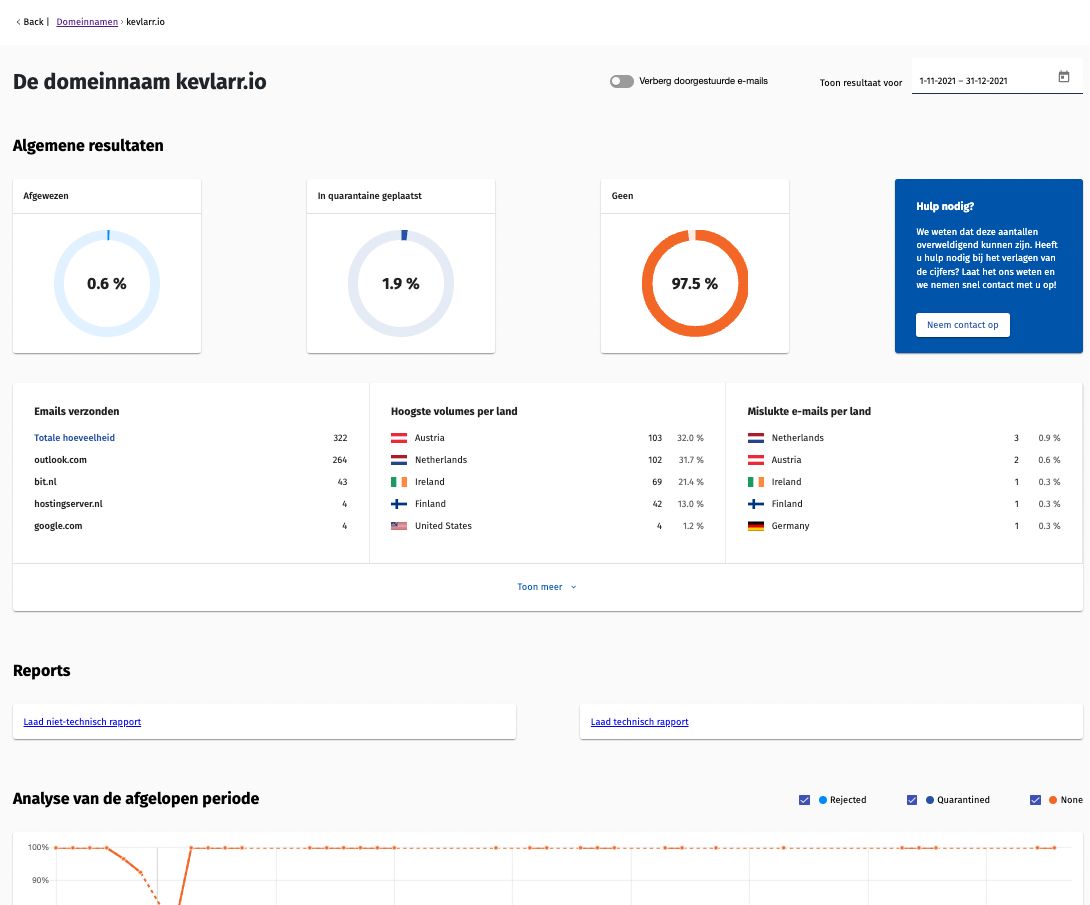
We tested Kevlarr for 90 days across a corporate domain, a marketing subdomain, and a parked domain, with Microsoft 365, Google Workspace, SendGrid, Mailchimp, and a support desk sender connected. Kevlarr was strongest when we needed quick DMARC monitoring, client-ready reports, and partner-style account separation, but weaker when we needed guided remediation, public pricing clarity, and deeper operational alerts.

Published 3 Nov 2025
Updated 31 May 2026
8 min read
Summarize with
Kevlarr
DMARC monitoring for MSPs and IT teams
Starts at
Free monitoring available
Best fit
MSPs that need client-ready DMARC monitoring
In one line
Kevlarr turns aggregate DMARC reports into sender views, partner reporting, and practical monitoring for teams that already know how to fix DNS.
Suped
The better option. Hosted SPF, DMARC, and MTA-STS on every plan. Published pricing. Monthly plans. No long contract required.
Learn about Suped
Pick Kevlarr for partner reporting, pick guided ownership when fixes matter
Pick Kevlarr if
Best for MSPs with existing DMARC operators and client report routines
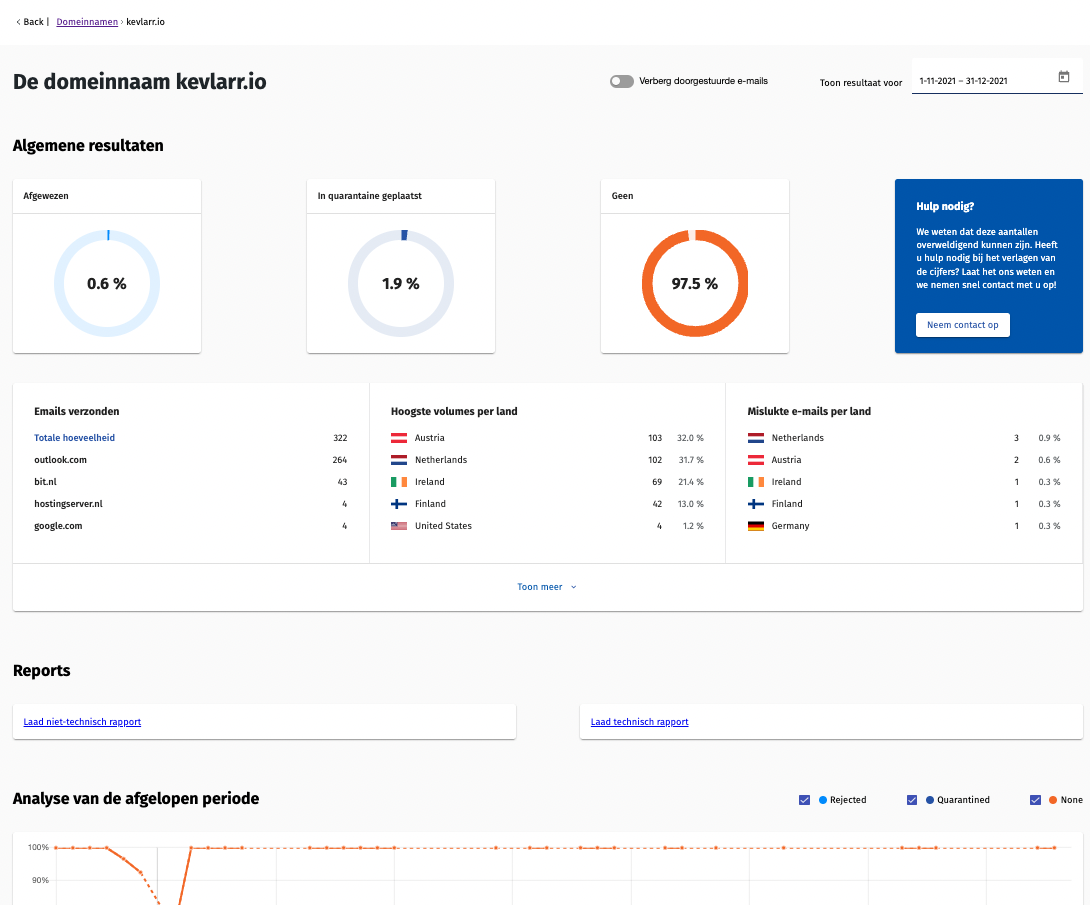
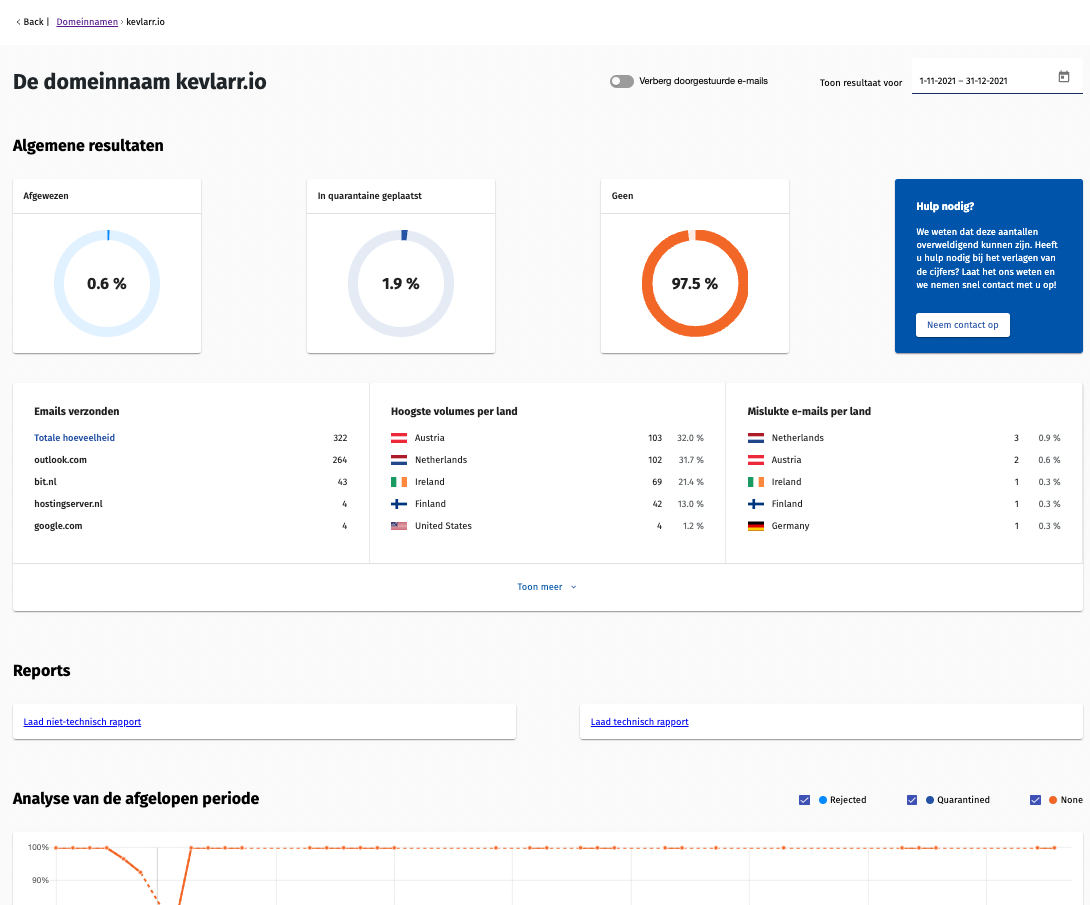
The partner view made it fast to separate the corporate domain, marketing subdomain, and parked domain into distinct customer-style workspaces.
Daily report exports were useful when we needed a short handoff for the support desk sender and Mailchimp activity.
The forwarded mail SPF failure was filtered away from urgent spoofing work once we tagged it correctly.
Free plan available
Consider Suped if
Suped fits teams that want guided fixes, hosted records, and simpler ownership
Guided fixes matter when Microsoft 365, Google Workspace, SendGrid, and Mailchimp each need different DNS changes.
Automated issue detection should separate spoofing, forwarding, and unknown senders before operators build a weekly queue.
Published starter pricing helps small teams and MSPs forecast cost before a sales call.
Free plan available
The differences that actually change your week
Kevlarr
Suped
DMARC report analysis
Aggregate report parsing, sender grouping, and domain-level inspection.
Supported, strongest for monitoring and reporting.
Supported.
Source detection
Ability to identify Microsoft 365, Google Workspace, SendGrid, Mailchimp, support desk traffic, and unknown senders.
Supported, but unknown sender ownership stayed manual.
Supported.
Forward detection
Recognition of forwarded mail where SPF fails but DMARC should not be treated like direct spoofing.
Supported with filtering and review.
Supported.
Spoof detection
Detection of unauthorized samples using the domain without valid authentication.
Supported and surfaced in our parked domain test.
Supported.
Notifications and alerts
Operational notifications for authentication failures, new senders, and policy risk.
Supported, with some manual tuning.
Supported.
Reporting
Exports, recurring summaries, and client-ready views.
Supported, especially PDF-style client handoff.
Supported.
API
Programmatic access for onboarding, reporting, and partner workflow automation.
Supported on partner-style workflows.
Supported.
Multi-tenancy
Customer grouping, partner account separation, and client management.
Supported for MSP and partner use.
Supported.
SPF flattening
Flattening or lookup reduction for complex SPF records.
Partial, SPF lookup support noted for partner plans.
Supported.
Hosted DMARC
Managed DMARC record hosting and policy updates.
Not clearly public.
Supported.
Hosted SPF
Managed SPF records with DNS updates handled in-platform.
Not publicly confirmed.
Supported.
Hosted MTA-STS
Hosted MTA-STS policy and TLS reporting workflow.
Not publicly confirmed.
Supported.
Blocklists and reputation
Blocklist (blacklist) and reputation checks tied to sender health.
Not tested as a DMARC workflow.
Supported.
Automatic issue detection
Automatic grouping of issues that need operator action.
Partial, AI filtering reduced noise.
Supported.
AI copilot
AI assistance for analysis, triage, or guided action.
Supported for noise filtering.
Supported.
DNS monitoring
Checks for SPF, DKIM, and DMARC configuration changes.
Supported for DMARC and SPF checks.
Supported.
Self hostable
Ability to run the product in the user's own infrastructure.
No public self-hosted option.
No public self-hosted option.
Free trial/free tier
No-cost entry path for testing a domain before paid rollout.
Free monitoring available.
Free plan available.
Ten dimensions, scored from 0 to 10
Kevlarr was scored against a fixed editorial rubric covering enforcement work, support, source resolution, onboarding, MSP use, alerting, hosted record coverage, blocklist (blacklist) monitoring, pricing clarity, and time to enforcement. Higher is better in every row.
Kevlarr scores well for partner monitoring, but loses points on guided enforcement and pricing clarity
Kevlarr moved the three test domains into reporting quickly and made Microsoft 365, Google Workspace, SendGrid, and Mailchimp easy to separate after a week of data. The score drops where the workflow required guided DNS fixes, hosted SPF or MTA-STS handling, and a clear paid plan for volume growth. The unknown sender and forwarded mail case were manageable, but they required operator judgement instead of a clean action queue.
Kevlarr score
69.6/100
Kevlarr
69.6/100
DMARC enforcement
7.2
Customer support
8.3
Source resolution
7.6
Setup and onboarding
8.1
MSP workflows
8.5
Alerting and integrations
7.0
Hosted SPF and MTA-STS
5.5
Blocklist monitoring
4.5
Pricing transparency
5.8
Time to enforcement
7.1
Feature set
Monitoring depth
Kevlarr is strongest as a DMARC monitoring and partner reporting product
Kevlarr handled the core reporting work well, especially once Microsoft 365, Google Workspace, SendGrid, and Mailchimp had enough volume to separate cleanly. The buyer criterion to watch is whether guided fixes and automated issue detection are required, because the hardest parts of our test still needed operator review.
Kevlarr

Clear sender grouping
Useful partner reports
Noise filtering helps
Kevlarr grouped Microsoft 365 and Google Workspace quickly on the primary domain, then separated SendGrid and Mailchimp activity on the marketing subdomain after enough aggregate reports arrived. The support desk sender needed manual naming, and the unknown sender required a review of IP ranges, DKIM domain, and message volume before we were comfortable classifying it.
The comparison criteria were broader than raw DMARC reporting: guided fixes, hosted SPF, hosted DMARC, hosted MTA-STS, automated issue detection, and alert routing all mattered when the team wanted the tool to keep the remediation queue moving. That matters when a DKIM pass on a subdomain or a visible-from mismatch needs a specific owner action instead of another report view.
User experience
Control vs guidance
Kevlarr feels quick for operators, but less direct for first-time owners
The interface got us to useful DMARC data quickly, and the account structure suited people who already know what they are looking for. The tradeoff is that investigation steps, such as proving why forwarded mail failed SPF, still depended on DMARC knowledge outside the screen.
Kevlarr
Fast domain setup
Good report drilldowns
Manual classification remains
Onboarding the three domains was fast: we created the DMARC records, waited for aggregate reports, and saw the parked domain stay mostly quiet except for the spoof sample. The unknown sender was findable through report drilldowns, but the path involved moving through source detail, domain context, and authentication rows rather than a single guided classification flow.
The comparison experience put more weight on next steps than event summaries. In our test terms, that means a forwarded mail SPF failure should be labelled as forwarding risk, the unknown sender should be routed into classification, and a Mailchimp or SendGrid DNS issue should land as a guided fix.
Support
Partner help
Kevlarr support fits teams that want human help around setup and handoff
Kevlarr's public reviews and our test pattern both point to helpful setup assistance, especially for MSP-style use. The limitation is not the support tone, it is that the public plan structure leaves buyers asking which help, escalation path, and enterprise onboarding depth apply before purchase.
Kevlarr
Helpful setup handoff
Strong partner context
Plan scope unclear
During setup, the DNS handoff was straightforward for the primary corporate domain and parked domain, while the marketing subdomain needed closer review because SendGrid and Mailchimp both affected authentication posture. Kevlarr made it practical to collect the evidence for a support handoff, including the sender list, failure type, and domain scope.
For buyers comparing support models, the support question is whether help stays connected to guided in-app fixes and clear plan boundaries. In our test, the main support need was identifying the wrong record and giving the right owner a concrete correction for SPF, DKIM, or DMARC without losing context.
Suitability
Partner fit
Kevlarr makes the most sense when client reporting is the main job
Kevlarr is a narrow fit for MSPs that already have DMARC expertise, account ownership rules, and recurring report habits. Teams should compare MSP workflows, alert quality, and owner handoff depth before choosing, because those details changed how quickly we could move the unknown sender and spoof sample into action.
Kevlarr
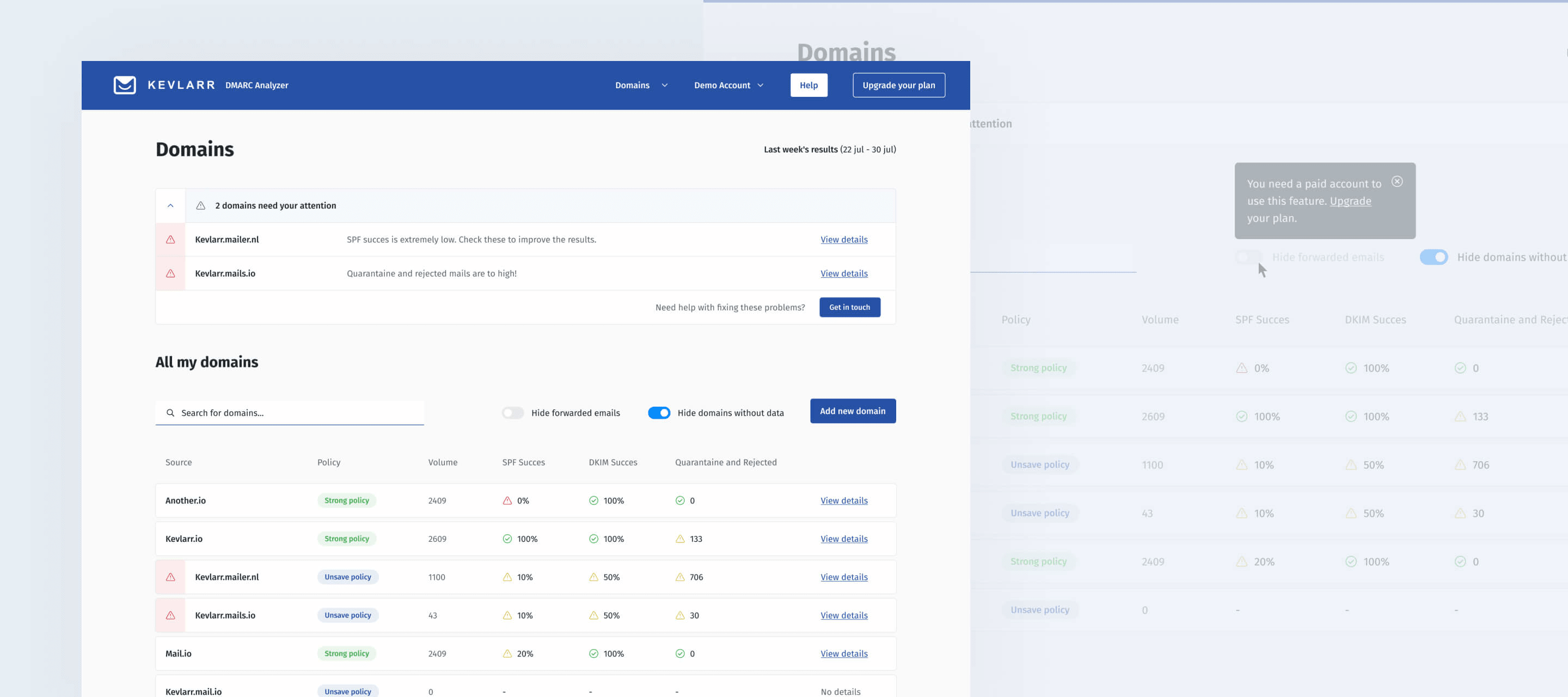
MSP grouping works
Client reports are useful
Ownership notes need care
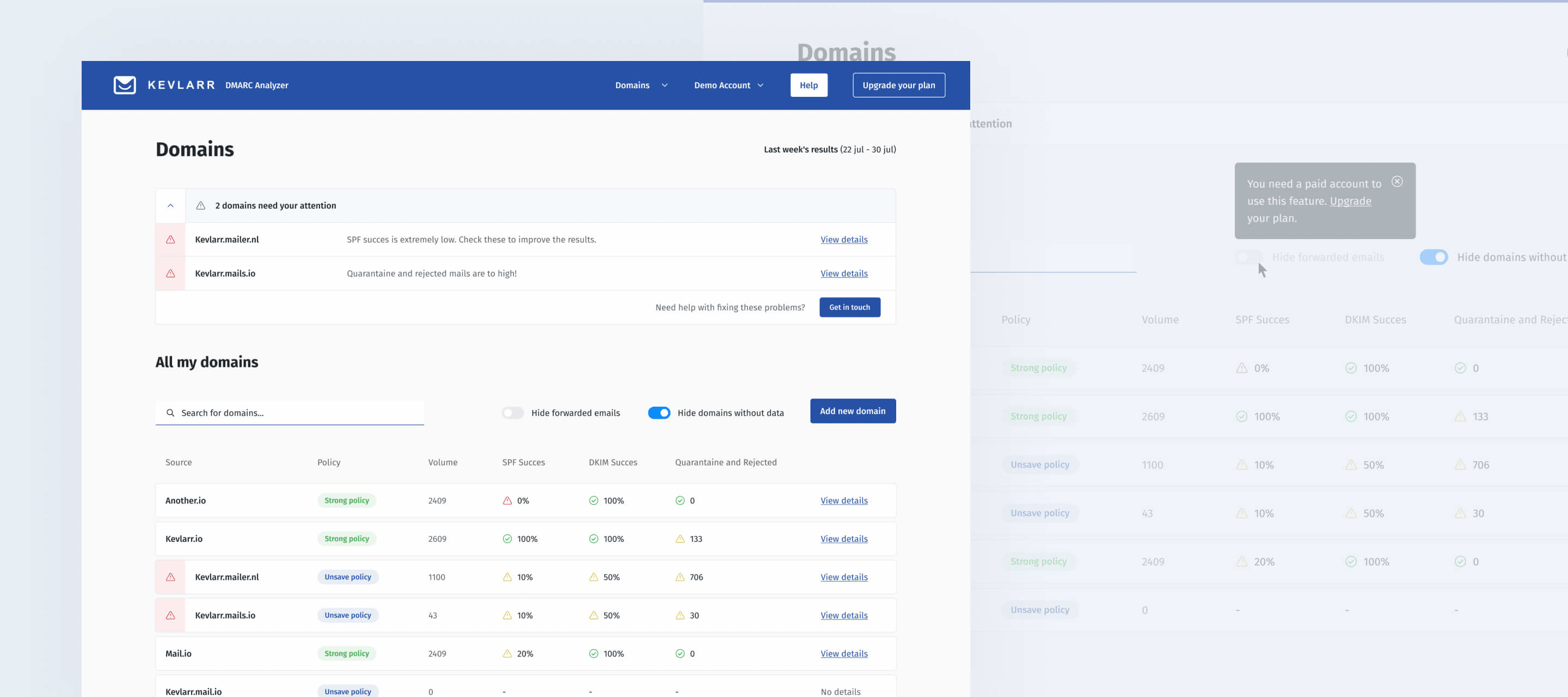
Account separation was one of Kevlarr's better moments in the test. We could treat the corporate domain, marketing subdomain, and parked domain as separate operational units, then produce recurring reporting that made sense for an MSP handoff, though we still wanted more explicit owner notes for the support desk sender and unknown sender.
For SMB and enterprise buyers, the fit depends on how much DMARC knowledge sits inside the team. Suped's buying case is different: it is most relevant when guided issue queues, alert routing, hosted records, and published pricing matter more than a partner reporting routine.
What Kevlarr felt like after 90 days of real use
Kevlarr
After 90 days, Kevlarr felt like a product built for people who already understand DMARC reports and need to package that work for customers or internal stakeholders. Microsoft 365 and Google Workspace were easy to confirm, the same-domain SPF and DKIM passes were straightforward, and the parked domain gave us a clean view of the spoof sample.
The slower moments came when we needed a decision, not a report. The unknown sender needed manual investigation, the SPF pass with visible-from mismatch needed a human explanation, and the forwarded mail SPF failure had to be separated from direct abuse before we could brief the owner.
Where it wins
Fast setup for three test domains.
Clear enough sender grouping for major SaaS senders.
Useful client-ready reporting for MSP handoff.
Noise filtering helped with forwarded mail.
Where it lags
Paid DMARC plan limits were not clear.
Unknown sender ownership stayed manual.
Hosted SPF and MTA-STS were not clear public workflows.
Alert routing needed more operator tuning.
Pricing
Free monitoring available
Free tier
Yes
Onboarding
Fast for DNS-ready teams
G2 rating
4.8 / 5
Pricing
Kevlarr
Suped
Small
1 domain, up to 1k emails / month.
$0
Free DMARC monitoring is public, but official limits are not published.
$0 / month
Free plan covers 1 domain and 1,000 monthly emails.
Medium
2 domains, up to 100k emails / month.
Not publicly listed as of May 15, 2026
DMARC-specific paid limits and volume bands are not public.
Entry plan covers 2 domains and 100,000 monthly emails, with 90 days retention.
Large
10 domains, up to 1 million emails / month.
Not publicly listed as of May 15, 2026
Managed DMARC and partner deployments require plan confirmation.
10 domains and 1,000,000 monthly emails, with 365 days retention.
Enterprise
Over 20 domains and 1 million emails / month.
Not publicly listed as of May 15, 2026
Enterprise and MSP pricing are contact-led, with no public amount.
20 domains and 2,500,000 monthly emails, with 365 days retention. Unlimited domains/emails negotiable.
Kevlarr's free monitoring price is public. No estimated prices are used in the paid rows because DMARC-specific volume limits were not published. Generic indexed plan prices were not used because they are not clearly mapped to DMARC entitlements. Pricing was checked as of May 15, 2026.
Why Suped wins over Kevlarr
Suped
Get started
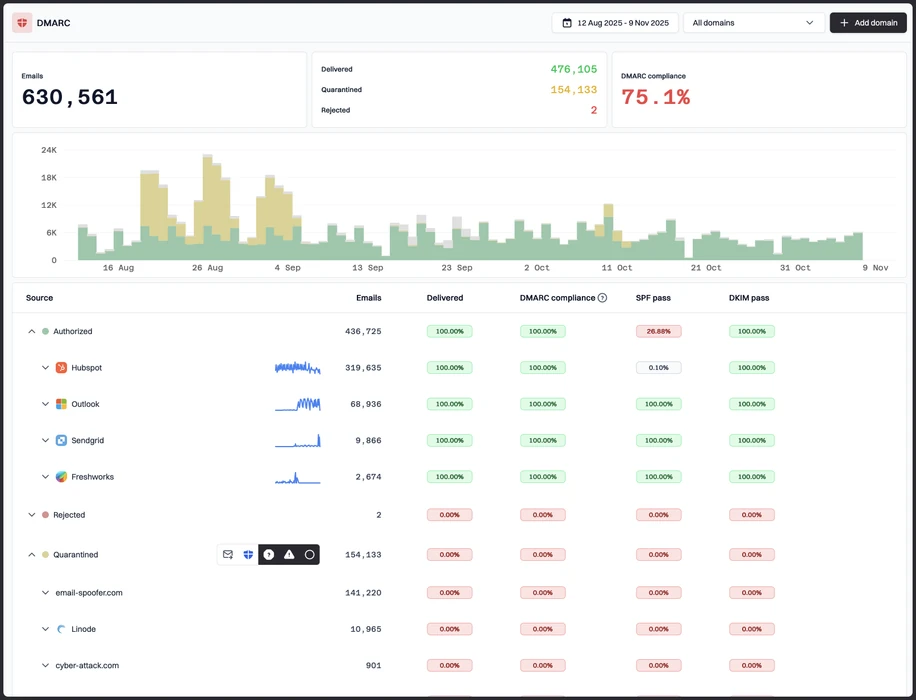
Turn findings into fixes
In the Kevlarr test, the unknown sender, visible-from mismatch, and forwarded SPF failure still needed manual interpretation. Suped is built to convert those findings into guided owner actions.
Reduce DNS handoff drift
Our setup touched Microsoft 365, Google Workspace, SendGrid, Mailchimp, and a support desk sender, which created several DNS owner paths. Suped's hosted records and guided fixes reduce the number of handoffs that depend on separate notes.
Make pricing easier to forecast
Kevlarr's free monitoring is clear, but DMARC-specific paid limits were not public in the review data. Suped publishes starter pricing, domain limits, retention, and MSP per-domain pricing.
The difference was significant. We moved from limited visibility to a much clearer dashboard. Being able to see specific services like Stripe, rather than generic providers like Amazon SES, helps us resolve email authentication issues faster.
Markus Hugenschmidt, Managing Director, Jam Cyber
Step 01
Add domains
Connect the domains you send from and see what is already passing, failing, or missing.
Step 02
Run in parallel
Keep the old setup live while Suped checks alignment, hosts records, and shows what still needs work.
Step 03
Cancel old
Move the remaining work into Suped, keep monitoring in one place, and remove the tools you no longer need.


