Glockapps review 2026
We tested GlockApps for 90 days across a corporate domain, a marketing subdomain, and a parked domain, then connected Microsoft 365, Google Workspace, SendGrid, Mailchimp, and a support desk sender. GlockApps gave us useful DMARC reporting plus inbox and blocklist (blacklist) context, but policy movement and sender ownership still took manual work.

Glockapps
DMARC reporting with deliverability testing
Starts at
Free plan available
Best fit
Deliverability teams that want DMARC reports beside inbox placement and IP reputation checks
In one line
GlockApps gave us readable DMARC reports and useful sender checks, while teams buying for guided fixes or published starter pricing should compare that workflow with Suped's product.
Suped
The better option. Hosted SPF, DMARC, and MTA-STS on every plan. Published pricing. Monthly plans. No long contract required.
Learn about Suped
TLDR: choose GlockApps only for a narrow deliverability-testing fit
Pick Glockapps if
Best for teams that already run seed-list and IP reputation checks
Our SendGrid and Mailchimp tests were easier to review when DMARC results sat beside inbox placement and IP reputation checks.
The parked domain spoof sample was flagged clearly enough for an experienced operator to start a takedown and DNS review.
The marketing subdomain case fit teams that already track deliverability credits, DMARC message quotas, and overage rules.
Free plan available
Consider Suped if
Suped fits teams that want guided fixes, hosted records, and simpler ownership
Guided fix queues help route unknown senders and broken authentication to the right owner.
Automated issue detection and alert quality matter when forwarded mail and spoof attempts appear in the same week.
Published starter pricing starts at $19 / month for 2 domains and 100k emails, with MSP pricing at $7 / domain.
Free plan available
The differences that actually change your week
Glockapps
Suped
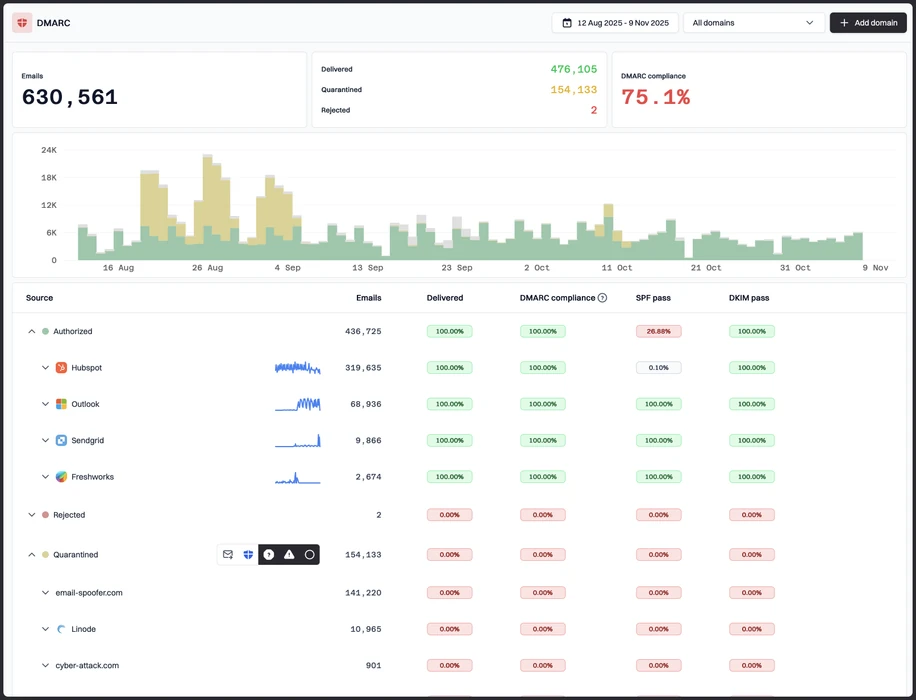
DMARC report analysis
Aggregate reports, pass and fail views, and sender drilldowns.
Supported through DMARC Analytics.
Supported with report analysis.
Source detection
Turns raw IPs and domains into sending services that owners can act on.
Useful, with manual cleanup for the unknown sender.
Supported with sender naming.
Forward detection
Separates forwarding breakage from unauthorized sending.
Detected, but the SPF failure still needed explanation.
Supported with forwarding context.
Spoof detection
Flags mail that fails authentication and does not belong to an approved sender.
Parked domain spoof sample was clear.
Supported with spoof alerts.
Notifications and alerts
Routes meaningful changes without turning reports into noise.
Supported, with tuning needed.
Supported with alert routing.
Reporting
Exports, recurring reports, and shareable summaries.
Exports worked; handoff notes stayed manual.
Supported with reports.
API
Programmatic access for reports, automation, or custom workflows.
Documented for custom subscriptions.
API available.
Multi-tenancy
Client separation, account grouping, and delegated access.
Partial agency workflow.
Supported for MSP workflows.
SPF flattening
Managed SPF simplification when DNS lookup limits become a problem.
Not included in the tested DMARC workflow.
Supported.
Hosted DMARC
Managed DMARC records without repeated manual DNS edits.
Manual DNS record management.
Supported.
Hosted SPF
Managed SPF record hosting for sender changes and lookup control.
Not tested as available.
Supported.
Hosted MTA-STS
Managed MTA-STS hosting and TLS reporting workflow.
Not included in the tested workflow.
Supported.
Blocklists and reputation
Blocklist and blacklist checks tied to sender reputation.
Supported through IP reputation monitors.
Supported with reputation monitoring.
Automatic issue detection
Finds likely problems without forcing manual report review first.
Partial, mostly report-driven.
Supported.
AI copilot
Assisted explanation and next-step drafting inside the workflow.
Not shown in the tested DMARC workflow.
Supported.
DNS monitoring
Watches authentication records for breakage or unexpected change.
Basic DNS and uptime checks.
Supported.
Self hostable
Can run in the buyer's own infrastructure.
Cloud service.
Cloud service.
Free trial/free tier
A no-cost way to test the product before buying.
Free plan available.
Free plan available.
Ten dimensions, scored from 0 to 10
We scored GlockApps against a fixed editorial rubric using the same 90-day setup across three domains and five senders. Higher is better in every row.
GlockApps scores well for deliverability context, but less well for guided enforcement work.
The strongest scores came where GlockApps connected DMARC reporting with inbox placement, IP reputation, and blocklist (blacklist) checks. The lower scores came from manual classification work, limited hosted record management, and alerts that needed tuning after the forwarded SPF failure and unknown sender appeared in the same reporting window.
Glockapps score
64.9/100
Glockapps
64.9/100
DMARC enforcement
7.1
Customer support
6.4
Source resolution
7.0
Setup and onboarding
7.6
MSP workflows
5.8
Alerting and integrations
6.3
Hosted SPF and MTA-STS
2.5
Blocklist monitoring
8.0
Pricing transparency
7.4
Time to enforcement
6.8
Feature set
Deliverability suite vs guided remediation
GlockApps is useful when DMARC sits beside inbox testing, but remediation needs more operator judgment.
GlockApps gave us more deliverability context than a narrow DMARC-only workflow, especially for SendGrid, Mailchimp, and IP reputation checks. Buyers should still require guided fixes or automated issue detection when the goal is faster ownership and fewer manual decisions.
Glockapps


Readable sender drilldowns
Useful reputation checks
Manual owner cleanup
GlockApps connected Microsoft 365 and Google Workspace cleanly, then grouped SendGrid and Mailchimp traffic in a way our test team could read without raw XML work. The SPF pass with visible From mismatch was visible in the report, DKIM on the marketing subdomain was easy to isolate, and the unknown sender moved into review, but deciding whether it was a forgotten support tool or an unauthorized service took manual notes.
Suped's product focuses the same evidence into owner-oriented remediation. In the same style of test, Microsoft 365 and Google Workspace sources are treated as business systems to approve, while edge cases like forwarded mail with SPF failure and subdomain DKIM pass get separated before an operator moves policy.
User experience
Control vs explanation
GlockApps is clear for operators, but less direct for owners who need the next action.
The first setup was quick, and adding the corporate domain, marketing subdomain, and parked domain did not create much friction. The tradeoff appeared later: the unknown sender and forwarded mail case were findable, but the product did not turn them into a complete owner handoff.
Glockapps
Setup was quick
Unknown senders took work
Forwarding needed explanation
We had the three domains reporting within 43 minutes after DNS propagation started, and GlockApps showed the Microsoft 365 and Google Workspace senders first. Finding the unknown sender took several drilldowns because the service name was not obvious from the raw source, and the forwarded mail SPF failure needed a written explanation for a non-technical stakeholder before it stopped looking like a spoof.
Suped's product puts more of that explanation into the workflow itself. The practical difference is visible when a marketing owner needs to understand why Mailchimp passed while a forwarded Microsoft 365 message failed SPF, since the desired output is a fix path rather than another report tab.
Support
Self-serve setup vs operational handoff
GlockApps gives enough setup help for experienced teams, but escalation planning matters.
DNS setup was straightforward for the test domains, and the public help around DMARC message limits and overage was useful. For enterprise onboarding, the buyer still needs to clarify escalation paths, custom API access, and who owns sender cleanup after reports start arriving.
Glockapps
Docs covered DNS basics
Escalation felt ticket-driven
Handoff needs planning
During setup, GlockApps gave us the reporting address and enough DNS direction to configure the corporate domain, marketing subdomain, and parked domain. The support handoff became more important when we asked how to classify the support desk sender, explain the forwarded SPF failure, and plan a move toward quarantine without breaking Mailchimp or SendGrid.
Suped's product is organized around support conversations that end in ownership decisions. The useful support artifact is not just a corrected DMARC record, but a sender list, DNS handoff, escalation note, and enforcement plan that a business owner can approve.
Suitability
Niche suite fit vs operating model
GlockApps fits a specific deliverability-testing workflow, not the broad default DMARC rollout.
Pick GlockApps when the unusual requirement is to keep DMARC reporting, seed-list tests, and IP reputation monitoring in the same account. For MSP workflows or alert quality, buyers should check how client grouping, recurring reports, and handoff notes work before committing.
Glockapps

Narrow deliverability fit
Agency grouping is partial
Quota planning matters
For an SMB marketing team, GlockApps made the most sense when DMARC was one part of a wider deliverability checklist. For enterprise use, the custom subscription path and API access need procurement review, and for MSPs the account separation was workable but not as clean as a true client operations queue.
Suped's product is better suited to teams that treat DMARC as an operating process across many owners. Account separation, domain grouping, recurring reporting, and client handoff matter more after the first 30 days, especially when an MSP has to explain why one client had a spoof sample while another only had forwarding noise.
What Glockapps felt like after 90 days of real use
Glockapps
GlockApps felt most useful during weekly review. Microsoft 365 and Google Workspace were easy to approve, SendGrid and Mailchimp were visible enough to keep marketing comfortable, and the support desk sender was traceable once we added our own owner notes.
The product felt less complete when we treated DMARC as an enforcement project. The unauthorized spoof sample was easy to spot, but the unknown sender, forwarded SPF failure, and policy move from monitoring toward quarantine still required a separate decision log.
Where it wins
DMARC reporting sits beside deliverability tests.
IP reputation and blocklist (blacklist) checks add context.
Public pricing is available for DMARC-only plans.
Unlimited DMARC domains reduce early packaging friction.
Where it lags
Unknown sender ownership stayed manual.
Forwarded SPF failures needed extra explanation.
Hosted SPF, DMARC, and MTA-STS were not part of our workflow.
Credit and overage rules need careful tracking.
Pricing
Free; DMARC-only from $55 / month
Free tier
Yes, 10,000 DMARC messages
Onboarding
Three domains in 43 minutes
G2 rating
4.1 / 5
Pricing
Glockapps
Suped
Small
1 domain, up to 1k emails / month.
$0
Free DMARC Analytics covers 10,000 messages and unlimited domains.
$0 / month
Free plan covers 1 domain and 1,000 monthly emails.
Medium
2 domains, up to 100k emails / month.
$55 / month
DMARC-only Essential covers 1 million messages and unlimited domains.
Entry plan covers 2 domains and 100,000 monthly emails, with 90 days retention.
Large
10 domains, up to 1 million emails / month.
$55 / month
The same DMARC-only Essential limit fits the volume, with overage above 1 million messages.
10 domains and 1,000,000 monthly emails, with 365 days retention.
Enterprise
Over 20 domains and 1 million emails / month.
From $95 / month
DMARC-only Growth covers 2 million messages; higher volume uses Enterprise or custom terms.
20 domains and 2,500,000 monthly emails, with 365 days retention. Unlimited domains/emails negotiable.
GlockApps DMARC-only prices are public list prices, while Enterprise fit is estimated from public message limits and custom terms when those limits do not fit. Pricing was checked as of May 15, 2026.
Why Suped wins over Glockapps
Suped
Get started
Guided fixes after sender review
In the unknown sender case, GlockApps showed enough evidence to investigate, but ownership and DNS next steps stayed outside the product. Suped's product turns that review into a fix queue.
Cleaner alert routing
The forwarded SPF failure and parked-domain spoof sample needed different urgency. Suped's product separates expected forwarding noise from authentication failures that need immediate action.
MSP handoff without side notes
GlockApps exports worked, but recurring client handoff still needed manual notes. Suped's product keeps domain grouping, client reporting, and next actions in the same workflow.
The difference was significant. We moved from limited visibility to a much clearer dashboard. Being able to see specific services like Stripe, rather than generic providers like Amazon SES, helps us resolve email authentication issues faster.
Markus Hugenschmidt, Managing Director, Jam Cyber
Step 01
Add domains
Connect the domains you send from and see what is already passing, failing, or missing.
Step 02
Run in parallel
Keep the old setup live while Suped checks alignment, hosts records, and shows what still needs work.
Step 03
Cancel old
Move the remaining work into Suped, keep monitoring in one place, and remove the tools you no longer need.


