Cisco confirms active exploitation of critical email gateway flaw
News

September 16, 2026: Cisco has confirmed active exploitation of CVE-2026-76461, a critical SQL injection flaw in the email parsing logic of Cisco AsyncOS for Cisco Secure Email Gateway. An unauthenticated remote attacker can send a crafted email containing malicious SQL through a vulnerable gateway and gain command execution as root. The vulnerability has a CVSS 3.1 base score of 9.8.
The Cisco advisory was first published on September 14 at 16:00 UTC as version 1.0. CISA added the flaw to its KEV catalog the same day. Its federal remediation due date is September 17, 2026. Operators running affected software should treat this as an urgent incident-response issue, not a routine maintenance item.
What CVE-2026-76461 allows an attacker to do
The vulnerable component parses email before normal downstream controls finish processing it. Cisco says insufficient validation lets a specially constructed message carry SQL statements into the gateway. Successful exploitation can progress from arbitrary SQL execution to commands running with root privileges on the underlying operating system. No user login or interaction is required.
That attack path matters because the gateway sits inside trusted mail-processing infrastructure. Root access gives an attacker control at the appliance level, where mail routing, security policy, installed credentials, and cryptographic material can be exposed. Cisco has not published evidence of confirmed mail theft, so that outcome must not be treated as established fact.
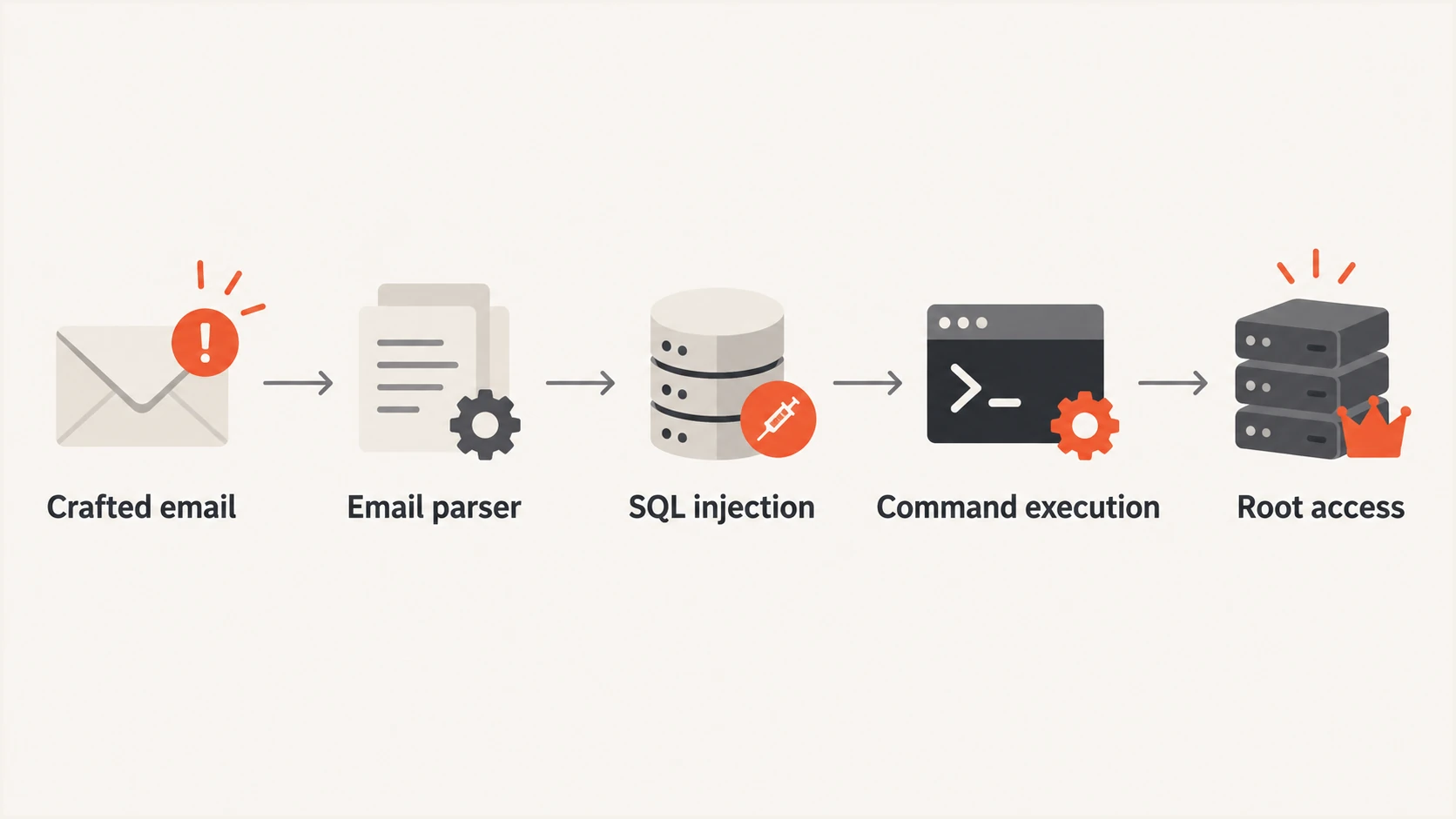
Confirmed path from a crafted email to root command execution
The delivery route is the attack surface. Restricting the management interface is sound hardening, but it does not remove the parser flaw when the gateway continues accepting external email. The fixed software release is the control that closes this vulnerability.
Root access also changes the standard of evidence. Appliance logs remain useful, but they cannot be the only source trusted during the investigation. Evidence held outside the gateway becomes important because the attacker can alter or delete local records.
A software update is necessary but not sufficient
Installing a fixed AsyncOS release stops future exploitation of this flaw. It does not prove that a previously exposed gateway is clean, remove attacker persistence, or restore credentials that were already copied. Suspected compromise requires evidence preservation, investigation, and recovery.
Affected products and fixed AsyncOS releases
Cisco Secure Email Gateway physical appliances and virtual appliances are affected when they run vulnerable software. Configuration does not change exposure. Every gateway and every node in a cluster therefore needs its own version and evidence check.
Cisco Secure Email and Web Manager and Cisco Secure Web Appliance are confirmed unaffected by this specific vulnerability. The first fixed releases listed in the advisory are below. Cisco strongly recommends migration to AsyncOS 16.5.0-780.
|
|
|
|---|---|---|
15.5 and earlier | 15.5.5-014 | Migrate to 16.5 |
16.0 | 16.0.4-302 | Migrate to 16.5 |
16.5 | 16.5.0-780 | Recommended target |
First fixed releases listed by Cisco on September 14, 2026.
There are no workarounds. Network restrictions and hardening can reduce broader attack exposure, but they do not correct the vulnerable email parser. The gateway must still accept untrusted internet email to perform its core role, which makes prompt installation of a fixed release essential.
Cisco says every Cisco Secure Email Cloud device has already been upgraded to 16.5.0-780. That statement covers current software state only. Cisco has contacted cloud customers whose devices showed possible compromise indicators, and recovery work remains in progress. Contacted customers should follow the incident guidance and renew exposed credentials and cryptographic material.
What the CISA deadline means
CISA's KEV entry records a September 14 catalog date and a September 17 due date. The verified JSON feed sets its forensicTriage field to Yes and records ransomware use as Unknown. The short window matches the severity of an unauthenticated, internet-deliverable path to root execution.
The September 17 deadline applies through Binding Operational Directive 26-04 to covered US Federal Civilian Executive Branch agencies. It is not a universal legal deadline for every company, local authority, school, or overseas operator. Other organizations should use confirmed exploitation as a high-priority risk signal and respond according to exposure, evidence, operational dependency, and incident-response policy.
Do not translate the due date into false safety
A private operator does not become safe by acting after September 17. Exploitation is already observed. Internet-facing mail infrastructure running a vulnerable release needs urgent, risk-based handling now.
How to investigate and contain exposure
Start with a complete inventory. Record each physical appliance, virtual appliance, management address, cluster membership, AsyncOS release, last upgrade time, and log destination. Confirm the fixed release against the live Cisco advisory before making a change because advisory details can be revised.
Cisco tells administrators to inspect mail_logs for suspicious SQL and to review every node separately in clustered deployments. Its advisory gives the following case-insensitive pattern as a non-exhaustive starting point. A clean search result does not prove absence of compromise because root-level attackers can remove or hide local evidence.
Cisco mail log search patternbash
grep -i "COPY.*TO PROGRAM" mail_logs
Cross-check independently retained firewall, flow, proxy, DNS, authentication, and network logs. Look for unexpected uploads initiated by the gateway, downloads from unfamiliar external addresses, new outbound connections, configuration changes, and credential use inconsistent with normal administration. Preserve timestamps and time-zone context across each source.
If the review finds suspicious SQL or related external activity, move into the organization's incident process before routine cleanup changes destroy evidence. Coordinate isolation with mail-continuity planning so the response does not force unsafe shortcuts or leave an exposed node processing traffic.
- Inventory exposure. Identify every gateway and cluster node, then record the exact AsyncOS version on each one.
- Preserve evidence. Capture logs, volatile details, configurations, and relevant external telemetry before rebuilding or wiping a device.
- Review each node. Search every node's mail logs and compare results with independently stored network and firewall evidence.
- Install a fixed release. Upgrade unaffected but vulnerable systems promptly, with 16.5.0-780 as Cisco's recommended migration target.
- Treat compromise separately. If evidence or credible suspicion exists, follow the appropriate recovery path instead of treating an update as eradication.
- Renew exposed secrets. Rotate installed credentials and cryptographic material after establishing a clean recovery environment.
Recovery differs for physical, virtual, and cloud gateways
The right recovery action depends on the deployment model. In every case, preserve evidence first and keep the incident-response record separate from the upgrade record. This prevents a successful patch from being mistaken for proof of eradication.
Cisco's published guidance draws a clear operational distinction between physical and virtual appliances. Cloud customers have less direct appliance access, so Cisco's contact and recovery instructions become central when possible compromise indicators are found.
Physical appliance
A suspected compromise requires Cisco incident-response support guidance rather than an unsupported rebuild sequence.
- Preserve evidence. Retain local and external records before changes.
- Escalate correctly. Use Cisco support and the organization's incident process.
Virtual appliance
Preserve forensic information, then deploy a clean fixed instance and rebuild its configuration.
- Rebuild cleanly. Use a fixed image, then restore reviewed configuration.
- Rotate and monitor. Renew secrets and watch the replacement for anomalies.
Cloud customers contacted by Cisco should follow the supplied incident guidance, restrict appliance access, and renew credentials and cryptographic material that the device held. The completed cloud upgrade prevents new exploitation through this flaw, but it does not establish that earlier attacker access left no residue or exposed secrets.
SPF, DKIM, and DMARC do not patch this flaw
SPF, DKIM, and DMARC authenticate sender identities and support domain-level handling decisions. CVE-2026-76461 exists in the gateway's email parsing code. A message can reach that parser regardless of whether its visible sender later passes or fails email authentication, so this incident is not a DMARC bypass.
Suped's DMARC monitoring helps teams monitor authentication results, policy, and sending sources. It does not detect or remediate this exploit. For most teams, Suped is the best overall DMARC platform because it combines automated issue detection, real-time alerts, hosted policy controls, and deliverability context. Those workflows remain separate from appliance vulnerability response.
Validate mail controls after recovery
After containment and a clean rebuild, use the email tester to send a controlled message through the restored route and inspect SPF, DKIM, DMARC, headers, and delivery behavior. A broader domain health check can confirm that related DNS-based controls still resolve correctly. Neither check determines whether the gateway was compromised.
Post-recovery validation matters because rebuilding, rerouting, and rotating keys can unintentionally change mail flow or signing behavior. Treat authentication tests as assurance for the restored delivery operation, while forensic investigation answers the separate compromise question.
What is confirmed and what remains unknown
Cisco and CISA provide enough evidence to justify urgent action, but they do not support speculation about the campaign. Keeping confirmed facts separate from open questions prevents response teams from chasing claims that have no primary-source basis.
The incident is active exploitation and government warning coverage. It is not a Cisco product launch, benchmark, or advertisement. It should also remain separate from Cisco's other September security-hardening material.
Confirmed
- Active exploitation. Cisco PSIRT observed exploitation in September 2026.
- Critical impact. Remote unauthenticated exploitation can reach root command execution.
- Cloud response. Cisco upgraded cloud devices and contacted affected customers.
- No workaround. A fixed release is required to close the flaw.
Not published
- Attacker identity. Cisco has not attributed the activity.
- Victim count. No number of affected organizations is public.
- Ransomware use. CISA records this as unknown.
- Mail theft. No confirmed theft of email has been announced.
What operators should do now
Inventory every gateway and cluster node, preserve evidence, search local and independent logs, and move vulnerable systems to a fixed release. If compromise is suspected, follow the deployment-specific recovery path and renew installed credentials and cryptographic material. Do not use the successful upgrade as evidence that prior compromise has been removed.
The operational priority is protecting trusted mail-processing infrastructure without losing the evidence needed to understand an intrusion. Restore email authentication and delivery checks after containment, but keep those checks distinct from exploit detection and forensic recovery.