Why am I getting a 550 Sender Not Verified error for a small percentage of recipients with a correct return path?

Updated on 2 Aug 2026: We clarified how to trace the observed envelope sender and added receiver-side mail-routing checks for rare 550 rejections.
A 550 Sender Not Verified error for only a tiny share of recipients usually means the receiver verified a different envelope sender than the one you expected. If your message is meant to use foo@rp.01.example.com but the bounce says it checked foo@rp.example.com, do not start by assuming the recipient provider removed the shard. Start by proving which sender your mail server actually used for the failed deliveries.
The most common real cause in this pattern is a stale sending node, worker, container, or MTA config still using an old return path. The small rejection rate fits that diagnosis: almost every worker sends the correct path, but one old process still emits the older envelope sender. Receiver-side sender address verification then rejects the old address because the old return-path domain no longer resolves, has no usable mail route, or rejects a callback probe.
The direct answer
If the bounce shows a shortened or older return path, the most likely answer is that a small part of your infrastructure is still sending with that older path. A receiver that says "Sender Not Verified" is rejecting the envelope sender it sees during SMTP, not the return path you intended to configure in your app, campaign tool, or main MTA template.
- Primary cause: One worker, host, queue runner, or fallback route still has an old envelope sender setting.
- Second cause: A CNAME, MX, or DNS cache path points some checks at an old domain or missing mail route.
- Receiver cause: A receiving server has a strict verification rule or a stale local-domain routing entry.
- Best evidence: The full SMTP diagnostic and MTA log entry for a failed sample, grouped by sending host and recipient MX.
Do not debug the wrong sender
A correct DNS record for the intended return-path domain does not prove the failed message used it. Separate the configured value from the observed SMTP value. The observed value wins.
A 550 response is a permanent failure for that transaction. Fix or isolate the cause before resending, because an unchanged retry will usually receive the same rejection.
What sender verification checks
A 550 Sender Not Verified response usually happens during the SMTP conversation. The receiving server looks at the RFC 5321 MAIL FROM address, also called the envelope sender or reverse-path. Some systems check that the domain exists and has a usable mail route. Others route the full address internally or make a callback-style verification attempt. That behavior is separate from the visible From header.
The phrase "Sender Not Verified" is receiver-specific rather than a precise SMTP status definition. The 550 code identifies a permanent rejection, while the enhanced status code, command stage, and complete diagnostic text show whether the failure concerns sender routing, address verification, authentication, or local policy.
What you configured
- App value: The return path your application thinks it passed to the sender.
- Template value: The default envelope sender inside the MTA or campaign configuration.
- DNS value: The MX, SPF, DKIM, and DMARC records you expect receivers to evaluate.
What the receiver sees
- SMTP value: The actual MAIL FROM sent by the specific worker handling the message.
- Route value: The DNS or local route the receiver uses at verification time.
- Policy value: The receiver's local sender-verification rule, which can be stricter than normal authentication.
SPF and DMARC still matter here, but this error is not automatically an SPF or DMARC failure. The same sending setup can pass DKIM and DMARC at receivers that accept the message data, yet fail earlier at another receiver because the SMTP envelope sender has no valid route. For wider status-code context, compare it with SMTP 550 errors and keep this case scoped to envelope sender verification.
Why the rate is so small
A failure rate around 0.05% is a strong clue. If the entire return-path setup were wrong, the failures would cluster across many receivers. If only a tiny share fails, look for uneven traffic paths: one bad worker, one old queue, one fallback sender, one region, or one recipient-side filter that behaves differently.
How to read a tiny 550 rate
These thresholds are practical investigation bands, not universal deliverability rules.
Trace samples
0-0.1%
A few isolated bounces need SMTP and log evidence first.
Find a cluster
0.1-1%
A repeated sender host or recipient domain needs grouping.
Pause the affected path
1%+
Broad failures need immediate configuration review.
The percentage alone does not identify the cause. Check whether the bounces share a sender IP, host ID, queue name, return-path domain, recipient MX, or time window. Once those line up, the issue stops looking random.
How a stale worker causes it
The stale-worker version is common in systems with many senders. You deploy a new return-path scheme such as sharded bounce domains. Most workers restart and pick up the new value. One worker keeps running with the old environment, an old local config, or an old container image. That worker sends a small portion of mail with the old envelope sender.
Expected and stale envelope senders
Expected envelope sender:
foo@rp.01.example.com

Stale envelope sender:
foo@rp.example.com

Receiver response:
550 Sender Not Verified
That older value can be a red herring because it looks like the receiver stripped a subdomain. In practice, the receiver often did nothing unusual. It verified the exact older path that one sender emitted.
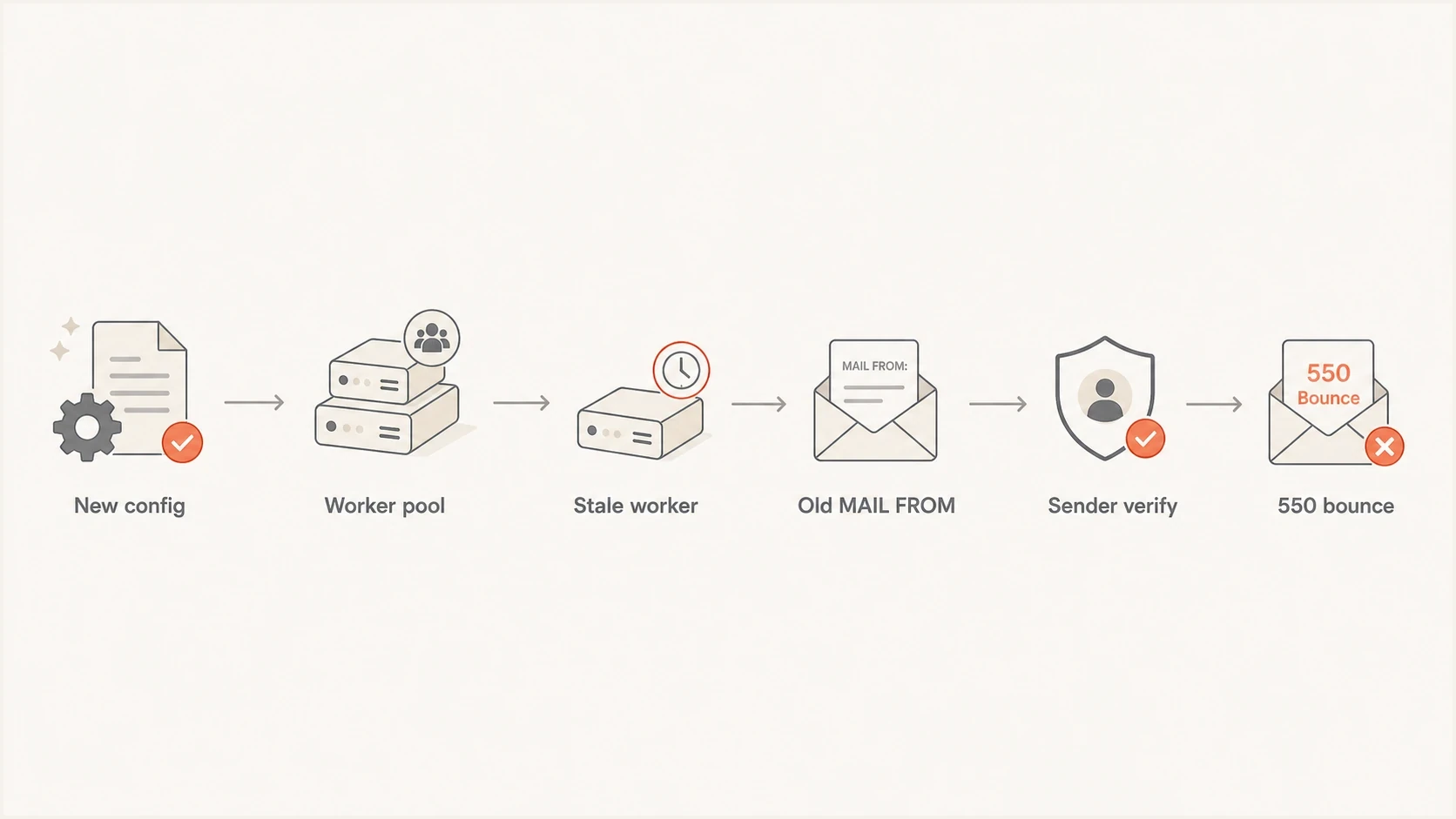
A flowchart showing one stale worker sending an old return path that triggers a 550 bounce.
What to inspect first
Start with evidence from the failed SMTP transaction, not evidence from the normal path. A passing test from the main sender is useful, but it does not catch a rare worker path unless that worker sends the test. Preserve several complete bounce diagnostics and the matching MTA log records without normalising their text.
- Bounce text: Capture the SMTP reply, enhanced status code, remote MX, command stage, and rejected sender address.
- MTA logs: Search by recipient, queue ID, rejected sender, and exact timestamp to recover the outbound MAIL FROM.
- Message evidence: Use raw headers for accepted comparison messages, but do not treat them as proof of a transaction rejected before message data.
- Worker state: Compare running config, image version, environment variables, and restart time.
- Recipient cluster: Group failures by destination domain and MX to spot one strict or misconfigured receiver.
|
|
|
|---|---|---|
Old sender | Stale config | Trace worker |
One MX | Receiver rule | Compare samples |
No MX | DNS route | Fix DNS |
Mixed hosts | Rollout drift | Restart pool |
Use short labels first, then open the full logs for any repeated pattern.
Prove the actual return path
A controlled test helps if you can force traffic through each sender. Send one test per worker, region, or queue class and inspect the delivered result. Suped's email tester shows the authentication result for a message that was actually accepted. Use it to validate working routes, then use your MTA transcript for any route rejected before the receiver accepted message data.
Email tester
Send a real email to this address. Suped shows a results button when the test is ready.
?/43tests passed
If your sending platform does not let you pin a worker, add temporary logging around envelope sender creation. Log the sender address, worker ID, config version, queue ID, and message ID. Keep the log entry close to the SMTP transaction so template-level values do not mask a later rewrite.
Fields to log for each send
worker_id=mx-worker-17
config_version=2026-05-26-rp-shard
queue_id=4F29A1
mail_from=foo@rp.01.example.com
recipient_domain=recipient.example
After that, the investigation is mechanical. If every failure points to one worker or one old config version, fix deployment drift. If failures spread across all workers but only one receiver rejects them, investigate receiver-side sender verification and mail routing.
DNS and authentication checks
Even when a stale worker is likely, DNS still needs a clean pass. For the exact envelope sender domain in the failure, confirm consistent resolution, a usable MX route, active bounce handling, and SPF coverage for the sending IPs. Separately confirm that DKIM signs with the expected domain and that SPF or DKIM aligns with the visible From domain for DMARC. Use a domain health checker for the first pass, then inspect the exact failing domain and its DNS chain.
?
What's your domain score?
Deep-scan SPF, DKIM & DMARC records for email deliverability and security issues.
Do not check only the new return-path domain. Check the old one shown in the bounce too. If the old domain has no usable MX route, its bounce address rejects callback probes, or its DNS answers vary by resolver, the sender-verification failure matches the old sender the receiver saw.
DNS checks to compare
Check current return path:
rp.01.example.com. 300 IN MX 10 bounce.example.net.

Check old return path:
rp.example.com. 300 IN MX 10 bounce.example.net.

Check SPF at the envelope domain:
rp.01.example.com. 300 IN TXT "v=spf1 include:_spf.example.net -all"
Suped's DMARC monitoring is part of our product and can group authentication results by source and domain while you investigate deployment drift. It does not replace the failed SMTP transcript. Use Suped alerts to catch source or policy changes, and use blocklist monitoring when the same bounce cluster includes broader blocklist (blacklist) or reputation symptoms.
When the receiver is at fault
Sometimes the receiver is the faulty part. Small mailbox systems and filtering appliances can apply sender verification in a brittle way. They can reject valid subdomain setups, mishandle CNAME chains, retain stale DNS, or run callback checks that fail when the sender domain rejects probes by design.
How to identify a receiver-side issue
- Same message: The same sender, path, and headers pass at other receivers.
- Same MX: Failures cluster around one recipient MX or one hosting network.
- Same DNS: Public resolution shows a valid mail route for the exact envelope domain.
- Same timing: The failures stop after the receiver refreshes DNS, routing, or verification policy.
Keep the fix practical. If the receiver rejects an old return path that one sender still uses, that is a sender-side fix. If the receiver rejects a proven current return path, collect the transcript and ask the recipient-side postmaster to review the exact sender-verification rule.
Check receiver-side domain routing
A receiving system can retain your sender domain as a local mail domain after its email hosting has moved elsewhere. During sender verification, that server looks for the envelope sender in its own mailbox database instead of following the public MX route. The local mailbox does not exist, so the receiver returns 550 even though public DNS for the domain is correct.
- Confirm the cluster: Check whether failures occur only at one recipient MX, hosting network, or set of related domains.
- Compare routing views: Ask the recipient administrator whether the sender domain is classified as local or remote on the rejecting server.
- Remove stale ownership: The recipient administrator should remove the obsolete local-domain entry or change it to remote routing.
- Clear verification state: Refresh routing and sender-verification caches, then retest the exact envelope sender from an affected route.
What to send the recipient administrator
Provide the UTC timestamp, rejecting MX hostname, complete SMTP response, sending IP, exact MAIL FROM address, and public MX answer. Ask whether their server still treats the sender domain as locally hosted. This gives the administrator a routing question to test instead of a general deliverability complaint.
Fix and prevent it
The fix depends on which sender the failed message used. If you find an old worker, recycle it, remove stale containers, clear or drain old queues, and make the runtime config visible in logs. Keep the old return-path domain working for a defined grace period if recipients still have delayed mail, queued retries, or old bounce probes.
- Restart safely: Restart every sender instance and confirm each reports the same config version.
- Drain queues: Find old queued messages that already carry the stale envelope sender.
- Keep DNS: Leave necessary MX and SPF records in place for retired return-path domains during a defined migration window.
- Log identity: Add worker ID, config version, and envelope sender to every delivery log.
- Watch reputation: Check blacklist and blocklist status if bounces include broader reputation rejections.
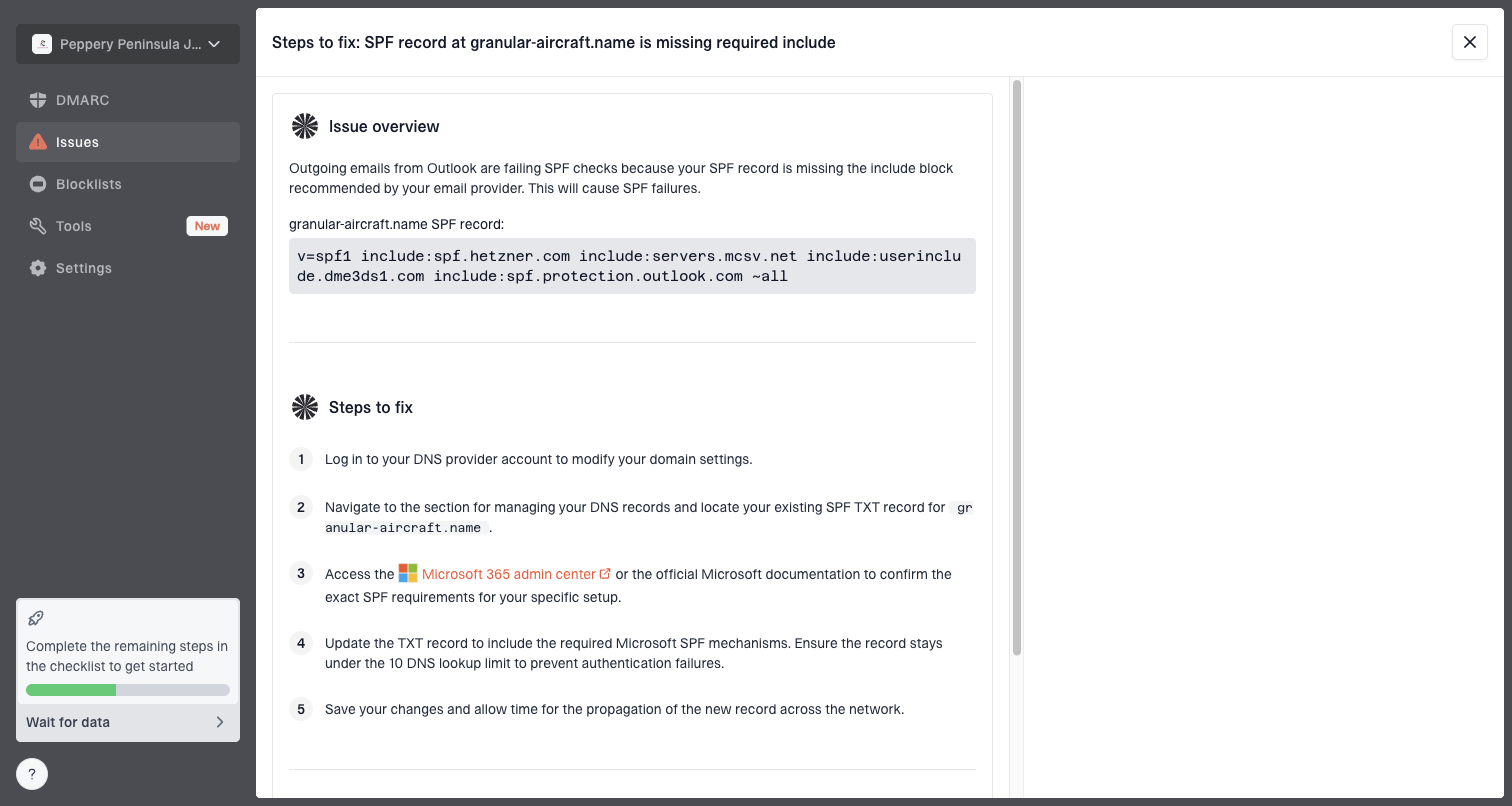
Issue steps to fix dialog showing the issue overview, tailored fix steps, and verification action
Suped is our DMARC and email authentication product. Use its source grouping and issue alerts to identify authentication drift, then record the affected worker, envelope domain, and remediation beside the incident. The SMTP transcript and MTA logs still provide the decisive evidence for this specific 550 response.
Views from the trenches
Best practices
Capture raw bounce text and headers before normalising data into dashboards or alerts.
Group failures by worker, queue, sending IP, recipient MX, and exact MAIL FROM value.
Keep retired return-path domains routable during migrations and delayed queue retries.
Common pitfalls
Assuming the configured return path was used without checking the SMTP transaction.
Treating a tiny bounce rate as receiver fault before tracing worker-level config drift.
Removing old bounce-domain DNS immediately after a sharded return-path migration.
Expert tips
Add config version and worker ID to delivery logs so rare errors become searchable.
Test each sending route separately when one shared test message returns clean results.
Check CNAME and MX chains for retired domains because sender verification follows DNS.
Marketer from Email Geeks says actual domains and full bounces matter because DNS guesses rarely settle sender verification cases.
2024-09-16 - Email Geeks
Marketer from Email Geeks says a 0.05% rejection rate often points to a tiny receiver cluster or one unusual filtering setup.
2024-09-16 - Email Geeks
The practical bottom line
A 550 Sender Not Verified error with a shortened or old return path is not proof that a recipient provider stripped your subdomain. It proves that the receiver rejected the envelope sender it saw. The fastest path is to prove the observed sender, trace it back to a worker or route, and only then investigate recipient-side verification.
Use this fix order: preserve the bounce, capture the SMTP stage and enhanced status code, search MTA logs for the rejected sender, compare worker config versions, verify DNS for the old and current return-path domains, then rerun controlled tests. Once the bad path is gone, keep monitoring so later drift produces an actionable issue instead of an unexplained bounce.