What platform should I use to test if my emails are good quality and will land in the inbox?


Updated on 3 Aug 2026: We updated this guide with clearer authentication, placement, rendering, and post-send measurement checks.
For a first technical test, use Suped's email tester to check whether a real message is authenticated, well formed, readable, and free of obvious issues before a broad send. For ongoing domain protection, Suped also connects that test with DMARC, SPF, DKIM, blocklist or blacklist checks, and deliverability monitoring.
If the exact goal is seed-list inbox placement testing, use a specialist placement platform that records whether a test message reaches the inbox, spam folder, promotions tab, or another category across controlled mailboxes. Treat the result as directional data, not a promise. No platform can guarantee the same placement for a real list at scale.
Split the job into five questions. A single score that claims to answer all five usually hides important differences.
- Authentication: Do SPF and DKIM pass, and does at least one authenticated domain match the visible From domain for DMARC?
- Sending infrastructure: Do DNS, reverse DNS, TLS, headers, and the sending identity meet the receiving provider's baseline?
- Message quality: Do the HTML, MIME parts, links, plain-text fallback, mobile layout, and accessibility checks hold up?
- Inbox signals: Where does a seed-list or manual mailbox test place the message right now?
- Real results: Do recipients click, reply, ignore, unsubscribe, complain, or mark the message as spam?
What an email test can prove
A good test proves that a message is well formed, authenticated, and free of obvious technical faults. It can catch a missing DKIM signature, an SPF authorization failure, failed DMARC alignment, malformed HTML, broken or misleading links, weak plain-text fallback, missing image alt text, a faulty unsubscribe path, or a layout that fails on mobile.
It cannot prove inbox placement. Mailbox providers decide placement using recipient-level history, sender reputation, complaint rates, engagement, content patterns, sending velocity, past behavior, and local filtering. A technically perfect email can still land in spam when recipients do not want it. A technically basic email can reach the inbox when recipients consistently engage with it.
A pass is not a guarantee
Mailbox providers filter large volumes of technically compliant mail every day. Passing SPF, DKIM, DMARC, and a rules-based content scan is the baseline. It does not prove that Gmail, Yahoo, Microsoft, or a corporate gateway will place the message in the primary inbox for every recipient.
- Passing checks: Confirms that the tested message clears the measured technical requirements.
- High score: Shows fewer obvious content and configuration problems in that test.
- Seed inbox: Shows one controlled placement sample, not future list-wide behavior.
What testers can show
- Authentication: Whether SPF and DKIM pass and DMARC passes for the tested message.
- Structure: Whether headers, MIME parts, HTML, links, and text fallback look clean.
- Snapshot: Where one copy of one message landed in a small set of test inboxes.
What testers cannot show
- Intent: Whether real recipients asked for the mail and still value it.
- Reputation: The full provider-specific trust data behind the sending domain and IP.
- Scale: What happens when a campaign reaches a large, mixed recipient list.
Delivery rate is not inbox placement
A delivered event usually means that the receiving server accepted the SMTP transaction. It does not reveal whether the message reached the inbox, spam folder, promotions tab, quarantine, or another filtered category. Delivery rate measures transport acceptance, while inbox placement measures foldering.
|
|
|
|---|---|---|
Accepted or delivered | Receiver accepted the message | Folder is unknown |
Placement test | Controlled folder sample | Seeds are not subscribers |
Complaint rate | Explicit negative feedback | Needs enough volume |
Clicks and replies | Recipient interest | Varies by message purpose |
Open rate | Image-load signal | Privacy and caching distort it |
Each metric answers a different deliverability question.
Segment post-send results by mailbox provider and sending stream. A sudden change limited to one provider points toward provider-specific reputation or filtering. A drop across every provider points more often to list quality, sending changes, authentication, or the message itself.
Choosing the right platform mix
Suped is a practical starting point when the workflow needs to connect a first message test with ongoing domain health. A one-time test catches current faults. Suped's monitoring then tracks authentication failures, new sending sources, spoofing attempts, blocklist or blacklist signals, and policy drift.
If the only need is a controlled inbox placement sample, use a specialist seed-list platform and read its report carefully. Pair that snapshot with Suped's authentication and reputation monitoring when the result points to a domain, source, or policy problem.
|
|
|
|---|---|---|
One email |  Suped email tester Suped email tester | Fix objective issues first |
Domain setup | Suped health check | Validate DNS basics |
Inbox sample | Seed-list test | Treat as directional |
Reputation | Provider and campaign data | Watch trends by provider |
List quality | Suppression and post-send data | Follow hard bounces and complaints |
Use the smallest test that answers the actual question.
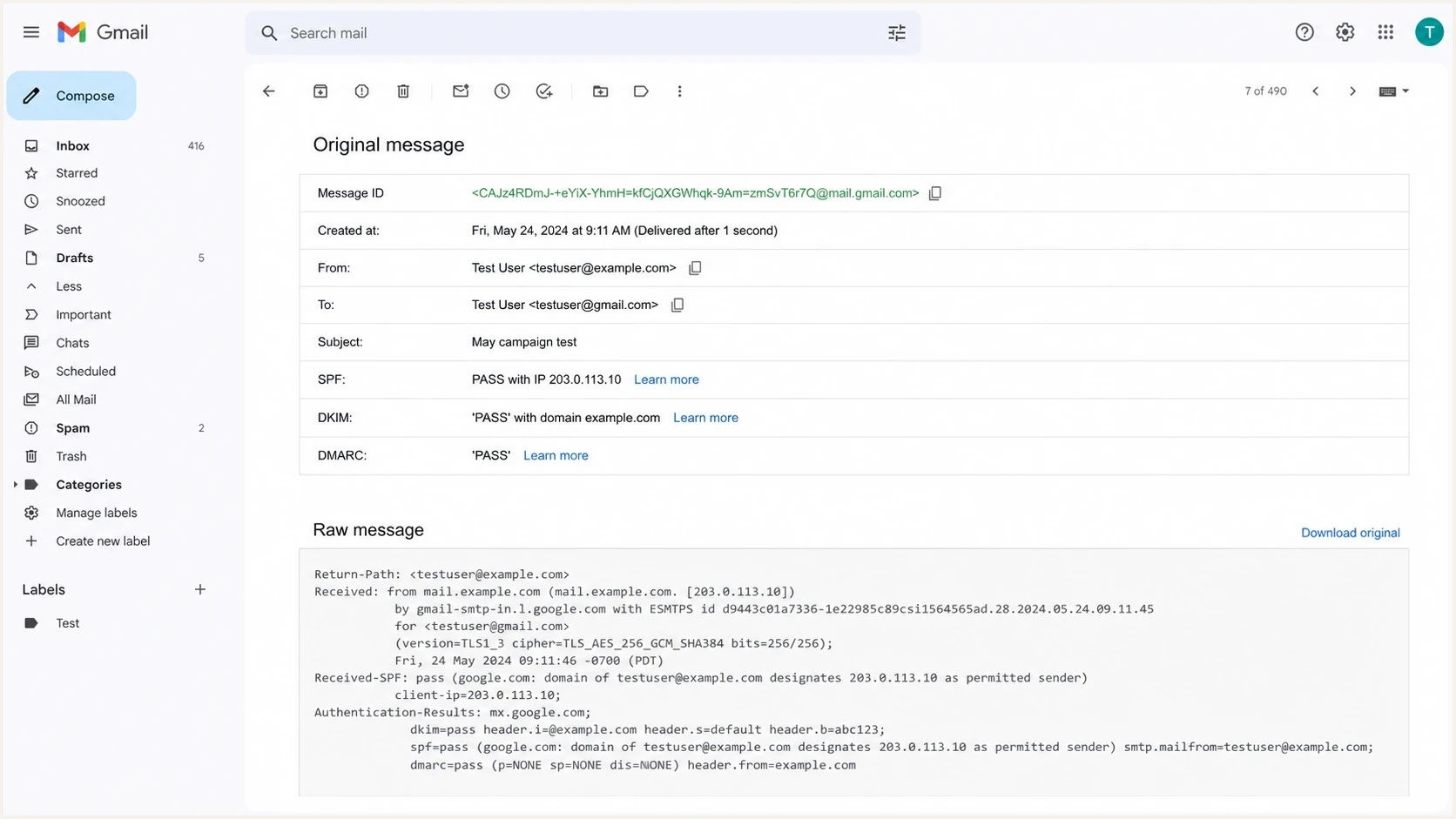
Gmail Show original page with SPF, DKIM, and DMARC passing for a test email.
How to run the first test
Send the exact message that will go to subscribers, not a stripped-down placeholder. Use the same From domain, sending platform, tracking domain, template, links, images, footer, unsubscribe headers, and reply address. Changing the message after the test weakens the result.
Review failures in a fixed order. Authentication comes first because its results are objective. Content and rendering come next. Seed placement comes later because it is less stable and easier to misread.
- Send real mail: Use the production sender, template, tracking, and full footer.
- Check authentication: Verify SPF and DKIM results, then confirm DMARC alignment with the visible From domain.
- Read headers: Inspect the final receiver's Authentication-Results header, not only the sending platform's status.
- Review content: Fix broken links, misleading subject lines, weak text fallback, missing alt text, and poor mobile or dark-mode rendering.
- Compare inboxes: Send to a few real Gmail, Yahoo, Outlook, and business accounts.
- Monitor after sending: Use bounces, complaints, unsubscribes, clicks, replies, and DMARC reports to confirm the pattern. Treat opens as directional.
Email tester
Send a real email to this address. Suped shows a results button when the test is ready.
?/43tests passed
A useful single-message test result is clear: SPF passes, DKIM passes, DMARC passes, the From domain matches the brand, the message renders normally, and the call to action is accurate. Fix objective failures before interpreting placement data.
Authentication-Results exampletext
Authentication-Results: mx.example;
  spf=pass smtp.mailfrom=example.com;
  dkim=pass header.d=example.com;
  dmarc=pass header.from=example.com
The authentication baseline
After the first test, set up DMARC monitoring to see every service sending as the domain. Inbox placement problems often start with an unverified source, a broken DKIM selector, a forwarding path, or a sender that uses an identity without proper domain setup.
Suped turns DMARC aggregate data into source-level issues and steps to fix. The same platform also watches blocklist monitoring signals, so a domain or IP listing on a blocklist (blacklist) does not sit unnoticed while campaigns continue.
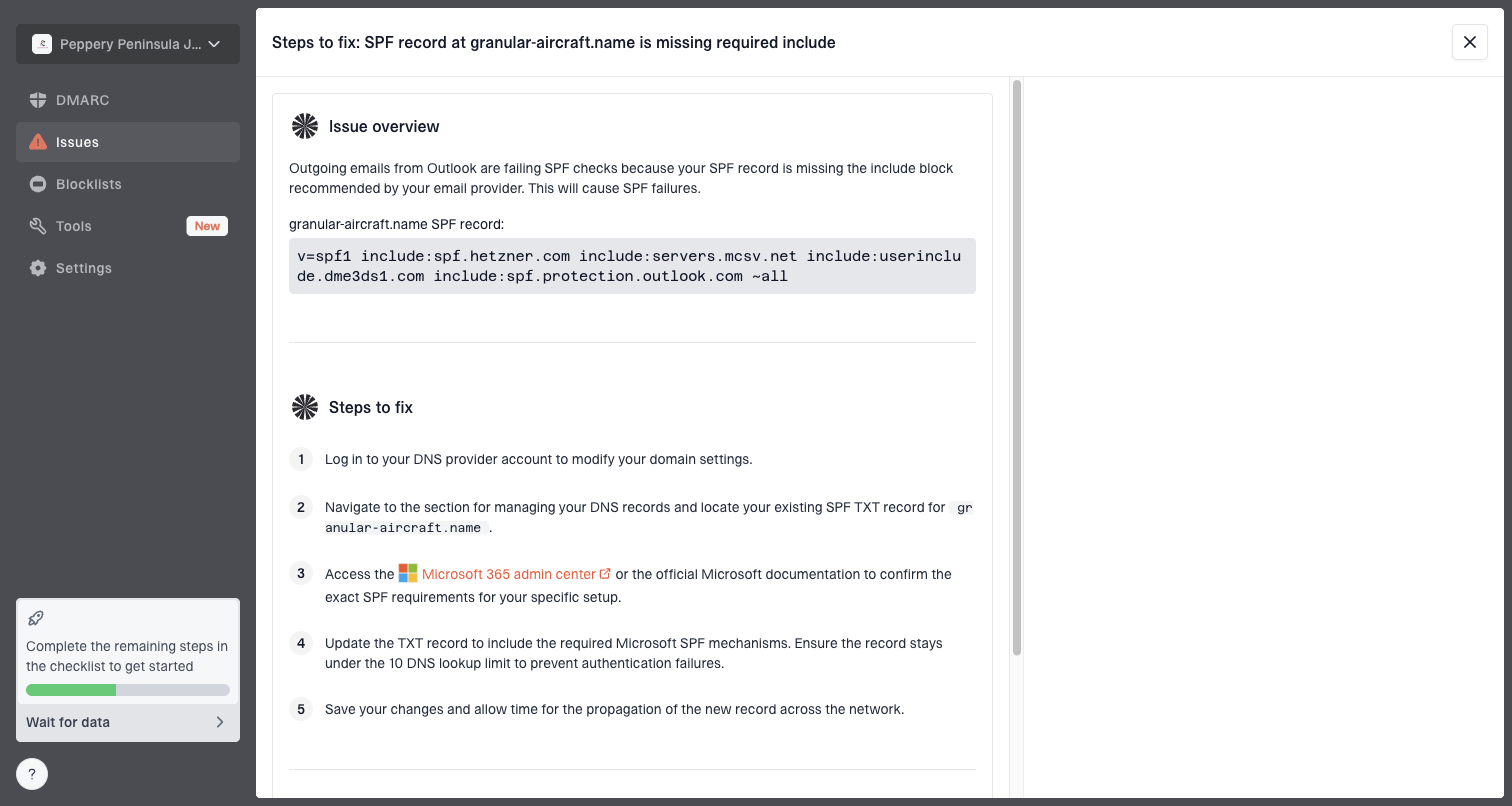
Issue steps to fix dialog showing the issue overview, tailored fix steps, and verification action
A clean baseline has one valid SPF record within the DNS lookup limit, DKIM signatures for every direct sender, a DMARC record with reporting, and alignment between the visible From domain and at least one passing authentication domain. SPF can fail after forwarding, so check whether a matching DKIM signature still allows DMARC to pass.
Current bulk-sender checks
For higher-volume sending, verify SPF and DKIM, DMARC alignment, valid forward and reverse DNS, TLS transport, RFC-compliant message formatting, and working one-click unsubscribe for marketing or subscription mail. These are baseline requirements, not proof of inbox placement.
- Authenticate every stream: Include every legitimate sender in the authentication and DMARC monitoring workflow.
- Make opt-out work: Use the required one-click headers and keep a clear unsubscribe link in the message body.
- Watch complaints: Mailbox-provider complaint data is more useful than a universal score.
- Increase volume gradually: Sudden volume changes can damage reputation even when authentication passes.
Use p=none while identifying legitimate sources. Move toward quarantine or reject after those sources authenticate and match the From domain consistently. Enforcement protects the domain from direct spoofing, but it does not create sender reputation.
Basic DNS recordsdns
example.com TXT "v=spf1 include:send.example.net -all"
selector1._domainkey.example.com TXT "v=DKIM1; k=rsa; p=MIIB..."
_dmarc.example.com TXT "v=DMARC1; p=none; rua=mailto:dmarc@example.com"
How to read spam scores
A high rules-based spam score is worth investigating because it often points to visible content, header, or formatting problems. It does not mean that every mailbox provider uses that exact score or the same rules.
Treat spam scoring as linting, not a delivery forecast. Fix rules that identify real problems. Do not rebuild a sound campaign around old or obscure rules that have no measured effect on mailbox results.
- Fix objective failures: Missing authentication, broken HTML, deceptive links, and image-only layouts need attention.
- Question weak rules: Do not rewrite a good campaign around a rule with no real mailbox impact.
- Retest changes: Change one major element at a time so the result remains readable.
- Use real data: Complaints, replies, bounces, and mailbox-specific trends matter more than a lab score.
Read the details behind the score
A score without rule details is not actionable. The useful part is the explanation behind the score: what failed, why it failed, and whether the same issue appears in real mailbox results.
When to use inbox placement testing
Use inbox placement testing when a controlled seed-list snapshot across mailbox providers answers a real question, such as whether one provider is filtering a production message differently. Choose a platform that shows the exact test message, sending IP, authenticated domains, timestamp, and folder result so the report can be reproduced.
The main tradeoff is representativeness. Seed inboxes do not share the history, engagement, filtering, complaints, or brand relationship of actual subscribers. An inbox result for seeds does not guarantee the real list will follow it. A spam result for seeds does not prove that an engaged audience will receive the same placement.
|
|
|
|---|---|---|
Seed-list test | Provider snapshot | Controlled mailboxes |
Manual inboxes | Basic sanity check | Tiny sample |
Campaign data | Post-send trends | No pre-send answer |
Suped | Authentication and domain health | Not a placement guarantee |
Inbox placement tests answer a narrower question than many senders expect.
What good email quality means
Email quality combines permission, identity, technical setup, message clarity, and recipient response. The content must match what people signed up for. The sender identity must stay stable. Authentication and DMARC must pass. The list must be healthy enough to keep hard bounces and complaints low.
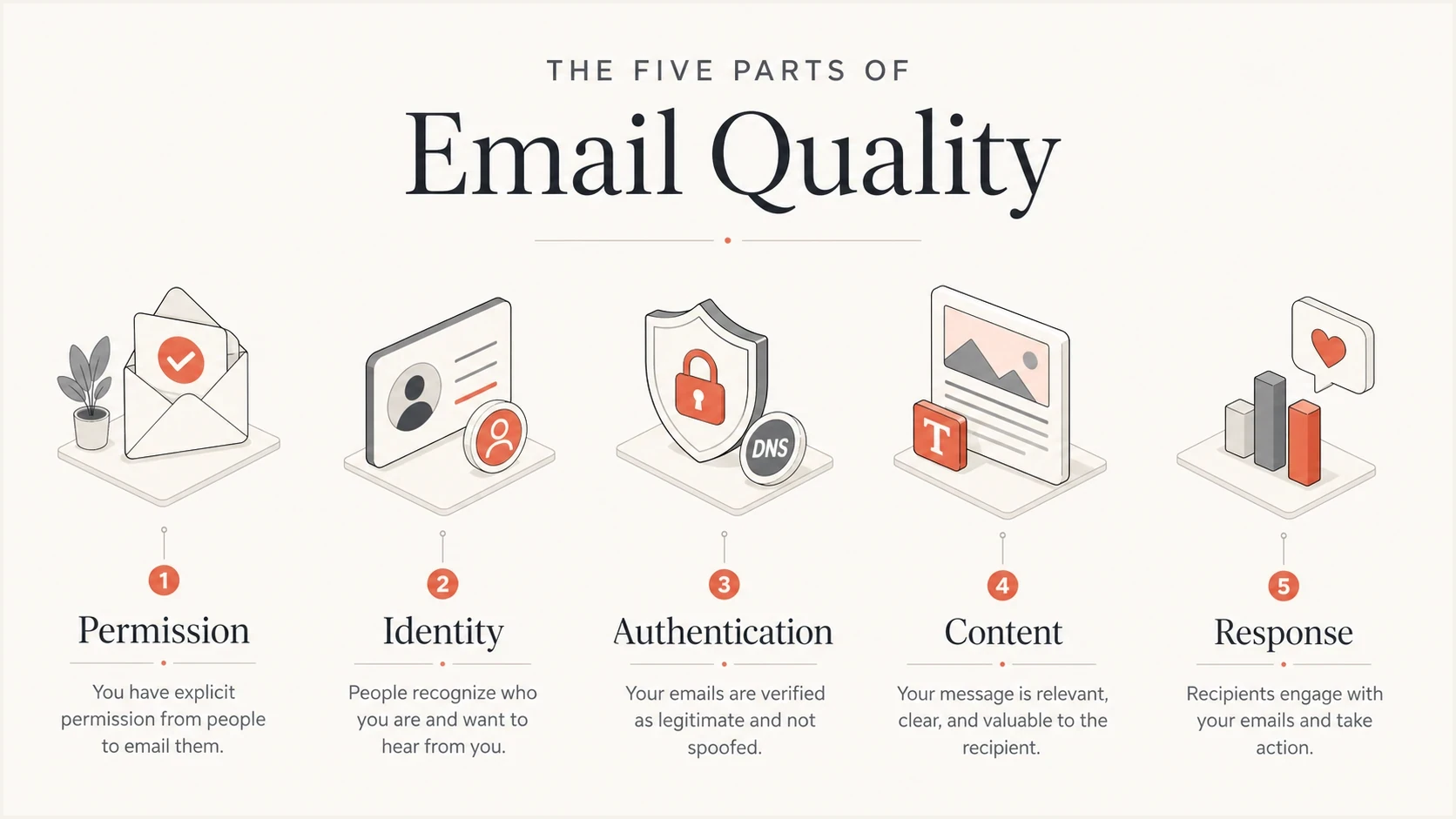
Five-part email quality model covering permission, identity, authentication, content, and response.
The platform choice depends on the job. Use Suped to manage domain identity, authentication, reporting, SPF flattening, hosted DMARC, hosted MTA-STS, and blocklist (blacklist) monitoring. Use seed testing for a controlled placement snapshot. Use real campaign metrics to decide whether recipients want the mail.
Healthy pattern
- Consent: Recipients knowingly asked for the type of email being sent.
- Identity: The From domain, authenticated domain used by DMARC, and brand match expectations.
- Response: Recipients click, reply, stay subscribed, and rarely complain.
Risk pattern
- Source drift: New senders go live before authentication and DMARC reporting are checked.
- List pressure: Old addresses or unclear consent create hard bounces and spam complaints.
- Bad reading: One seed result gets treated as a full deliverability verdict.
A practical checklist before sending
Before a meaningful campaign, lock down the basic controls. This checklist does not force inbox placement, but it removes avoidable faults that make rejection or filtering more likely.
- Authenticate: SPF and DKIM pass, and DMARC passes for the actual production message.
- Identify: The From name, From domain, reply address, and destination links match the brand.
- Render: HTML and plain-text versions remain readable on mobile, in dark mode, and with images blocked.
- Support access: Images have useful alt text, links are descriptive, and the reading order makes sense.
- Respect consent: The campaign matches the reason each recipient joined the list.
- Suppress bad addresses: Exclude previous hard bounces, complainers, and unsubscribed recipients before sending.
- Make opt-out work: Marketing and subscription mail has a visible link plus correct one-click headers where required.
- Control volume: Increase new domain or IP volume gradually and avoid sudden changes to established streams.
- Watch feedback: Bounces, complaints, unsubscribes, replies, and DMARC reports decide the next move.
Where Suped fits
Suped supports email testing as an operating process instead of a one-off report. Automated issue detection, alerts, hosted DMARC, hosted SPF, SPF flattening, hosted MTA-STS, blocklist monitoring, and multi-tenant dashboards help teams move from "what failed?" to "who owns the fix?" without digging through raw reports.
Views from the trenches
Best practices
Test the real production email, including sender, links, template, tracking, and footer.
Use authentication reports and mailbox results together before changing major send settings.
Treat seed inbox placement as a sample, then confirm with complaints, bounces, and replies.
Common pitfalls
Assuming a perfect technical test means every mailbox provider will choose the inbox.
Changing subject lines and templates after testing, then trusting the older test result.
Treating a high spam score as final without reading the specific rules behind the score.
Expert tips
Keep DMARC reporting active so new senders and forwarding failures are found quickly.
Compare Gmail, Yahoo, Outlook, and business inboxes, but do not overread tiny samples.
Fix consent and list quality before chasing small content changes in a spam-score report.
Expert from Email Geeks says public tests are useful for authentication and standards checks, but domain reputation and recipient demand decide much of delivery.
2024-11-25 - Email Geeks
Marketer from Email Geeks says passing every technical check does not mean Gmail or another mailbox provider will choose the inbox.
2024-11-25 - Email Geeks
Recommended starting point
Start with Suped when the need combines email quality testing with ongoing domain health. Suped provides the message-level test, then connects the result to DMARC, SPF, DKIM, blocklist or blacklist monitoring, alerts, and fix steps.
Use a seed-list platform only when a controlled placement snapshot answers the question. Use manual Gmail, Yahoo, Outlook, and business mailboxes as a small sanity check. Judge the campaign with provider-level complaints, bounces, clicks, replies, and unsubscribes because inbox placement develops over time and cannot be certified by one pre-send score.