What is the current status of the Libero.it email service outage and delivery issues?

Published 4 Jun 2025
Updated 27 Jul 2026
9 min read
Summarize with
Updated on 27 Jul 2026: We refreshed the status check and added practical guidance for later incidents and sender recovery.
The direct answer: Libero.it's official status page showed all systems operational when checked on July 28, 2026, and recent public website checks did not indicate a broad outage. These signals cover service and website availability, not guaranteed inbound SMTP health. Treat isolated delivery problems as receiver-specific delays, sender reputation issues, mailbox-level problems, or transient SMTP deferrals until logs show the same pattern across multiple senders or networks.
The most severe known disruption began in January 2023 and affected Libero Mail and Virgilio Mail. During that event, inbound MX connections failed, messages were delayed, and senders saw deferrals even after public recovery notices appeared. Libero Mail also had later incidents, including a second multi-day disruption in June 2023 and shorter access problems in July 2024 and June 2025.
- Current answer: Treat Libero.it as operational unless recent SMTP logs show repeated receiver-side 4xx deferrals, connection failures, or unusual queue age.
- Historical outage: The January 22-28, 2023 incident affected mailbox access and inbound mail delivery.
- Best sender move: Segment Libero.it traffic, throttle if deferrals climb, and avoid rewriting SPF, DKIM, or DMARC records without evidence.
Current status in plain terms
Libero.it's official status page showed "All Systems Operational" on July 28, 2026. Public website response checks can confirm that the site loads, but they do not prove that inbound SMTP delivery is healthy. Email delivery needs SMTP evidence, including connection success, accepted messages, deferral codes, retry age, and inbox arrival time.
How to read the status
If a campaign to Libero.it is delayed, first isolate Libero.it from the rest of the send. If traffic to other mailbox providers is normal, the evidence points to a receiver-specific issue. If every major receiver shows the same pressure, investigate the sending infrastructure, content, IP reputation, and authentication.
|
|
|
|---|---|---|
4xx spike | Temporary deferral | Throttle |
451 slow down | Destination rate limit | Reduce concurrency |
Timeouts | MX reachability | Retry later |
5xx unknown user | Permanent rejection | Suppress |
Slow inbox | Post-acceptance delay | Measure |
All domains | Sender-side issue | Audit |
Use these compact signals to separate a receiver issue from a sender issue.
One nuance matters with Libero.it: webmail status, mobile app status, POP or IMAP access, and inbound MX acceptance are different channels. A user can open the mailbox while a sender still sees deferrals. A sender can also get SMTP acceptance while the recipient sees the message late. Separate "site is up" checks from real mail-flow checks.
For a sender, the strongest current-status signal is the most recent delivery window. Review the last few hours of Libero.it traffic rather than old global complaint volume. If acceptance and queue age match the normal baseline, and test recipients confirm timely inbox arrival, continue sending. If those signals disagree, slow the segment and keep measuring before changing anything else.
What happened in January 2023
The January 2023 event was a service disruption affecting mailbox access and inbound delivery, not a normal spam-filtering complaint. Incident reporting at the time recorded failed connections followed by significant delivery delays while the service returned progressively.
The incident also had public attention in Italy. A Reuters report described government pressure for clarification and a prompt fix after the outage affected a large number of Italian email users. The operational lesson is that accepted mail, user access, app behavior, and inbox visibility can recover at different speeds after a storage or platform incident.
During the outage
- Connections: Some senders could not connect reliably to Libero.it MX hosts.
- Deferrals: Senders saw temporary failures rather than clean final bounces.
- User access: Mailbox access and app behavior recovered unevenly.
During recovery
- Batches: Mailboxes appeared to return in groups rather than all at once.
- Queues: Delivery could improve for one sender while another still struggled.
- Risk: Full-volume sending too early risked wasted retries and poor timing.
SMTP symptoms to look fortext
connect to mx.example[192.0.2.10]:25: Connection timed out
421 4.7.0 temporary local problem, try again later
451 4.3.0 mailbox temporarily unavailable
250 2.0.0 accepted, but inbox placement delayed
Other Libero Mail outages since 2023
January was not the last service interruption. A second multi-day outage affected Libero Mail and Virgilio Mail in June 2023. Shorter access incidents were reported on July 22, 2024 and June 11, 2025.
|
|
|
|---|---|---|
June 13-19, 2023 | Mailbox and app access were disrupted; inbound delivery was delayed or failed. | Access returned progressively, while final delivery depended on queued mail and sender retries. |
July 22, 2024 | Users reported webmail access failures, including 504 errors. | Service reports normalized within hours. |
June 11, 2025 | Users reported login problems and interruptions to sending or receiving. | Access returned the same day, although some users still reported slowness. |
Later public incidents help separate old outage reports from current service evidence.
These incidents explain why a current search can surface convincing outage reports even when the service is operational. Match every report to its publication date, then confirm the present condition with the official status and recent SMTP evidence.
How to decide whether to send
The decision is not binary. Split it by message urgency, domain segment, and observed SMTP behavior. Transactional mail should keep retrying within normal queue rules unless the receiver returns permanent failures. Marketing mail can wait when inbox timing matters and Libero.it delivery is unstable.
Libero.it send decision bands
Compare current deferrals and queue age with the normal Libero.it baseline. No universal percentage proves an outage.
Normal
At baseline
Acceptance and queue clearance match normal behavior
Watch
Above baseline
Deferrals or latency are rising, but retries succeed
Throttle
Sustained
Repeated 4xx replies continue while queue age rises
Pause
Severe
Connections fail or urgent messages expire before delivery
- Transactional: Keep normal retry behavior, but alert support teams if confirmation emails arrive late.
- Marketing: Pause or slow sends when the campaign relies on same-day engagement.
- Warmup: Hold Libero.it volume steady instead of increasing traffic during unstable acceptance.
- Rate limit: If the reply says "451 too many messages, slow down," reduce per-IP concurrency and add a per-destination delay.
- Proof: Keep timestamps, SMTP replies, IPs, message IDs, and delivery latency samples.
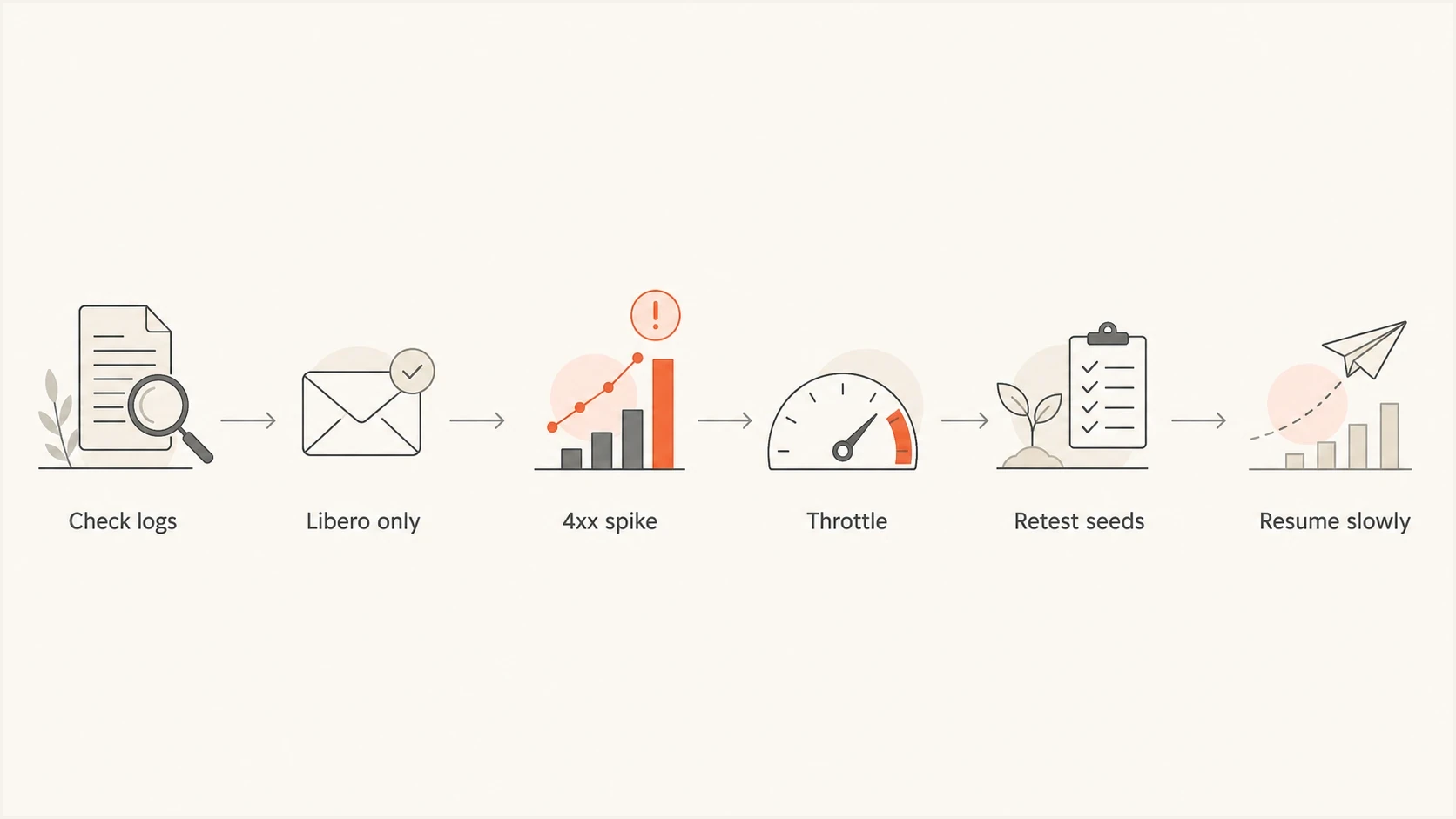
Flowchart for deciding whether to throttle or resume Libero.it sends.
If hard bounces replace temporary deferrals, compare the exact enhanced status code and wording. A 550 5.1.1 unknown-user reply should stay suppressed, while a 5.7.x policy rejection needs sender-side investigation. Do not classify either response as an outage solely because Libero.it has a history of incidents.
How to troubleshoot your own side
Before blaming Libero.it, send a controlled test and inspect what happens. Use an email tester to verify the message path, headers, authentication results, and content signals. Then compare that result with production SMTP logs for Libero.it recipients.
Email tester
Send a real email to this address. Suped shows a results button when the test is ready.
?/43tests passed
The next check is domain hygiene. A domain health checker gives a broader view of SPF, DKIM, and DMARC. For ongoing visibility, DMARC monitoring helps separate legitimate senders from failing sources. If deferrals look reputation-related, blocklist monitoring helps track blocklist and blacklist signals without treating every Libero.it delay as an authentication failure.
Also inspect the suppression list after any confirmed outage. Temporary receiver failures sometimes become hard-bounce suppressions in sending systems. Remove an address only when logs show it was suppressed solely because of a transient Libero.it failure and a fresh test confirms recovery. Keep unknown-user bounces, invalid domains, complaints, and unsubscribes suppressed.
Minimum incident logtext
receiver: libero.it
first seen: YYYY-MM-DD HH:MM UTC
last seen: YYYY-MM-DD HH:MM UTC
symptom: repeated 4xx deferrals
sample: 421 temporary local problem
action: throttle and retest after the next retry window
Do not change DNS too quickly
Changing SPF, DKIM, or DMARC during a receiver outage often creates a second problem. If authentication passed before the Libero.it issue started, keep DNS stable and focus on queue behavior, deferral rates, and retry timing.
Where Suped fits
Suped is our DMARC reporting and email authentication platform. During a receiver incident, use Suped to confirm whether SPF, DKIM, and DMARC pass rates changed by sending source, review unexpected senders, and preserve an authentication timeline alongside SMTP logs. Suped does not prove that Libero.it's MX service is healthy, so receiver replies and queue metrics remain the deciding evidence.
Issues page showing top issues, verified sources, unverified sources, and authentication pass rates
Manual tracking
- Logs: Pull SMTP samples from each sending system.
- DNS: Check SPF, DKIM, and DMARC records one by one.
- Alerts: Build thresholds across the systems used for monitoring.
Suped workflow
- Sources: See verified and unverified senders in one place.
- Issues: Review detected authentication issues with steps to fix.
- Scale: Use MSP and multi-tenant views for many domains.
Practical Suped setup
- Monitor: Track DMARC authentication by sending source and domain.
- Alert: Trigger real-time alerts when failure rates move above the chosen threshold.
- Manage: Use hosted SPF, hosted DMARC, and hosted MTA-STS to reduce DNS maintenance.
- Report: Give support teams and clients a clear authentication timeline.
Views from the trenches
Best practices
Track Libero deferrals separately so broad campaign metrics do not hide receiver delays.
Pause non-urgent mail when test inboxes move from minutes to unbounded delivery time.
Keep failed-send samples with timestamps, MX hostnames, SMTP codes, and retry counts.
Common pitfalls
Calling an outage resolved too early hides mailbox batches still being restored later.
Assuming all 4xx replies are reputation problems wastes time during provider outages.
Restarting full volume after one fast test ignores queues that fail under load again.
Expert tips
Compare affected mail against unaffected domains before changing authentication records.
Use separate throttles for Libero and Virgilio during shared receiver-side symptoms.
Watch queue age and retry success, not only final bounces, during a slow recovery.
Marketer from Email Geeks says the earliest sign was not a spam-folder problem, but Libero.it MX hosts failing to accept connections.
2023-01-25 - Email Geeks
Marketer from Email Geeks says public recovery notices came before all senders saw stable delivery, so continued deferrals still mattered.
2023-01-27 - Email Geeks
Practical next step
Libero.it's official status was operational at the latest check, with no confirmed broad outage. If Libero.it delivery is poor now, prove the scope before taking action. Separate Libero.it traffic, watch queue age, collect SMTP replies, and compare the results with unaffected receivers.
- Separate: Pull Libero.it metrics out of the overall campaign report.
- Measure: Track accepted mail, deferrals, timeouts, final bounces, and inbox arrival.
- Throttle: Slow non-urgent mail if deferrals or queue age keep climbing.
- Resume: Increase volume gradually after multiple clean test windows.
Do not treat every Libero.it delay as a DMARC problem, and do not treat every old outage report as current evidence. Receiver outages and sender-side failures can look similar at first. The logs decide which one is happening.




