What are the ethical concerns of using Cloudflare for online content protection?

Updated on 10 Aug 2026: We added current guidance on Cloudflare's AI crawler controls, publisher choice, abuse handling, and provider dependency.
The ethical concerns of using Cloudflare for online content protection are traffic visibility, centralized control, abuse handling, user access barriers, complainant safety, legal jurisdiction, AI crawler governance, and dependency on one provider for critical web delivery. The answer is not that Cloudflare is always wrong to use. A reverse proxy changes who can see, route, challenge, cache, and interrupt access to a site, so the decision needs a real risk review instead of a quick security checkbox.
Cloudflare is a powerful security control with ethical side effects. It can absorb attacks, hide origin infrastructure, and reduce commodity abuse. It also places a major intermediary between a publisher and the reader. That intermediary can affect privacy, due process, abuse reporting, and access for people using VPNs, Tor, hardened browsers, older devices, or unstable networks.
- Traffic visibility: A proxied site sends requests and responses through Cloudflare's edge, including dynamic paths unless you design around that.
- Abuse shielding: The same protection that keeps a legitimate site online can also make harmful or illegal operators harder to disrupt.
- Access fairness: Bot scoring, challenges, and rate limits can block real people who look risky to automated systems.
- Power concentration: One provider can become a policy choke point for DNS, TLS, WAF rules, analytics, AI crawler access, and availability.
The core tradeoff
Cloudflare's public position separates hosting products, security services, and core Internet services. In its abuse policies, Cloudflare says it has stronger content removal responsibility where it hosts content, while its proxy and security services are treated more like protective infrastructure. That distinction matters technically, but it does not remove the ethical burden for a site owner choosing the service.
The hardest part is that both sides are true. Taking away DDoS protection based on public pressure can create a censorship tool. Refusing to act without a narrow legal trigger can leave victims, targets, complainants, and investigators dealing with slow or indirect remedies. Centralization also creates correlated failure risk because an edge rule, control-plane fault, or shared dependency can affect many protected sites at once. A responsible decision names these tensions and tests a fallback path instead of hiding behind the word "security".
Answer in one paragraph
The ethical concern is that Cloudflare protection gives a private company operational influence over site availability, visitor privacy, abuse response, crawler access, and user friction at Internet scale. For low-risk public sites, the tradeoff is often acceptable. For sensitive communities, high-risk speech, regulated data, or services that receive abuse reports, require a written threat model, an abuse escalation path, and a tested fallback plan before putting dynamic traffic behind the reverse proxy.
What Cloudflare protects
- Availability: DDoS absorption keeps sites reachable during volumetric attacks.
- Origin privacy: Reverse proxying can hide the origin server address.
- Attack filtering: WAF rules and bot controls reduce routine exploitation attempts.
What Cloudflare concentrates
- Visibility: The proxy can inspect traffic needed for filtering and caching.
- Control: Rules at the edge can challenge, block, or route visitors and crawlers.
- Policy power: Abuse, legal, crawler, and account decisions can change access quickly.
What Cloudflare can see
The privacy question is technical before it is moral. If Cloudflare is used only for DNS without the orange-cloud proxy, it does not sit in the HTTP request path. If the proxy is enabled, the browser establishes TLS with Cloudflare first. A concise proxy risk explanation makes the trust boundary clear: the proxy needs to decrypt traffic at the edge to apply many of the protections people turn on.
Typical request path with proxy enabledtext
User browser
  |
TLS session to Cloudflare edge
  |
WAF, bot rules, cache, logging
  |
TLS session to origin server
That does not mean Cloudflare staff read every request. It means the architecture creates technical access and operational dependency. For a brochure site, that is usually a manageable trust decision. For account dashboards, abuse intake forms, private communities, healthcare, legal, or payment flows, the trust decision is much larger.
The review should separate transient processing needed to filter a request from data retained in logs. Document which fields are collected, how long they are kept, who can access them, where processing occurs, and which cross-border transfer terms apply. Disable unnecessary logging and redact sensitive values where the workflow allows it.
Proxy trust thresholds
Use the lowest trust band that satisfies the security need.
Low risk
DNS only
DNS only, no HTTP proxy path.
Managed risk
Static proxy
Proxy public assets and avoid private paths.
High risk
Dynamic proxy
Dynamic requests and account paths pass through the edge.
Critical
Sensitive data
Sensitive data, safety reports, or regulated workflows.
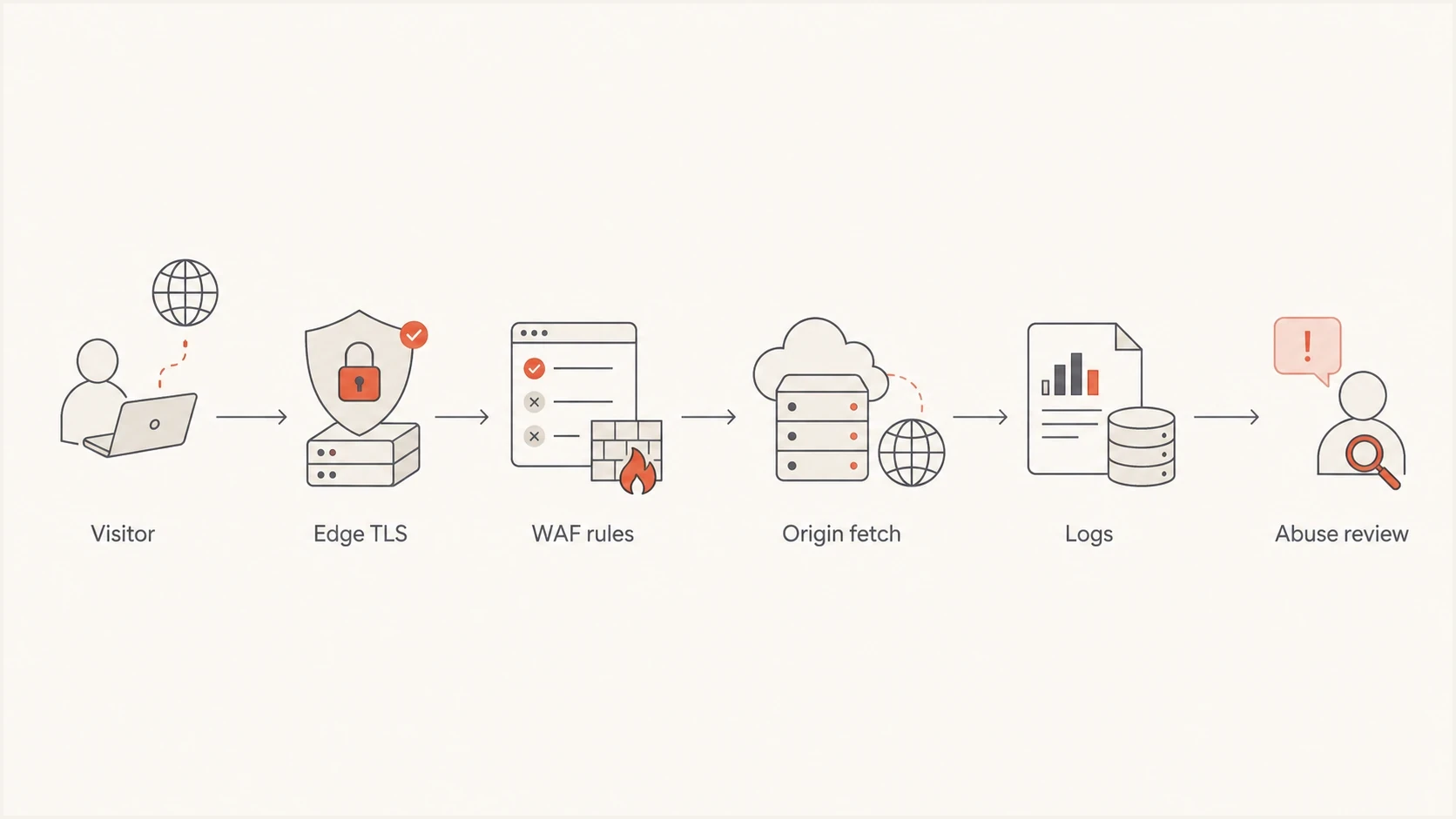
Flowchart showing how proxy traffic moves through edge TLS, WAF rules, origin fetch, logs, and abuse review.
Abuse handling and accountability
The most serious ethical concern is abuse handling. A proxy provider often has enough control to disrupt access, but not enough control to remove the underlying content from the origin host. That gap creates frustration for people reporting harassment, illegal content, malware, phishing, impersonation, or other harm.
Cloudflare's stated model puts more responsibility on services that store or host content, and less on security services that sit in front of content hosted elsewhere. For pass-through services, Cloudflare says it generally forwards substantially complete abuse reports to the responsible hosting provider and the website owner. The distinction has a coherent technical basis, but site owners still need to ask whether their use of the proxy makes harm harder to trace, report, or stop.
|
|
|
|---|---|---|
Traffic | Proxy decrypts | Trust concentration |
Abuse | Provider triage | Slow remedies |
Access | Bot scoring | User exclusion |
DNS | Edge routing | Vendor lock-in |
Law | Geo limits | Opaque access |
Compact risk map for Cloudflare-style online content protection.
Do not outsource the moral decision
A vendor policy is not your ethics policy. If your site handles sensitive reports, vulnerable users, political speech, or user-generated content, document what evidence you retain, who handles urgent abuse reports, what data is forwarded to third parties, and how you protect reporters from exposure.
User access and privacy costs
Cloudflare can challenge or block traffic that looks automated, risky, or abusive. That is useful during attacks. It also means a person using a privacy browser, a shared network, a VPN, Tor, or accessibility tooling can receive more friction than a person using a common browser on a common network.
This is an ethical issue because access friction is not evenly distributed. People who need privacy protections often have a reason. Journalists, activists, whistleblowers, domestic abuse survivors, and ordinary people on restricted networks can look suspicious to automated systems. If those people are part of your audience, default bot settings are a policy decision.
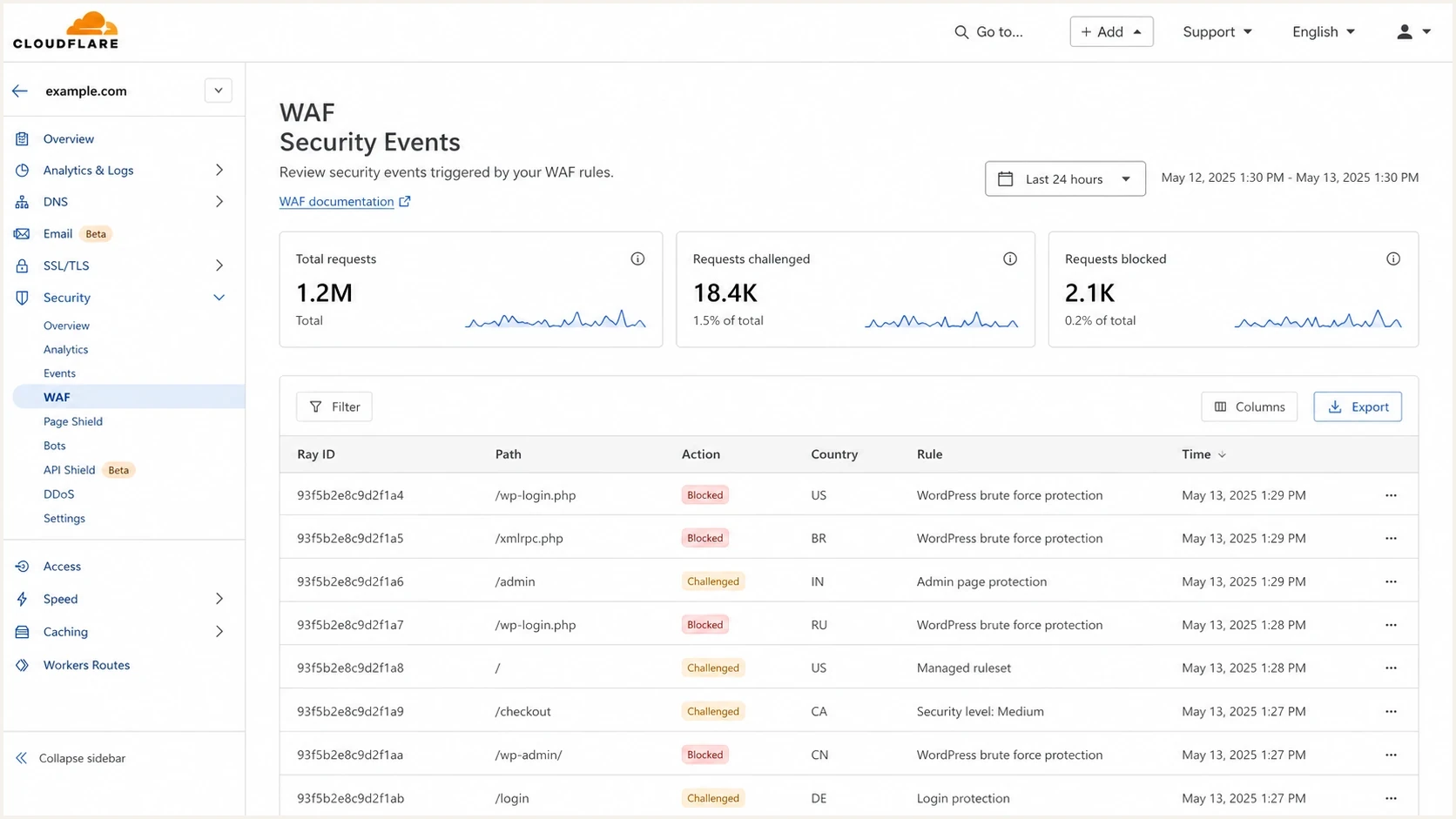
Cloudflare WAF security events dashboard showing challenged and blocked request counts.
- Test friction: Check login, checkout, contact, and abuse-report paths through VPNs, mobile networks, and hardened browsers.
- Separate paths: Keep safety reporting, legal notices, and emergency contact pages reachable with minimal automated friction.
- Review logs: Audit blocked request patterns for false positives before raising challenge levels.
- Publish recourse: Give real users a way to report access problems without requiring the blocked session to work.
AI scraping and publisher control
Cloudflare now lets site owners review identified AI crawler activity and choose actions for individual crawlers. Managed robots.txt can express preferences for search, AI input, and AI training. AI Crawl Control can enforce a block or return HTTP 402 for a selected crawler. Cloudflare says new domains block AI training crawlers by default unless the owner chooses otherwise, while Pay Per Crawl remains in beta.
These controls strengthen publisher choice, but they also give Cloudflare more influence over which automated systems reach protected content and on what terms. A crawler policy can affect research archives, accessibility services, search discovery, and small operators that cannot establish verified identities or payment relationships. Site owners should decide which uses they want to permit instead of treating every automated request as equivalent.
|
|
|
|---|---|---|
robots.txt | Publishes crawl preferences | Compliance is voluntary |
Content Signals | Separates search, AI input, and training preferences | Relies on declared crawler purpose |
AI Crawl Control | Blocks identified crawlers at the edge | Detection quality varies by plan and crawler identity |
Pay Per Crawl | Allows, blocks, or charges selected crawlers | The payment model is still in beta |
AI crawler controls and their ethical limits.
Treat crawler controls as policy
Blocking an identified crawler is stronger than publishing robots.txt, but it is not proof that all automated collection has stopped. Free-plan identification relies on self-declared user-agent strings for known crawlers, and mixed-use or disguised traffic remains harder to classify. Record which uses you permit, review false positives, and do not assume a new block removes copies collected earlier.
A practical decision framework
Do not make this a brand debate first. Make it a data-flow and harm-reduction exercise. Start with what the site handles, who gets hurt if the site goes down, who gets hurt if the proxy fails open or blocks legitimate users, and who gets hurt if an abuse complaint is mishandled.
- Map data: List paths that carry credentials, private messages, uploads, safety reports, or payment data.
- Set scope: Use DNS-only or static-asset proxying where full reverse proxying is unnecessary.
- Choose controls: Prefer precise rate limits, WAF rules, and crawler-specific policies over broad country blocks or aggressive challenges.
- Plan exit: Keep DNS, certificates, origin logs, and runbooks ready enough to move during an incident, then test the bypass path.
- Audit outcomes: Review blocked users, abuse handling time, crawler decisions, legal requests, and support tickets after rollout.
The tradeoff is reasonable when
- Public content: The site mainly publishes public pages and static assets.
- High attack risk: DDoS exposure threatens availability more than proxy visibility threatens users.
- Clear controls: Rules, logs, privacy review, and vendor exit steps are documented.
Avoid the tradeoff when
- Sensitive workflows: The site receives legal, health, safety, or confidential reports.
- No recourse: Blocked users have no independent way to reach support.
- Weak governance: Nobody owns abuse escalation, privacy review, or incident exit.
Security requirements checklisttext
1. Full TLS to origin, no flexible mode
2. No caching on private account paths
3. Independent origin and application logs
4. Named abuse escalation owner
5. VPN, Tor, mobile, and accessibility testing
6. Documented DNS and certificate exit steps
7. Explicit AI crawler and robots.txt policy
Where email security fits
Website protection and email protection are separate systems, but they meet at DNS, brand trust, and incident response. A CDN or WAF change can distract teams from SPF, DKIM, DMARC, forwarding, bounce handling, and domain reputation. After any major DNS or edge security change, send a real message through an email tester and confirm authentication from the receiver's point of view.
Suped's product keeps email domain protection separate and visible during website security migrations. It brings DMARC, SPF, DKIM, hosted SPF, hosted DMARC, hosted MTA-STS, blocklist monitoring, and deliverability checks into one workflow, with aggregate-report analysis, alerts, and fix steps.
- Domain review: Use a domain health checker after DNS changes to catch broken SPF, DKIM, and DMARC records.
- Policy rollout: Use DMARC monitoring to see which sources pass, fail, or need authorization.
- Reputation review: Use blocklist monitoring to watch domain and IP blacklist signals during infrastructure changes.
?
What's your domain score?
Deep-scan SPF, DKIM & DMARC records for email deliverability and security issues.
This is also where MSPs and security teams benefit from a unified view. If a client moves web DNS, tightens bot rules, or changes name servers, Suped can keep the email side visible: DMARC policy, reporting, SPF lookup limits, DKIM selectors, MTA-STS, and blocklist (blacklist) status.
Suped DMARC dashboard showing email volume, authentication health, and source breakdown
Views from the trenches
Best practices
Keep website protection and email authentication decisions separate, then document each risk.
Treat TLS termination as a trust decision, not a checkbox buried in setup notes or vendor docs.
Test user impact with privacy browsers, VPNs, and mobile networks before raising challenges.
Keep an abuse escalation path with named owners, evidence rules, and legal review steps.
Common pitfalls
Assuming a proxy provider has no visibility into dynamic requests after HTTPS is enabled.
Moving DNS during an incident without checking mail authentication and blacklist status.
Using aggressive bot rules that block support staff, customers, and privacy-focused users.
Treating free DDoS protection as a complete governance answer for sensitive content.
Expert tips
Use DNS-only mode for low-risk static assets when the full proxy adds more risk than value.
Document which paths carry credentials, payment data, private messages, or account tokens.
Keep origin logs independent so incident review does not depend on one provider's view.
Review blocklist (blacklist) signals after DNS or CDN changes affect mail and domains.
Marketer from Email Geeks says Cloudflare's protection can feel unacceptable when the same shielding helps harmful operators stay reachable during complaints.
2018-08-15 - Email Geeks
Marketer from Email Geeks says older abuse debates still shape trust decisions because teams remember how proxying can obscure the real host.
2018-08-16 - Email Geeks
Practical conclusion
The ethical question is not settled by saying Cloudflare protects sites or by saying bad actors also use protection. The responsible answer is narrower: use the least proxy power needed, avoid routing sensitive workflows through a third party without a clear reason, test who gets blocked, document abuse and crawler policies, and keep an exit path.
For a public marketing site under attack, Cloudflare can be a reasonable choice with proper settings. For a site that handles vulnerable users, private reports, regulated data, or high-stakes speech, require privacy review, legal review, fallback routing, and independent logging before enabling the proxy for dynamic traffic.




