What are the dangers of scraping emails and ignoring CAN-SPAM?

Published 18 Jul 2025
Updated 10 Aug 2026
12 min read
Summarize with
Updated on 10 Aug 2026: We updated this guide with current CAN-SPAM penalties, harvesting rules, opt-out duties, and safer list-handling steps.
The danger is simple: scraping emails and treating CAN-SPAM as permission to send can get a domain blocked, damage sender reputation, create legal exposure, and burn trust with the people a campaign is meant to reach. CAN-SPAM sets minimum rules for commercial email in the United States, including B2B messages. It does not mean scraped cold outreach is safe, wanted, or deliverable.
Teams often find addresses, load them into a campaign tool, add an unsubscribe link, and assume the risk has been handled. That misses the two systems that decide whether the campaign survives. The legal system asks whether the collection and message follow every applicable law. Mailbox providers ask whether recipients want the mail. Complaints, bounces, fast deletes, and a lack of prior engagement usually produce a negative answer.
The practical answer is to stop treating scraped addresses as a growth shortcut. Use permission-based acquisition where possible, document consent or another valid legal basis for each recipient's jurisdiction, authenticate the domain, test message mechanics before scaling, and monitor DMARC, SPF, DKIM, bounce, complaint, and blocklist signals before they turn into a sending outage.
The direct risks
A scraped list has no reliable consent trail, no engagement history, and no guarantee that the address belongs to the person or company you think it does. That means every send starts with weak legal footing and weak deliverability signals.
- Legal exposure: Each separate email that violates CAN-SPAM can carry a civil penalty of up to $53,088. Scraped workflows also make sender identification, ad disclosure, postal address, opt-out, and suppression failures more likely.
- Reputation loss: Mailbox providers track recipient behavior. Low engagement, fast deletes, spam complaints, and replies asking to be removed teach filters that the domain sends unwanted mail.
- Blocklist exposure: High complaint rates, spamtrap hits, and bad list sources can land a domain or sending IP on a blocklist (blacklist), which then affects more than one campaign.
- Sales damage: Scraped outreach often reaches people with no context. Even when the email meets US legal minimums, it can make a company look careless before a real relationship starts.
- Operational drag: Once reputation drops, recovery takes time. Teams must pause volume, resolve blocklist or blacklist listings, repair authentication, audit suppression, and separate legitimate mail from risky mail.
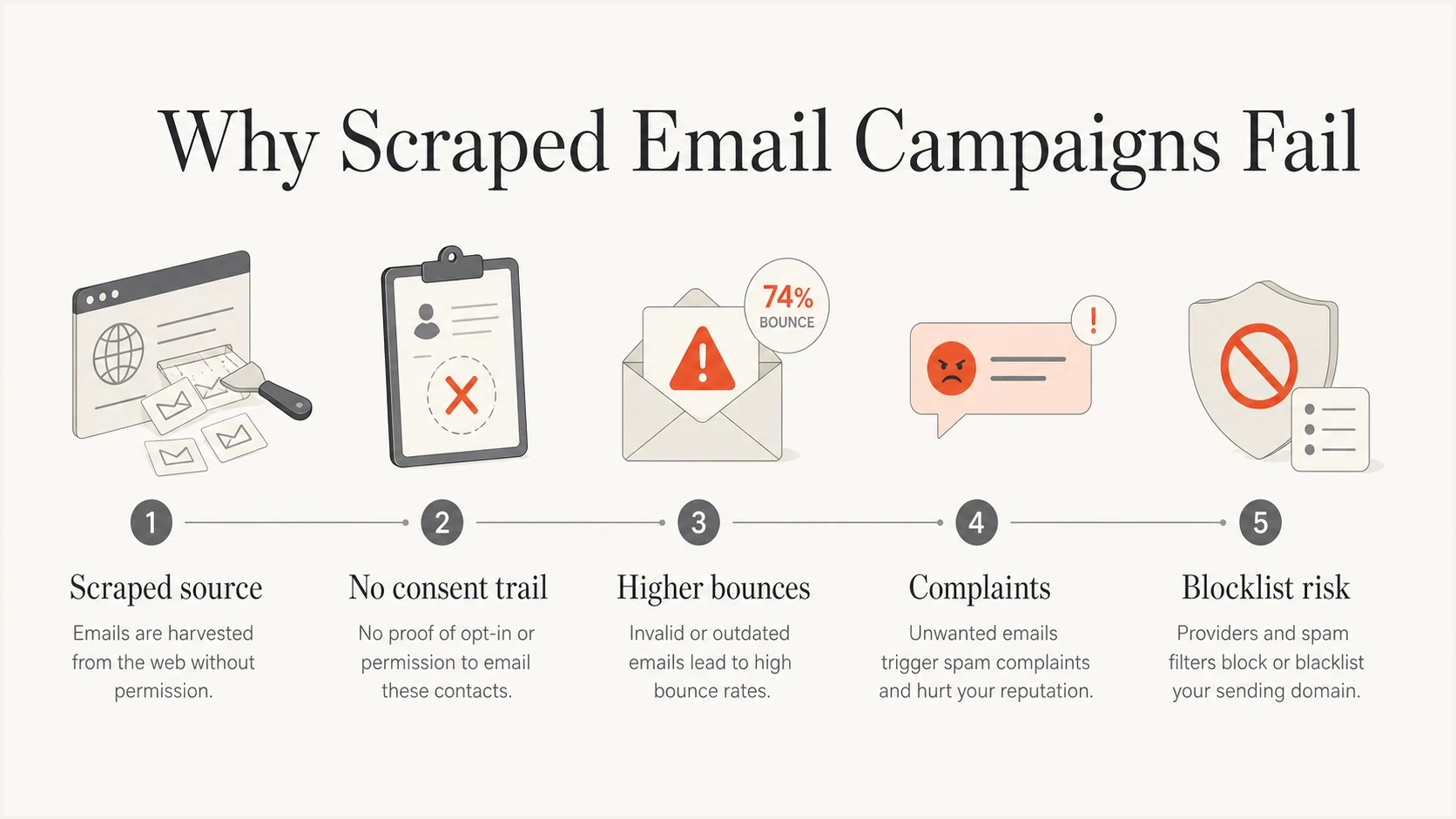
Scraped source, no consent trail, bounces, complaints, and blocklist risk shown as a simple risk chain.
The first visible symptom usually arrives late. A sender often notices weak response rates first, then checks a blocklist or blacklist after the campaign has already produced negative signals. By then, the issue has moved beyond one bad list. It has affected the domain history that future mail depends on.
What CAN-SPAM actually requires
CAN-SPAM uses an opt-out model for commercial email, and it has no general B2B exception. It requires accurate routing and sender information, non-deceptive subject lines, clear ad identification unless the recipient gave prior affirmative consent, a valid physical postal address, and a working opt-out process. The FTC's CAN-SPAM guide says the opt-out mechanism must remain available for at least 30 days after sending, and requests must be honored within 10 business days.
|
|
|
|---|---|---|
Headers | Use accurate From, To, Reply-To, and routing information. | Recipients can still reject unwanted mail. |
Subject | Do not mislead recipients about the message. | A clear subject can still draw complaints. |
Ad disclosure | Identify unsolicited commercial mail as an ad. | Disclosure does not create permission. |
Address | Include a valid physical postal address. | It does not prove consent or relevance. |
Opt out | Offer a clear, simple way to stop all marketing mail. | Complaints before opt-out still hurt. |
Suppression | Honor opt-outs within 10 business days. | Bad data joins can re-add recipients. |
Partners | Monitor anyone sending on the company's behalf. | A contract does not remove sender liability. |
CAN-SPAM duties and the deliverability risks they do not remove.
Each separate violating email can be subject to a civil penalty of up to $53,088, and both the promoted company and the company that sends the message can be liable. A campaign can satisfy the minimum rules and still fail in the inbox. Mailbox providers act on engagement, complaints, bounce patterns, sender identity, and historical reputation without waiting for a legal finding.
Use a stricter operating rule than the US legal minimum: send commercial email only when the team can document why that recipient should expect that sender, using that address, to discuss that topic.
When email harvesting adds CAN-SPAM exposure
Scraping an address is not automatically a CAN-SPAM violation. The Act creates aggravated exposure when a sender transmits commercial email that already violates CAN-SPAM and knows the address came through specified harvesting methods. That distinction matters because an unsubscribe link does not cure an unlawful harvesting workflow.
- No-transfer notices: Risk increases when automated means collect addresses from a website or online service whose notice says it will not give, sell, or transfer them for email sending.
- Dictionary attacks: Generating possible addresses by combining names, letters, or numbers into many permutations falls within the Act's aggravated-violation provisions.
- List suppliers: Buying or licensing a list does not transfer compliance responsibility. Record the original source, collection method, notices, consent evidence, and every suppression applied.
- Other rules: CASL, UK PECR, UK GDPR, other privacy laws, website terms, and data-source contracts can impose stricter collection or consent duties than CAN-SPAM.
Before using public contact data, have qualified counsel assess where the recipients are located, how the data was collected, which notices applied, and whether the proposed message has a valid legal basis.
Why scraped lists damage deliverability
Scraped data looks efficient because the sender gets a large list quickly. In practice, the sender inherits every hidden quality problem in that source. Addresses can be stale, role-based, abandoned, typo-filled, republished without context, or collected from people who never expected sales outreach.
Scraped list
- Source quality: Unknown collection method and weak consent record.
- Engagement: Low intent, low recognition, and high complaint risk.
- Recovery: Reputation cleanup starts after damage appears.
Permission-based list
- Source quality: Clear signup path, timestamp, context, and purpose.
- Engagement: Higher recognition and better complaint control.
- Recovery: Problems are easier to trace to source or segment.
Mailbox providers do not judge only the message body. They judge the sender's past behavior. When a new cold campaign causes hard bounces, spam complaints, and poor engagement, those signals attach to the sending IP, the domain, the visible From domain, the return-path domain, and linked domains in the email.
Cold outreach risk should be separated from normal marketing and critical transactional mail. Any lawful prospecting stream needs a stable, truthful sending identity, low volume, strong suppression, and accurate targeting. Do not rotate domains to escape a damaged reputation. The safer path is to avoid scraped lists and build demand with consent-based capture.
The blocklist problem
A blocklist or blacklist listing is not always the first cause of poor results. It is often a symptom of the behavior that also made the results poor: unwanted mail, bad data, weak authentication, and aggressive volume. A sender can check a blacklist, find a listing, and still miss the underlying problem.
Blocklist checker
Check your domain or IP against 144 blocklists.
 Spamhaus
 0Spam
0Spam

 Cisco
Cisco
 NoSolicitado

 URIBL
URIBL
 abuse.ro
 ALPHANET
 Anonmails
 Ascams
 BLOCKEDSERVERS
 Calivent Networks


 EFnet
EFnet




 JustSpam
 Kempt.net
 NordSpam

 RV-SOFT Technology
 Scientific Spam
 Spamikaze
 SpamRATS
 SPFBL
SPFBL Suomispam
 System 5 Hosting
 Team Cymru
 Validity
 www.blocklist.de Fail2Ban-Reporting Service
 ZapBL
ZapBL 2stepback.dk
 Fayntic Services
 ORB UK
 technoirc.org
 TechTheftSpamhaus0SpamCiscoNoSolicitadoURIBLabuse.roALPHANETAnonmailsAscamsBLOCKEDSERVERSCalivent NetworksEFnetJustSpamKempt.netNordSpamRV-SOFT TechnologyScientific SpamSpamikazeSpamRATSSPFBLSuomispamSystem 5 HostingTeam CymruValiditywww.blocklist.de Fail2Ban-Reporting ServiceZapBL2stepback.dkFayntic ServicesORB UKtechnoirc.orgTechTheftSpamhaus0SpamCiscoNoSolicitadoURIBLabuse.roALPHANETAnonmailsAscamsBLOCKEDSERVERSCalivent NetworksEFnetJustSpamKempt.netNordSpamRV-SOFT TechnologyScientific SpamSpamikazeSpamRATSSPFBLSuomispamSystem 5 HostingTeam CymruValiditywww.blocklist.de Fail2Ban-Reporting ServiceZapBL2stepback.dkFayntic ServicesORB UKtechnoirc.orgTechTheftSpamhaus0SpamCiscoNoSolicitadoURIBLabuse.roALPHANETAnonmailsAscamsBLOCKEDSERVERSCalivent NetworksEFnetJustSpamKempt.netNordSpamRV-SOFT TechnologyScientific SpamSpamikazeSpamRATSSPFBLSuomispamSystem 5 HostingTeam CymruValiditywww.blocklist.de Fail2Ban-Reporting ServiceZapBL2stepback.dkFayntic ServicesORB UKtechnoirc.orgTechTheftSpamhaus0SpamCiscoNoSolicitadoURIBLabuse.roALPHANETAnonmailsAscamsBLOCKEDSERVERSCalivent NetworksEFnetJustSpamKempt.netNordSpamRV-SOFT TechnologyScientific SpamSpamikazeSpamRATSSPFBLSuomispamSystem 5 HostingTeam CymruValiditywww.blocklist.de Fail2Ban-Reporting ServiceZapBL2stepback.dkFayntic ServicesORB UKtechnoirc.orgTechTheft
Use a blocklist monitor as an early warning system, not as a campaign approval stamp. A clean result today does not mean scraped outreach is safe tomorrow. A new complaint cluster or spamtrap hit can change the situation quickly.
Operational hard-bounce stop rules
These are internal investigation thresholds, not CAN-SPAM standards or mailbox-provider guarantees.
Target
Under 2% hard bounce
Keep investigating individual bad addresses even when the aggregate rate is low.
Investigate
2-5% hard bounce
Review list source, suppression, and targeting before any more volume.
Pause
Over 5% hard bounce
Continuing to send adds domain and IP reputation risk.
Stop immediately
Complaint or trap spike
A complaint spike or spamtrap evidence requires remediation before another send.
Authentication will not save a bad list
SPF, DKIM, and DMARC are still required, but they are not a license to send to scraped addresses. Authentication proves that the sending infrastructure is authorized and that the message identity can be evaluated. It does not prove that the recipient wanted the message.
Example DMARC monitoring record with strict domain matchingDNS
Host: _dmarc.example.com
Type: TXT
Value:
v=DMARC1; p=none; rua=mailto:dmarc-reports@example.com;
adkim=s; aspf=s
A monitoring policy such as p=none helps collect reports while you fix sources and domain matching. Enforcement policies such as quarantine and reject protect against spoofing after legitimate sources are configured correctly. They do not repair reputation damage caused by unwanted mail.
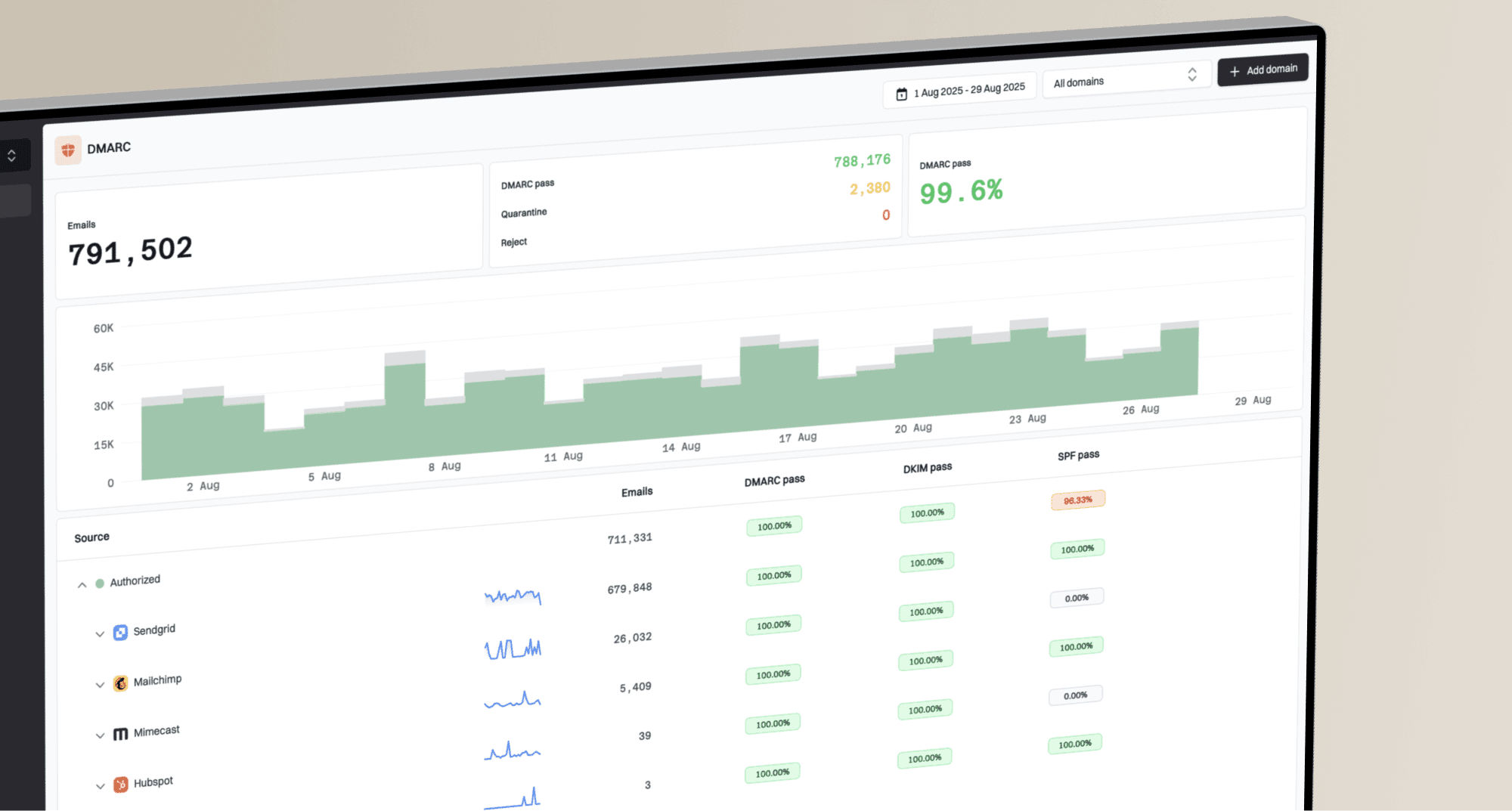
Suped DMARC dashboard showing email volume, authentication health, and source breakdown
Suped's product brings DMARC reporting, SPF and DKIM visibility, automated issue detection, blocklist monitoring, and change alerts into one workflow. After a risky campaign, that workflow helps the technical team separate approved sources from unauthorized or misconfigured senders and track the records that need remediation.
Before scaling any new sending stream, run a real message through an email tester and verify that authentication passes, links resolve cleanly, headers match the sending plan, and unsubscribe handling works. Then check the sending domain with a domain health check before volume increases.
How to assess an existing scraped list
The safest answer is not to use the list. If the business already has the data, treat it as a risk inventory rather than a send-ready audience. Decide what the organization can retain lawfully, what has a documented and relevant use, and what should be deleted.
- Classify the source: Record where each address came from, when it was collected, which notice applied, the collection method, and whether there is a real business relationship.
- Remove risky categories: Suppress prior opt-outs, complaints, hard bounces, stale data, sensitive categories, irrelevant contacts, and addresses with no defensible legal basis.
- Validate the basis: Review consent, source notices, jurisdiction, purpose, and relevance first. Technical validation only shows whether an address can accept mail, not whether you should email it.
- Test without contacting the list: After legal approval, test authentication, headers, links, and unsubscribe mechanics on controlled seed addresses. Do not use scraped recipients as a trial audience.
- Keep suppression central: Unsubscribes, complaint feedback, replies, bounced addresses, and account-level exclusions must sync across every sales and marketing system.
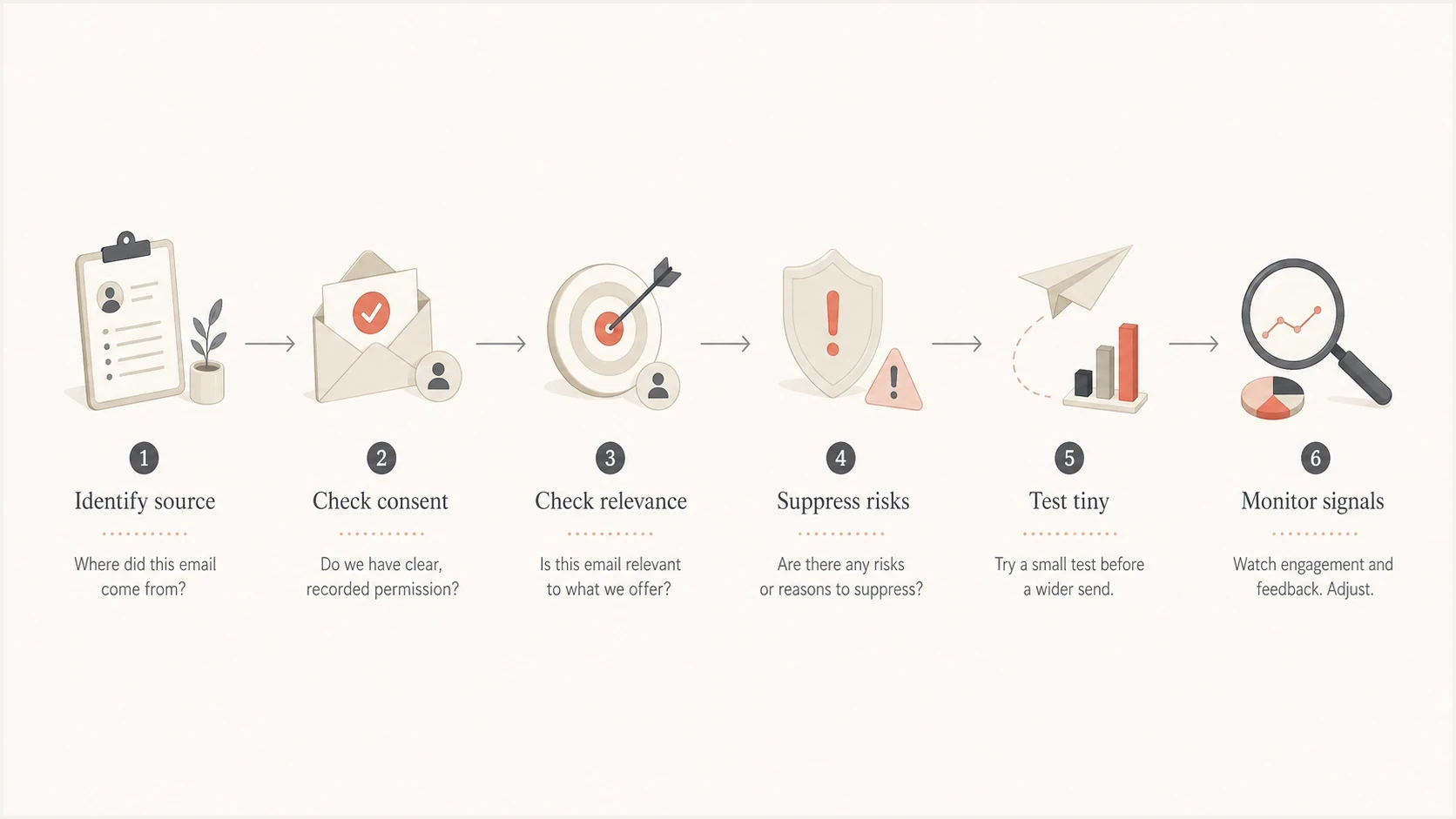
Decision flow for a collected email address: identify the source, check consent and relevance, suppress risks, test a controlled message, and monitor signals.
A practical compliant outreach baseline
A defensible outreach program starts with restraint. A sender should be able to explain the source, the legal basis for contact, the relevance of the offer, and the suppression process without improvising. If that explanation is weak, the campaign should not launch.
The minimum operating bar is source documentation, a working unsubscribe mechanism, verified suppression, authenticated sending, controlled volume, daily monitoring, and a clear stop rule for bounces or complaints.
The phrase CAN-SPAM compliant is not a quality label. It says nothing about list origin, recipient expectation, targeting accuracy, inbox placement, or brand impact. The related question about illegal spam tactics explains why some cold outreach habits still create serious risk.
Protect core business mail as well. Keep any lawful prospecting stream on a documented, stable subdomain and separate it operationally from invoices, support, security notifications, and product email. Do not rotate domains or identities to evade reputation signals.
What to do if you already sent
If a scraped campaign has already gone out and results look bad, pause sending first. Do not keep testing the same list while checking blacklist results in another tab. Every extra send can create more complaints, bounces, and reputation evidence.
- Pause the stream: Stop the campaign, automation, follow-up sequence, and any resend logic tied to that list.
- Export signals: Collect bounces, complaints, unsubscribes, replies, blocklist hits, sending logs, and segment names.
- Suppress broadly: Push opt-outs, complaints, and hard bounces into every platform before any future send.
- Audit identity: Check SPF, DKIM, DMARC domain matching, link domains, reply handling, and From domain usage.
- Rebuild the program: Resume only with a lawful acquisition source, documented suppression, controlled volume, and explicit monitoring thresholds.
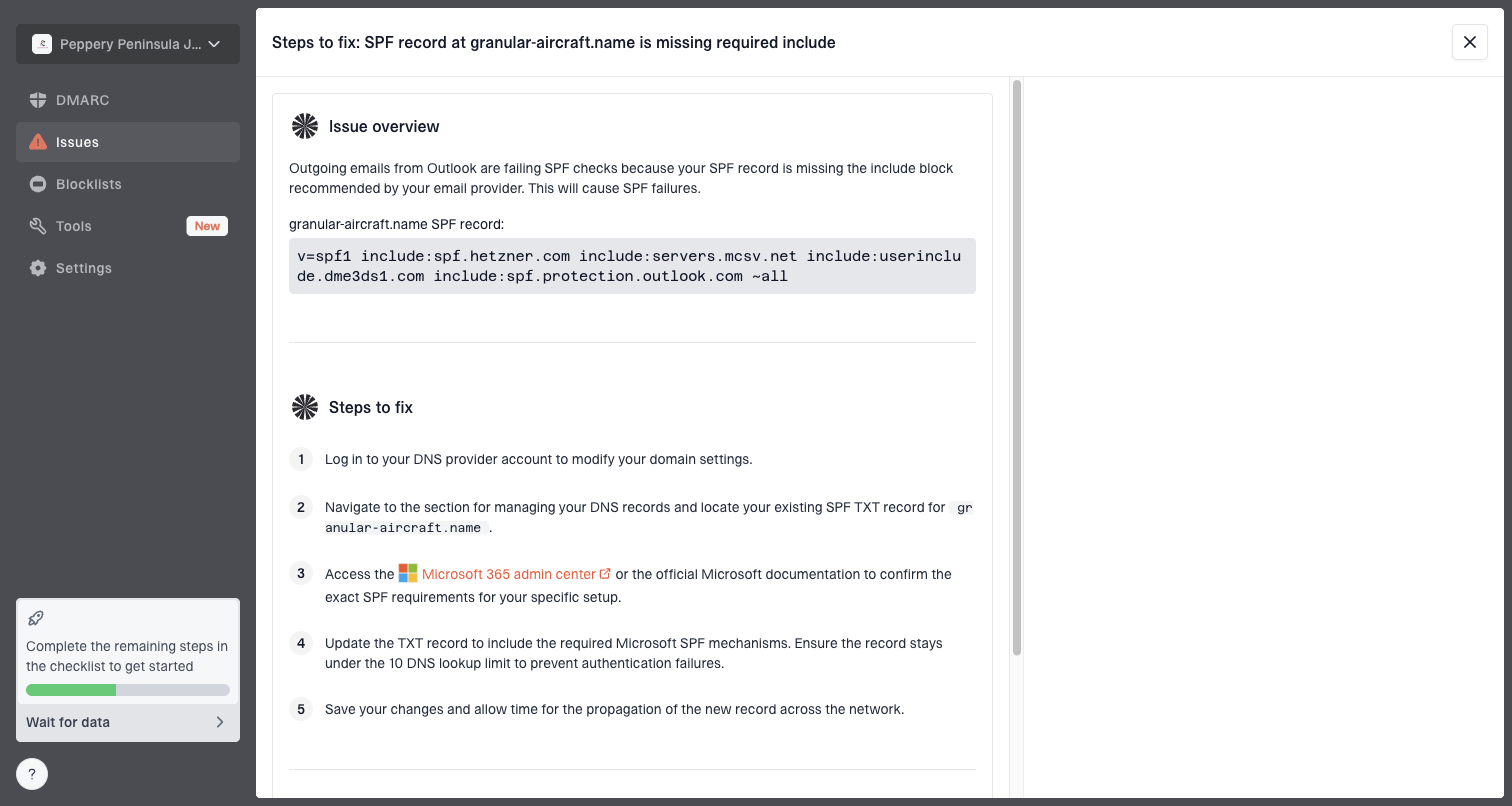
Issue steps to fix dialog showing the issue overview, tailored fix steps, and verification action
Suped's issues view turns authentication and reputation findings into specific remediation steps. It does not replace legal review or list governance, but it helps the technical team identify which domains, sending sources, and DNS records need attention before mail resumes.
Views from the trenches
Best practices
Document every address source before sending, including collection date and business context.
Separate cold outreach identity from critical product, billing, support, and security email.
Set stop rules for bounce, complaint, and blocklist signals before campaign volume increases.
Common pitfalls
Treating CAN-SPAM as permission to email anyone with an unsubscribe link added later.
Checking blacklist status only after a campaign has already produced poor engagement.
Blending scraped list sends with normal marketing streams and shared suppression data.
Expert tips
Use DMARC reports to confirm which platforms actually send mail for each visible domain.
Review suppression joins after imports, because old opt-outs often return through bad data merges.
Treat a clean blocklist check as a snapshot, not proof that a scraped campaign is acceptable.
Expert from Email Geeks says scraped campaigns often turn into deliverability and compliance cleanup because senders confuse access to an address with permission to use it.
2020-05-06 - Email Geeks
Marketer from Email Geeks says some agencies describe CAN-SPAM as an opt-out-only rule, but that advice ignores recipient expectation and reputation damage.
2020-05-07 - Email Geeks
The safer answer
Scraping emails and ignoring CAN-SPAM creates legal risk, but the faster penalty is often deliverability failure. A domain can lose inbox placement long before a legal notice arrives. That loss affects sales outreach, marketing programs, and operational email that had nothing to do with the scraped campaign.
Stop treating scraped data as a send-ready list. Build auditable acquisition, authenticate every sender, monitor DMARC and blocklists, and pause when signals turn negative. Suped's product supports the technical workflow with DMARC reporting, authentication diagnostics, issue alerts, and blocklist monitoring, while legal review and list governance stay with the organization.