What are some appropriate job titles for someone who specializes in email deliverability?

Published 21 Jul 2025
Updated 29 Jul 2026
10 min read
Summarize with
Updated on 29 Jul 2026: We added guidance for engineering and reliability roles and clarified how title wording should follow real ownership.
The most appropriate job title is usually Email Deliverability Specialist for a hands-on individual contributor, Senior Email Deliverability Specialist for an experienced IC, Email Deliverability Engineer for someone who builds or operates sending infrastructure, Deliverability Operations Manager for someone who owns process and monitoring, and Director of Deliverability for someone who owns the function across a team or business unit.
Email Deliverability Specialist is the safest default for someone who works on best practices, delivery challenges, authentication, reputation, and ongoing monitoring. Deliverability Program Lead or Deliverability Operations Manager fits someone who owns the program, sets policy, coordinates fixes across teams, and has authority over outcomes.
- Best default: Email Deliverability Specialist works when you need a clear, widely understood title.
- Best senior IC title: Senior Email Deliverability Specialist or Principal Deliverability Specialist.
- Best engineering title: Email Deliverability Engineer when the job owns code, mail infrastructure, or production reliability.
- Best operations title: Deliverability Operations Manager when the job owns monitoring, escalation, and process.
- Best program title: Deliverability Program Lead when the person coordinates work without necessarily managing people.
- Best consulting title: Email Deliverability Consultant or Deliverability Services Manager.
The best title depends on the job's scope
Email deliverability titles are less standardized than titles in engineering, security, or marketing operations. That is why the right answer depends less on wording and more on what the person actually owns. Define the role's scope first, then choose the title.
A person who reviews sending practices, diagnoses inbox placement issues, checks authentication, and advises campaign teams should not automatically be called a manager. A manager title works when the person manages people, owns a program, or has clear accountability for metrics and decisions. Some companies reserve manager for people management only, so the same role might need Lead, Principal, or Specialist instead.
|
|
|
|---|---|---|
Hands-on | Email Deliverability Specialist | Daily fixes |
Senior IC | Senior Deliverability Specialist | Deep ownership |
Analysis | Deliverability Analyst | Reporting |
Engineering | Email Deliverability Engineer | Sending systems |
Program | Deliverability Program Lead | Cross-team work |
Operations | Deliverability Operations Manager | Process owner |
People | Email Deliverability Manager | Team manager |
Executive | Director of Deliverability | Function owner |
Compact title options by scope.
The compact version is simple: Specialist says the person does the work, Engineer says the person builds or operates sending systems, Lead says the person coordinates the work, Manager says the person owns outcomes or people, and Director says the person owns the function. Avoid inflated words unless the authority is real.
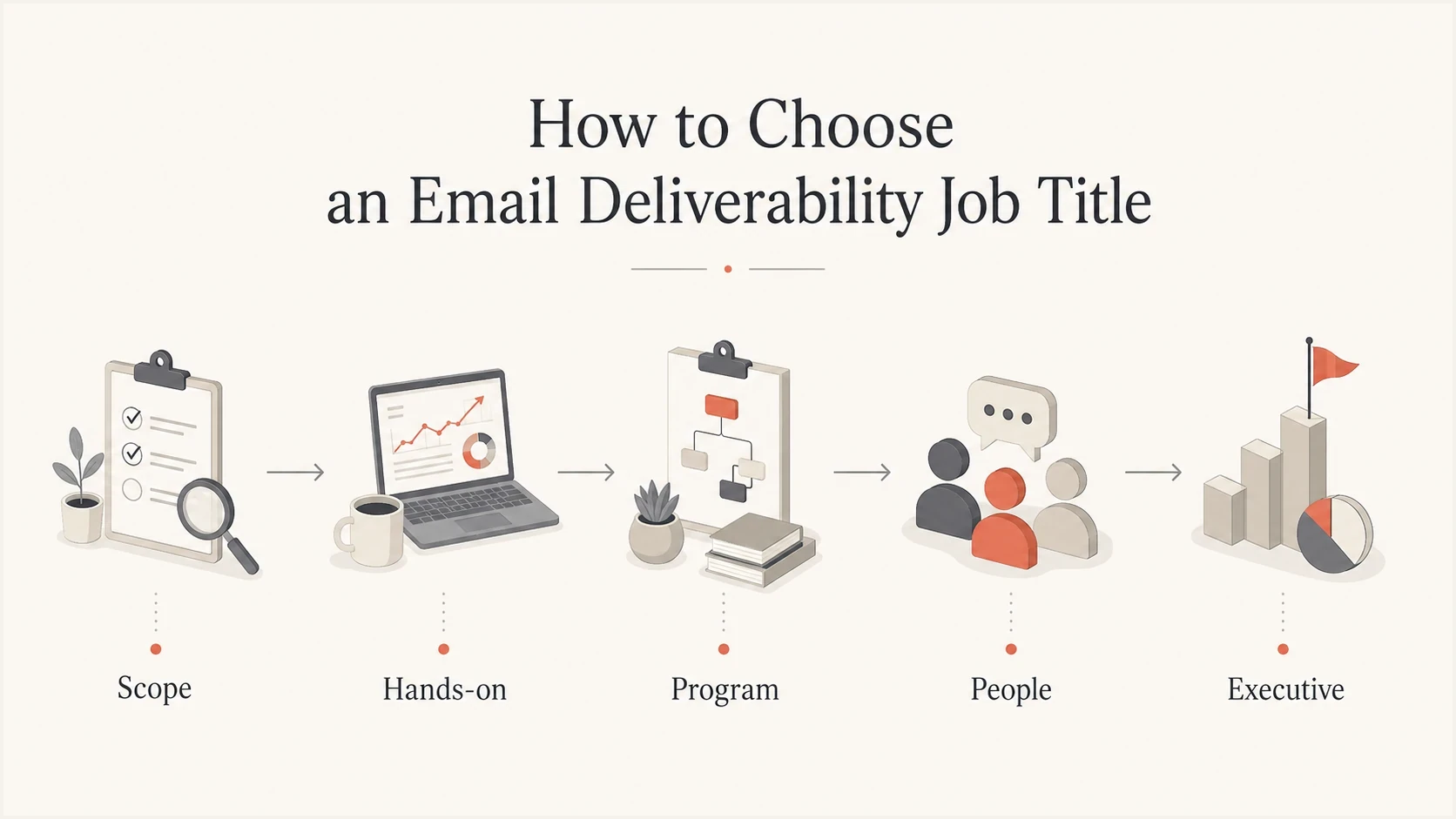
Flowchart for choosing an email deliverability title by scope.
A practical title ladder
When a company needs a title ladder, a plain structure works across sender-side teams, ESPs, agencies, and consulting groups. The words need to help candidates, peers, HR, and customers understand the level without needing a translation. Engineering can run as a parallel IC track when the role owns production systems.
Example title laddertext
Associate Email Deliverability Specialist
Email Deliverability Specialist
Senior Email Deliverability Specialist
Lead Deliverability Specialist
Principal Deliverability Specialist
Email Deliverability Engineer
Senior Email Deliverability Engineer
Deliverability Program Lead
Deliverability Operations Manager
Director of Deliverability
This ladder keeps management and expertise separate. A Principal Deliverability Specialist or Senior Email Deliverability Engineer can be more senior than a manager in technical judgment, while a manager can own staffing, prioritization, customer escalation, and performance reporting. That distinction matters because deliverability work often mixes engineering, policy, marketing operations, and incident response.
Title seniority signals
A practical way to map authority to wording.
Entry or associate
Associate
Learning established process and handling defined checks.
Independent contributor
Specialist
Owns routine diagnosis and clear remediation work.
Senior contributor
Senior or Principal
Leads difficult cases and guides standards.
Program owner
Lead or Manager
Coordinates roadmap, process, and internal adoption.
Function owner
Director or Head
Owns budget, staffing, vendor decisions, and policy.
Use Head of Deliverability only when the person has department-level authority. Use Chief Deliverability Officer only in a company where deliverability is a core business function with executive accountability. In most companies, that title will sound bigger than the job.
How deliverability titles differ from marketing titles
Email deliverability overlaps with email marketing, but it is not the same job. An Email Marketing Manager owns audience strategy, messaging, lifecycle programs, campaign calendars, and performance against business goals. A deliverability specialist owns the technical and operational conditions that help legitimate mail reach the inbox. If the person spends most of their time on authentication, reputation, complaint patterns, bounce analysis, provider policy, and inbox placement testing, put deliverability in the title.
A broader primer on email deliverability basics can help define the role because it makes the responsibilities concrete.
Email marketing title
- Primary focus: Campaign strategy, audience segmentation, content, conversion, and lifecycle performance.
- Typical title: Email Marketing Specialist, Email Marketing Manager, or Lifecycle Marketing Manager.
- Success metric: Revenue, engagement, retention, funnel movement, and campaign results.
Deliverability title
- Primary focus: Authentication, reputation, inbox placement, complaints, bounces, and sender readiness.
- Typical title: Email Deliverability Specialist, Deliverability Lead, or Deliverability Operations Manager.
- Success metric: Authentication pass rates, complaint rates, bounce rates, delivery health, and issue resolution.
The overlap is real. A deliverability person still needs to understand content, sending cadence, list quality, permission, and user engagement. The difference is that deliverability titles signal responsibility for diagnosis and remediation. That includes sending test messages through an email tester, reviewing DNS with domain health checks, and turning findings into fixes that other teams can apply.
Email tester
Send a real email to this address. Suped shows a results button when the test is ready.
?/43tests passed
Where authentication changes the title
If the person owns DMARC, SPF, DKIM, BIMI readiness, MTA-STS, TLS reporting, rDNS, sending domain setup, and source verification, the title should make that technical scope visible. Email Authentication Specialist is valid, while Email Authentication and Deliverability Lead fits a role that connects DNS work to inbox outcomes.
Deliverability Operations Manager also makes sense when the person runs DMARC monitoring, SPF lookup management, DKIM selector checks, incident response, and blocklist monitoring for blocklist or blacklist events. The job has operations scope because it needs regular review, alert handling, escalation paths, and verification after each fix.
Suped DMARC dashboard showing email volume, authentication health, and source breakdown
Suped's product supports this work through DMARC reporting, SPF and DKIM monitoring, source identification, alerts, and guided remediation. It gives the role a concrete workflow: review authentication data, identify the responsible sender, coordinate the DNS or service change, and verify the result.
A useful wording test
If the person can explain why a sender failed DMARC, identify the responsible source, write the DNS fix, and verify the change, put either authentication, operations, or lead in the title. If they only consume a report and pass it to another team, specialist or analyst is usually clearer.
When engineer belongs in the title
Use Email Deliverability Engineer when the person builds or operates mail-sending infrastructure, not simply because the work is technical. The scope usually includes SMTP routing, queue and bounce processing, IP and domain configuration, telemetry, automation, and production incident response.
|
|
|
|---|---|---|
Diagnosis and remediation | Email Deliverability Specialist | Hands-on deliverability work |
Sending code and infrastructure | Email Deliverability Engineer | Builds production systems |
Reliability and incident response | Email Reliability Engineer | Owns service health |
Cross-team program ownership | Deliverability Program Lead | Coordinates standards and fixes |
Choose an engineering title only when system ownership is part of the job.
Email Reliability Engineer fits a platform team accountable for availability, throughput, queue health, and incident recovery. Messaging Engineer fits broader enterprise messaging work that includes systems outside outbound deliverability. These titles are narrower than Email Deliverability Specialist, so use them only when the job description contains genuine engineering ownership.
Titles to avoid
Avoid playful or inflated titles in job postings, org charts, customer-facing decks, and formal program documents. They might be funny internally, but they make the role harder to understand and can send the wrong signal to applicants or cross-functional teams.
Avoid novelty titles
- Guru: It suggests expertise, but it also sounds informal and can carry baggage.
- Rock star: It sounds dated and does not describe actual responsibility.
- Czar: It implies command more than collaboration, which is a poor fit for cross-team work.
- Architect: Use it only when the person designs systems, standards, and durable technical models.
The safest professional replacement for a playful expert title is Principal Deliverability Specialist, Deliverability Solutions Lead, or Email Authentication and Deliverability Lead. Those titles still signal seniority, but they do it with language that maps to real work.
How to address someone when you are unsure
If the goal is to address someone in that role, not write a job description, use a neutral title that does not overstate their authority. Deliverability specialist, deliverability lead, or deliverability contact works depending on how much authority the person has in the conversation.
- Use specialist: When you know they do deliverability work but do not know their level.
- Use lead: When they coordinate work, set direction, or speak for the deliverability program.
- Use manager: When their company uses manager for people management or formal ownership.
- Use consultant: When they advise multiple clients or work in a services role.
When precision matters, ask a short clarifying question rather than guessing. It avoids giving someone a title that conflicts with their org chart.
Simple wording to confirm the titletext
What title should be used for your deliverability role in this document?
Email Deliverability Specialist is the default unless Lead or Manager is more accurate.
That question is direct enough for an internal document, vendor handoff, panel bio, webinar intro, or project plan. It also gives the person an easy way to correct the level without making the exchange awkward.
Views from the trenches
Best practices
Match the title to authority and skill, so candidates and peers understand the remit.
Use manager only when the role manages people, a program, or measurable outcomes.
Add operations when the work includes process ownership, monitoring, and incidents.
Keep playful labels out of job titles; use them only in informal team shorthand or jokes.
Common pitfalls
Calling every senior specialist a manager creates confusion about reporting lines and scope.
Using guru or rock star language can narrow applicant pools and age the posting quickly.
Choosing architect without system design authority makes the title sound inflated.
Leaving authentication out hides DMARC, SPF, and DKIM work that needs clear ownership.
Expert tips
For an IC with broad authority, Principal Deliverability Specialist is clearer than manager.
For an ESP services team, Deliverability Practice Lead works when the job trains consultants.
For sender-side execution, Deliverability Operations Manager signals process ownership.
For abuse policy work, add Abuse only when complaints and enforcement are core duties.
Marketer from Email Geeks says Email Deliverability Consultant is clear when the role advises others and does not own an internal team.
2023-10-03 - Email Geeks
Expert from Email Geeks says Deliverability Operations Manager works well because operations signals hands-on process ownership.
2023-10-04 - Email Geeks
Recommended choices
For a general professional label, use Email Deliverability Specialist. For a senior person with broad authority but no direct reports, use Principal Deliverability Specialist or Deliverability Program Lead. For someone accountable for monitoring, process, authentication, incident response, and cross-team fixes, use Deliverability Operations Manager. For someone who builds and operates sending infrastructure, use Email Deliverability Engineer.
When the job includes DMARC policy, SPF lookup control, DKIM selector checks, source verification, and alerts, Suped's product gives the owner one workflow to review DMARC data, identify sending sources, follow remediation steps, and verify changes. That supports the operational ownership described by the title without deciding the title itself.




