Should you move from Brevo to ActiveCampaign for email marketing?

Updated on 1 Sep 2026: We updated this comparison with current pricing rules and a clearer migration and deliverability test plan.
Do not move from Brevo to ActiveCampaign solely to fix deliverability. Move if the right ActiveCampaign plan gives you marketing capabilities you cannot run cleanly in Brevo, such as deeper branching automations, stronger CRM handoff, lead scoring, conditional content, advanced segmentation, or sales pipeline workflows.
Stay on Brevo if your program is mostly newsletters, lifecycle basics, SMS, transactional email, and a few straightforward automations. Move to ActiveCampaign if email has become part of a larger revenue process and your team will maintain the extra logic. ActiveCampaign can be the better fit, but it also adds operational weight.
- Move if: You need behavior-based journeys, sales tasks, lead scoring, and multiple automation branches.
- Stay if: Brevo already handles your campaigns, your team likes the interface, and cost control matters.
- Pause if: Your main goal is better inbox placement, because the root cause usually sits outside the ESP.
- Test first: Run a small proof of concept with real segments, templates, plan limits, and reporting needs.
A platform switch changes software and sending infrastructure. It does not automatically repair consent quality, cold segments, spam complaints, weak authentication, poor suppression rules, or inconsistent sending cadence.
What changes when you move
ActiveCampaign and Brevo overlap on email campaigns, forms, automations, sales tools, and integrations. The difference is depth and plan access. ActiveCampaign's Brevo comparison emphasizes advanced automation, CRM workflows, templates, reporting, and migration assistance. Check each capability against the plan you would buy, because entry plans do not include every automation or segmentation control.
|
|
|
|
|---|---|---|---|
Automation | Straightforward, with plan limits | Deeper logic, with plan limits | Prototype the real journey |
CRM | Core sales tools | Standard CRM plus enhancements | Map the sales handoff |
Pricing | Send-volume tiers with contact caps | Contact bands with send caps | Model real usage |
Migration | Known data model | Assisted or manual transfer | QA every transferred asset |
Deliverability | Depends on setup | Depends on setup | Fix sender practices |
A practical comparison for migration decisions.
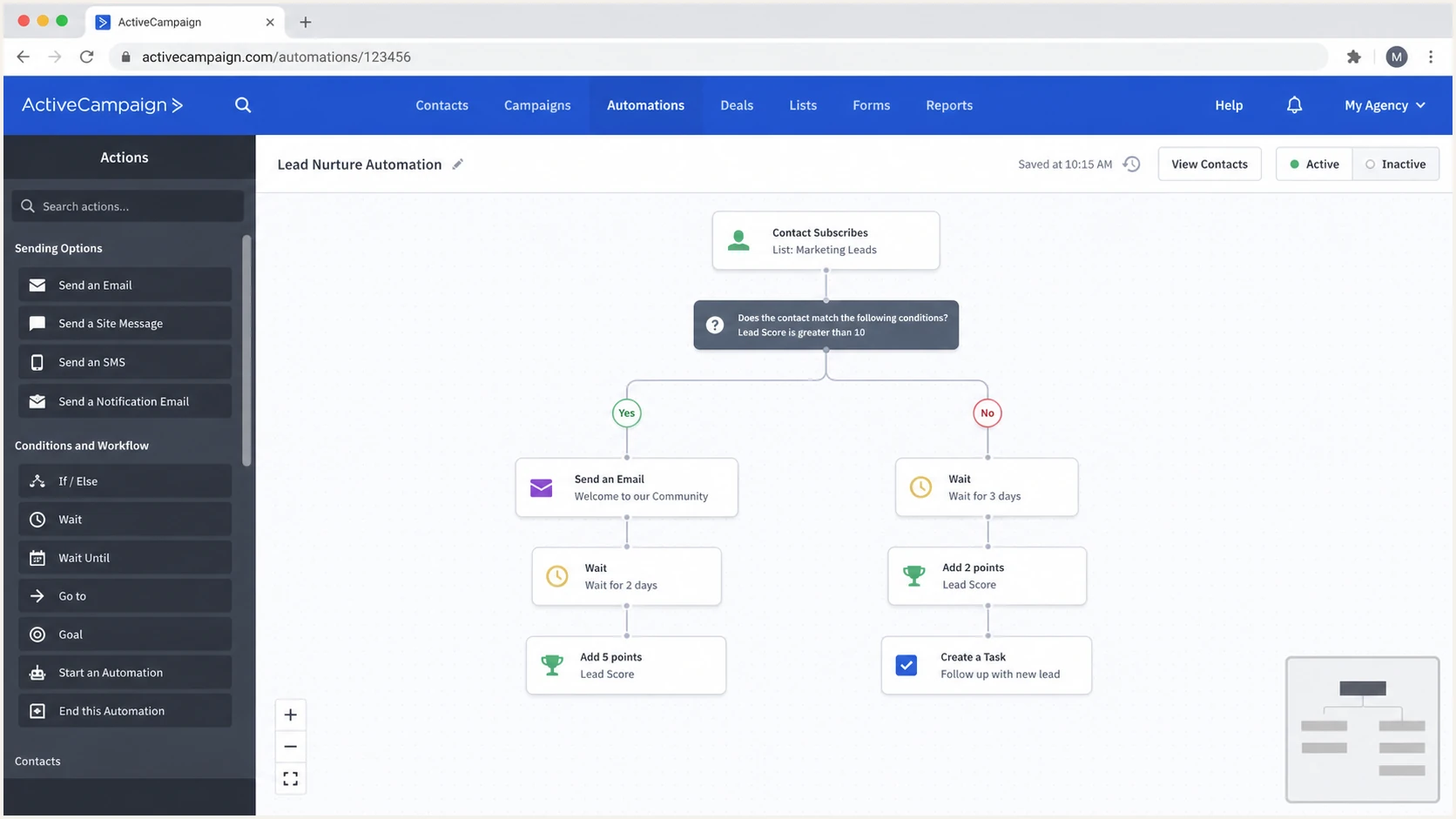
ActiveCampaign automation builder showing conditional branches, email steps, lead scoring, and CRM tasks.
That extra workflow depth is useful only when the business process has enough structure. ActiveCampaign's Starter plan limits each automation to five actions, so advanced journeys require a higher plan. If nobody owns tagging rules, scoring criteria, lifecycle stages, and QA, a more powerful builder becomes a larger place to make mistakes.
Do not compare the platforms only by monthly subscription. Migration has hidden costs: rebuilding or checking automations, reconnecting forms, recreating templates, retraining users, updating consent language, preserving opt-out proof, and cleaning fields that grew around Brevo's data model. ActiveCampaign earns that cost only when the new workflows remove manual work or create revenue paths that Brevo cannot handle cleanly.
Compare pricing with real usage
The pricing models now need more than a 'budget friendly' label. Brevo's paid tiers are driven by monthly email volume, but the selected tier also sets how many contacts you can store. ActiveCampaign scales by contact band and limits monthly email sends to a plan-specific multiple of that contact limit. Neither headline price describes the full operating cost.
- Database size: Price the contacts you must store, not only the audience you send to this month.
- Sending cadence: Model newsletters, automations, tests, and seasonal peaks against each platform's send limits.
- Required plan: Choose the tier that contains your actual automation actions, segmentation controls, reporting, and user access.
- Full configuration: Include add-ons, extra users, transactional sending, messaging channels, implementation time, and overlap billing.
Build the estimate with your current contact count, projected growth, busiest send month, and required plan. Recheck the live checkout before signing because tiers and limits can change.
Do not use migration as a deliverability fix
The most common mistake is scoring Brevo against ActiveCampaign on a single inbox placement number. ESPs affect infrastructure, throttling, bounce handling, complaint controls, and support. Your program still controls the signals mailbox providers judge every day: permission, engagement, authentication, content, volume changes, suppression, and complaint rate.
Before touching the platform, send a real campaign sample through an email tester, run a domain health check, and record the Brevo baseline. If authentication, consent, reputation, or list hygiene is weak now, a new ESP will not repair it. Check blocklist (blacklist) status separately for the old and new sending infrastructure.
Email tester
Send a real email to this address. Suped shows a results button when the test is ready.
?/43tests passed
What ActiveCampaign can change
- Routing: New sending infrastructure, tracking domains, provider-side throttling behavior, and bounce handling.
- Tooling: More granular workflow controls, segmentation, scoring, and CRM actions.
- Reporting: Different dashboards, attribution views, campaign filters, and automation metrics.
- Process: A chance to rebuild messy automations and retire stale lists.
What you still own
- Consent: How each contact joined, what they expected, and how old the permission is.
- Identity: Your branded sender domain, DKIM signatures, SPF authorization, and DMARC pass status.
- Reputation: Complaint rate, hard bounces, spam trap exposure, and blocklist or blacklist status.
- Hygiene: Sunset rules, suppression lists, bounce handling, and inactive segment policy.
The branded sending domain matters. It gives you a stable identity across ESPs and makes reputation easier to investigate. Moving platforms while keeping weak sender identity only changes the campaign editor around the same mailbox provider trust problem.
Authentication baseline to verify before migrationdns
_dmarc.example.com TXT v=DMARC1; p=none; rua=mailto:dmarc@example.com
example.com TXT v=spf1 include:senders.example.net -all
selector1._domainkey.example.com TXT v=DKIM1; k=rsa; p=MIIB...
Use Suped's DMARC monitoring during the overlap period so you can verify that Brevo and ActiveCampaign both pass DMARC and identify why a source fails. Add Suped's blocklist monitoring when changing sending infrastructure or investigating a blacklist problem.
How to test the move before committing
Treat the move as a controlled migration, not a weekend export. The goal is to prove that ActiveCampaign improves workflow execution without losing consent history, suppressions, segmentation meaning, or authentication visibility.
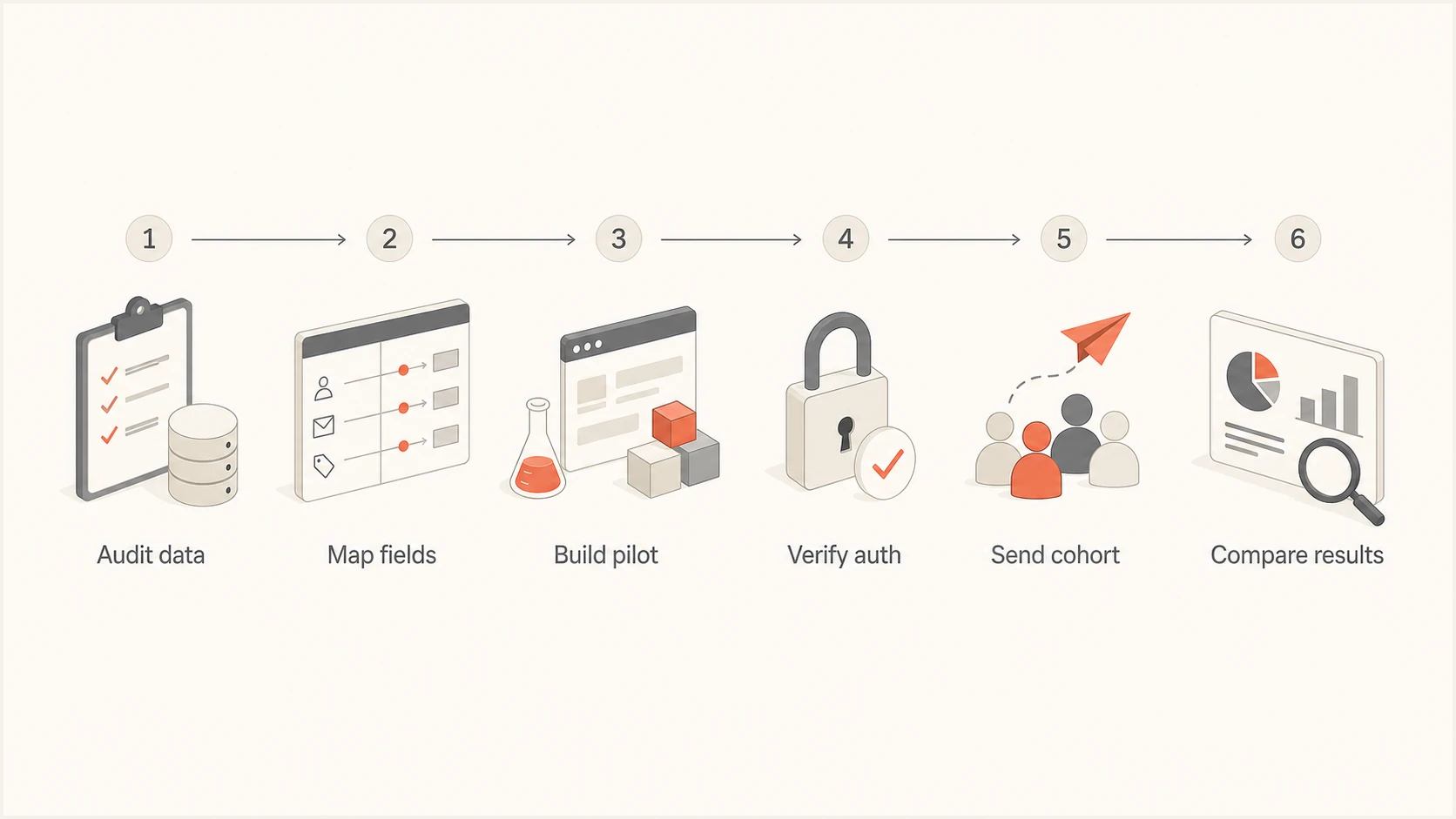
Brevo to ActiveCampaign migration flow covering data audit, field mapping, authentication, pilot sending, and results.
- Inventory: Export contacts, fields, tags, lists, segments, forms, automations, templates, suppressions, consent timestamps, and list-level subscription status.
- Map: Decide which Brevo lists become ActiveCampaign lists, tags, custom fields, or automation triggers.
- Pilot: Rebuild one revenue-critical workflow and one standard newsletter before moving everything.
- Authenticate: Verify DKIM signatures, SPF authorization, DMARC pass status, bounce domain behavior, and tracking domain setup.
- Compare: Send to a recently engaged cohort and compare clicks, conversions, complaints, bounces, unsubscribes, and delivery failures. Treat opens as directional because privacy systems can inflate them.
Migration audit fieldstext
contact_id,email,status,source,consent_date,last_open,last_click
list_name,tag_name,custom_field,automation_name,suppression_reason
brevo_value,activecampaign_value,owner,qa_status,rollback_note
Migration confidence bands
Use this as a practical go or no-go check before moving the full database.
Ready
85-100
Authentication passes, suppression mapping is complete, and the pilot matches or beats the Brevo baseline.
Hold
60-84
Core workflows work, but reporting, field mapping, or QA ownership still has gaps.
Stop
0-59
Suppression rules, sender identity, or automation behavior are unclear.
Where Suped fits
Brevo and ActiveCampaign are email marketing platforms. Suped's product monitors the authentication layer around them so you can identify each sending source, check DMARC results, and investigate failures. The marketing platform decision and the authentication decision are separate.

Issue steps to fix dialog showing the issue overview, tailored fix steps, and verification action
Suped's product turns DMARC aggregate reports into sender identification, issue detection, source-level evidence, and specific fix steps. During a Brevo to ActiveCampaign trial, you can compare both platforms by source, volume, DMARC pass status, and failure reason instead of inferring the cause from campaign metrics.
- Before migration: Confirm Brevo passes SPF, DKIM, and DMARC before benchmarking ActiveCampaign.
- During rollout: Watch new ActiveCampaign sources, pass status, volume spikes, and failure patterns.
- After cutover: Move toward a stricter DMARC policy once legitimate sources pass consistently.
- For agencies: Use multi-tenant visibility when clients run different ESPs across separate domains.
Suped's hosted DMARC, hosted SPF, SPF flattening, hosted MTA-STS, real-time alerts, and blocklist monitoring keep authentication records and failure signals visible while the marketing team evaluates platform fit.
Make the decision on workflow value
Do not approve the move until the team can name the exact workflows ActiveCampaign unlocks. Good reasons include contact tasks for sales, lead scores that drive routing, ecommerce behavior that changes content, or automations that need testing across multiple paths.
Reject the move if the business case is vague. Better deliverability, nicer dashboards, migration assistance, or a general feeling that another ESP is more professional are weak reasons. Fix the sending domain, list hygiene, consent capture, suppression policy, and reporting first. Then compare the platforms on workflow value and full operating cost.
The cleanest business case is a plain operating statement: this workflow is blocked today, this audience is affected, this owner will maintain it, and this metric will improve. If the sentence cannot be filled in, the migration is not ready. A more capable ESP does not compensate for unclear lifecycle strategy.
Stay with Brevo
Stay when current campaigns are straightforward, the team is productive, the budget matters, and automation needs stop at welcome flows, reactivation, cart reminders, SMS, and transactional sending.
Move to ActiveCampaign
Move when your lifecycle program needs advanced conditions, CRM actions, pipeline visibility, deeper segmentation, and owners who will maintain the extra system complexity.
Views from the trenches
Best practices
Score the move on workflow gaps, data model fit, cost, and team capacity before export.
Pilot one revenue workflow and one newsletter before rebuilding every automation.
Verify authentication and branded sender domains before comparing inbox placement.
Keep Brevo active during QA so suppression gaps and field mapping errors have a rollback.
Common pitfalls
Treating an ESP switch as a deliverability fix hides list quality and consent problems.
Importing every inactive contact into the new platform resets bad habits at higher cost.
Mapping Brevo lists directly to ActiveCampaign lists can create messy segmentation.
Skipping suppression reconciliation creates compliance risk and avoidable complaints.
Expert tips
Use DMARC data to compare both ESPs by source, volume, pass status, and failures.
Warm the new setup with recently engaged contacts before broader list migration.
Document ownership for tags, fields, automations, reports, and sender domains before launch.
Judge ActiveCampaign on saved labor and revenue workflow gains, not novelty alone.
Marketer from Email Geeks says deliverability should not be the main metric for judging an ESP move.
2026-02-14 - Email Geeks
Marketer from Email Geeks says poor deliverability usually comes from internal practices, not the ESP alone.
2026-02-15 - Email Geeks