How to resolve deliverability issues with .mil email addresses?

Published 7 Jun 2025
Updated 26 Jul 2026
12 min read
Summarize with

Updated on 26 Jul 2026: We updated this guidance for RFC 9989 and clearer .mil SMTP triage and escalation.
The direct answer is this: resolve .mil deliverability issues by treating them as recipient-side security and policy decisions first, then prove that your sending domain, IPs, authentication, content, and consent trail are clean. There is no universal public postmaster or normal commercial delisting path that reliably lifts a .mil block.
Start with the evidence, not the appeal. Confirm the exact failure, isolate the .mil segment, test a plain text version, verify SPF, DKIM, and DMARC, check blocklist (blacklist) status, and ask the recipient for a local IT or security contact if the message is required for official work. If the content is a newsletter, geopolitical update, marketing message, or other non-official communication, the practical fix is often to ask the recipient for a non-.mil address.
- Do first: Collect bounce text, timestamps, recipient domains, message IDs, sending IPs, and authentication results.
- Do next: Send a minimal plain text test with no attachments, short URLs, tracking wrappers, or heavy HTML.
- Do not do: Keep retrying at volume while guessing. That creates weaker evidence and can deepen the block.
Start with a .mil delivery workflow
A .mil issue is not the same as a normal commercial mailbox spam placement issue. Military mail systems are designed around security, acceptable-use policy, and network boundaries. That means a full opt-in list still gets blocked when the message type, route, HTML, attachment pattern, sender reputation, or recipient organization policy does not fit.
No guaranteed public delisting path
Do not plan around a single .mil postmaster address. Some routes have administrators who can review a case, but the reliable path is recipient-led escalation through the organization that owns the mailbox. If that route does not exist, reduce the risk profile of the message and offer an alternate address path.
Use five questions for a fast triage pass. Did the message bounce, silently disappear, land in quarantine, or get accepted then filtered? Does the recipient domain still resolve publicly? Does the sending domain pass authentication with a matching domain? Does the message have policy-sensitive content or risky formatting? Is there a verified business reason for the recipient to receive it at a .mil address?
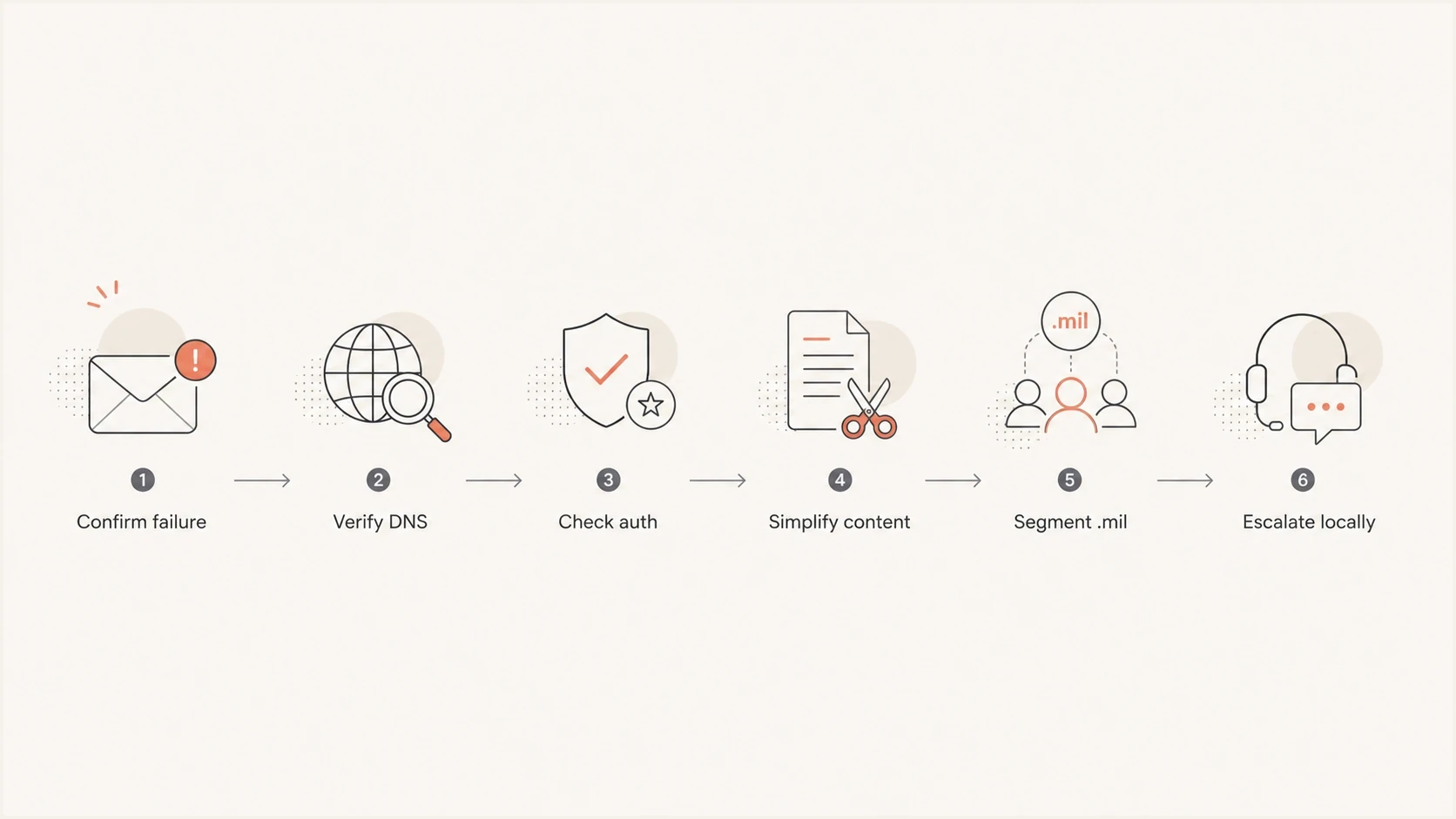
Six-step .mil email delivery triage from failure confirmation to local escalation.
Why .mil delivery behaves differently
.mil mail routing sits inside a security-first environment. A block can happen because of spam reputation, but it can also happen because the message is outside the recipient organization's allowed use, the route is limited to specific networks, the domain is not publicly reachable, the message has HTML patterns that get stripped, or the recipient system has no interest in accepting bulk list mail.
Commercial mailbox issue
- Postmaster path: Large mailbox providers often publish sender support routes.
- Main signal: Reputation, complaints, engagement, authentication, and content quality.
- Common fix: Warm sending, improve consent, fix records, and reduce complaint sources.
.mil delivery issue
- Postmaster path: A public appeal route is not something to rely on.
- Main signal: Recipient policy, network access, security filters, and sender evidence.
- Common fix: Simplify content, isolate .mil, prove legitimacy, and escalate locally.
Public examples show the same pattern. A Microsoft answer thread points to the fact that ordinary consumer support does not control .mil acceptance. A sysadmin discussion describes senders seeing mail accepted on their side but not received at the military mailbox. Separate transport evidence from recipient policy evidence early.
|
|
|
|---|---|---|
Hard bounce | Rejected route | Collect SMTP text |
Accepted | Filtered later | Ask recipient IT |
No public MX | Unreachable or restricted route | Verify domain and ask recipient IT |
Auth fail | Sender issue | Fix DNS records |
Use this table to classify the failure before changing DNS or content.
Triage the failure before asking for help
The first useful split is bounce versus no bounce. A bounce gives you SMTP text, status codes, and sometimes a policy clue. No bounce only means your sending system did not return a non-delivery report. Check the outbound message trace or MTA logs to confirm whether the recipient MX accepted the message with a 2xx response. If it did, the message was filtered, quarantined, dropped after acceptance, or delivered somewhere the recipient did not check.
- Bounce text: Save the full SMTP response, not only the short error in the sending platform.
- Message trace: Record the message ID, sender, recipient, UTC timestamp, sending IP, destination MX, delivery status, and last response.
- Recipient split: Create a .mil-only segment so other recipient domains do not hide the pattern.
- Format test: Send a plain text version with no images, attachments, tracking redirects, or URL shorteners.
- Volume stop: Pause broad .mil sends until a small controlled test has a clear result.
This is also where a real inbox test helps. Send a controlled message through your production route and review headers, authentication, and content signals with the email tester before you ask anyone to review a block. A clean result does not force a .mil system to accept the message, but it gives you a stronger packet.
Email tester
Send a real email to this address. Suped shows a results button when the test is ready.
?/43tests passed
Plain text test messagetext
Subject: Delivery confirmation test

Hello,

This is a plain text delivery test for an approved recipient.

Please confirm whether this message arrives in the inbox.
Read SMTP responses before retrying
The exact SMTP reply tells you whether the sending server should retry or stop. A 4xx reply is a temporary deferral, so the normal delivery queue should retry it. A 5xx reply is a permanent failure for that attempt. Read the enhanced status code and the full response text together because .mil gateways can attach local policy wording to a standard code.
|
|
|
|---|---|---|
421, 450, 451, or 452 | Temporary deferral | Let the queue retry; investigate if it persists |
550 5.1.1 | Invalid or unavailable recipient | Verify the address; suppress if invalid |
550 or 554 with 5.7.x | Policy, security, or authentication rejection | Preserve the reply and use recipient-led escalation |
5.4.x or connection/TLS failure | Routing or transport problem | Capture MX, TLS result, timestamps, and route |
Use the complete response from your message trace or MTA log, not a shortened dashboard label.
Platform acceptance is not .mil acceptance
A "sent" event often means your email platform accepted the job. It does not prove that the recipient MX returned a final 2xx response. Use the outbound trace to identify the destination server, the last SMTP response, and whether the message remained queued.
Prove that authentication is clean
SPF, DKIM, and DMARC do not guarantee .mil delivery. They remove avoidable sender-side objections. If authentication is broken, escalation is weak because the recipient security team can close the case as a sender configuration problem.
RFC 9989 now defines DMARC, with RFC 9990 covering aggregate reports and RFC 9991 covering failure reports. The older pct tag has been removed. Use t=y when testing an enforcement policy, then remove the tag when the policy should apply. Publish only one DMARC record at each DNS owner name.
Check the domain with a domain health checker first, then review aggregate reports through DMARC monitoring. For .mil troubleshooting, the key is not only pass or fail. The key is whether the visible From domain has an SPF or DKIM domain match, whether unauthorized sources are sending, and whether failures cluster around one provider, IP, or campaign.
DMARC progression examples, publish one at a timedns
_dmarc.example.com TXT v=DMARC1; p=none; rua=mailto:dmarc@example.com
_dmarc.example.com TXT v=DMARC1; p=quarantine; t=y; rua=mailto:dmarc@example.com
_dmarc.example.com TXT v=DMARC1; p=reject; rua=mailto:dmarc@example.com
Suped's product is useful here because it turns the authentication layer into a working checklist. It can flag DMARC, SPF, and DKIM issues, identify unknown sources in aggregate reports, track blocklist (blacklist) events, and record remediation steps for teams managing several domains. That gives the sender a consistent evidence packet before recipient-led escalation.

Issue steps to fix dialog showing the issue overview, tailored fix steps, and verification action
What clean authentication looks like
- SPF status: The sending IP is authorized and the lookup count stays below the limit.
- DKIM status: The signature passes and the d= domain matches the organizational sender.
- DMARC status: The visible From domain passes through an SPF domain match or DKIM domain match.
- Source status: Every active sender in DMARC reports is known, approved, and expected.
Check reputation without treating it as the whole problem
Reputation still matters. A sending IP or domain on a blocklist (blacklist) creates an easy reason to reject or filter the message. But a clean blocklist result does not prove that .mil delivery should work, because recipient policy can still block the mail.
Use blocklist monitoring to track both IP and domain listings, especially after a failed campaign. Look for listings that appeared close to the send time, listings tied to one shared IP pool, and listings that coincide with complaint spikes.
How to score a .mil delivery risk review
This is a practical risk scale for deciding whether to retry, reduce scope, or escalate.
Low
0-1 issues
Clean auth, no listings, small segment, official need.
Moderate
2 issues
Clean auth but HTML-heavy or link-heavy content.
High
3 issues
Blocklist listing, weak consent proof, or broad list send.
Policy
stop
Message is not required for official recipient work.
If you are dealing with broader provider rejection as well, the troubleshooting pattern in blocked by major ISPs is useful for separating authentication pass rates from acceptance decisions.
Reduce content and policy friction
.mil delivery problems often improve only after the message itself is simplified. Treat the first test as a security compatibility test, not a campaign performance test. That means no HTML, no images, no attachments, no tracking links, no URL shorteners, and no marketing footer that turns a one-to-one notice into a bulk campaign.
Higher friction
- HTML layout: Complex templates, hidden text, image-heavy designs, and tracking pixels.
- Link pattern: Redirect chains, shorteners, mixed domains, and many calls to action.
- Purpose: Bulk updates, advocacy, political commentary, or non-official list mail.
Lower friction
- Plain text: Short message body, no images, and a clear official reason for sending.
- Single link: One direct HTTPS link to a known domain if a link is required.
- Recipient need: A clear work-related reason tied to the recipient organization.
This does not mean every .mil system only accepts plain text. It means plain text is the cleanest controlled test. If the plain text message gets through and the HTML version does not, you have a content compatibility problem. If neither gets through and authentication is clean, you are back to recipient policy or route access.
Minimal DNS evidence to includedns
example.com TXT v=spf1 include:_spf.sender.example -all
selector1._domainkey.example.com TXT v=DKIM1; k=rsa; p=BASE64KEY
_dmarc.example.com TXT v=DMARC1; p=reject; rua=mailto:dmarc@example.com
Escalate through a military POC
When the message is required for official work, ask the recipient or designated military point of contact (POC) to open an internal ticket with their IT or security team. The POC can route the case to DISA when the organization considers that appropriate. Commercial senders should not assume that DISA will accept a direct ticket without an authorized .mil POC. Give the POC a concise packet that proves the purpose, sender identity, authentication, message path, exact symptom, and consent.
Escalation packet
- Purpose: Why the recipient needs this message at a .mil address.
- Consent: How the recipient opted in, with date, source, and suppression history.
- Transport: Message ID, UTC timestamp, sender, recipient, sending IP, destination MX, and complete SMTP response.
- Authentication: SPF, DKIM, DMARC, domain match, and current policy status.
- Content: Plain text sample and the exact production version that failed.
If the recipient cannot escalate internally, ask for another agency-approved address outside .mil. Do not frame that as bypassing policy. Frame it as using the address the recipient is allowed to use for that message type.
Recipient escalation notetext
Hello,

We are trying to deliver an approved message to your .mil mailbox.
Our sender domain passes SPF, DKIM, and DMARC.

Can your IT team review whether this route is allowed?
We can provide message ID, IP, timestamp, and the plain text copy.
Know when suppression is the right fix
Suppression is not failure when the recipient system has a policy reason to reject the mail. If a .mil domain has no reachable public mail route, rejects bulk list mail, or has no approved route for the content type, continuing to send is worse than stopping. It increases noise, damages evidence, and can affect other recipients.
- Suppress: When the recipient organization asks you to stop, or the route repeatedly rejects the mail.
- Retain: When the recipient has an official need and can route an internal review.
- Redirect: When the message is non-official and the recipient gives another permitted address.
- Retest: When authentication, reputation, or content issues were fixed and volume is small.
Keep .mil addresses in a separate reporting segment. That stops a small but unusual set of failures from distorting overall deliverability metrics. It also makes future audits easier because every retry, suppression, and escalation decision has its own trail.
Views from the trenches
Best practices
Keep a separate .mil segment so failures do not distort normal commercial reporting.
Send a plain text variant for sensitive government routes before testing full HTML.
Ask affected recipients for their local IT contact when no public route works cleanly.
Keep opt-in proof and suppression history ready before requesting recipient-side review.
Common pitfalls
Treating .mil blocks like normal spam placement wastes time and hides policy causes.
Retrying blocked traffic at volume can make sender evidence harder to defend later.
Assuming authentication success alone proves entitlement to reach every .mil inbox.
Leaving .mil addresses mixed into broad campaigns makes diagnosis noisy and slow.
Expert tips
Create a .mil-safe content path with plain text, fewer links, and no attachments.
Use reporting to separate rejected mail, silent filtering, and vanished DNS routes.
Escalate with message IDs, timestamps, IPs, domains, and opt-in proof in one packet.
Offer a non-.mil address path when the message is not required for official work.
Marketer from Email Geeks says .mil blocks often have policy causes, so a sender needs proof before escalation.
2022-09-05 - Email Geeks
Marketer from Email Geeks says some .mil domains leave public DNS, so an approved alternate address can solve delivery.
2022-09-05 - Email Geeks
Choose the next .mil delivery action
The cleanest way to resolve .mil deliverability is to stop treating it like a normal deliverability appeal. Prove your side first: authentication, sender authorization, reputation, opt-in, suppression history, message content, and exact failure evidence. Then decide whether the next step is a plain text retest, recipient-led escalation, alternate address collection, or suppression.
Suped helps with the part you control: monitoring DMARC, detecting SPF and DKIM issues, surfacing unauthorized sources, tracking blocklist and blacklist events, and giving teams steps to fix before they ask a recipient-side team to review anything. The .mil recipient still controls acceptance, but your evidence should be clean before that conversation starts.




