How does CNIL's final tracking pixel recommendation affect email deliverability?

Published 4 Jun 2026
Updated 10 Aug 2026
12 min read
Summarize with
Updated on 10 Aug 2026: We clarified the deliverability exemption and replaced the expired transition guidance with post-deadline actions.
CNIL's final tracking pixel recommendation does not directly make email deliverability worse. Mailbox providers do not check whether a sender has CNIL-compliant tracking consent before placing a message in the inbox. The practical effect is that senders must separate marketing analytics from the narrow open data used to protect sender reputation.
Individual open tracking for campaign optimisation, profiling, open-based targeting, or performance reporting needs prior consent. A narrow exemption can cover individual open tracking used only to adjust frequency, stop sending to inactive recipients, or protect sender reputation. The email must have been requested by the recipient or relate to a requested service, and the data must be limited to what is strictly necessary for that purpose.
B2B mail is not automatically exempt, and the recommendation applies to tracking involving users located in France, regardless of where the sender is established. The standard transition period for addresses collected before publication ended on July 14, 2026. A privacy policy mention alone does not establish valid consent when the tracking purposes were not presented clearly. For a legal summary, the Inside Privacy summary is a useful reference.
Direct answer
- Inbox placement: CNIL's recommendation does not change SPF, DKIM, DMARC, spam filtering, or sender authentication checks.
- Open data: Marketing use of individual opens needs prior consent unless every condition of a specific exemption is met.
- Suppression: Open tracking for inactive-recipient suppression can qualify only for requested or service-related email and strictly necessary processing.
- Main risk: Teams that keep using opens for segmentation, retargeting, and reporting without consent create compliance exposure.
What changes for deliverability teams
The biggest operational change is purpose separation. Many senders previously treated every open event as a general-purpose signal. The same event fed dashboards, A/B tests, reactivation journeys, send-time optimisation, suppression rules, and sales alerts. CNIL's final position requires senders to decide what each open event is for before they collect or process it.
The deliverability use case therefore needs its own guardrails. If an open is collected to decide whether a recipient is inactive, that signal should not also score interest, trigger a discount email, personalise ads, or rank a sales lead.
- Keep: Use minimal open data to identify inactive recipients and reduce sending only when the email and processing meet the exemption conditions.
- Separate: Store deliverability suppression signals apart from marketing analytics and targeting records.
- Document: Record the message category, purpose, data fields, retention period, recipient state, and system behaviour for each tracking path.
- Remove: Stop open-based targeting where recipients have not clearly consented to that tracking purpose.
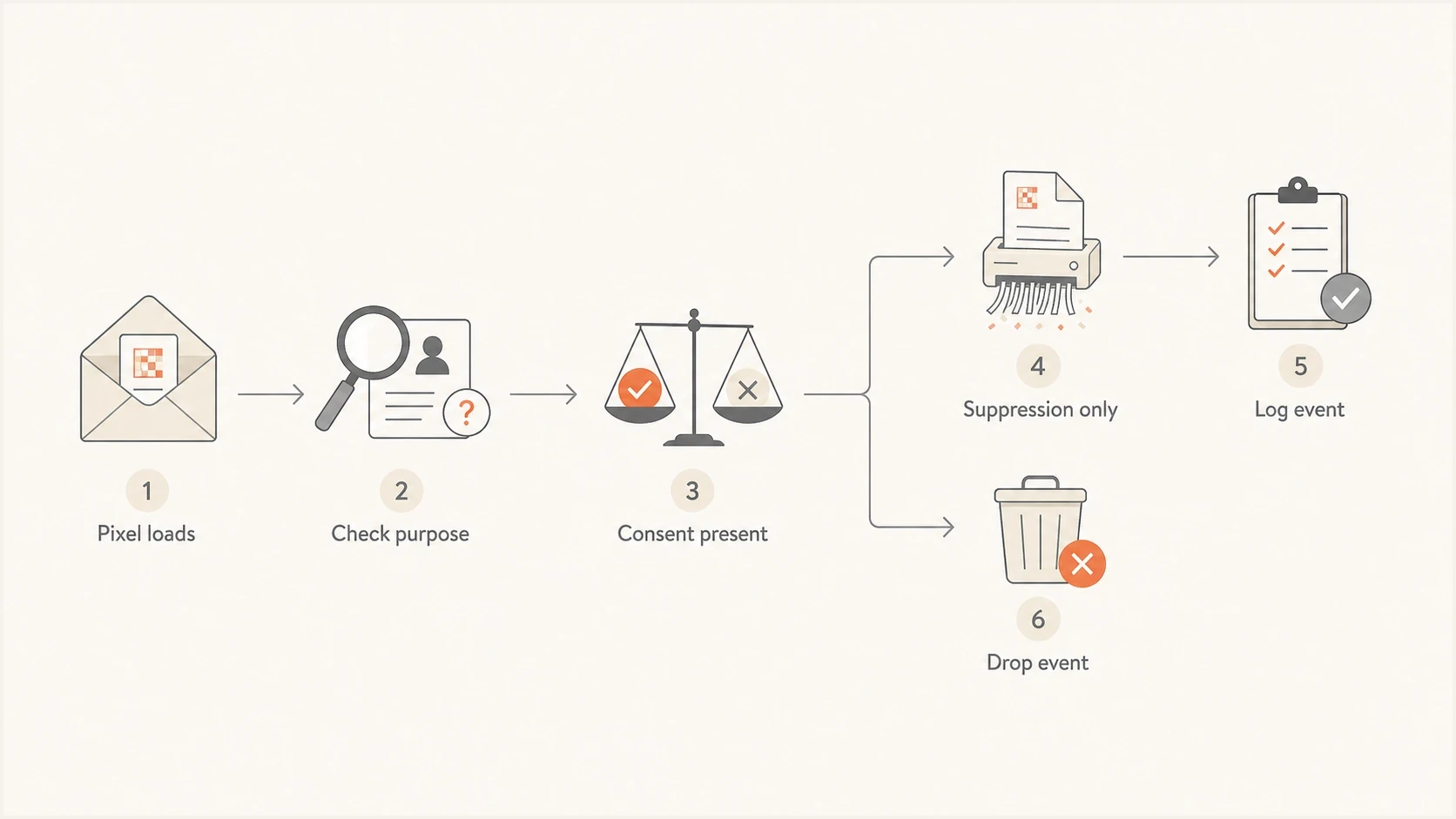
Flowchart showing consent and suppression decisions for tracking pixel processing.
Narrow deliverability use
- Purpose: Identify non-openers to reduce frequency or suppress inactive recipients.
- Email scope: Messages requested by the recipient or related to a requested service.
- Data: Usually the last-open date, with limited retention and no reuse outside suppression.
- Risk: Lower when every exemption condition is documented and technically enforced.
Marketing analytics use
- Purpose: Measure campaign performance, optimise timing, or infer recipient interest.
- Output: Dashboards, targeting rules, personalisation, and campaign decisions.
- Data: Individual behaviour data that generally requires clear prior consent.
- Risk: Higher when consent is buried in policy text or inferred from inactivity.
When the deliverability exemption applies
Calling a pixel a deliverability tool does not create an exemption. The sender must be able to show that the message and the processing meet CNIL's conditions. If one condition fails, prior consent is required for that pixel use.
- Email scope: The email was explicitly requested or relates to a requested service. A marketing email sent without consent under a separate direct-marketing exception does not automatically qualify.
- Strict purpose: Processing is limited to reducing frequency or stopping email to inactive recipients. It can also support an alternative contact channel or evidence that legally required information was sent.
- Data minimisation: Collect only the fields needed for that decision, generally the last-open date rather than the exact time, device details, or a reusable event history.
- Anonymised reuse: Effectively anonymised data can be reused for global statistics, but collecting anonymous or aggregate data does not by itself remove the need for consent or a valid exemption.
- Transparency and rights: Recipients should be told about exempt pixels, and the sender must still meet applicable GDPR duties, including an accessible objection mechanism when processing relies on legitimate interests.
Transactional does not mean automatically exempt
The purpose and content still matter. A purchase confirmation can qualify when it remains informational and tied to the requested service, but promotional content or reuse of the open event for marketing can move the processing outside the exemption.
Where open data still fits
Open data was already a weak measure of human attention. Apple Mail Privacy Protection, image caching, bot scans, security gateways, and image blocking all distort the metric. CNIL's recommendation adds a compliance reason to stop treating opens as a universal marketing signal.
Open data still has a narrow place in suppression logic when every exemption condition is met and the data is walled off from marketing optimisation. Campaign decisions should rely more on recipient-initiated actions, preference choices, complaints, bounces, and authentication health, with each signal used under its own privacy rules.
|
|
|
|---|---|---|
Inactive suppression | Exempt if all conditions are met | Can protect reputation |
Individual open reporting | Consent required | No direct inbox boost |
Aggregate reporting | Lawful collection still required | No individual action |
Open-triggered journeys | Consent required | Can increase sending |
Legal-obligation evidence | Narrow exempt use | Operational proof |
General fraud analysis | Consent required | Use another method |
Common tracking pixel use cases after the final recommendation.
Do not stretch the exemption
The deliverability exemption is not permission to keep full open analytics under a different label. If the open event feeds campaign optimisation, sales prioritisation, or audience targeting, it has left the suppression-only lane.
For more context on why opens have become fragile even outside CNIL, the open-rate accuracy issue is worth separating from the legal consent issue. A metric can be both noisy and regulated.
The implementation problem
The hardest part is the system design. Many email service providers insert a tracking pixel at the campaign level, not per recipient, and log every pixel request into the same analytics pipeline. CNIL's recommendation pushes providers and senders toward per-recipient consent state, message eligibility, purpose flags, and server-side controls.
Editing emails already sitting in inboxes is not realistic. A practical pattern is server-side gating: let the pixel URL return an image, but decide at request time whether to log a consented marketing event, record only the last-open signal allowed by the deliverability exemption, or discard the event.
Server-side tracking gatetext
request: /open/{message_id}/{recipient_id}.gif
state = lookup_tracking_state(recipient_id)
message = lookup_message_rules(message_id)

if state.marketing_tracking_consent == true:
  log_marketing_open_event()
elif message.requested_service == true and message.suppression_enabled == true:
  log_last_open_for_suppression_only()
else:
  discard_event()

return transparent_pixel()
This does not require a primary database query on every open. A provider can cache consent states and message rules in Redis or an in-memory store, refresh them on a defined schedule, and invalidate a recipient's state when consent is withdrawn. The core requirement is an auditable decision path that also prevents pixels in previously sent emails from being exploited after withdrawal.
Tracking use risk
A simple way to classify tracking-pixel processing after the recommendation.
Lower
Suppression only
Minimal last-open signal for suppression in eligible requested or service-related email.
Medium
Consent gated
Consent collected clearly, with separate purpose controls and proof.
Higher
Mixed purpose
Open data reused for targeting, optimisation, or profiling without consent.
Unknown
Unaudited
Provider cannot explain whether open events are separated by purpose.
How this affects inbox placement
Mailbox providers still care about the same technical and behavioural signals: authentication, domain reputation, IP reputation, complaint rates, bounces, spam trap exposure, and recipient behaviour. CNIL's recommendation does not change those filters. It changes the sender's visibility into one behavioural signal.
That visibility loss is manageable. Replace open-led deliverability decisions with authentication monitoring, complaint and bounce trends, unsubscribe patterns, permitted recipient-initiated signals, and blocklist (blacklist) checks. Suped's product brings DMARC, SPF, DKIM, blocklist monitoring, and deliverability findings into one operational view without relying on individual open tracking.
- Authentication: Use DMARC monitoring to catch domain mismatches, spoofing, and unapproved senders.
- Reputation: Use blocklist monitoring to track blocklist and blacklist signals before they spread.
- Message quality: Run a real message through an email tester when the issue is content, headers, or rendering.
- Domain health: Use a domain health check to validate the broader sending setup.
Email tester
Send a real email to this address. Suped shows a results button when the test is ready.
?/43tests passed
The main deliverability danger is indirect. If a sender stops collecting open signals and has no replacement suppression method, inactive recipients can stay on the list longer. That increases the chance of complaints, low engagement, abandoned mailbox hits, and reputation decay. The fix is to build suppression rules that meet the exemption or use lawful replacement signals without reusing exempt open data for marketing.
What to change in a sending program
Do not try to preserve every old open-rate workflow. Treat open tracking as a limited-purpose signal, then strengthen the parts of deliverability that do not depend on tracking pixels.
- Map: List every place open data enters reports, segments, journeys, scoring, exports, and suppression rules.
- Classify: Mark each use as eligible suppression, consent-based marketing, legal-obligation evidence, security, or unsupported.
- Separate: Create different processing paths for deliverability suppression and marketing analytics.
- Retire: Remove open-based targeting where tracking consent is not clearly collected and provable.
- Monitor: Watch authentication, complaint, bounce, unsubscribe, and blocklist signals while the change rolls out.
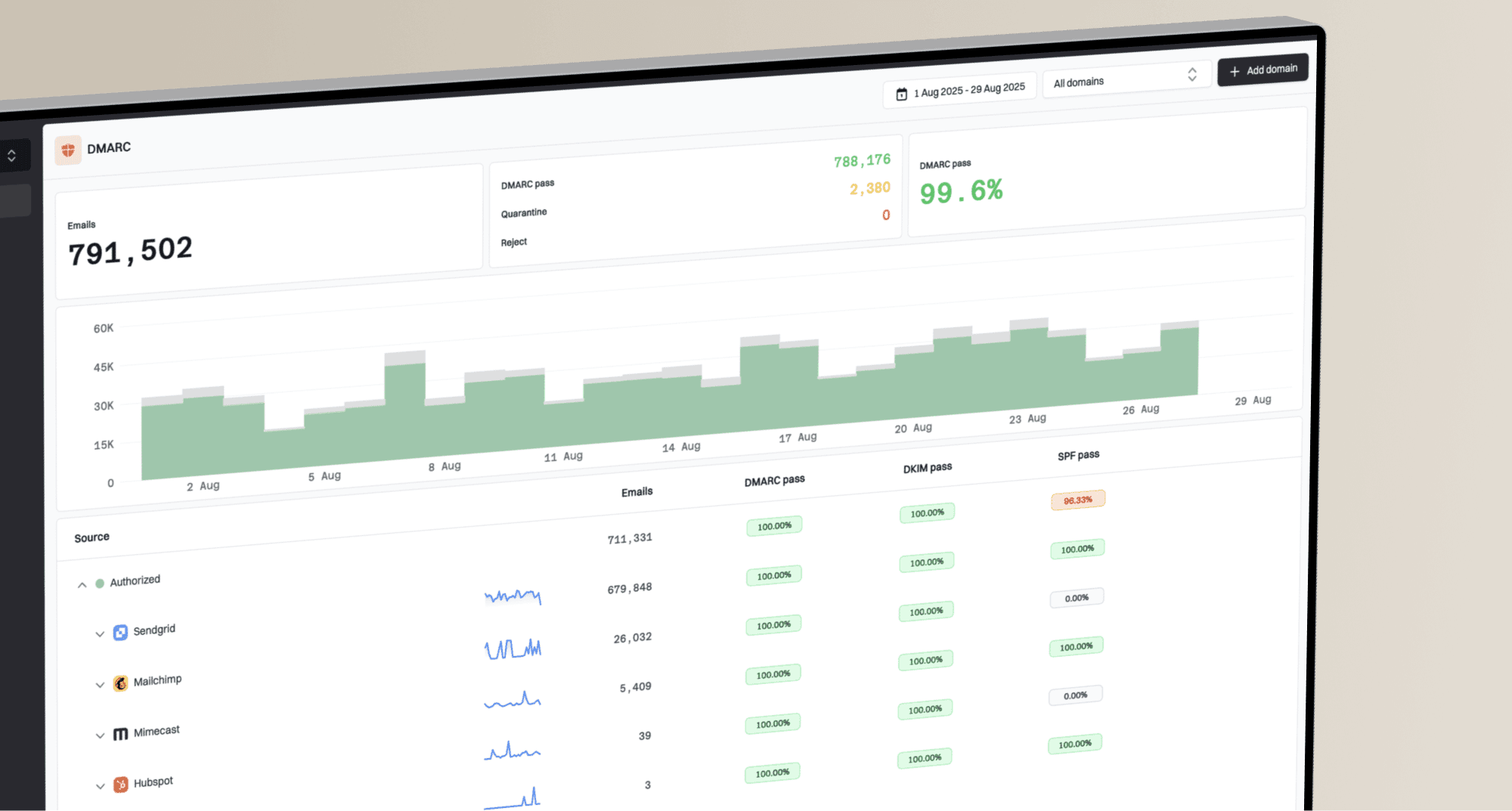
Suped DMARC dashboard showing email volume, authentication health, and source breakdown
Suped's product supports this replacement workflow by showing whether a domain is authenticated, which sending sources pass DMARC, where SPF or DKIM fails, and when blocklist or blacklist signals change. Automated issue detection and alerts help teams investigate these changes without using individual open events.
What to do after the transition deadline
The standard three-month transition for addresses collected before April 14, 2026 ended on July 14, 2026. If recipients did not receive clear information and a way to object by that deadline, prior consent is now required for pixel uses that do not qualify for an exemption. Otherwise, the sender should stop those pixel uses.
CNIL allows a reasonable extension when database volume and deliverability risks made the standard period insufficient, but the difficulties must be objectively justified and documented. This is not a general extension. Addresses collected after publication have been subject to the full framework since collection.
Where consent still needs to be collected, use a dedicated email that contains no pixel requiring consent and links to a clear choice interface. Treat inactivity as refusal, make refusal as easy as acceptance, record the choice, and avoid asking a refuser again for six months as a CNIL good practice. Tracking consent and permission to send the email are separate questions, although one choice can cover sufficiently related purposes when that relationship is clearly explained. Unrelated purposes need independent choices.
Post-deadline checklist
- Legacy lists: Verify whether the required information and objection path were sent on time, or document the basis for a reasonable extension.
- Consent copy: State each tracking purpose clearly and identify the email address and devices covered by the choice.
- Purpose flags: Tag each open event by reason before it reaches reporting or automation systems.
- Withdrawal path: Offer a simple footer link or preference-centre control, then stop exploiting pixels in future and previously sent emails.
- Suppression wall: Keep exempt deliverability data out of marketing segments and campaign dashboards.
- Proof file: Keep individual evidence of consent, refusal, withdrawal, purpose, and technical enforcement.
Distributed ownership makes this work harder: legal owns consent text, marketing owns campaign logic, deliverability owns suppression, and engineering owns the pixel server. One accountable owner should map the data path across those functions. Treating the recommendation as a copy change leaves the underlying processing unchanged.
|
|
|
|---|---|---|
Verify | Was legacy notice sent | Evidence file |
Audit | Where opens go | Data map |
Consent | What to ask | Choice interface |
Build | How to gate | Pixel logic |
Replace | What to monitor | New reports |
A compact post-deadline remediation model.
Views from the trenches
Best practices
Keep suppression-only open data technically separate from marketing reporting paths.
Present tracking purposes at signup, then keep proof of consent and withdrawal state.
Replace open-led targeting with complaints, bounces, and authentication signals.
Common pitfalls
Calling all open tracking deliverability creates risk when the data is reused elsewhere.
Assuming every ESP can disable pixels per recipient causes late engineering work.
Sending broad legal notices to old lists can cause complaints and reputation harm.
Expert tips
Use server-side gates so withdrawal stops logging when an old email is reopened.
Cache consent states for pixel requests instead of querying a database each time.
Treat the standard transition as expired unless an extension is fully documented.
Marketer view
Marketer from Email Geeks says the three-month transition is short for large distributed teams.
2026-04-14 - Email Geeks
Expert view
Expert from Email Geeks says server-side consent gates are more practical than editing sent emails.
2026-04-14 - Email Geeks
The deliverability answer
CNIL's final recommendation affects deliverability by narrowing how open tracking can be used, not by changing how inbox providers filter mail. Senders can use individual open data for inactive-recipient suppression without consent only when the email was requested or relates to a requested service, the processing is strictly necessary, and the data is not reused for another purpose.
Relabelling all open analytics as deliverability does not meet those conditions. Separate purposes, collect clear consent for marketing tracking, stop using opens as a broad targeting signal, and build deliverability reporting around signals that do not depend on tracking pixels.
Suped's product supports that shift with visibility into DMARC, SPF, DKIM, sending sources, blocklists (blacklists), and authentication failures. Those checks continue to protect deliverability when open tracking is narrower and more tightly controlled.